
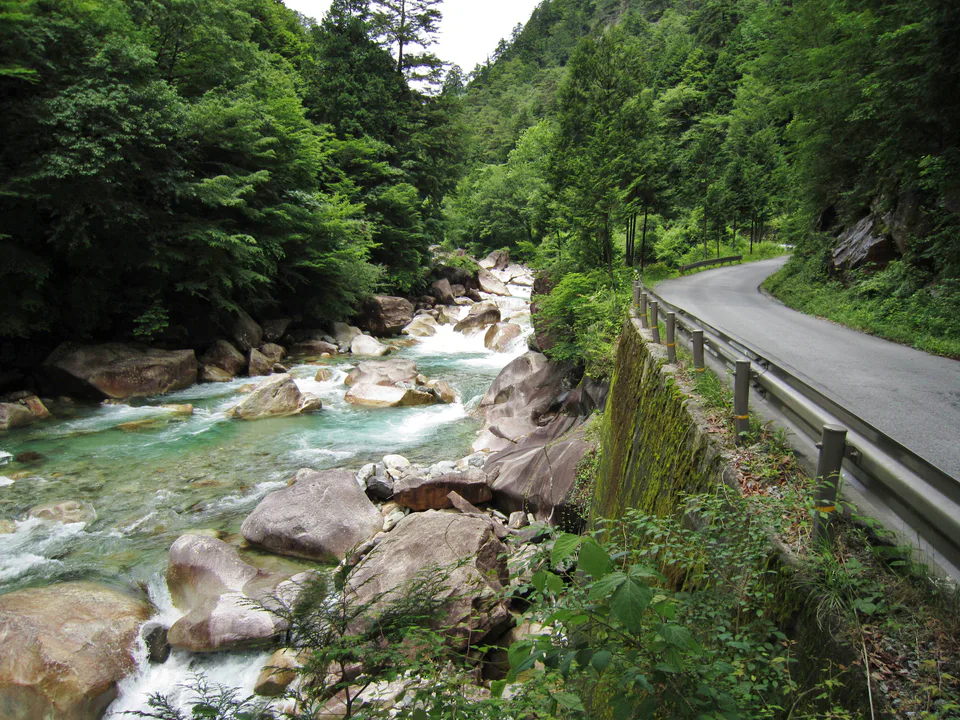
Atera Valley is worth a half-day when you treat “20 minutes from Nojiri Station” as the walk to the valley entrance—not the walk to the famous Atera Blue pools. Okuwa Village currently gives JR Nojiri Station → valley entrance as about 1.5 km / 20 minutes, but the official walking guide gives the entrance → Atera Valley Campground route as 6.3 km / roughly two hours one way. Kuma-ga-fuchi is about 1 hour 25 minutes from the entrance and Ushiga-fuchi about 1 hour 37 minutes. That difference should decide whether you walk, use the 2026 shuttle, rent an e-bike or shorten the visit.
During the main 2026 restriction period, July 18–September 6, ordinary private vehicles cannot simply drive up the gorge. The current shuttle runs from Forrespa Kiso to the Shimaki Akahiko monument parking area inside the valley from 09:00 to 16:00 at roughly one to three services per hour. The village’s 2026 event schedule also lists additional planned restriction dates on September 12–13 and September 19–23. Check the live operating notice for those dates rather than assuming the summer shuttle timetable automatically carries over.
Checked August 27, 2026. Okuwa Village still lists the July 18–September 6 all-day summer vehicle restriction, 09:00–16:00 shuttle operation and current river-safety warnings. The access rule is date-sensitive, so the live village notice should override this article if conditions change.
↔ Scroll table left or right
Your real trip | Best starting plan | Why | Main failure mode |
Driving on a July 18–September 6 restriction date | Park at Forrespa Kiso, use the shuttle, then walk a defined section | The vehicle restriction is the governing access rule | Treating the 16:00 shuttle window as a suggestion instead of a return constraint |
No car, arriving at JR Nojiri | Walk 20 minutes to the entrance, then decide how deep you realistically want to go | The station is genuinely close to the entrance | Assuming the famous pools are another short 20-minute stroll |
Family, older traveller or limited hiking interest | Use shuttle/e-bike where available and prioritise a shorter viewpoint + trail block | You preserve energy for the unpaved 45-minute walking trail rather than spending it all on the access road | Calling the gorge “easy” because much of the route follows a road |
Heavy rain, recent heavy rain or unstable weather upstream | Postpone or replace Atera | Water level and rockfall risk can rise even when conditions at the entrance look acceptable | Chasing better water colour after a storm |
Swimming is the main reason for the visit | Reframe the trip as walking and riverside viewing | The river is cold, deep in places and unmanaged as a swimming facility | Clear water makes depth and current look safer than they are |
ValueNavi Attraction Decision Score: Atera is strongest when you cap the walking depth
This uses the same ValueNavi attraction framework as other sightseeing decisions: uniqueness 20%, route fit 20%, time efficiency 15%, weather resilience 15%, operational flexibility 10%, crowd resilience 10% and money efficiency 10%. Each factor is scored from 0 to 10. These are editorial scenario scores, not official ratings.
↔ Scroll table left or right
Visit pattern | ValueNavi score | Why | What lowers it |
Rail arrival + lower / mid-valley viewpoints with a fixed turnaround | 8.0/10 | High uniqueness, low admission cost and a route you can shorten without ruining the visit | The station walk is paid twice and deeper pools quickly turn the half-day into a walking day |
Restriction-day driver + shuttle + defined half-day walking block | 7.9/10 | The shuttle deletes much of the access-road walking and keeps the gorge usable without private-car entry | Parking, per-seat shuttle cost and the 16:00 operating edge reduce flexibility |
Rail arrival + walk all the way to the campground and back | 7.3/10 | The scenery is still distinctive, but pure access walking consumes a large share of the day | About 4 hours 40 minutes of baseline walking from Nojiri Station to the campground and back before photo, rest or trail time |
Heavy rain / recent heavy rain / unstable upstream weather | NO-GO safety veto | Official warnings cover rising water, rockfall and upstream rain | A numerical score should never override a natural-hazard condition |
The important boundary is the final row. ValueNavi scores help compare otherwise reasonable plans; they do not convert an official safety warning into a “low score but still go” recommendation.
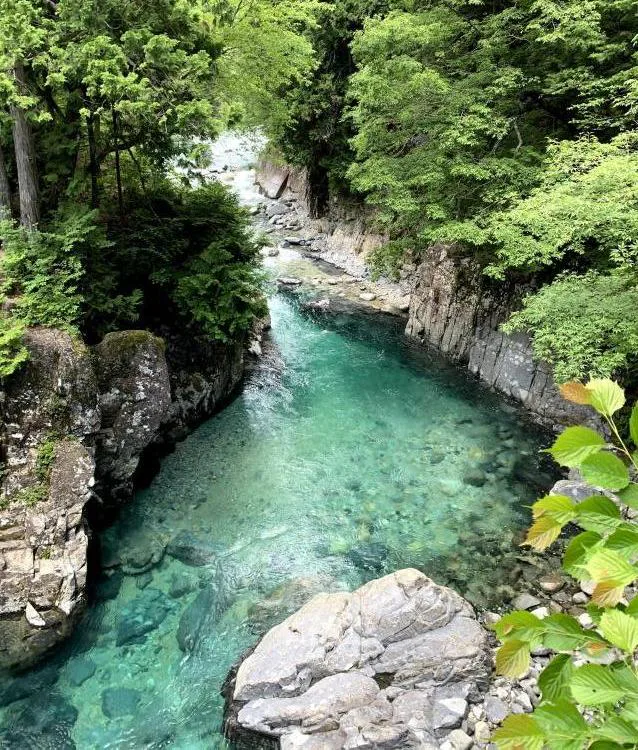
The most important correction: Nojiri Station is 20 minutes from the entrance, not from “Atera Blue”
The official access page says JR Nojiri Station is about 20 minutes on foot from the valley entrance. That makes Atera unusually reachable by rail for a mountain gorge, but it is easy to turn that true fact into a bad itinerary.
Okuwa Village’s current walking guide gives the deeper sequence more honestly:
Entrance → Senjojiki Rock: about 25 minutes.
Entrance → Tanuki-ga-fuchi: about 45 minutes.
Entrance → Inugaeri-no-fuchi: about 58 minutes.
Entrance → Kuma-ga-fuchi: about 1 hour 25 minutes.
Entrance → Ushiga-fuchi: about 1 hour 37 minutes.
Entrance → Atera Valley Campground: about 2 hours / 6.3 km.
Those are one-way walking estimates before photo stops, lunch, the separate walking trail, a return journey or the 20-minute walk back to Nojiri Station. A rail traveller attempting the full road on foot can therefore turn “20 minutes from the station” into several hours of walking very quickly.
ValueNavi true time-cost table: what the 20-minute station claim becomes after you choose a turnaround
The table below is derived from Okuwa Village’s published 20-minute Nojiri Station → entrance walk plus its one-way walking estimates from the entrance. The “minimum return walking” column simply doubles that baseline. It deliberately excludes photos, lunch, waiting, the 45-minute nature trail and any detour.
↔ Scroll table left or right
Furthest point | Minimum walk from Nojiri Station, one way | Minimum return walking | Planning implication |
Valley entrance | 20 min | 40 min | The “easy access” claim is true only at the entrance |
Senjojiki Rock | 45 min | 1 hr 30 min | Still a plausible short rail visit if you keep stops brief |
Tanuki-ga-fuchi | 1 hr 5 min | 2 hr 10 min | Walking is now a major part of the half-day |
Inugaeri-no-fuchi | 1 hr 18 min | 2 hr 36 min | Add photo/rest time and the trip is no longer a quick station stop |
Kuma-ga-fuchi | 1 hr 45 min | 3 hr 30 min | Rail access without shuttle/e-bike is becoming a hiking-day decision |
Ushiga-fuchi | 1 hr 57 min | 3 hr 54 min | A fixed train departure now needs a conservative turnaround |
Atera Valley Campground | 2 hr 20 min | 4 hr 40 min | Not a half-day rail plan once normal stops are added |
ValueNavi rule: choose the furthest pool you genuinely need before you leave the station. Do not discover your turnaround point only after reaching it.
2026 vehicle-restriction days change the product from a drive to a park-and-transfer trip
Okuwa Village’s current main summer notice restricts ordinary vehicle entry all day from July 18 through September 6, 2026. During that period, the shuttle operates between Forrespa Kiso and the Shimaki Akahiko monument parking area inside the valley.
The current published operating framework is:
Shuttle window: 09:00–16:00.
Frequency: roughly one to three buses per hour; full buses can require waiting for the next service.
Fare: ¥1,500 return (about US$9.40) or ¥800 one way (about US$5.00) per seat. The official notice says there is no separate child fare.
Parking: ¥1,000 (about US$6.30) for a standard car and ¥500 (about US$3.10) for a motorcycle.
Alternative: electric-assist bicycle rental is currently ¥1,000 or ¥1,500 per hour (about US$6.30 or US$9.40), depending on bicycle type.
FX assumption: ¥1 ≈ US$0.00627 (¥1,000 ≈ US$6.27), checked August 27, 2026. USD figures are rounded planning equivalents, not guaranteed card or cash exchange rates.
Hidden-cost check: one standard car plus two return-shuttle seats is ¥4,000 (about US$25); with four return-shuttle seats it becomes ¥7,000 (about US$44), before food, e-bike rental or other transport. The shuttle is still often the efficient choice on a restriction day, but “the valley itself is free” is not the same thing as “the access day costs nothing.”
The village’s annual 2026 schedule also lists vehicle restrictions for April 25–May 6, September 12–13 and September 19–23, while warning that planned dates can change. The detailed summer operating page specifically covers the July 18–September 6 period, so verify the live shuttle/parking arrangement for the extra dates instead of extrapolating.
This distinction matters for autumn visitors. “Vehicle restriction day” and “same exact summer shuttle operation” are not automatically identical facts.
Driving outside a restriction period does not automatically make the visit easier
Outside the regulated periods, a car restores access flexibility, but it does not turn Atera into an ordinary scenic road. Okuwa Village warns that the gorge road is narrow, pedestrians and vehicles share it, and passing can be difficult.
A driver still has three costs that a route planner may not show:
slow sections where pedestrians, cyclists and cars meet;
limited places to stop without obstructing traffic;
the temptation to turn every pool into a roadside photo instead of doing one coherent walking section.
If the car is only being used to eliminate walking, the e-bike/shuttle combination on regulated dates may actually create a calmer sightseeing day. If the wider Kiso itinerary genuinely needs a car, driving remains useful—but do not value unrestricted entry as though it were a private scenic road.
The 45-minute walking trail is a real mountain path, not a paved riverside promenade
Okuwa Village’s separate walking-trail page describes a loop connecting two suspension bridges. The trail itself is unpaved, has ups and downs, and includes metal stairs. The basic loop takes about 45 minutes; adding Rokudan-no-taki adds roughly another 15 minutes.
That produces a better physical-effort model than “the valley is mostly a road.” You can combine:
road viewpoints for lower-effort access to selected pools;
the 45-minute trail when you actually want a forest walk;
Rokudan-no-taki only when the stairs and surface conditions are appropriate.
In rain, the official page warns that the metal steps become slippery. A family or older traveller does not need to prove anything by completing the trail just because the road approach felt easy.
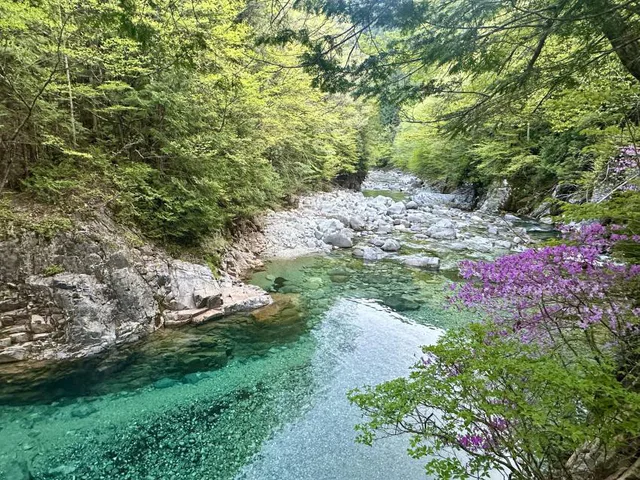
The water is unusually clear; that makes the risk easier to underestimate
Atera is a natural river, not a managed swimming attraction. Okuwa Village’s current safety notice is unusually specific: the water is very cold even in summer, with average noon temperatures around 13°C in July and 16°C in August. The village also warns of deceptively deep sections, strong current and unstable rocks.
The transparency creates a visual trap. When the riverbed is clearly visible, deep water can look shallow. That is exactly why “Atera Blue” should not be translated into “safe swimming water.”
There is also no reliable mobile-phone signal throughout the gorge under the village’s current warning. Do not build the day around being able to call for transport, look up a map or stream the live shuttle timetable from every pool. Save the route and return plan before entering.
The current rules also prohibit dangerous behaviour such as jumping from bridges or rocks, and entering the water after drinking alcohol. Treat riverside cooling as optional; the core attraction is the gorge itself.
Rain after-effects are a bigger red flag than imperfect water colour
If the choice is “slightly less blue water on a safe dry day” versus “dramatic water after heavy rain,” choose the safer day. Okuwa Village warns that rain can raise water levels and rockfall risk, and that rain upstream matters even when the gorge itself appears sunny.
This creates a practical cancellation test:
Light rain with stable local guidance: shorten the walk, skip slippery trail sections and reassess whether the view is still worth the trip.
Heavy rain, recent heavy rain or upstream warnings: do not force the gorge day because the hotel is already booked.
Typhoon or severe-weather pattern: replace the day entirely and follow official closures/transport information.
The Japan rainy-day backup guide is more useful here than an umbrella. A natural gorge has failure modes an indoor attraction does not.
Half-day or full day? Use the access method, not the attraction count
A half-day is realistic when you arrive early, use the shuttle/e-bike/car to remove most of the long access road and choose a limited set of pools plus the 45-minute trail or another defined walking block.
A half-day becomes weak when you arrive by rail, walk from Nojiri Station, then also expect to walk several kilometres deep into the gorge and back. The attraction list may be short, but the access walking is doing most of the day’s work.
A full day is justified when the gorge itself is one of the main nature experiences of the trip, you want to walk slowly, photograph several pools, complete a trail section and avoid scheduling another timed attraction afterward.
Do not extend the visit merely because reaching Atera took effort. Sunk transport time is not a reason to walk farther once weather, energy or the return shuttle says stop.
No-car travellers need a turnaround plan before they need a hotel recommendation
By rail, the simplest arrival is JR Nojiri Station → roughly 20-minute walk to the entrance. On weekdays, Okuwa also operates a village bus on the Nojiri/Suhara route, but the live timetable should be checked for the actual date rather than treated as a frequent tourist shuttle.
The important calculation is the return. A no-car traveller who walks 90 minutes into the gorge has created a 90-minute walk back before the station approach. If the chosen train out of Nojiri matters, set a hard turnaround time first.
If you are changing hotels the same day, forward the main suitcase when possible and carry a day bag. Atera is exactly the kind of destination where luggage weight changes whether “car-free” feels elegant or punishing. Use the Japan luggage-forwarding guide before making the gorge your transfer-day stop.
Should you stay near Atera Valley?
Do not book an Atera-area night simply because the gorge is remote. The night is worth it when it removes a hard travel cost you would otherwise pay in the morning or evening.
Stay near the entrance when an early Atera start is itself valuable, you want a slow gorge day, or the surrounding Kiso route makes Nojiri/Okuwa a natural overnight. Forespa Kiso Aterasou and the official Kiso Fureai-no-Sato campground sit near the access area; the village says the campground is about a 15-minute walk from Atera Valley.
Do not move hotels when Atera is only a half-day side trip from an already useful Kiso base and the hotel change adds more luggage friction than the early start saves.
There is also a 2026 legal boundary worth knowing: the village amended its conservation ordinance effective June 17, 2026 to prohibit camping/overnight tent use in specified Atera forest/entrance areas outside the designated Atera Valley campground. Loud noise is also prohibited day and night, with ordinance violations subject to a fine of up to ¥50,000 (about US$314). An “early start” does not mean informal roadside camping is an acceptable workaround.
Three itineraries that actually fit the current access rules
1. Driver during the main summer restriction
Arrive at Forrespa Kiso → park → shuttle into the valley → select a walking loop / pool sequence → return with a meaningful buffer before the last operating window → continue to the hotel. Best when you want the gorge without spending the entire day on the access road.
2. Rail traveller from Nojiri
Nojiri Station → 20-minute walk to the entrance → choose a conservative furthest point based on your train out → return before energy or daylight becomes the limiting factor. Best for walkers who understand that the station-to-entrance figure is only the first segment.
3. Atera as the main Kiso nature day
Sleep in or near Okuwa/Nojiri → start early → use the best available access mode for that date → walk the gorge slowly → avoid stacking another fixed reservation in the afternoon. Best when Atera itself is the reason for stopping in this part of Kiso.
Final verdict
Atera Valley is worth the detour when you plan the depth of the gorge, not just the entrance. The 20-minute walk from Nojiri Station makes the entrance accessible; it does not make Kuma-ga-fuchi, Ushiga-fuchi or the campground a short station walk. During the main 2026 vehicle restriction, the shuttle is a core part of the visit and its 09:00–16:00 window should define the route.
The red-team condition is weather. Cold water, deep pools, no reliable mobile signal, slippery trail sections and post-rain water/rockfall risk mean this is not a destination to force simply because Atera Blue photographs well. On a stable day, choose one coherent walking section and move slowly. On a bad day, protect the rest of the Kiso itinerary and come back another time.
Japan eSIM Guide 2026: Data, Networks, Activation and Limits
National Museum of Nature and Science 2026: The ¥630 Ticket Is Cheap — Your 3–5 Hours Aren’t
Tokyo Game Show 2026: Fast Ticket, First-Hall Trap and Family Cost
Sapporo Winter Horseback Riding: 50 vs 80 Minutes — Direct Booking, Pickup and Winter Access
Eikando Nanzenji Philosopher’s Path Autumn Route: Day, Night and Access
References
Okuwa Village — 2026 vehicle restrictions, shuttle, parking, e-bike rental, safety and conservation rules · Okuwa Village — 2026 planned restriction dates · Okuwa Village — walking times and Nojiri access · Okuwa Village — walking-trail conditions · Okuwa Village — access map. Checked August 27, 2026. Restrictions, shuttle operations, weather and trail conditions can change; verify live village updates for the travel date.