
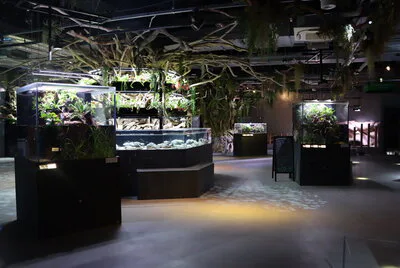
átoa is worth its current ¥2,600 (about US$16) adult ticket when you want an aquarium-art installation inside a Kobe waterfront half-day, not when your main goal is the biggest tanks or the broadest marine-life collection in Kansai. The venue’s value comes from changing the way live animals are staged through light, sound, architecture and themed spaces. If you would judge the ticket mainly by species count, compare a conventional large aquarium instead.
The second filter is geography. átoa is about 18 minutes on foot from Sannomiya and about 15 minutes from Motomachi. That is easy to absorb when Nankinmachi, the waterfront, Kobe Port Tower or dinner are already in the same half-day. It is a much weaker purchase when you cross from Osaka or another part of Kobe only for a roughly two-hour indoor stop and immediately turn around.
↔ Scroll table left or right
Your priority | Verdict | Why |
Immersive design, photography and a compact indoor stop | Strong fit | The aquarium × art format is the product you are paying for |
Largest marine animals / conventional aquarium scale | Weak fit | átoa is deliberately smaller and exhibition-led |
Already spending the afternoon on Kobe waterfront | Strong fit | Transport opportunity cost is low |
Osaka day trip with only one short Kobe block | Conditional | The 15–18 minute last mile plus return transport can dominate a two-hour attraction |
Family with preschool children | Potentially strong value | One child aged three or over can currently enter free with each paying adult |
You visited before July 2026 | Reconsider | The ELEMENTS zone reopened after a substantial renewal on July 11, 2026 |
The ¥2,600 (about US$16) ticket buys format, not aquarium scale
átoa’s current standard admission is ¥2,600 (about US$16) for adults and junior-high students or older, ¥1,500 (about US$9) for elementary-school children, and free for children under three. One child aged three or over can currently enter free with each paying general-admission adult; an additional child is ¥500 (about US$3).
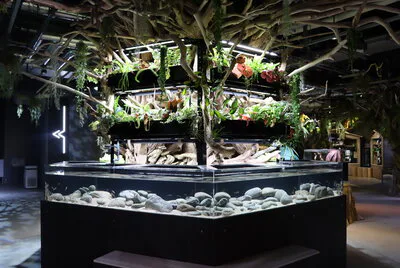
Those prices become easier to evaluate once the comparison category is correct. átoa is not trying to win a “most fish per yen” contest. PLANETS, CAVE, MARINE NOTE, MIYABI, ELEMENTS and the open-air SKYSHORE area use different staging languages around live animals. The ticket makes more sense for visitors who enjoy exhibition design and atmosphere than for visitors looking for a single giant headline tank.
This is the useful deletion test: if the animals were shown in ordinary tanks without the designed environments, would you still choose this attraction? If yes because you mainly want aquarium scale, átoa may not be the best use of the money. If no because the staging is exactly what interests you, the ticket is buying the right thing.
PLANETS is the signature image, but one room should not justify the whole detour
PLANETS is the spherical-tank room that appears most often in átoa photos. It is visually distinctive, but the ticket should not be justified by one photo opportunity. The stronger case is the sequence: darker cave-like spaces, marine blue zones, Japanese-inspired presentation, the spherical PLANETS room, animal interpretation and then the rooftop/open-air transition.
A traveller who wants only one social-media frame can finish the “reason for going” very quickly. A traveller who enjoys the changing exhibition language has a much stronger reason to spend two or more hours inside.
That distinction is important on a short Kansai trip. A photogenic stop is not automatically a high-priority stop if it displaces the only Kobe neighborhood, Kyoto temple block or Osaka evening you actually care about.
The July 2026 ELEMENTS renewal is the clearest reason older reviews can mislead
átoa reopened its second-floor ELEMENTS zone on July 11, 2026 after a major renewal. The official update added new hands-on and interactive components, including a Garra rufa experience, turtle feeding, aquaponics and biomimicry interpretation. The previous Parma wallaby and veiled chameleon displays ended as part of the change.
This matters because an older review can be factually accurate about the venue and still describe an attraction that no longer has the same second-floor content. If you visited before July 2026, the decision is not simply “I have already seen átoa.” Decide whether the renewed interaction and interpretation are enough to make a repeat visit useful.
For a first-time visitor, the renewal strengthens the educational side of a venue that can otherwise be described too narrowly as “an Instagram aquarium.” It still does not turn átoa into a full conventional aquarium day.
The Sannomiya walk is part of the ticket cost
átoa’s official access page currently gives about 18 minutes on foot from Sannomiya, roughly 1.4 km, and about 15 minutes from Motomachi, roughly 1.2 km. Bus options also connect the Sannomiya side with the waterfront.
In mild weather with a day bag, that last mile is straightforward. In humid August weather, heavy rain, with young children or after a full day of walking, it is a real cost. The difference between “central Kobe” and “beside the station” matters when the attraction itself may only occupy two hours.
Use the full door-to-door test:
Already in Nankinmachi / Motomachi / waterfront: átoa is easy to add.
Hotel near Sannomiya and no luggage: the walk or bus is manageable.
Arriving at Shin-Kobe with full-size luggage: store the bags first; do not make the attraction the luggage route.
Coming from Osaka only for átoa: count Osaka → Kobe transport + 15–18 minute local leg + return journey before calling it a “two-hour stop.”
If Kobe accommodation is still undecided, use Sannomiya vs Shin-Kobe before optimizing a single attraction.
Families can get much better per-person value—but only if the format fits the child
The current child rule can materially change the maths. One child aged three or over can enter free with each paying general-admission adult, while children under three are free. A family of two adults and two eligible young children can therefore enter for the two adult fares under the current rule.
That is strong price leverage, but it does not answer whether the attraction fits the child. átoa is built around atmosphere, observation and designed spaces rather than a large play zone. A child fascinated by animals, lighting and feeding interactions may get excellent value. A child whose main wish is a giant shark tank or a long hands-on play session may not.
Do not let “the child is free” become the reason to spend the half-day. Free admission lowers the money cost; it does not lower the time cost.
Standard vs variable-price days: check the date, but do not over-plan around a small fare difference
átoa uses variable pricing on designated high-demand dates. The official ticket page currently lists the standard adult price at ¥2,600 (about US$16) and the designated-day adult price at ¥2,800 (about US$18). Check the live calendar for your exact date rather than assuming the higher tier applies to every weekend or holiday.
That ¥200 (about US$1.25) difference is not a reason to reorganize a Kobe itinerary. The more important peak-day issue is capacity and entry timing: átoa can use timed entry during crowded periods, and opening hours can change on special dates.
Tickets are sold from one month before the visit. If a peak date or fixed Kobe day matters, buy for schedule certainty. If the day is flexible, the weather and wider Kobe route may be more valuable than booking at the first possible moment.
How long should you allocate?
átoa does not impose a normal fixed stay duration after entry. For itinerary planning, roughly two to three hours inside is a useful ValueNavi range for most visitors, not an official time requirement.
The lower end fits a visitor moving steadily through the zones. The upper end is more realistic for families, photographers, animal talks/feeding experiences, café time or a slower pace. Add the local walk or bus before you call it a two-hour attraction.
The mistake is not staying “too short.” The mistake is forcing the visit to become half a day just to make the ticket feel better value. If you are ready to leave after the core sequence, continue into the waterfront.
The best itinerary is a waterfront half-day, not a standalone aquarium mission
átoa becomes easier to justify when several activities share the same geography. A practical sequence is Motomachi/Nankinmachi → átoa → Kobe waterfront / Port Tower → dinner. That turns the 15-minute walk into part of a coherent district rather than a repeated approach and retreat.
The reverse is weaker: Osaka → átoa → immediate Osaka return. In that version, the transport time can rival the attraction time and the ticket has to carry the entire trip by itself.
If you are building a wider Kansai route, the Osaka, Kobe and Koyasan four-day itinerary helps decide whether Kobe deserves the half-day before you optimise ticket details.
When should you skip átoa?
Skip it if aquarium scale is your priority. The ticket is not buying the largest marine-life spectacle.
Skip it if Kobe only has a few hours and your real priority is something else. The attraction is easy to like and easy to overvalue because it photographs well.
Skip it as a standalone Osaka-to-Kobe mission unless the exhibition format itself is a high priority. The intercity and local transport are part of the real cost.
Skip a repeat visit if the July 2026 ELEMENTS renewal does not add anything you care about. “The venue changed” is not the same as “you need to go again.”
KKday · Check átoa admission for your date
Klook · Compare current átoa and Kobe bundle options
Final verdict
Choose átoa when you want the aquarium-art format and can place it inside a Kobe waterfront half-day. The current ¥2,600 (about US$16) price is much easier to defend when the Sannomiya/Motomachi last mile, harbor walk and dinner already belong to the same route.
Do not choose it by fish count, and do not choose it because PLANETS produces one famous photo. Its original value is the changing exhibition environment around live animals. If that is not what you want, a larger conventional aquarium or a different Kobe attraction will use the same time better.
Osaka Kuromon Market Food Tour 2026: You’re Paying for a Guide, Not the Food
Luggage Forwarding for Kawaguchiko and Hakone: What Actually Works
Swissotel Nankai Osaka: Is Nankai Namba Access Worth Paying More For?
Nada no Kenka Matsuri 2026: If You Only Go One Day, Choose Oct 15
Early Morning Things to Do in Tokyo: What Actually Works Before 10 a.m.
References
átoa — official tickets, prices and hours · átoa — official access · átoa — ELEMENTS July 2026 renewal. Checked August 26, 2026. USD conversions are approximate at roughly ¥160 per US$1; prices, designated dates, hours, animal displays and interactive programs can change, so verify the exact visit date.