
Current status — 25 August 2026: Japan's nationwide 2026 autumn-foliage reporting has not opened yet, but the first high-elevation monitoring phase has begun. Tenki.jp still says its 2026 foliage service is expected around September, and Weathernews likewise still presents the 2025 season rather than a live nationwide 2026 colour board. That means there is still no defensible nationwide 2026 peak calendar to publish today.
At the same time, “nothing is happening anywhere” is now too blunt. Daisetsuzan Asahidake Ropeway published an official 19 August update describing Mount Asahidake as moving from summer toward the entrance to autumn. On 24 August its live mountain page reported about 15°C at Sugatami Station at 1,600 metres, rain, poor visibility and winds reaching 13 m/s; the operator later showed the ropeway suspended. It also published a planned 25 August operating window of 06:30–17:30, which is a schedule rather than a guarantee of uninterrupted service.
The useful distinction is therefore: national forecast not open; alpine watch open; verified peak claims still require a dated location-level observation; and a good colour signal is useless when visibility or access fails. This page will not turn a seasonal hint, a webcam frame or a historical average into a current-colour claim.
Japan autumn leaves live update: the 30-second answer
Travelling before mid-September: monitor Asahidake, Kurodake and other high-elevation Hokkaido locations first. Do not extrapolate an alpine signal to Sapporo, Tokyo or Kyoto.
Planning October–December now: use historical timing only to choose a corridor. Do not buy a non-refundable remote hotel because an old “peak week” matches your dates.
When nationwide 2026 forecast services open: use them to narrow the corridor, then use exact-location reports and operator status for the actual day.
If a dated report says green: move higher or cooler inside the same corridor before changing hotels or crossing Japan.
If it says near peak or peak: run three gates before committing—colour, visibility/weather, and access/return transport. Failing any one can make the day poor value.
If it says fading or fallen: move lower, south or to a later-changing species rather than treating the entire region as finished.
What changed between 3 August and 25 August?
On 3 August, the honest nationwide status was simply “2026 reporting not open.” By 25 August, that remains true at national level, but local alpine monitoring has become worth separating from the rest of Japan. The 24 August Asahidake suspension adds another lesson: the first useful live signal of autumn is not just colour. It is the combination of colour evidence and whether the mountain can actually be reached and seen.
↔ Scroll table left or right
Layer | 25 Aug 2026 status | What you may conclude | What you may not conclude |
tenki.jp nationwide service | 2025 service closed; 2026 service expected around September | No national tenki.jp 2026 foliage board yet | Do not reuse 2025 colour dates as 2026 predictions |
Weathernews nationwide service | 2025 season page remains the current nationwide product | No defensible nationwide 2026 live status from that page yet | Do not call a region “peak” from historical ranking pages |
Asahidake local operator | Local seasonal watch active; 24 Aug also demonstrated weather/access failure risk | Start checking colour wording, live visibility and ropeway operation together | The phrase “entrance to autumn” is not a verified peak-colour report, and a published timetable is not an operation guarantee |
Tokyo / Kyoto / most lowlands | No current 2026 foliage claim on this page | Continue booking by broad historical window and itinerary value | Do not move dates because Hokkaido high elevations are cooling |
This layered approach prevents three late-August errors: declaring the whole country “not started” after high mountains begin changing, declaring “Japan autumn has started” when only a narrow alpine zone is entering the watch period, and treating a promising colour report as executable without checking wind, visibility and transport.
Official 2026 reporting status
tenki.jp foliage information: the current page says 2025 updates have ended and 2026 information is expected around September.
Weathernews foliage information: the current nationwide page still presents the 2025 season rather than a live 2026 status board.
Daisetsuzan Asahidake Ropeway: use the live camera, current Sugatami weather and dated operator blog as a high-elevation monitoring source. The operator's 19 August post describes the area as moving toward autumn. On 24 August the live page reported rain, roughly 15°C, poor visibility and winds up to 13 m/s at 1,600 m; service was subsequently shown as suspended. The operator published 06:30–17:30 as the planned 25 August operating window, but same-day status still overrides the timetable.
Local attraction or tourism office: use the newest dated update for the exact viewpoint, elevation and tree type.
Transport and road operators: recheck rail, bus, ropeway, road, trail and final-service status about 48 hours before travel and again that morning.
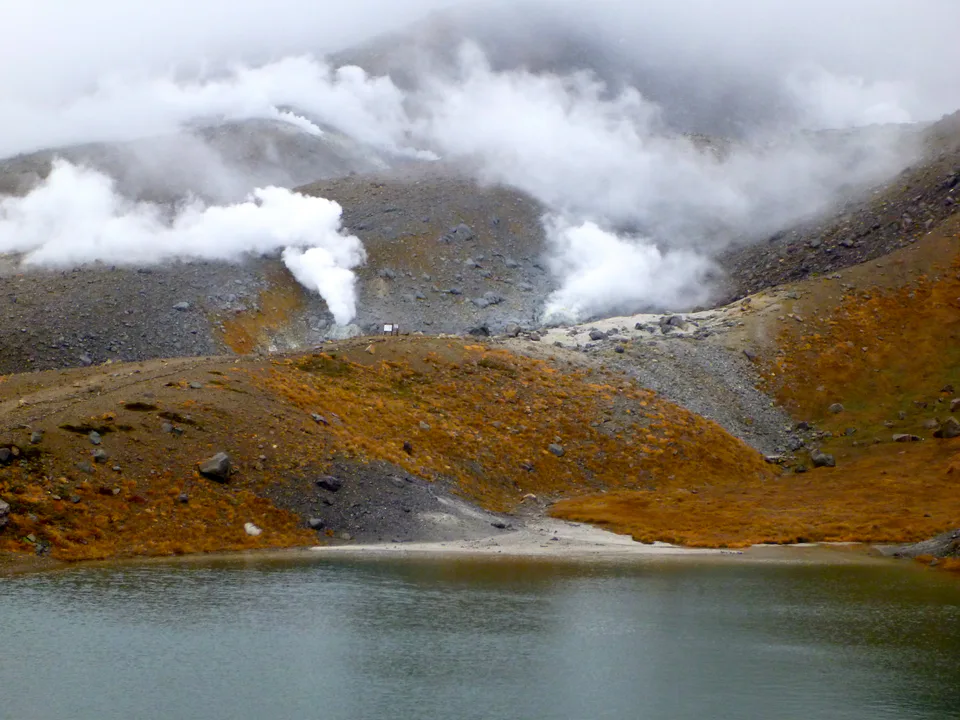
Sugatami Pond, Mount Asahidake. Historical location image, not current 2026 colour.
Image: Rick McCharles, Wikimedia Commons, 25 October 2011, CC BY 2.0. Historical context only.

Weekly regional decision board
The status column below reports what can be defended on 25 August, not a guessed 2026 peak date. “Watch” means a dated local signal is useful enough to monitor; it does not mean the location is at peak or that access will operate.
↔ Scroll table left or right
Base / region | 25 Aug status | First watch | Later fallback | Main risk |
Asahikawa / Sapporo | Alpine watch active; no peak claim; recent weather/access disruption demonstrated | Asahidake, Kurodake | Sounkyo lower elevations, Biei/Asahikawa, Sapporo parks, Onuma | Wind, visibility, ropeway suspension, cold, seasonal buses |
Aomori / Hachinohe | No verified 2026 colour claim here yet | Hakkoda, upper Oirase | Lower Oirase, Hirosaki | Bus capacity, mountain roads |
Tokyo / Kanto | No verified 2026 colour claim here yet | Oku-Nikko, high Hakone | Tokyo gardens, lower Hakone | Traffic, ropeway or boat suspension |
Matsumoto / Nagano | No verified 2026 colour claim here yet | Kamikochi, Okuhida, Tateyama | Castle towns, lower valleys | Seasonal closure, snow, one-way routes |
Kyoto / Osaka | No verified 2026 colour claim here yet | Northern Kyoto, Hieizan, Koyasan | Central Kyoto, Uji, Nara | Temple hours, reservations, crowds |
Fukuoka / Kyushu | No verified 2026 colour claim here yet | Kuju, Unzen, upper Takachiho | Takeo, lower gardens | Driving distance, sparse transit |
Decision rule: change elevation before changing the country, but never move to the higher location until it passes all three execution gates: usable colour, usable visibility/weather, and usable access/return transport.
Asahidake is now a watch signal, not a Japan-wide forecast
Asahidake matters in late August because its upper ropeway area is one of Japan's earliest useful autumn monitoring zones. The operator's own 19 August wording — moving from summer toward the entrance to autumn — is enough to upgrade the area from “ignore for now” to “check frequently.” It is not enough to label the mountain “colouring,” “near peak” or “peak” without a more explicit dated observation.
The operational side matters equally. On 24 August the official live page reported rain, around 15°C at Sugatami Station at 1,600 m, poor visibility and winds reaching 13 m/s; the ropeway was later shown as suspended. The operator then published a planned 25 August operating window of 06:30–17:30. The point is not that 25 August is automatically safe—the timetable is only the planned window. Same-day wind, visibility and service status can still remove the mountain from the itinerary.
For a high-alpine foliage day, use a three-gate test:
Colour gate: is there a dated exact-location report that actually says colouring, near peak or peak, rather than a vague seasonal transition?
Visibility gate: can you realistically see the landscape, and are wind/rain conditions appropriate for the walk you intend to do?
Access gate: is the ropeway/bus/road operating, and is the final return service still realistic?
Only after all three pass should a remote mountain day displace a strong lower-elevation alternative. A perfect foliage report with a suspended ropeway is still a failed day trip; an operating ropeway in zero visibility can also be poor value.
Keep a Biei/Asahikawa or lower-elevation fallback that does not require the same weather system to cooperate. That turns a suspension from a lost day into a route switch.
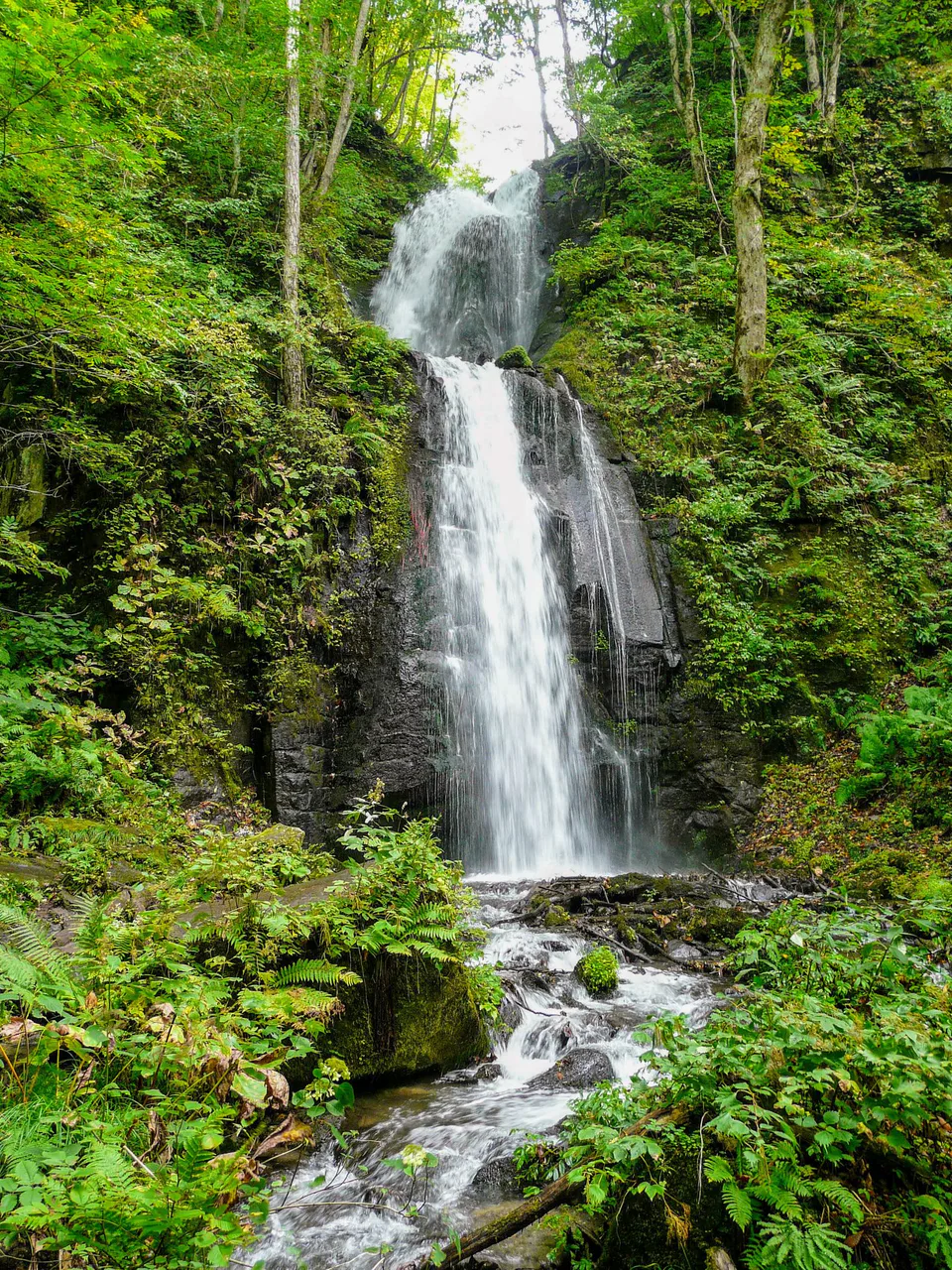
Kumoi Falls, Oirase Stream. Historical location image.
Image: Naokijp, Wikimedia Commons, CC BY-SA 4.0. Historical context only.

Use four phases instead of asking whether “autumn has started”
↔ Scroll table left or right
Phase | Evidence available | Booking action |
0 — Historical planning | No current local signal and no nationwide 2026 forecast | Choose month, gateway and flexible bases only |
1 — Local watch | Dated high-elevation seasonal signal, local weather/camera/operator updates | Watch the corridor more closely; do not chase it nationally |
2 — Forecast open | 2026 nationwide forecast products are published | Narrow dates/elevations and protect scarce transport/hotels |
3 — Live execution | Dated location-level colour report + visibility/weather + transport status | Choose the actual day only after the three execution gates pass; otherwise switch higher/lower or execute Plan B |
As of 25 August, Japan is still mostly in Phase 0, with Asahidake and similar very high locations entering Phase 1 monitoring. The 24 August suspension is useful evidence for why Phase 3 must include access, not just leaf colour.
30-, 14-, 7- and 2-day adjustment plan
↔ Scroll table left or right
When | Make this decision | Reasonable change | Verify |
30 days | Protect flexibility | Refundable hotel, adjacent dates, base city | Cancellation and seasonal operation |
14 days | Keep two viable corridors | Higher or lower day trips from the same base | Live trend, roads, final services |
7 days | Set daily order | Place the mountain day on the best forecast | Weather, restrictions, tickets |
48 hours | Commit or switch | Remove suspended sectors and reserve required seats | Operators, road, wind, rain |
Same morning | Confirm execution | Shorten or replace the route if visibility/access worsens | Newest colour observation, live visibility, operator status and final return |
Choose a base city instead of moving every night
Keep one base for two or three nights when it can reach different elevations and indoor backups. Changing hotels adds check-in deadlines, luggage handling and cancellation costs. Compare the final room price, tax, meal plan and cancellation deadline; do not pay a large premium because one historical date looks perfect.
↔ Scroll table left or right
Base | Useful directions | Suggested stay | Main limitation |
Asahikawa | Asahidake, Sounkyo, Biei, city backup | 2–3 nights | Mountain transport is weather-sensitive |
Aomori or Hachinohe | Hakkoda, Oirase, Lake Towada, Hirosaki | 2–3 nights | Station names and seasonal buses |
Tokyo | Nikko, Hakone, Kawaguchiko, Takao, city gardens | 3–5 nights | Day trips can be long and crowded |
Matsumoto or Nagano | Kamikochi, higher valleys, castle towns | 2–3 nights | Seasonal closure and one-way transport |
Kyoto | Northern Kyoto, central temples, Uji, Nara | 3–5 nights | Staying in Osaka weakens dawn and late access |
Search flexible Asahikawa hotels on Booking.com
Compare Kyoto hotel bases on Expedia
Transport, weather, clothing and luggage checks
Confirm the exact station or bus stop, reservation rule and final service. A foliage report does not guarantee a seat.
Wind, lightning, fog and maintenance can stop ropeways, boats and lifts even when colour is good.
Check road closures, one-way controls, parking restrictions, snow or ice and whether the viewpoint remains reachable.
Near-peak weekends need an earlier start, a shorter stop list and a protected return plan.
Use the destination forecast. High-elevation mornings can be far colder than the base city; carry layers, rain protection, grip and a warm accessory.
Leave large luggage at the base or forward it before a mountain segment. Confirm receiving hotel, delivery date and cutoff.
Ryokan dinner may have a strict arrival window; do not keep adding stops after a delayed bus.
Plan B: green, fallen, rain or suspension
Still green: move higher in the same corridor only if the higher site also passes visibility and access gates; if not, make onsen, scenery, food or hiking the main value lower down.
Past peak: move lower or south, or choose ginkgo, city gardens and later species.
Rain: use a sheltered garden, museum or onsen and move the mountain day to the best forecast.
Strong wind or suspension: remove ropeway, boat and ridge sectors; choose a rail-accessible lowland site rather than waiting at the base for an uncertain restart.
No rooms: keep the nearby base city and take an early day trip rather than paying an irrational last-room premium.
Sources disagree: prefer the newest exact-location observation and add a same-day camera plus operator notice.
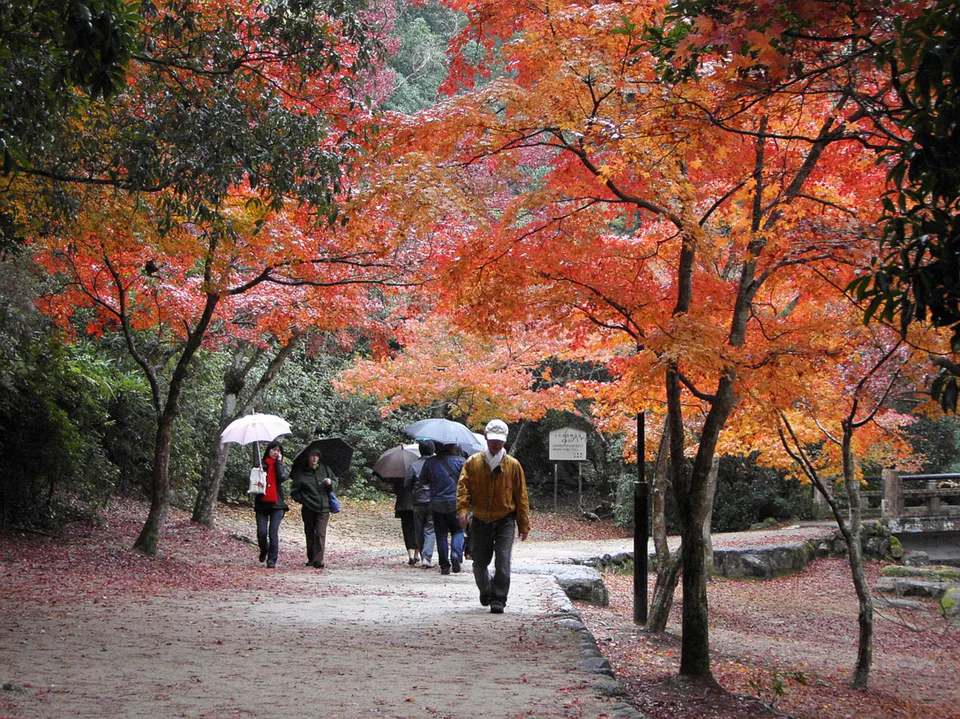
Miyajima Island, Hiroshima. Historical location image.
Image: Spiegel, Wikimedia Commons, CC BY 2.0. Historical context only.

Frequently asked questions
Are Japan's autumn leaves changing now?
As of 25 August 2026, the main nationwide 2026 foliage services have not opened. High-elevation local monitoring has begun at places such as Asahidake, but this page does not claim that any broad region is at peak.
Does “autumn entrance” at Asahidake mean the leaves are already peak?
No. It means the operator has published a dated seasonal-transition signal worth monitoring. Wait for an explicit colour report before labelling the mountain colouring, near peak or peak.
What if the foliage is good but the ropeway or visibility is bad?
Switch the day or use the lower-elevation fallback. A current colour report is only one of three execution gates; visibility/weather and access/return transport must also work.
When should I use a live report?
Use 30 days for flexibility, 14 days for route options, seven days for daily order and about 48 hours for execution. Same-day operator status still overrides a good foliage report.
How recent should the report be?
Rapid cooling, heavy rain and wind can make a report stale within days. Prefer the newest exact-location update.
What if the report is green?
Try higher elevation or an earlier-changing species in the same corridor before changing hotels—but only when the higher site is actually visible and operating.
What if the mountain is past peak?
Move lower, south or to later city gardens, and shift value toward onsen, food, museums or architecture.
Should I cancel a non-refundable hotel?
Usually keep the base and change day trips, elevation and order. Compare the total cancellation and transfer cost first.
Are the photographs current?
No. The images on this page are historical location images. Current status comes only from dated 2026 observations and operator information.
Official sources and last check
Primary national sources: tenki.jp and Weathernews. Current high-elevation local source: Daisetsuzan Asahidake Ropeway, including its live weather/camera and dated operator blog. Also verify the local tourism office, railway, bus, ropeway, road and weather operator for the exact travel day. Last checked 25 August 2026.
Cover: Matsukawa River Valley, Takayama, Nagano, by Yoshi Canopus, Wikimedia Commons, CC0 1.0. Historical image only; it does not show current August 2026 conditions.
Sapporo Autumn Fest 2026: The One-Kilometre Food Route That Leaves Room for Dessert
Hakone Autumn Leaves Guide: Foliage Timing from Gora to Lake Ashi and Hakone-Yumoto
Tateyama Kurobe Autumn Leaves: Foliage Timing by Elevation from Murodo to the Dam
Karuizawa Autumn Leaves 2026: Kumoba Pond, Shiraito, Cycling and Trains
JR Pass for Japan Autumn Leaves: National vs Regional Rail Passes