
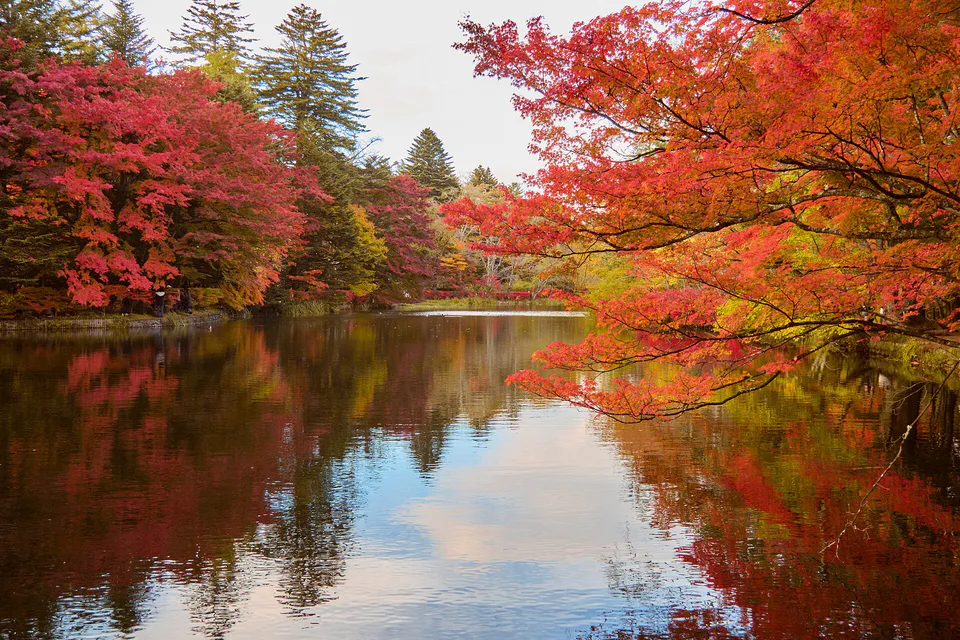
For a Tokyo day trip, treat Karuizawa as a town core plus one branch—not as one giant autumn loop. The safest first-time plan is Kumoba Pond + Old Karuizawa, then either Hoshino or Shiraito Falls. Choose Hoshino for the more forgiving afternoon. Choose Shiraito when the waterfall and higher-elevation forest are important enough to accept a fixed bus branch. Trying to do Kumoba, Old Karuizawa, Shiraito, Hoshino and the outlet in one day turns a foliage trip into a connection-management exercise.
Stay one night only when the hotel buys a session you cannot reproduce on the day trip: early Kumoba photography, a calmer Shiraito branch, an onsen evening, or a second weather window. As of August 26, 2026, do not choose a non-refundable date from an old “peak week” or an old autumn shuttle timetable. Foliage and crowd-control measures are date-sensitive; build the route shape now and recheck live colour, buses and town notices closer to travel.
↔ Scroll table left or right
Your actual trip | Build this first | Cut this first | Why |
First visit from Tokyo, full day | Kumoba + Old Karuizawa + Hoshino | Shiraito and outlet | Three useful zones without making the mountain bus the day’s weakest link |
Foliage / waterfall priority | Shiraito + Old Karuizawa + Kumoba | Hoshino and outlet | The mountain branch gets the morning while the town core remains recoverable later |
Family or older traveller | Kumoba + Old Karuizawa + Hoshino | Shiraito if timing is tight | More cafés, indoor breaks and easier route shortening |
Arrival in Karuizawa after about 11:00 | Town core only, then Hoshino if time remains | Shiraito | A late mountain branch consumes the same return margin needed for the Shinkansen |
Photography / weather-sensitive trip | One-night stay | Extra same-day zones | A second light/weather window is more useful than squeezing in another district |
ValueNavi Karuizawa Autumn Day-Trip Resilience Score
To make the one-branch rule reusable rather than anecdotal, ValueNavi scores route shapes on six dimensions: route recoverability 25%, transport independence 20%, foliage/experience payoff 20%, weather flexibility 15%, Tokyo-return resilience 10%, and mixed-mobility tolerance 10%. Each dimension is scored from 0 to 10. This is an editorial planning score, not an official tourism rating.
Route shape | ValueNavi score | Why |
|---|---|---|
Kumoba + Old Karuizawa + Hoshino | Strong first-trip payoff, easy shortening, food/rest options and a forgiving final branch. | |
Shiraito + Old Karuizawa + Kumoba | Higher transport dependency, but the mountain branch earns its cost when waterfall/forest scenery is a priority. | |
Late start after about 11:00: Kumoba + Old Karuizawa only | Lower total coverage but very high recoverability and strong return-train margin. | |
Kumoba + Old + Shiraito + Hoshino in one Tokyo day trip | Two separate branches create timetable anchors and make delay recovery much weaker. | |
One-night split with town session + separate Shiraito/weather session | The hotel buys a second independent session instead of merely adding sleep. |
I treat 8.5+ as a resilient default, 7.5–8.4 as good but purpose-dependent, and below 7.5 as a sign that transport anchors are starting to control the day. A traveller who specifically values Shiraito can rationally choose the 8.4 route over the 9.1 route because the score measures itinerary resilience, not personal scenic preference.
ValueNavi Branch Load Index: count the commitments, not the map pins
Karuizawa branches create different amounts of schedule commitment. Use this simple planning index:
Branch Load = fixed transport anchors + non-walkable connector dependence + hard return dependency
The town core is effectively the baseline. Hoshino usually adds one manageable branch. Shiraito adds a stronger bus/taxi dependency and a mountain-road return. Making both mandatory creates two separate branch commitments before the Tokyo-bound Shinkansen is protected.
↔ Scroll table left or right
Plan | Branch load | Interpretation |
Kumoba + Old Karuizawa | 0 | Green: easiest to shorten, extend or recover. |
Town core + Hoshino | 1 | Normal day-trip load. |
Town core + Shiraito | 2 | Purposeful branch: check the dated transport first. |
Town core + Shiraito + Hoshino | 3 | Fragile: one delay can delete the final zone or return margin. |
The index is deliberately ordinal rather than fake precision. It tells you how many parts of the day become difficult to move once transport is committed. The official Tourist Association model currently illustrates why Shiraito carries more load: its example uses Karuizawa Station 09:20 → Shiraito 09:43, then Shiraito 10:10 → Old Karuizawa-side stop 10:29 plus an eight-minute walk. Those are model-course example times, not a guaranteed live timetable for every autumn 2026 date.
The one-branch rule: Karuizawa is several transport zones, not one walk
The biggest planning mistake is looking at “Karuizawa” as one destination pin. The station, Kumoba Pond and Old Karuizawa form the most forgiving town-side cluster. Hoshino sits around Naka-Karuizawa and works as a separate afternoon branch. Shiraito Falls is farther into the mountain-road corridor. Shiozawa and South Karuizawa form another museum/garden branch.
That means every extra zone has a transport tax. The official Karuizawa Tourist Association’s car-free model course demonstrates the point: its sample bus leaves Karuizawa Station at 09:20 and reaches Shiraito Falls at 09:43, then leaves the falls at 10:10 and reaches the Old Karuizawa side at 10:29, followed by an eight-minute walk. That is already roughly fifty minutes of scheduled connector time around a relatively short waterfall stop, before allowing for waiting, loading, autumn traffic or a missed bus.
ValueNavi rule: on a Tokyo day trip, add only one branch beyond the town core unless you have checked the exact dated timetable and are comfortable losing the final optional stop. This is the difference between a route that bends and one that breaks.
%2026%20Oct,%202014%20-%20panoramio.jpg?width=1600)
Kumoba Pond is small geographically but large in the autumn time budget
Kumoba Pond is the easiest foliage anchor to understand. The official tourism site describes a roughly one-kilometre walking path around the pond, and its sample bus itinerary allocates about 30 minutes there. Thirty minutes is a useful minimum for a simple loop. It is not a guaranteed autumn visit time.
For planning, I would give it roughly 45–75 minutes when photography matters or crowds are heavy. That range is ValueNavi planning guidance, not an official rule. The extra time is for pausing at reflections, moving around slower walkers and accepting that the “best” viewpoint may be busy. A calm-water morning can justify arriving early; wind can erase the reflection advantage without making the pond itself worthless.
Kumoba is also where old transport information can mislead. The Tourist Association published a special autumn shuttle and congestion notice in 2023, including the reminder that the pond had no dedicated parking. That historical timetable should not be copied into a 2026 itinerary. Use it only as evidence that peak-season access can receive temporary measures, then check the current year’s town and bus notices before travel.
Shiraito Falls is a branch decision, not an “extra stop”
Shiraito is the route most likely to make an ambitious day look easier on a map than it feels in practice. The official model course’s 23-minute station-to-falls bus ride is not the full cost. You need to be at the stop before departure, allow for autumn road conditions, spend meaningful time at the falls, then catch the next useful service back toward Old Karuizawa or the station.
This creates a simple test: would you still choose Shiraito if it forces you to delete Hoshino or the outlet? If yes, it belongs in the itinerary. If no, it is probably not important enough to control the day.
I would place Shiraito before lunch on a day trip. If the exact bus no longer fits, keep the town core instead of gambling the return. On a one-night stay, Shiraito becomes easier because you can give it a dedicated half-day without simultaneously protecting a Tokyo-bound train.
Cycling does not solve this branch for most visitors. Town cycling and mountain-road cycling are different products. A rider who is comfortable between the station, Kumoba and Old Karuizawa may still be poorly matched to sustained climbing, traffic, wet leaves, fog and a colder downhill return. Use bus or taxi unless the rider is deliberately choosing the mountain ride itself.
Hoshino is the lower-risk afternoon branch
Hoshino and Harunire Terrace work differently from Shiraito. They still require transport, but the branch is easier to pair with food, a café or onsen time and easier to shorten when energy drops. In the Tourist Association’s model course, the example moves from the Kumoba area at 14:04 to Hoshino Onsen at 14:20, allows about 60 minutes around Harunire Terrace, then returns from Hoshino at 15:55 to Karuizawa Station at 16:10.
Those example departures are useful for understanding route shape, not as a promise that the exact same service operates on every autumn 2026 date. The important pattern is that Hoshino can function as the final branch before the station. If the afternoon is slipping, you can shorten the branch or return earlier without abandoning a mountain-road excursion.
This is why I prefer Hoshino over Shiraito for many first-time families and older travellers. The choice is not “better foliage versus worse foliage.” It is higher transport commitment versus higher recovery flexibility.
How much fits in one Tokyo day trip?
The official tourism model proves that a multi-zone bus day is possible. The editorial question is whether it remains enjoyable once autumn crowds, photos, lunch and a fixed return train are added. Use the following as planning capacity rather than a stopwatch schedule:
↔ Scroll table left or right
Route shape | Planning load | My verdict |
Kumoba + Old Karuizawa | About half a sightseeing day, depending on lunch/shopping | Very resilient; best late-start fallback |
Kumoba + Old Karuizawa + Hoshino | Comfortable full-day shape | Best default for a first day trip |
Shiraito + Old Karuizawa + Kumoba | Full day with one fixed mountain branch | Best when waterfall/forest scenery is the priority |
Kumoba + Old Karuizawa + Shiraito + Hoshino | High-load day with two branches | Possible on paper; fragile in peak autumn |
Add the outlet to the high-load version | Very high | Use the outlet as a replacement or departure buffer, not another mandatory zone |
The “comfortable” and “high-load” labels are ValueNavi analysis built from the official route structure. They are intentionally more conservative than a maximum-attraction checklist. A day trip is successful when you still have margin for the return train, not when every map pin is technically visited.
What to cut first when the day goes wrong
A useful autumn itinerary has a deletion order before you need it.
You reach Karuizawa late: cut Shiraito first. Protect Kumoba + Old Karuizawa, then add Hoshino only if the afternoon remains clean.
Rain becomes persistent: cut cycling and the mountain branch before cutting the entire trip. Shift time toward Old Karuizawa, cafés, museums, Hoshino or the outlet.
The Shiraito bus is crowded, delayed or the dated timetable does not fit: do not wait away the best part of the day. Use the town core.
Your main goal is higher-elevation forest colour: reverse the usual priority. Keep Shiraito and remove Hoshino/outlet.
A child, older traveller or tired adult is fading: cut geographic spread, not meal and rest time. One pleasant branch is worth more than two rushed ones.
This is especially useful in autumn because “another foliage spot” often looks low-cost. It is not. Every extra zone spends daylight, transport margin and walking capacity.
One night is worth it when it buys a second useful session
A hotel night should do more than avoid the Shinkansen back to Tokyo. The overnight is strongest when it creates two distinct sessions that a day trip cannot combine comfortably.
Photography version: Day 1 uses Old Karuizawa and Hoshino; Day 2 starts at Kumoba before the day-trip rhythm builds, then returns to Tokyo. Mountain version: Day 1 stays in the town core; Day 2 gives Shiraito its own weather and transport window. Family version: Day 1 is deliberately light, with an onsen or long hotel break; Day 2 chooses one outdoor branch according to energy and weather.
If the second day merely repeats shopping and cafés you could have done before the evening train, the room is not buying much itinerary value. If it protects dawn light, removes a fragile late-afternoon branch or gives weather another chance, the premium is easier to justify.
Stay near Karuizawa Station when luggage, a late arrival or an early departure is the hard edge. Old Karuizawa is stronger when the first morning is built around walking and Kumoba. Naka-Karuizawa/Hoshino makes more sense when onsen and a slower resort rhythm are the purpose. Match the hotel to the next non-replaceable session, not just the cheapest rate.

Cycling, bus, taxi or rental car: choose by the branch you are removing
Bicycle or e-bike: best for the town-side cluster when weather is dry and the rider is comfortable around pedestrians and wet leaves. Confirm rental hours and return rules before leaving the shop. Do not assume a bike makes Shiraito an easy add-on.
Bus: best value for the mountain and Hoshino branches when the exact timetable works. Check the dated service rather than relying on an evergreen model course.
Taxi: strongest when a small group values time more than fare, especially after a missed bus or when moving directly between non-adjacent zones. It buys flexibility but does not remove autumn road congestion.
Rental car: useful when the itinerary deliberately includes several outlying zones. It is less attractive for one or two visitors spending most of the day around Kumoba and Old Karuizawa, where parking and congestion can remove much of the theoretical time saving.
Families, older travellers and luggage: protect the weakest hour
For a family or older traveller, the hardest hour is often not the first attraction. It is the late-afternoon combination of cold, waiting, bags and a fixed train home. Build backward from that hour.
Leave full-size luggage at the hotel or station-side storage solution rather than carrying it onto a multi-zone sightseeing day. If Karuizawa sits between two longer Japan bases, the Japan luggage-forwarding guide can help separate the main suitcase from the overnight decision.
Mobility also changes the branch ranking. Kumoba’s loop is straightforward in concept but can become muddy, crowded or slippery after rain. Shiraito adds bus waiting and colder mountain conditions. Hoshino usually gives the group more places to stop without abandoning the whole plan. When one traveller’s pace is uncertain, choose the route that can shrink gracefully.
Compare Karuizawa hotels only after choosing the second session
Use the hotel search after you know what the overnight is buying. Compare the same dates, guest count, breakfast, shuttle, cancellation deadline and exact location. A cheaper room near the station and a more expensive Hoshino-area stay are not interchangeable if the next morning has a different purpose.
Search Karuizawa hotels on Booking.com
Compare Karuizawa hotels on Expedia
Weather and foliage timing: choose a route that still works when the forecast is wrong
Do not make a 2026 booking decision from one historical peak date. Shiraito, town-side Karuizawa, Hoshino and the southern zones differ in elevation and exposure, so colour does not have to align perfectly. Wind can damage the reflection value at Kumoba; rain can remove cycling; colder mountain weather can reduce the comfort of Shiraito even when foliage is good.
The best response is not to chase every live-colour report around town in one day. Keep one branch swappable. If the mountain conditions look poor, stay in the town/Hoshino structure. If the higher-elevation branch is clearly the strongest reason to go, give Shiraito the first half of the day and accept that another zone may disappear.
For the wider seasonal route, use the Central Japan autumn leaves guide, the Tokyo autumn day-trip comparison and the autumn photography guide.
Final verdict
For most first-time visitors coming from Tokyo, I would plan Kumoba Pond + Old Karuizawa + one branch. Choose Hoshino for the more resilient all-round day; choose Shiraito when the waterfall and mountain forest are important enough to control the schedule. Do not make both mandatory.
Stay one night when the room buys a second useful session—dawn light, a dedicated mountain branch, onsen time or weather flexibility. Skip the overnight when it only creates another hotel check-in. And if the exact autumn bus or crowd-control plan for your 2026 date is not yet published, keep the route flexible instead of copying an old timetable.
Official sources checked
Karuizawa Tourist Association — official car-free day-trip model course · Karuizawa Tourist Association — Kumoba Pond · Karuizawa Tourist Association — first-time two-day/one-night model course.
Checked August 26, 2026. The official model course is useful for understanding route structure, but its example departure times should not be treated as a guaranteed live timetable for every autumn date. Recheck the operating bus company, town notices, weather and current foliage status before travel.