Matsumae Castle is one of those places where the admission fee can completely mislead your planning. The museum ticket is only ¥360, but if you are staying in Hakodate without a car, public transport to Matsumae can take about three hours each way. For Japan’s 100 Famous Castles collectors, spring cherry-blossom travelers and drivers already exploring southern Hokkaido, No.3 can be a very worthwhile stop. For a first Hakodate trip with only one or two days, the time cost is usually the reason to skip it.
There are four decisions to separate before you go: the keep you see today is a reconstruction rather than the surviving Edo-period keep; the ¥360 ticket buys museum context and an elevated view, not entry to an original tower; the official No.3 stamp is different from the souvenir goshuin; and, without a car, your return bus matters more than how long you would ideally like to browse. In August 2026 there is one additional live issue: geological investigation is taking place around the castle from August 17 to 31, although the museum remains open.
30-second decision: who should make a special trip to Matsumae Castle?
↔ Scroll table left or right
Your situation | Verdict | What really needs calculating |
Japan 100 Famous Castles collector | Worth the trip | Lock the museum opening period and your return transport before worrying about the ¥360 fee |
Cherry-blossom trip in roughly mid-April to mid-May | Very worthwhile | The park’s long blossom season can make Matsumae a destination in its own right |
Southern Hokkaido road trip | Worth it | Combine Matsumae with Kikonai and the western coast while you have transport flexibility |
First Hakodate trip, no car, only 1–2 days | Usually skip it | About three hours each way by public transport can consume most of the day |
Older traveler or limited knee mobility | See the exterior first | The museum spans four levels and movement inside is by stairs only |
December 11–April 9 | Do not travel just to enter the keep | The museum is closed for winter; recheck the current stamp location before going |
The ¥360 ticket is not the expensive part — getting from Hakodate to Matsumae is
For the 2026 operating season, Matsumae Castle Museum charges ¥360 for adults and ¥240 for elementary and junior-high students. It opens from April 10 through December 10, 9:00–17:00, with last admission at 16:30. At that price, there is not much of a ticket-value debate. The real question is whether Matsumae deserves the transport time: Matsumae Town estimates roughly three hours from Hakodate Station by public transport, and roughly 90 minutes from Kikonai Station by route bus.
That turns Matsumae into something very different from “one more cheap attraction near Hakodate.” You are committing at least half a day and, with conservative connections, very easily most of a day. If you have not even decided whether this trip should reach far into southern Hokkaido, use the Hokkaido Travel Itinerary region-planning guide first. The official No.3 label is a collecting order, not a reason to force Matsumae into a short Hakodate city stay.
The first-timer trap: the keep you see today is not the surviving Edo-period original
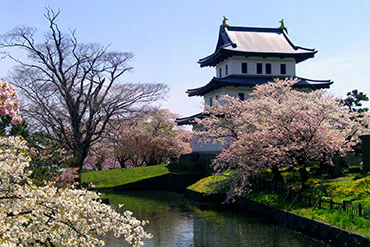
The formal historic-site name is Fukuyama Castle Ruins, though travelers normally know it as Matsumae Castle. The original wooden three-story keep, Honmaru Gate and east wall survived into the modern era and were designated National Treasures in 1941. A 1949 fire destroyed the wooden keep and east wall. The white tower standing today is the reinforced-concrete reconstruction completed in 1960 and opened as Matsumae Castle Museum the following year.
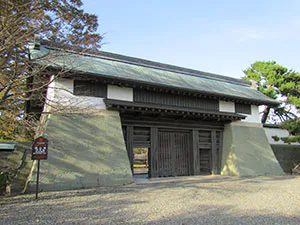
That changes where you should spend your attention. If surviving historic fabric matters most to you, do not photograph the reconstructed keep for ten minutes and rush past the gate. Honmaru Gate is the castle’s only surviving building remnant and was designated an Important Cultural Property in 1950. Matsumae is interesting because a late-Edo coastal-defense castle, a surviving gate, a castle town and a postwar reconstructed keep all occupy the same story — not because Hokkaido somehow has an untouched original tenshu here.
What does ¥360 actually buy? Context and an elevated view, not entry to an original keep
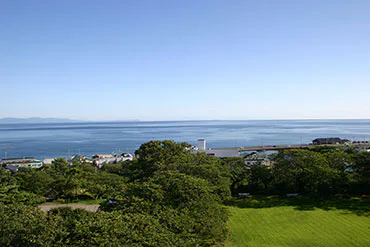
Paying to enter the museum is still easy to justify when you have enough time — just for the correct reason. The displays connect the Matsumae domain, the castle town, coastal defense and the fighting around the end of the shogunate. From the upper level you can also look toward the Tsugaru Strait, which makes the geography of the site much easier to understand. In 2026 the town also promotes a paid-area photo point at Kanto-dai.
If all you want is an exterior photograph, Honmaru Gate and a walk through Matsumae Park, however, do not cram the museum into the final twenty minutes before your bus because “it is only ¥360.” The free exterior still contains meaningful castle evidence. The paid area deepens the historical reading; it is not a compulsory purchase for Japan 100 Castles completion.
Mobility warning: the museum has four levels, and the route inside is stairs only
This limitation matters more than the cheap ticket. Matsumae Town states that the museum runs from one basement level through the third floor — four levels in total — and movement inside is by stairs only. If someone in your group has knee problems or does not handle repeated stairs comfortably, “the ticket is cheap, so we may as well go in” is not a good default.
A better version of the visit can be Matsumae Park, the castle exterior and Honmaru Gate first, then decide whether the museum is realistic. Matsumae Town Local History Museum is another free indoor fallback for local history, castle-town material and the Hakodate War; it is about a 15-minute walk from the Matsushiro bus stop. The point is not to downgrade the castle, but to avoid turning a low admission price into an accessibility problem.
Collectors: the official stamp is handled at the museum; a goshuin is a different souvenir
For the normal operating season, Matsumae Castle Museum is the practical point around which Japan 100 Famous Castles No.3 collectors should plan. Since 2024, visitors who stamp an official Japan 100 Castles stamp book at Matsumae Castle have also been able to receive a special “How to Walk Matsumae Castle” leaflet, one per official stamp book while supplies last. It maps a more purposeful route through the castle and related historical points.
Do not confuse that official stamp with a goshuin-style castle certificate. Matsumae sells separate souvenir goshuin editions, including seasonal designs; in 2026 a summer edition is being sold from July 11 through August 31. Buying one does not replace the No.3 stamp. Winter requires extra caution: the castle museum closes from December 11, and older official notices have used alternative stamp locations in past winters. Treat those as historical arrangements, not a guaranteed 2026–27 rule — check the current official notice before making a winter collecting trip.
No car? Choose your return transport before you decide how long to stay
The museum’s access guidance is simple on paper: take Hakodate Bus to the Matsushiro stop, then walk about ten minutes. The constraint is the timetable, not the last ten minutes on foot. Matsumae is not a place where a no-car traveler should finish sightseeing and only then ask when the next bus runs. Sparse intervals can turn an extra café stop or museum visit into a much longer wait.
Reverse the planning order. First choose the latest return connection you are willing to use from Matsushiro toward Kikonai or Hakodate. Then work backward through museum last admission, lunch, Honmaru Gate and the park. The same logic is central to the Hokkaido Without a Car 7-Day Winter Itinerary: in rural Hokkaido, the map distance is often less important than the timetable that locks your day into a few usable windows.
↔ Scroll table left or right
Transport style | Best way to plan Matsumae | Most common mistake |
Kikonai + route bus | Lock the return bus first, then allow roughly 2–3 hours around the castle town | Checking the return only after you finish sightseeing |
Hakodate without a car | Treat Matsumae as a full-day southern Hokkaido outing | Seeing ¥360 and mentally treating it as a quick Hakodate add-on |
Driving | Combine the castle with the temple district, clan residence or western coast | Assuming a large paved car park sits right at the gate |
Cherry-blossom season | Arrive early and keep buffer for crowds, photos and walking | Treating festival dates as a guarantee of peak bloom |
Driving does not save admission money; it gives you back southern Hokkaido time
A car changes the verdict because it removes much of the timetable penalty. The museum’s designated parking for historic-site visitors and worshippers has about 40 spaces, is free, and is roughly a five-minute walk from the museum — but it is unpaved. That detail matters after rain and if you are dressed for photographs rather than rough ground.
Even official drive-time estimates vary depending on what the page uses as its start and end point: Matsumae Town’s general access page gives about one hour from Kikonai to Matsumae, while the cultural-property page gives roughly 80 minutes to the museum. That is a useful warning not to plan to the minute. If this is a winter road trip, read the
Hokkaido Winter Driving Guide before treating a coastal destination as automatically easy. Matsumae may be at Hokkaido’s southern edge, but winter road risk does not disappear at the castle gate.
Spring changes the verdict: the cherry blossoms can make Matsumae a destination by themselves
If your trip falls in cherry-blossom season, the recommendation becomes much more positive. Matsumae Town describes roughly 250 varieties and more than 10,000 cherry trees, with early-, mid- and late-blooming cultivars stretching the viewing season well beyond one single Somei Yoshino peak. At that point, the transport time is buying you Matsumae Park, the castle landscape, temple district and a long succession of blooms — not just access to a reconstructed keep.
This is also why a broad Hokkaido Summer and Non-Snow 5-Day Planning Guide can only solve the regional question. For a spring Matsumae trip, you still need the town’s current bloom updates close to departure. A special 2026 cherry-blossom-festival goshuin ran from April 18 to May 10, but event dates are not a forecast for a future year’s peak flowers.
The blossom-season trap: festival dates do not guarantee that your date is peak bloom
Matsumae’s strength is variety: early and late cultivars extend the overall season. The same strength creates a planning trap. “There are blossoms somewhere in Matsumae” is not the same as “the trees I want to photograph are at peak bloom today.” A festival window is an event calendar, not a phenology guarantee. If flowers are the reason you are spending hours getting here, check the town’s bloom updates and live visual information instead of copying the festival period into your itinerary and treating it as certain.
Use the same weather-and-season logic as the Hakodate and Onuma Autumn Leaves guide: decide which natural condition is the day’s primary objective, then use museums and historic streets as resilient secondary plans. That is much safer than stacking several seasonal “must-sees” into one day and hoping every one peaks on command.
Is the ¥620 combo ticket worth it? Only if you actually want Matsumae Clan Residence
The combined ticket for Matsumae Castle Museum and Matsumae Clan Residence is ¥620 for adults and ¥420 for elementary and junior-high students. Compared with the ¥360 castle-only ticket, that is only ¥260 more for an adult, which makes the upgrade look almost automatic.
It is not automatic. If you want to read Matsumae as a full castle town, are interested in reconstructed domain-era life and have at least two to three hours in the area, the combo is sensible. If you are a stamp collector racing a return bus, the important saving is not ¥260 — it is the time required by a second attraction. A cheap combo ticket can still be expensive when the timetable is the scarce resource.
Going in late August 2026: the museum is open, but castle-front photography can be affected by the survey
Matsumae Town announced a geological investigation around the castle from August 17 through 31, 2026, as part of preparation for stone-wall repair work. The work covers five investigation points. The official notice specifically says visitors can enter the keep normally, but excavation machinery and engine noise may be present, and investigation in front of the reconstructed keep may inconvenience sightseeing and photography.
That means you should not cancel a No.3 collecting trip simply because you see construction equipment. The museum is operating. But if your main purpose is a clean exterior photograph of the keep, do not promise yourself an unobstructed scene during this period. The distinction matters: “open” and “photographically unaffected” are two different claims.
The biggest winter trap: the castle museum closes from December 11 to April 9
Matsumae Castle Museum closes for winter every year from December 11 through April 9. Matsumae Park and exterior views are a different question, but the normal paid museum experience is not available. If your goal is specifically the No.3 stamp, you must also check the latest official winter location rather than reusing a past-year blog post.
Older official material has at times moved the stamp to Matsumae Town General Center during the museum closure. That history is useful only as proof that the arrangement can change. It is not evidence that the same location is guaranteed for the coming winter. This is exactly the kind of detail that should be rechecked shortly before a collecting trip.
If you only have one or two days in Hakodate, Matsumae is usually the thing I would cut
A first Hakodate visit normally has Goryokaku, Motomachi, the bay area, the morning market and the Mount Hakodate night view competing for the same short stay. Giving roughly three hours each way to Matsumae by public transport can leave you technically “based in Hakodate” while barely experiencing Hakodate. Outside cherry season, I would usually save No.3 for a dedicated southern Hokkaido trip unless castle collecting is one of the main purposes of the journey.
If you do commit to a long day from Hakodate, station-area logistics suddenly matter more than hotel extras. The Hakodate Kokusai Hotel station and early-departure guide is useful for that exact trade-off: storing luggage and getting moving early can create more value for a Matsumae day than another small in-room feature.
Which day should Matsumae fit into? Treat it as a western Donan day, not a Hakodate city add-on
The logical route is geographic, not numerical. Goryokaku is No.2 and Matsumae Castle is No.3, but the numbers do not make them adjacent sightseeing stops. Matsumae sits on the western side of Hokkaido’s southern tip. With a car, it makes more sense to combine it with Kikonai, Shiriuchi, Cape Shirakami, the coast or the Matsumae castle town than to bolt it onto a compact Hakodate city day.
The same warning applies to the series as a whole. No.1 is on the Nemuro Peninsula, No.2 is in Hakodate and No.3 is Matsumae. They occupy very different corners of Hokkaido. Japan’s 100 Famous Castles numbering is a list order, not a road-trip sequence. Trying to “complete them in order” is a reliable way to waste enormous amounts of transport time.
Failure backups: transport, stairs and season can ruin the day long before the ticket does
Return bus no longer fits: cut the clan residence, lunch stop or extra browsing first. If the remaining connections become too fragile, skip Matsumae for that day instead of forcing a high-risk chain of transfers.
Someone cannot manage the stairs: make Honmaru Gate, the exterior and Matsumae Park the core visit; use Matsumae Town Local History Museum as the free indoor history fallback.
You arrive in winter and the museum is closed: exterior viewing can still be worthwhile, but recheck the official stamp location rather than filling the gap with an old itinerary.
You want a clean castle photo during August 17–31, 2026: the museum remains open, but survey machinery may enter the frame; change the date if photography is the entire purpose.
Cherry blossoms are below expectations: keep the castle, Honmaru Gate, temple district and town history as the day’s substance instead of letting imperfect bloom timing erase the whole trip.
Final verdict: Matsumae Castle is cheap, but it is a transport-cost attraction
Matsumae Castle No.3 flips the normal “is the ticket worth it?” question. ¥360 is easy to justify. The real commitment is whether you are willing to spend around three hours each way from Hakodate by public transport, or build the western side of southern Hokkaido around a drive. Once you see the decision that way, the right audience becomes much clearer.
Japan 100 Famous Castles collectors: yes, go — but lock the operating period and your return first, and remember that surviving Honmaru Gate is the historic building to slow down for. Spring blossom travelers: strongly consider it, because roughly 250 varieties and more than 10,000 trees make the park a destination beyond the castle itself. Southern Hokkaido drivers: yes, because the transport penalty falls sharply. First-time Hakodate visitors without a car and only one or two days: usually no in the ordinary season. Older or mobility-limited travelers: decide with the “stairs only” museum route in mind, not the ticket price.
Before committing, check four things: the museum operating calendar, the latest return transport, the current Japan 100 Castles stamp notice if you are traveling in winter, and current blossom or construction conditions if those are central to your visit. Once those are settled, Matsumae stops being a cheap dot on a castle checklist and becomes a travel decision that actually fits — or does not fit — your Hokkaido itinerary.
Official sources and verification date
Information last checked: August 20, 2026. The official numbering follows the Japan Castle Foundation / Japan Castle Association Japan 100 Famous Castles list; Matsumae Castle is No.3.
Admission, operating season, combo ticket and winter closure: Matsumae Castle Museum fees and opening information. Reconstruction, Honmaru Gate and the stairs-only museum route: Matsumae Castle Museum highlights.
Bus stop and parking: Matsumae Castle Museum access. Hakodate/Kikonai travel-time estimates: Matsumae Town transport guide.
Japan 100 Castles stamp leaflet: Matsumae Town official collectors notice. August 2026 survey: Matsumae Town geological-investigation notice. Cherry-tree scale and flowering structure: Matsumae Town cherry blossom guide.