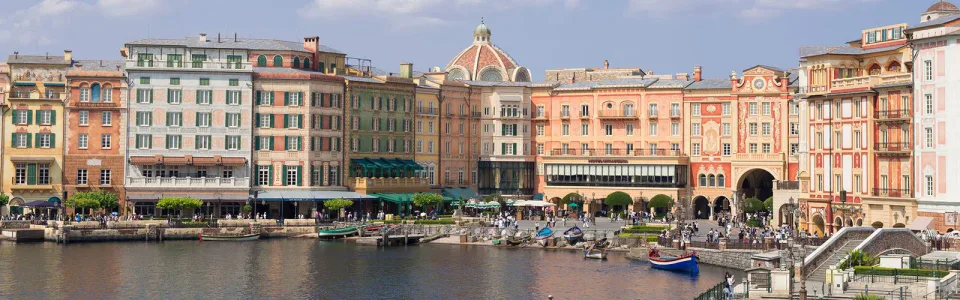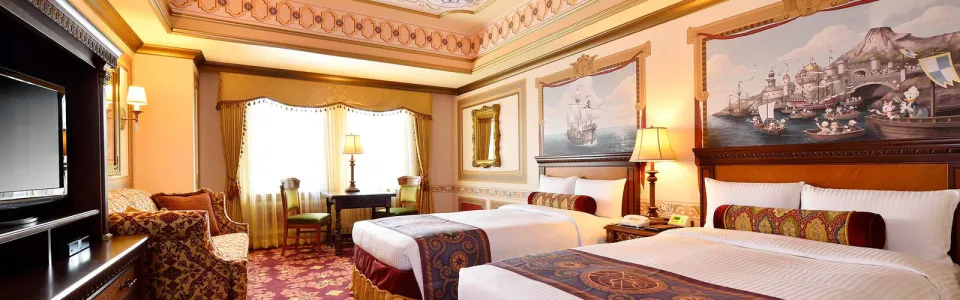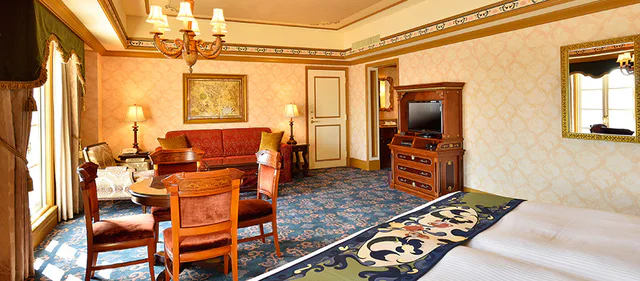
For four guests, choose MiraCosta’s 60 m² Harbor Room when the problem is indoor congestion: large luggage, children resting while others stay awake, four people getting ready together, or repeated midday returns. Choose the 40 m² Balcony Room (Harbor View) when the thing you are actually buying is the ability to step outside over Porto Paradiso. Both are Speciale Rooms & Suites, both can give a full Harbor View, and both include lounge access and breakfast. The useful comparison is therefore not “better view versus worse view.” It is 50% more published interior area versus real outdoor access.
There is one less-obvious difference that can reverse the answer for families: Harbor Room guests may currently choose breakfast in the room or at BellaVista Lounge, while Balcony Room (Harbor View) breakfast is served at BellaVista Lounge. For four people protecting an early DisneySea morning, avoiding another family-wide movement can be more useful than it sounds.
Checked August 25, 2026. Tokyo Disney Resort currently lists Harbor Room (Harbor View) at 60 m² for four guests, with two large windows, lounge use and breakfast; Balcony Room (Harbor View) is 37 m² for three guests or 40 m² for four and adds a real balcony. Harbor Room breakfast may be taken in-room or at BellaVista Lounge; Balcony Room breakfast is at BellaVista Lounge. The current refurbishment notice lists Balcony Room (Harbor View) as unavailable May 12–June 15, 2027. Room inventory and construction schedules can change.
MiraCosta Harbor Room vs Balcony Room: the 30-second decision
↔ Scroll table left or right
Your real constraint | Start with | Why | Main catch |
4 guests + several large suitcases | Harbor Room | 60 m² gives 20 m² more published interior area than the 4-person Balcony Room | No balcony |
Outdoor Porto Paradiso time is the memory | Balcony Room (Harbor View) | You can physically step outside over the harbor | 40 m² for four; weather can reduce use |
Young child naps while adults stay awake | Usually Harbor Room | More separation and circulation indoors | Still verify the exact sleeping setup |
Slow breakfast in the room matters | Harbor Room | Current breakfast choice includes room service | If rope drop matters more, you may not use a slow breakfast anyway |
Anniversary / photography / deliberate hotel time | Usually Balcony Room | The outdoor experience is difficult to substitute with interior space | Only worth it if you actually schedule balcony time |
4 adults insist on four equivalent normal beds | Neither automatically | Capacity four does not mean four equal regular beds | Bed layout can veto both rooms |
The 60 m² Harbor Room is a 50% interior-area upgrade, not a small step
The four-person Balcony Room (Harbor View) is 40 m². Harbor Room is 60 m². Using the hotel’s published room areas, that is an extra 20 m²—or 50% more interior area. For four guests, the simple gross-room-area comparison moves from 10 m² per guest to 15 m² per guest. This is ValueNavi’s derived comparison from the official specifications, not a measure of usable floor space after bathrooms and furniture.
The practical question is whether your group creates indoor congestion. Four long-haul travelers can arrive with three or four large suitcases, shopping bags, chargers, park bags and wet-weather gear. A child may need to nap while another person showers. Two adults may need to repack purchases while the other two get ready for dinner. In those scenarios, 20 extra square metres are not decorative luxury; they remove repeated friction.
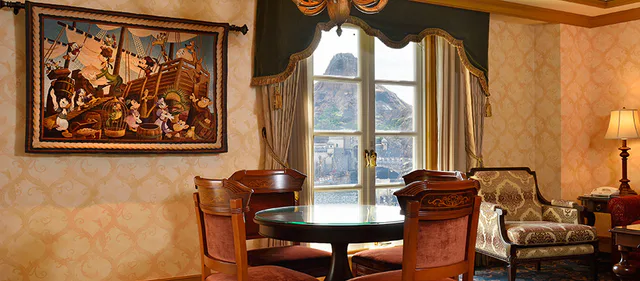
The red-team case is a park-maximising one-night stay. If everyone enters the room late, showers, sleeps and leaves early, the group may barely use the extra 20 m² while awake. In that itinerary, a large room can be objectively better yet still not be worth the rate gap.
Balcony Room buys a capability that 60 m² cannot imitate
Harbor Room (Harbor View) already provides a panoramic view of the entire Porto Paradiso harbor through two large windows. Balcony Room does not need to “win” on the view itself. Its unique product is the ability to step outside and make the harbor part of private hotel time.
That can matter for an anniversary drink, photography, a quiet morning, a child’s post-nap reset or twenty minutes outside after the park closes. But the balcony premium fails when “we want a balcony” really means “we will take one photograph from it.” A feature used once for ten minutes should not be valued the same way as one used three or four times across the stay.
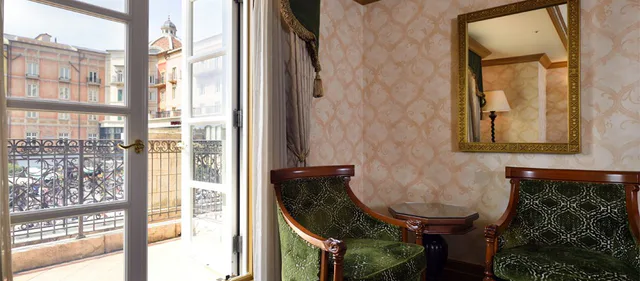
Use a simple balcony-session test before paying more. Write down the moments you realistically expect to step outside: arrival afternoon, sunset, post-park evening, next morning, midday return. If only one survives the itinerary, the emotional purchase may still be valid—but it should be recognised as an emotional purchase rather than disguised as practical value.
Breakfast is a real operational difference, not just an included perk
Both rooms are currently in the Speciale Rooms & Suites category, so both include lounge use and breakfast. The delivery mechanism is different. Harbor Room guests may choose breakfast in the room or at BellaVista Lounge. Balcony Room (Harbor View) breakfast is currently served at BellaVista Lounge.
For a couple, that difference may be minor. For four people, room-service breakfast can remove an entire family transition: getting everyone dressed, collecting bags, walking to breakfast, waiting, eating and then reorganising before the park. A family that values a calm room-service morning can therefore extract utility from Harbor Room beyond square metres.
But do not let an expensive room create a sunk-cost morning. If the first hour in DisneySea is the priority, a leisurely breakfast may destroy more park value than it recovers. The room-service option is useful because it supports the itinerary—not because you must use it to justify the room.
Four-person capacity still does not mean four equal permanent beds
This is the strongest veto for four adults or older teens. The official room pages describe two regular beds as the base arrangement and a trundle bed for the third guest. MiraCosta’s current bed table separately lists regular beds at 120 × 210 cm, trundle beds at 100 × 190 cm and cruise beds; the Harbor Room has a specific cruise-bed size of 85 × 184 cm. In other words, “capacity four” should never be read as “four identical adult beds.”
Harbor Room solves space; Balcony Room solves outdoor access. Neither automatically solves bed equality. If four adult-sized travelers consider the fourth sleeping surface unacceptable, stop the comparison there and widen the hotel search. The Tokyo Disney hotels for families of four guide is the more relevant decision.
If Harbor Room wins on space, you still have a second view decision
Harbor Room comes in both Piazza View and Harbor View. Both are 60 m², accommodate four and include Speciale benefits. Piazza View looks over the piazza and townscape; Harbor View provides the full Porto Paradiso panorama.
This creates a useful budget escape route. If the 60 m² interior is the thing your family genuinely needs but the full harbor panorama is not worth another premium, Harbor Room Piazza View vs Harbor View is the correct next comparison. Do not abandon the space solution merely because the highest-view version is expensive.
If Balcony wins, do not accidentally buy the wrong outdoor product
Balcony Room is also not the end of the decision tree. Three or four guests who want outdoor access fit the Balcony logic. Two guests who want outdoor space to become a major part of the stay should compare Terrace Room vs Balcony Room, because a Terrace Room changes the scale and use of the outdoor area.
If the only desired upgrade is lounge access and breakfast, outdoor access may be unnecessary altogether. In that case, a Speciale Superior Harbor View can solve the service-tier requirement without forcing the Balcony premium. This is why MiraCosta rooms should be selected by feature, not by climbing a price ladder.
One night versus two nights: count repeated friction, not nights
One night can still justify Harbor Room if the family arrives early, spends several afternoon hours inside, returns after dinner and uses room-service breakfast. Two nights can still fail to justify it if both days are spent open-to-close in the parks and the room is only used for sleep.
The same applies to Balcony Room. A one-night anniversary stay with a deliberate sunset and slow morning can use the balcony more meaningfully than a two-night attraction-maximising stay where nobody returns before midnight. Count awake hotel-use windows: arrival, midday reset, pre-dinner, late evening, breakfast and departure morning. Then ask whether each window benefits more from indoor space or outdoor access.
Weather changes the risk profile of the two premiums
Harbor Room’s 60 m² remains usable in rain, wind, heat or cold. A Balcony Room’s headline advantage is more weather-sensitive. Heavy rain, strong wind and midsummer heat can sharply reduce the time anyone wants to spend outside.
This does not make Harbor Room universally safer. Some travelers deliberately want the outdoor experience enough to accept weather risk. It does mean the two premiums have different resilience: interior space is a relatively stable benefit; balcony time is a higher-variance experience. If the rate gap is large and cancellation terms differ, flexibility deserves more weight when most of the value depends on weather.
2027 refurbishment is a hard date filter for Balcony Room
MiraCosta’s intermittent guest-room refurbishment currently runs from August 19, 2026 through July 20, 2027. The published room-type schedule specifically lists Balcony Room (Harbor View) as unavailable May 12 through June 15, 2027. Harbor Room is not among the room types currently named in the unavailable-period list, although the hotel warns that construction during the broader refurbishment period can create noise, vibration or paint odors and that dates may change.
If Balcony Room disappears for your dates, do not automatically substitute the next-most-expensive room. Return to the original question: did you need outdoor access, indoor space, full Harbor View, or merely Speciale service? The correct fallback depends on the missing feature, not the prestige of the replacement.
A four-person premium test that is harder to fool
Before booking, score the stay on four questions:
Congestion: will four people and their luggage repeatedly compete for indoor space?
Outdoor intent: can you name at least two realistic balcony-use sessions?
Morning plan: would in-room breakfast materially improve the family’s DisneySea morning?
Bed veto: is every traveler comfortable with the actual non-regular sleeping surfaces required by a four-person setup?
If congestion is high and outdoor intent is low, Harbor Room is the cleaner purchase. If congestion is modest and outdoor intent is the point of the stay, Balcony Room is stronger. If the bed veto fails, neither room should win simply because the view is spectacular.
Final verdict
For four guests, I would choose Harbor Room when the group will repeatedly use the 60 m² interior, carries substantial luggage, needs a better midday-reset space or values the option of in-room breakfast. I would choose Balcony Room (Harbor View) when physically stepping outside over Porto Paradiso is one of the memories the stay is designed to create. The Harbor Room’s extra 20 m² is a 50% published interior-area increase over the four-person Balcony Room, but no amount of indoor space substitutes for a balcony if outdoor time is the actual goal. Bed layout can override both choices for four adults.
voco Osaka Central: Is the Premium Room Worth Leaving Osaka Station?
lyf Tenjin Fukuoka Review: Is a 12m² Room Worth the Shared Kitchen and 24-Hour Lounge?
Hotel Sonia Otaru: Is a Canal-View Room and Rooftop Onsen Worth the 8-Minute Station Walk?
Mitsui Garden Hotel Fukuoka Gion: Is the 26.6 m² Triple Room Worth It for 3 Adults?
Okinawa Ocean-View Rooms: The Upgrade Is Only Worth It If You’ll Be Awake to Use the View