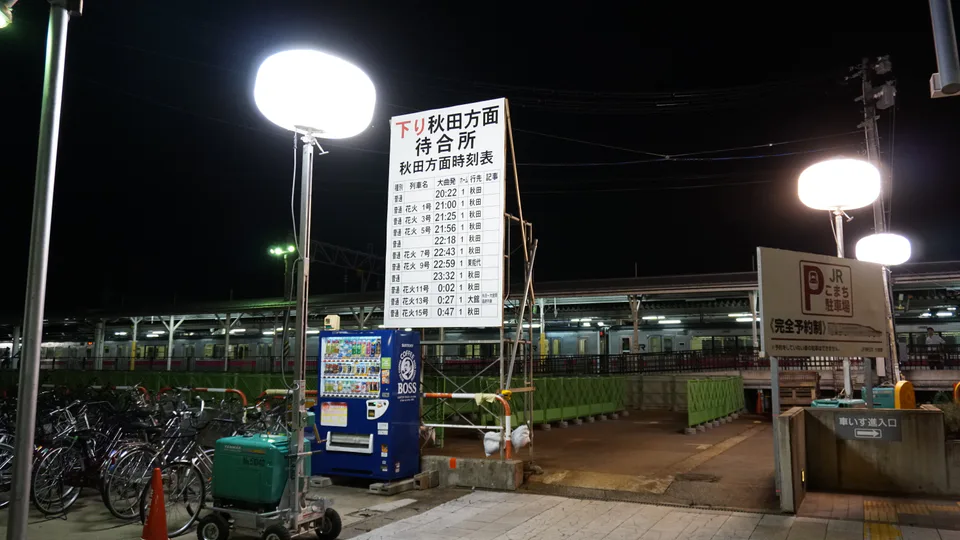
For Omagari Fireworks on August 29, 2026, use JR Omagari Station if you are travelling without a car, and choose the train home before you choose where to stand. The evening programme is scheduled for 19:00–21:30, while the official station-to-venue walk is about 2 km / 30 minutes in normal conditions. After the finale, that 30-minute figure is no longer a safe connection estimate because tens of thousands of people are leaving together. A 21:56 departure means leaving before the finale; even a 22:41 or 22:46 train gives only limited crowd-exit margin.
If you are already driving around Akita, Park & Ride is usually a better default than parking near the river. Central reserved parking can place the car closer to the venue but still trap it inside traffic restrictions long after the fireworks finish. The correct Omagari plan is therefore built backward from how late you are willing to reach Akita, Morioka or your hotel, not from the shortest arrival route.
↔ Scroll table left or right
Your situation | Best starting choice | Main catch |
No car, first visit | JR Omagari Station | The 30-minute walk can become much slower after the 21:30 finale |
Need to see the entire finale and return to Akita | Start with the 22:41 special train or a later workable service | 71 minutes from scheduled finale to departure is margin, not a guarantee |
Need to return toward Morioka | Compare 22:46 and 23:28 Komachi options | Later train buys exit margin but can put you in Morioka after midnight |
Already road-tripping in Akita | Official Park & Ride | You still join station/crowd flow for the final approach |
Reserved parking close to the venue | Use only if the late release fits | Some controlled-zone parking cannot exit until around midnight |
Large suitcase | Temporary station luggage counter | Current 23:00 closing must be built into the return-train plan |
The fireworks finish at 21:30; your exit does not
The 2026 Omagari Fireworks are scheduled for Saturday, August 29, with daytime fireworks from 17:10 to 18:00 and evening fireworks from 19:00 to 21:30. That 21:30 finish is the point at which the hardest transport period begins.
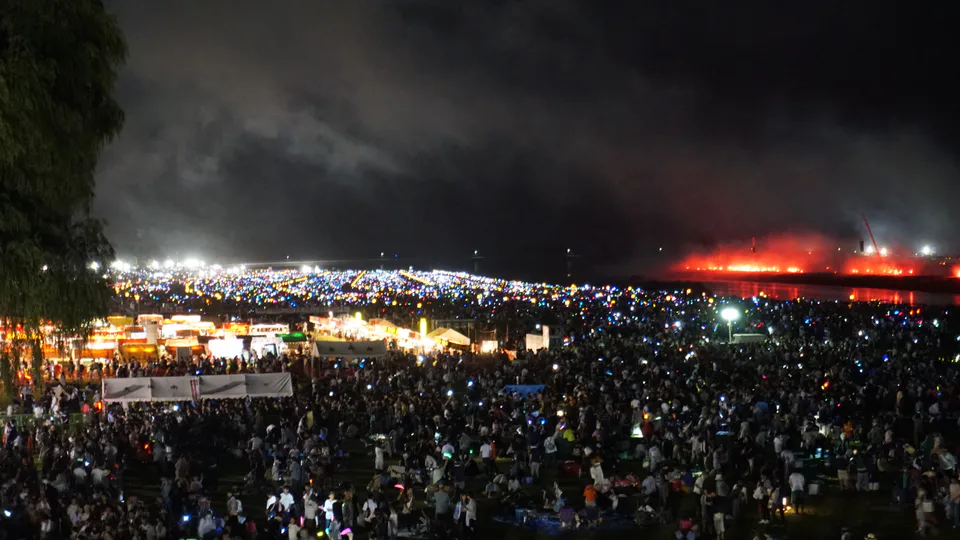
Daisen City’s normal planning figure is about 30 minutes on foot between JR Omagari Station and the venue. That is useful for arrival. It is not a promise that you can leave your seat at 21:30, cover the route in exactly 30 minutes and board a 22:00-class train. The first part of the journey is the crowd itself: leaving the riverbank, merging onto pedestrian routes, reaching the station control area and then entering the platform flow.
Use this formula instead:
real connection time =
venue exit delay
+ crowd-controlled walking time
+ station entry / queue time
+ platform margin
The normal 30-minute walk is only one component.
If you want the full finale, the 21:56 Akita train is not your train
JR East’s current August 29 special timetable includes a Hanabi service departing Omagari at 21:56 for Akita. On paper, that looks convenient. In practice, the scheduled fireworks end at 21:30 and the normal venue-to-station walk alone is about 30 minutes.
If seeing the full finale matters, rule out 21:56 before the day begins. Catching it requires leaving the venue before the final programme has finished, and the departure walk will still be crowded.
This is a good example of why a train list is not a transport plan. An earlier departure can be completely valid for families, travellers avoiding the biggest crush or people who value getting back to Akita earlier. But it should be chosen as an intentional “leave before the finale” strategy, not as a connection you hope to sprint for afterward.
22:41 to Akita is the first useful full-finale benchmark—but still not guaranteed
JR East currently lists a special Hanabi 9 service departing Omagari at 22:41 and reaching Akita at 23:43 on August 29. That gives 71 minutes between the scheduled 21:30 finale and train departure.
Seventy-one minutes is much more realistic than 26 minutes, but it is not a promise. A crowded exit can consume a large share of that time. Your actual seat location, how quickly the group can walk, station controls and weather all matter.
I would treat 22:41 as the first serious Akita return option for someone who intends to stay through the finale, then check whether a later service provides a safer fallback. Do not design the evening so that missing 22:41 creates an impossible hotel problem.
For Morioka, 22:46 vs 23:28 is an exit-margin decision
The current August 29 timetable includes Komachi services from Omagari toward Morioka after the finale. Two particularly useful benchmarks are:
Komachi 368: Omagari 22:46 → Morioka 23:59.
Komachi 370: Omagari 23:28 → Morioka 00:43 on August 30.
The earlier train keeps your hotel arrival on the same calendar day but gives only 76 minutes from the scheduled finale. The later train gives another 42 minutes of exit margin, but a 00:43 arrival changes the hotel and check-in problem.
This is the trade-off to decide before buying:
22:46: choose when the group walks well, you are comfortable with a tighter post-finale exit and the earlier hotel arrival matters.
23:28: choose when protecting the finale and reducing station-rush stress matters more than arriving in Morioka after midnight.
Komachi services are reserved-seat trains, so verify seat availability and the current booking conditions rather than assuming a place exists because the timetable exists.
Your hotel must be open when the train arrives
A 00:43 Morioka arrival is not automatically unusable. It becomes unusable if the hotel’s check-in desk, entrance procedure or late-arrival policy does not support it.
Before booking a late special train, confirm:
the hotel accepts the actual arrival time;
you have told the property about a post-midnight check-in if required;
the station-to-hotel transfer is walkable at that hour or a taxi is realistically available;
tomorrow morning does not begin so early that the festival night destroys the next day.
This is why Omagari should be placed inside the broader route before tickets are bought. A fireworks programme can be spectacular and still be the wrong night between two early-morning transport days.
Arrival by JR: come early enough that the 30-minute walk is not your whole buffer
Daisen City recommends JR access and lists Omagari Station as the main public-transport gateway. Special fireworks-day trains increase capacity, but they do not eliminate platform crowding or pedestrian congestion.
Do not target an arrival that reaches Omagari 35 minutes before the first fireworks you care about. You still need to leave the station, walk about 2 km, find the correct entrance/seat area, use toilets and buy food or water if needed.
If the daytime competition matters, arrive well before 17:10. If you only care about the evening programme, arriving in mid-afternoon creates a much more resilient day than trying to enter during the final pre-19:00 surge.
Driving close to the venue can give you the shortest walk and the latest escape
Daisen City explicitly discourages driving into the venue area because of congestion and traffic restrictions. Reserved parking close to the river can be useful for someone with mobility needs or a group that values a known parking space, but proximity does not equal quick departure.
Some official parking areas inside the controlled zone cannot release vehicles until around midnight. That means a car parked “closer” can leave later than a traveller who walks to the station, rides one stop or uses a Park & Ride lot outside the worst restrictions.
Before paying for central parking, compare two times:
walk-to-car time;
actual legal drive-away time.
The second one matters more.
Park & Ride is the better road-trip compromise
For travellers already using a rental car around Kakunodate, Lake Tazawa, Nyuto Onsen or Akita, Park & Ride keeps the car useful without forcing it into the most congested core.
The principle is simple: park at an official outer location, use rail for the final Omagari approach, then recover the car after escaping the central traffic controls. You still experience the station crowd and the venue walk, but the final drive begins outside the most difficult road zone.
Park & Ride is not automatically faster for every hotel. It is strongest when the next accommodation or the following day already needs the car. If you are sleeping beside Akita Station and do not need a vehicle until later, leaving the rental car out of fireworks day entirely may be simpler.
Local buses are not a normal fallback on August 29
Daisen City’s current 2026 notice says city circulation buses are suspended all day on August 29, with additional community-bus cancellations and route changes.
This is a hard planning boundary. Do not look at a normal Saturday bus timetable and assume it can rescue a missed walk, parking problem or hotel transfer on fireworks day.
If your accommodation normally depends on a local bus, confirm the event-day service before booking it. A cheaper room outside walking range can become an expensive taxi problem—or an impossible late-night return—when the bus disappears.
The temporary luggage counter solves one problem but creates a 23:00 deadline
Daisen City currently lists temporary luggage storage near Omagari Station from 10:00 to 23:00 on fireworks day, at JPY 1,000 per item.
This is useful for a traveller who arrives by Shinkansen and does not want to carry a large suitcase to the riverbank. But the closing time must be integrated with the post-show train choice.
If you watch the finale, move slowly through the crowd and aim for a very late train, “I will collect the suitcase on the way” becomes another queue and another deadline. Build bag collection into the route rather than treating 23:00 as a theoretical closing time.
If the itinerary allows it, forwarding the main suitcase to the next hotel before fireworks day can remove this decision entirely. Use the Japan luggage-forwarding guide to check whether the delivery timing works.
Three workable exit strategies
Strategy A: stay for the full finale and return to Akita
Use the 22:41 special service as the first benchmark, keep a later fallback if available, and begin moving promptly after the finale rather than lingering for photographs. This is the cleanest public-transport version when Akita city is the hotel base.
Strategy B: stay for the full finale and sleep in Morioka
Compare 22:46 against 23:28. The later train has more crowd margin; the earlier one preserves a same-day arrival. Confirm reserved-seat availability and late hotel check-in before choosing.
Strategy C: leave before the finale to protect tomorrow
This can be the best answer for families, older travellers or anyone with a hard early departure the next morning. Use an earlier special train such as the 21:56 Akita service only if you deliberately accept missing the end of the fireworks. Leaving early is not “doing Omagari wrong” when it prevents the event from breaking the rest of the trip.
What should you do if the station crowd is worse than expected?
Do not respond by running through the pedestrian flow or abandoning the official route. Keep moving with crowd controls, protect the group from separation and use the later train you planned as a fallback.
This is another reason not to book the final possible train as if it were an ordinary connection. A robust plan has one failure state already priced in: if the first train becomes unrealistic, the second still gets you to a hotel that will admit you.
Omagari should control the night before and the morning after
The fireworks are a late event in a small city handling a huge temporary crowd. That makes the surrounding hotel choices part of the event.
Night before: sleep somewhere that allows a calm arrival on August 29. Do not create a same-day long-distance race from Tokyo if a delayed Shinkansen would destroy the seat-entry plan.
Night after: choose Akita, Morioka or another base according to the actual train you can board after the finale. A hotel that requires another long local transfer after midnight is weak even if the room rate is lower.
Morning after: avoid putting a non-refundable 06:00-class departure immediately after a 23:43 or 00:43 hotel arrival unless the group genuinely accepts that sleep cost.
If Omagari is one piece of a longer northern-Japan trip, use the Tohoku summer festival itinerary before locking the night.
Final verdict
JR is the best default for visitors without a car; Park & Ride is the best default for travellers already road-tripping through Akita. Central parking is a specialist choice when a reserved space and the late release are acceptable.
For the full 21:30 finale, reject the 21:56 Akita train unless you deliberately leave early. Treat 22:41 to Akita and 22:46 to Morioka as tighter full-finale options, and the 23:28 Morioka service as a larger-margin option that creates a post-midnight hotel arrival. None of those departure times guarantees you will clear the crowd in time, so keep a fallback and verify current reservations.
The most important Omagari transport decision is made before the fireworks start: know which train, hotel or parking release can still work after 21:30.
Ghibli Park Tickets 2026: Before You Buy Standard, Name the Buildings You Refuse to Miss
Fukuoka Concert Hotels: Pick Your Base by the Trip Home After PayPay Dome or Marine Messe
THE RAIL KITCHEN CHIKUGO 2026: ¥13,000 Isn’t a Train Fare — It’s a Moving Lunch
Katakai Festival 2026: September 11 or 12? Daytime Fireworks, Seats and the Nagaoka Exit
Tokyo Disney Split Stay: Move the Night Before or After Your First Park Day?
References
Daisen City — 2026 driving, parking and traffic restrictions
JR East — August 29, 2026 special Omagari fireworks services
Current train times and event operations checked August 25, 2026. Recheck JR East seat availability, event-day weather and Daisen City traffic notices immediately before travel.