
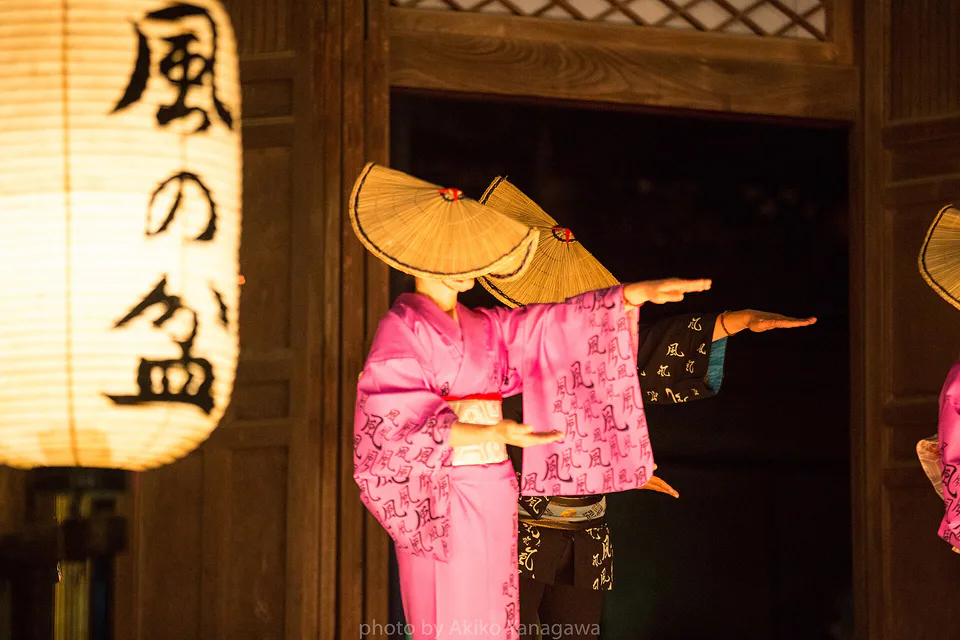
For Owara Kaze no Bon 2026, September 1 or 2 is the safer first-time choice; September 3 is for travellers who specifically want the final-night atmosphere and can accept a shorter official window. The 2026 festival runs September 1–3 in Yatsuo, Toyama: 17:00–23:00 on September 1 and 2, and 19:00–23:00 on September 3. The biggest planning mistake is treating it like a parade with a fixed route. Eleven neighbourhoods perform in their own streets, outdoor dancing can stop for rain or crowd safety, and the most atmospheric moment may require waiting rather than chasing performances across steep Yatsuo.
For a day visitor, I would stay in Toyama city, arrive at Etchu-Yatsuo before the evening peak, choose one or two old-town areas, and work backward from the return transport you are actually prepared to take. In 2026, rail access also has a specific control: travellers using the JR Takayama Line from Toyama to Etchu-Yatsuo during the festival need a JR-issued boarding-number ticket in addition to the normal fare ticket for designated festival services. Do not arrive at Toyama Station expecting the normal “tap in and go” pattern.
↔ Scroll table left or right
Your priority | Best starting choice | Why |
First visit, one night only | September 1 or 2 | 17:00 start gives two extra official hours versus September 3 |
Want a guaranteed seated performance | Book the indoor Kyōenkai | 2026 indoor performances run even when outdoor street dancing is vulnerable to rain |
Want the old-town street atmosphere | Free street viewing | More atmospheric, but no single public parade timetable |
Need an easy hotel and onward rail next morning | Sleep in Toyama city | More inventory and transport options; accept the return queue |
Want to stay late after day-trippers leave | Sleep in or very near Yatsuo | Higher scarcity and price, but removes the last-train decision |
Rain forecast is meaningful | Anchor with the indoor performance or keep the evening cancellable | 2026 outdoor activity is subject to interruption/cancellation in rain |
2026 is not a normal “show up at 19:00” festival night
Toyama City’s current 2026 information confirms the main festival on Tuesday September 1 through Thursday September 3. Official hours are:
September 1: 17:00–23:00
September 2: 17:00–23:00
September 3: 19:00–23:00
The city also states that rain can interrupt the event. Its current public notice warns that individual neighbourhoods may finish earlier than scheduled and that performances can be stopped when crowd conditions compromise safety.
That means the official finish time is not a promise that the exact street you want will still be performing at 22:50. Arrive early enough that one pause, one crowded lane or one rain interruption does not erase the entire visit.
Which night should you choose?
September 1: strongest when you want maximum official time
The first night gets the full 17:00–23:00 window. For a first visit, this is useful because you can learn the old-town geography in daylight, eat before the streets become difficult and then wait for evening performances without immediately racing the clock.
The trade-off is attention. Opening night is an obvious target for tours and first-time visitors. Do not use “Night 1” as a promise of lower crowds.
September 2: the cleanest all-round choice
September 2 has the same six-hour official window as the first night. For someone choosing only one evening, I prefer it slightly when accommodation and transport are equal because you get the long viewing window without needing the symbolic “first night.”
This is a ValueNavi preference, not an official ranking. The actual weather forecast should override it. If September 1 is dry and September 2 looks wet, choose the dry night.
September 3: choose the final night for atmosphere, not efficiency
The final night does not begin officially until 19:00, leaving a four-hour public programme. That is a much smaller recovery margin if you arrive late, get caught in a queue or rain interrupts outdoor dancing.
Choose September 3 because the final-night character matters to you, especially if you sleep locally and are not forced into an early exit. Do not choose it simply because “the last night must be best.” For a Toyama-based first-time visitor, September 1 or 2 is operationally easier.
Street Owara and the paid performance solve different problems
Street viewing is free and gives Owara its distinctive atmosphere: lantern-lit old streets, musicians and dancers moving through neighbourhoods, and long quiet intervals that are part of the experience rather than a production error.
The indoor Owara Kaze no Bon Kyōenkai solves the opposite problem. Toyama’s official tourism information currently lists two one-hour performances each festival day at Yatsuo Hikiyama Exhibition Hall: 18:00–19:00 and 19:20–20:20, with 350 unreserved seats per session and a 2026 price of JPY 4,000 per seat.
Choose the paid performance when: a guaranteed seated view matters, someone cannot stand outside for long, or rain risk makes a completely unstructured evening uncomfortable.
Choose street-only when: you want the old-town atmosphere more than a complete stage presentation and are comfortable waiting.
Combine both when: Owara is the main purpose of the trip. Use the indoor show as the fixed anchor, then spend the remaining time in one or two street areas instead of trying to cover all eleven neighbourhoods.
The best street-viewing strategy is to stop hunting
Suwa-machi is the most recognisable stone-paved streetscape, which also makes it the obvious place for visitors to concentrate. Kamishin-machi, Nishi-machi and other old-town neighbourhoods can give a different balance of street width, waiting space and local atmosphere.
The weak strategy is constantly walking uphill and downhill because another person said a performance had started two streets away. By the time you arrive, it may be over. The better strategy is:
arrive before dark;
learn the route back toward the station or bus;
choose one primary neighbourhood;
watch where local staff and spectators begin waiting;
move once only if the first area is clearly not working.
Owara rewards patience more than coverage. A quiet 20-minute wait followed by one memorable street performance is better than 90 minutes of searching for a “best” view.
From Toyama Station, the train now has an extra 2026 control step
Toyama City lists the JR Takayama Line journey from Toyama to Etchu-Yatsuo at roughly 25–30 minutes. The old town is then about a 30-minute walk from the station. The train journey therefore looks simple on a map, but 2026 festival operations add crowd controls.
A current railway notice published August 21, 2026 says passengers travelling from Toyama Station to Etchu-Yatsuo for Owara need a JR-issued boarding-number ticket in addition to the normal rail ticket for the controlled services. The numbered tickets are distributed at Toyama Station near the JR Midori no Madoguchi according to the published festival timetable.
This changes the correct arrival strategy. Do not time your hotel departure to the train’s platform departure alone. Allow time to obtain the required boarding ticket, buy the fare if needed, find the designated waiting point and absorb crowd-control instructions.
The bus is a real alternative, but its timetable should decide how late you stay
Toyama Chihō Railway has published 2026 extra direct buses between Toyama Station and Yatsuo for the festival. Current information gives roughly 50–60 minutes each way and JPY 750 adult one-way fare, with enhanced services approximately every 30 minutes during specified evening windows.
The important catch is the return window. The currently published additional return services are concentrated from 20:00 to 22:00. That does not automatically mean no other service exists after 22:00, but it does mean you should not assume “the festival ends at 23:00, so I can decide how to get back at 23:05.”
Choose the return mode before entering the old town. Save the exact final train/bus option you are willing to use and begin walking back based on that departure, not based on the event’s headline closing time.
Driving buys schedule control but adds a parking-and-restriction system
The 2026 organising committee lists general parking at designated temporary lots and asks for a JPY 3,000 cooperation fee per private car. One designated parking area has shuttle service; another may not. The old-town venue itself is under traffic restrictions and becomes a walking environment.
Current traffic-control hours are 16:00–24:00 on September 1 and 2, and 18:00–24:00 on September 3. Do not use an ordinary-day map route to predict where you can drop someone off or park during Owara.
Driving is strongest when your accommodation is outside Toyama city, the group can handle rural night driving and the designated parking plan is already understood. It is weaker when the driver expects to park near Suwa-machi or when everyone plans to drink.
Toyama city vs Yatsuo: the hotel decision is really about your exit time
Stay in Toyama city when this is one night inside a larger Hokuriku trip. Hotel supply is much broader, dinner and breakfast are easier, and the next morning’s rail network is simpler. The price you pay is the return walk plus station queue.
Stay in Yatsuo when late-night atmosphere is one of the main reasons for travelling. You remove the psychological pressure of the Toyama return, but rooms are scarce, event-period prices can be high and “Yatsuo” on a booking page does not guarantee that the room is beside the old-town streets.
Check the exact accommodation pin and late-night access before paying. A hotel several kilometres away with no late shuttle can be less convenient than returning to Toyama by train.
Rain should change what you buy, not only what you wear
For 2026, the city explicitly describes the outdoor festival as subject to rain interruption. This is not an event where a poncho guarantees the show continues around you. Costumes, instruments, surfaces and safety all matter.
If rain probability is high and Owara is non-negotiable, the indoor Kyōenkai becomes more valuable because it buys a fixed performance rather than merely a dry seat. Keep the rest of the evening flexible and check official day-of updates before leaving Toyama.
If you are attending multiple nights, do not lock the same expensive structure into all three. Use the better forecast for a street-focused night and the weaker forecast for a shorter or indoor-anchored visit.
Footwear and mobility matter more than festival clothing
Yatsuo is a town of slopes. The old streets, station-to-centre walk, standing time and late return can add up to far more physical load than the “30-minute walk” sounds like.
Wear shoes with grip and enough cushioning for several hours. If someone in the group cannot comfortably handle hills and standing, use the indoor performance as the core experience and reduce the number of neighbourhoods. Do not turn traditional-festival aesthetics into a requirement to wear footwear that makes the return unsafe.
A practical first-night plan
15:00–16:30: leave Toyama early enough to deal with the 2026 rail boarding-control system and arrive before the old town is fully dark.
Before 17:00: walk into the old town, eat early and identify one primary viewing area plus the route back.
17:00–20:30 on September 1/2: either use a booked indoor performance or wait for street Owara. Do not spend the entire first hour moving.
20:30 onward: reassess weather, energy and the return transport. Move to a second neighbourhood only if the time margin is still generous.
Exit: start walking back according to the train or bus you intend to catch. The festival’s 23:00 finish is not your departure time.
On September 3, shift this structure later because the official programme starts at 19:00, but keep the return deadline unchanged unless your transport plan specifically proves otherwise.
Final verdict
For a first Owara Kaze no Bon, choose September 1 or 2, stay in Toyama city unless late-night Owara is itself the goal, and treat transport as part of the festival rather than an afterthought. In 2026, rail crowd controls and the required boarding-number ticket make “just take the JR train” incomplete advice.
Do not try to see all eleven neighbourhoods. One indoor performance plus one street area is a strong structured version; one or two street areas with patient waiting is a strong free version. September 3 is the specialist choice for final-night atmosphere, not the efficient choice. And if rain threatens the outdoor programme, protect the experience with the indoor performance or a second night rather than pretending a fixed street schedule exists.
Tokyo Skydiving Guide: Skydive Nippon Booking, Transport and Cancellations
Kenrokuen Autumn Leaves 2026: Early Entry, Illumination, Transport and Hotels
Fukuoka Guys’ Trip Hotels: Four Adults, Real Beds, Late Nights and Whether a Sauna Is Worth It
How Many Nights in Lake Kawaguchi? Fuji Weather, Autumn Leaves and Hotels
Where to Stay in Fukui: Keep the Dinosaur Museum and Eiheiji Near the Rails, or Sleep in Awara Onsen
References
Toyama City — 2026 Owara Kaze no Bon dates, hours, access and rain interruption · Toyama City Tourism Association — 2026 viewing, indoor performance and access guide · Owara Kaze no Bon Organising Committee — 2026 parking and event notices · Ainokaze Toyama Railway — August 21, 2026 festival rail boarding-number ticket notice · Toyama Chihō Railway — 2026 special bus operations. Checked August 25, 2026; recheck the official day-of notices because weather, crowd controls and transport operations can change.