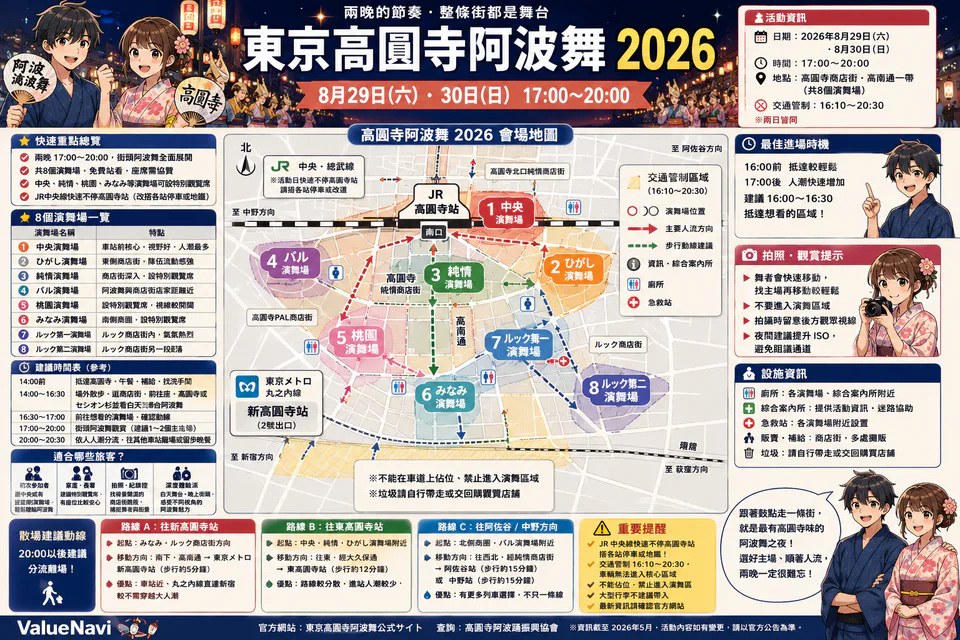
Tokyo Koenji Awa Odori 2026 runs August 29–30 from 17:00 to 20:00. Treat Koenji as the evening anchor, not as a festival you casually drop into after finishing another event. Traffic controls begin at 16:10, the dance route spreads through multiple streets, and the same weekend also hosts Super Yosakoi in Harajuku/Omotesando. If you try to combine both on one day, decide in advance which festival is allowed to be partial.
The best Koenji plan is still simple: choose one viewing area, decide your exit station before the dancing starts, and stop trying to collect every performance zone. The 2026 weekend adds one new constraint: on Sunday, Super Yosakoi continues until 17:30 while Koenji starts at 17:00, so the two headline programmes overlap before travel time is even counted.
Koenji Awa Odori 2026 in 30 seconds
↔ Scroll table left or right
Your priority | Best plan | Main risk |
Free street atmosphere | Pick one performance zone and arrive before 17:00 | Trying to move through all zones in a dense crowd |
Guaranteed seat / less standing | Use a supporter viewing seat | The seat creates a hard arrival deadline |
Also want Super Yosakoi | Split the festivals across Saturday and Sunday if both matter equally | Same-day schedules overlap |
Sunday Omotesando first | Accept a late/partial Koenji arrival, or leave Omotesando early | Super Yosakoi runs to 17:30; Koenji starts 17:00 |
Children / stroller / low stamina | Choose one festival, one viewing area | Official Koenji guidance discourages stroller use in the crowd |
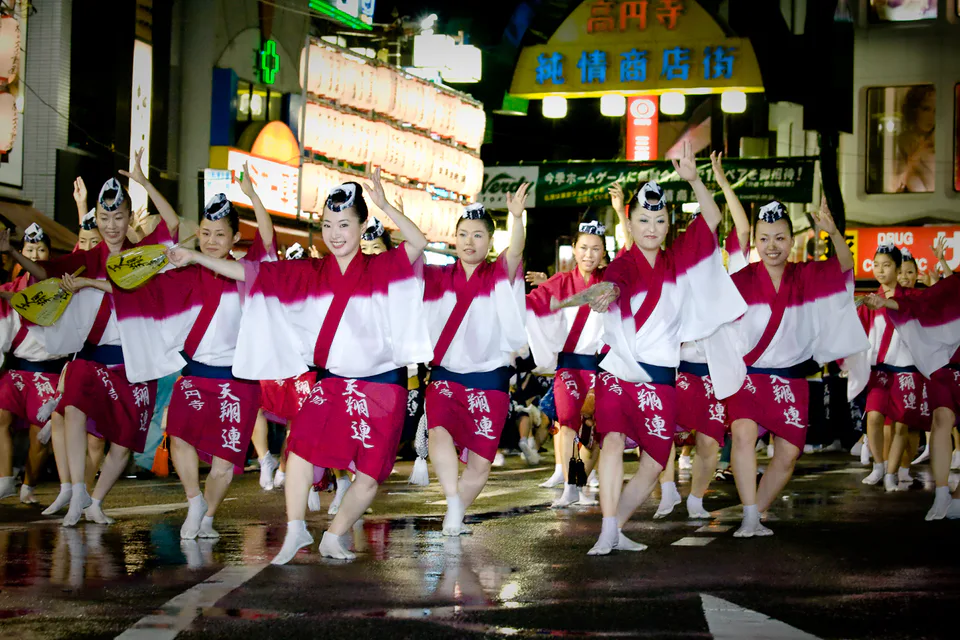
The route is the festival: choose one section and stay long enough to understand it
The official festival uses multiple performance areas around JR Koenji and Shin-Koenji. Dance groups move through routes rather than performing on one single central stage. That makes “I will see every zone” the wrong goal.
Station-side areas are easy to understand but collect the densest foot traffic. Deeper shopping-street sections can feel more neighbourhood-led, but they also give you less open walking space. The useful decision is not which zone is objectively best. It is whether you prioritise easiest arrival, easier exit, a fixed seat or the feel of a tighter shopping street.
Reserved seats buy certainty—and turn arrival time into a hard constraint
Street viewing is free. For 2026, special viewing seats are offered through supporter contributions, with published categories including JPY 15,000 for Chuo and JPY 10,000 for Junjo, Momozono or Minami, subject to availability.
The benefit is not a fundamentally different dance programme. It is a known place to sit and less standing/searching. That can be valuable for older travellers or anyone who dislikes competing for a viewing gap.
But a reserved seat changes a two-festival day. If you also want Super Yosakoi, the Koenji seat becomes the fixed appointment. You should work backward from the required arrival time rather than trying to watch “just one more” performance in Harajuku and hoping the transfer works.
Can you combine Koenji with Super Yosakoi on the same day?
You can sample both, but the schedules do not form a clean relay. Koenji runs 17:00–20:00 on both August 29 and 30. GO TOKYO currently lists Super Yosakoi until 19:30 on Saturday and 17:30 on Sunday.
That gives you three sensible strategies:
Both festivals are must-sees: use one day for Super Yosakoi and the other evening for Koenji. This is the most resilient choice.
Koenji is the priority: leave Harajuku early and give Koenji a hard arrival target before 17:00, especially if you hold a seat.
Sunday Omotesando is the priority: protect the avenue performance and treat Koenji as a later, partial evening. Do not claim you have a full Koenji plan if you arrive after the first hour.
The train ride between western Tokyo districts is not the only transfer cost. You must exit one festival crowd, reach a station, travel, then enter Koenji after traffic restrictions and pedestrian density have already built.
Traffic restrictions begin at 16:10, before the first dance
The official organiser currently lists traffic controls from 16:10 to 20:30 across the event area on both festival days. Vehicles cannot simply move through the restricted streets during that period.
This matters if you arrive by taxi, have luggage or expect to be dropped beside a reserved seat. The restriction begins 50 minutes before the 17:00 performance start. Solve food, water and baggage before entering the area.
The organiser also advises against bringing bicycles and strollers into the dense festival crowd. For families, that makes “just add Koenji after another afternoon festival” less attractive than the map suggests.
The JR trap: do not assume every Chuo Line train stops at Koenji
Festival-weekend rail operation can differ from a normal weekday. Use the current JR/organiser access information for the actual date and do not board a rapid service simply because Koenji sits on the Chuo corridor.
If your hotel is on the west side of Tokyo, Koenji is naturally easier to absorb into the evening. If your hotel is in eastern Tokyo, do not change hotels for one festival night. The hotel move costs more than the single cross-city return you are trying to remove.
The best exit may not be the nearest station
The official access information points to JR Koenji and Tokyo Metro Shin-Koenji as the main access nodes, with other nearby stations providing possible exit alternatives. A slightly longer walk can be better than joining the densest post-20:00 flow toward one gate.
Decide before the festival whether your hotel route works better from JR Koenji or the Marunouchi Line side. At 20:00, making that decision for the first time inside a crowd is unnecessary friction.
If rain hits, reduce movement instead of adding indoor detours
A wet festival night is a reason to choose one viewing zone and one exit path. Do not compensate for rain by moving constantly between streets or adding a separate indoor attraction before Koenji if it makes arrival tighter.
The same applies if you are combining Super Yosakoi and Koenji: rain increases the cost of changing festival zones, carrying wet gear and entering a second dense crowd. Split the festivals across the weekend if the weather makes same-day movement fragile.
Final verdict
Make Koenji the evening anchor. Pick one zone, arrive before the densest controls, and know how you are leaving before 20:00. Reserved seats are worth paying for when certainty and reduced standing matter; they are not automatically a “better” festival.
If Super Yosakoi is also on your weekend, the most complete plan is one festival per day. Sunday Omotesando and the 17:00 Koenji opening overlap, so a same-day plan always sacrifices something. Decide which event gets the protected ending before you enter the first crowd.
Hokkaido Autumn Leaves 2026: Daisetsuzan, Sapporo and Hakodate Routes
The Dancing Ends at 8 PM. Your Koenji Awa Odori Exit Plan Should Start Before It Does
USJ Halloween with Kids 2026: Day Plan, Safe Routes and Age Limits
Akita Kanto Festival 2026 Guide: Dates, Seats, Day Contest and Hotels
Mt Fuji Paragliding Guide 2026: Flight Time, Hotel Pickup and Tokyo Skydiving