
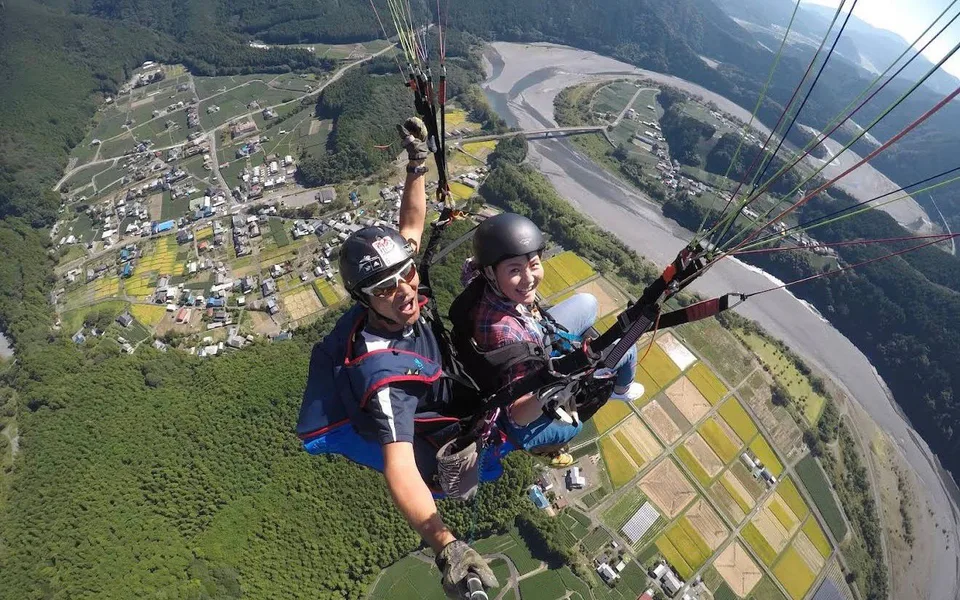
Planning Mt Fuji paragliding is mostly about separating three clocks: the full day, the activity window and the actual airborne time. Klook currently lists the Sky Asagiri product as an 8-hour experience with hotel pickup and a package called “Tandem (1-Hour Flight).” Sky Asagiri’s own standard tandem information describes a much shorter typical flight, while Explore Shizuoka puts the direct experience process at about 1.5 hours from meeting to finish. Treat those as different time layers and confirm the exact package details for your date.
If you are staying in Tokyo without a car, the package can still make sense because the higher price may be covering transport and logistics rather than the flight itself. If you are already in Fujinomiya, around Asagiri Plateau, or driving your own rental car, the operator’s direct tandem price becomes a more important benchmark. If what you want is freefall rather than a scenic glide, compare Tokyo skydiving as a separate option. They deliver very different experiences.
Quick decision: are you buying the view, the transport, or the adrenaline?
Tokyo-based, no rental car, and you want the transport handled: the Klook package deserves a look, but verify the pickup area and the meaning of “1-Hour Flight” first.
Already near Fujinomiya or Asagiri, or you are driving: use Sky Asagiri’s direct tandem rate—currently ¥12,000 on weekdays and ¥15,000 on weekends/public holidays—as the starting benchmark.
Your priority is freefall and a bigger physical rush: Tokyo skydiving may be the better match. Compare Tokyo skydiving instead.
This is your final day in Japan or you have a non-refundable evening plan: allow extra buffer, because weather delays or cancellations can affect the next booking too.
What do “8 hours” and “1-Hour Flight” cover? Separate the day from the airborne time
Klook’s current English product page lists “Paragliding Experience With Mt Fuji Views,” names Sky Asagiri as the operator, shows English/Japanese service, hotel pickup and an overall duration of about eight hours. The package selector also displays “Tandem (1-Hour Flight).” The useful distinction is that total package time and actual airborne time need to be read separately.
Sky Asagiri describes tandem flying as an instructor-controlled flight from a launch with roughly 240–300 meters of vertical difference, with a typical airborne time of around ten minutes. Explore Shizuoka, which lists the same Sky Asagiri experience, says the full direct activity takes about 1.5 hours and breaks that process into meeting the instructor, registration, briefing, moving to the launch point, putting on equipment and taking off. That distinction matters: total activity time, package time and airborne time are not interchangeable.
If actual airborne time matters to you, select your date, open the package details and look for explicit flight-time wording. If it is not clearly defined, confirm it with the platform before booking.
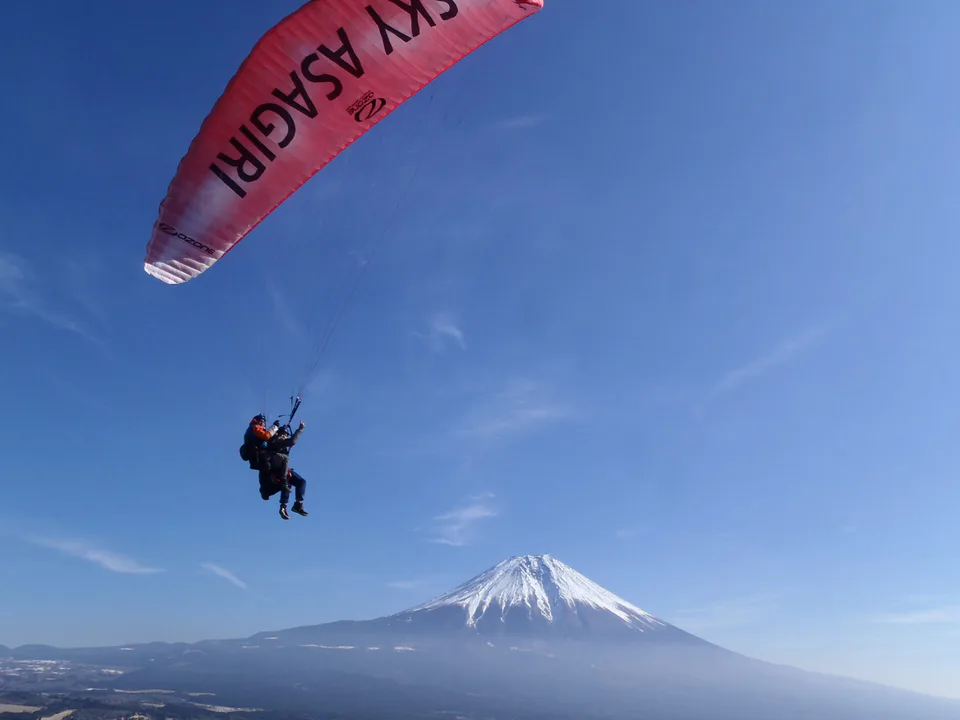
The attraction here is the combination of a tandem flight and the Asagiri Plateau landscape. A completely clear Mount Fuji view is still weather-dependent. Image source: Explore Shizuoka.
The price gap only makes sense if you separate the flight from the logistics
In our August 2026 check, Klook’s English listing was priced far above Sky Asagiri’s local tandem-only rate. The direct operator benchmark is currently ¥12,000 on weekdays and ¥15,000 on weekends and public holidays. Explore Shizuoka lists the same direct pricing and says the basic price covers instructor paragliding. That is why a straight “which ticket is cheaper?” comparison misses the point.
Klook’s listing is a different product because it also advertises hotel pickup and an eight-hour total duration. For someone staying in Tokyo without a car, the difficult part is not just flying. It is getting from central Tokyo to 499 Fumoto, Fujinomiya, reaching Asagiri Plateau at the right time, then getting back after a weather-dependent activity. If the Klook package truly covers pickup from your hotel and the return journey, you are paying to remove several rural-transport decisions from the day.
That value is lower if your hotel is outside the supported pickup area, if pickup is only from a limited meeting point, or if the return arrangement differs from what you expected. Before comparing the premium, confirm three things: whether your actual hotel is eligible, whether transport is round-trip, and what the one-hour label includes.
Check your date and pickup details before comparing the premium
The Klook package is most useful when you are starting in Tokyo without a car and want one booking to simplify the transfer. If you are already staying near Fujinomiya or Asagiri, compare direct operator pricing first—the transport premium may add less value.
Check Klook dates, pickup and package details
This article may contain affiliate links. If you complete an eligible booking through them, ValueNavi may earn a commission at no extra cost to you. Price, pickup coverage, cancellation terms and package details can change; recheck the exact option shown for your travel date before payment.
Who benefits most from pickup from Tokyo?
Pickup is especially useful for travelers who want to reduce the number of moving parts in a weather-sensitive day. Paragliding depends on wind, cloud and on-site safety decisions. If you also need to connect Tokyo, Fujinomiya, Asagiri Plateau, the flight window and the return journey, each transfer adds another timing point to manage.
For that traveler, pickup can be valuable because it simplifies coordination. You are paying for convenience and fewer transport decisions, not necessarily for a different type of flight. The logic is similar to choosing a private transfer after a late flight: public transport may be cheaper, but fewer moving parts can still be useful.
Drivers have a different calculation. Sky Asagiri’s meeting point is at 499 Fumoto in Fujinomiya, along the Asagiri Plateau area. If you already rented a car for a Mount Fuji road trip, or you are sleeping near Fujinomiya or Lake Tanuki, a Tokyo-oriented pickup package can add waiting and backtracking to a trip that is already easy to route independently. In that case, direct tandem plus nearby sights such as Shiraito Falls or Lake Tanuki is usually the cleaner structure.
If you have not yet decided whether Mount Fuji should be a Tokyo day trip or an overnight stop, settle that first. Our Mount Fuji day-trip decision guide explains why transport can be bought but visibility cannot. For a weather-sensitive activity, sleeping in the Fuji area changes the recovery options far more than another sightseeing stop does.
For a wider comparison of local tandem, pickup packages and full-day outdoor bundles, use our Mt Fuji paragliding guideThis article is narrower: it focuses on Klook’s hotel-pickup package and whether that transport-and-duration setup makes sense for your trip.
Mt Fuji paragliding vs Tokyo skydiving: same sky, completely different purchase
Paragliding is built around gliding in the air and reading the landscape. You launch with a pilot, feel speed and lift, but there is no aircraft exit and no freefall phase. Sky Asagiri’s standard tandem is designed around a scenic instructor-controlled flight over the plateau, with Mount Fuji as the visual prize when weather cooperates.
Skydive Nippon near Tokyo is a different intensity category. Its current tandem operation exits at around 4,000 meters, with roughly 40–50 seconds of freefall before several minutes under canopy. If your reaction to paragliding is “this might not be intense enough,” the Tokyo skydiving guide guide is a useful next comparison before choosing which aerial experience fits you better.
There is also a third category for travelers who mainly want the aerial view without the launch run, wind dependence and landing process: a Tokyo helicopter night flight. Separate “view,” “glide” and “freefall,” and the choice gets much easier than ranking three high-altitude activities by price.
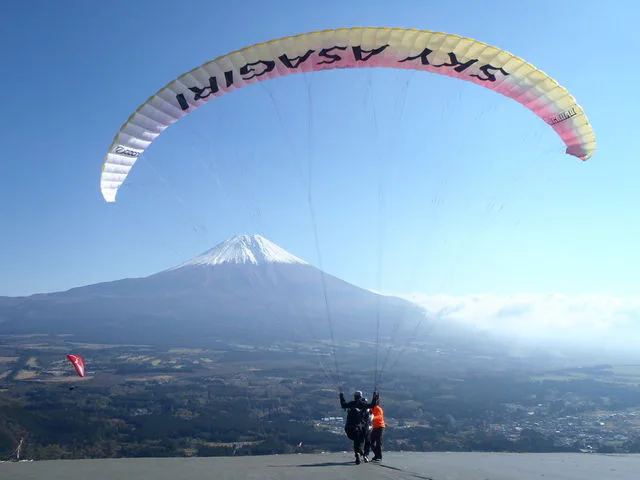
You are not only checking the flight. Launch conditions and Mount Fuji visibility can change the value of the same booking. Image source: Jalan / Sky Asagiri listing image.
Mount Fuji visibility depends on weather, regardless of package price
The product name includes “Mt Fuji Views,” but a clear mountain is not a service that can be guaranteed. Explore Shizuoka explicitly warns that Mount Fuji may not be visible, particularly in summer, and recommends late autumn or winter for a better chance of clear views. That is a major decision point if photography is the reason you are booking.
Flight conditions and mountain visibility are separate variables. It is possible for the flight to operate while Mount Fuji is partly or fully hidden by cloud. The reverse can happen too: the mountain may look clear from one location while wind at the launch site is unsuitable for safe flying. “The flight runs” and “I get the postcard Fuji shot” are best treated as separate outcomes.
For photography-first travelers, a practical way to frame the purchase is this: you are buying a tandem flight over Asagiri Plateau plus whatever transport is included. A full, clear Fuji view is an extra advantage when conditions cooperate. If the mountain view is central to your trip, give yourself more date flexibility rather than treating visibility as guaranteed.
Use Sky Asagiri’s direct rules as a baseline, but recheck the exact Klook package
Sky Asagiri’s current standard tandem information says healthy participants aged three and above can join and that no special technical ability is required. Takeoff still involves a short run. If a participant cannot run steadily enough for the conditions, the pilot may decide not to fly. The operator also asks guests above 90 kg to consult in advance. Those are useful direct-operator baselines, but they are not permission to assume every Klook date, vehicle or package applies identical limits.
Clothing matters because the launch site is not central Tokyo. Sky Asagiri asks for long sleeves, long pants and sports shoes. The plateau can feel different from the city, especially outside summer, so “Tokyo feels warm today” is not a reliable packing rule. If your selected Klook option publishes stricter shoe, age, weight or health rules, use the stricter rule.
Cancellation terms need the same separation. Explore Shizuoka currently lists 100% charges for same-day cancellation and no-show on its direct booking route. Klook is a different sales channel, so do not copy that policy onto a Klook order. Before paying, check three separate cases on your exact package: operator/weather cancellation, traveler-initiated cancellation, and missing or being late for pickup.
Four situations where another setup may fit better
You only want one tandem flight and you have a car: direct pricing makes Sky Asagiri worth comparing first.
You are assuming “1-Hour Flight” means 60 airborne minutes: confirm the package wording before treating it as 60 airborne minutes.
A completely clear Mount Fuji is mandatory for you: visibility cannot be reserved, and summer cloud risk is especially relevant.
What you really want is freefall: paragliding and skydiving deliver different sensations. Put the budget toward the one you actually want.
How to choose: the premium is mainly about transport convenience
For a first-time paraglider staying in Tokyo without a rental car, the Klook package belongs on the shortlist because the advertised hotel pickup can turn a rural outdoor activity into a more manageable full-day booking. Confirm actual airborne time, pickup coverage and the return arrangement, then compare that convenience against the direct operator price.
If you are already staying in Shizuoka or Fujinomiya, can drive, and can reach the meeting point independently, Sky Asagiri’s direct weekday ¥12,000 / weekend-and-holiday ¥15,000 tandem pricing is the stronger starting point. If your highest priority is adrenaline rather than the Fuji landscape, compare Tokyo skydiving first and choose the experience that better matches that goal.
The final payment check is four items: 1) what “1-Hour Flight” means on your selected Klook date; 2) whether your actual hotel is inside the pickup area and whether the transfer is round-trip; 3) how weather cancellation differs from traveler cancellation; and 4) whether age, weight, mobility and clothing requirements fit the participant. If all four line up, the package is much easier to judge on its actual travel value.
Okinawa Parasailing: Naha, Motobu, Uruma or Ginowan? Don’t Mistake Boat Time for Flight Time
Akita Kanto 2026 Is Over: What S, A, B and Free Viewing Taught Us
Tokyo Game Show 2026 Fast Ticket Is Not a Fast Pass — Buy It Only If You Know Your First Booth
Tokyo Autumn Leaves: Timing for Mt. Takao, Okutama, Gardens and Ginkgo
Tokushima Awa Odori 2026: Tickets, Stages, Free Streets and Transport