
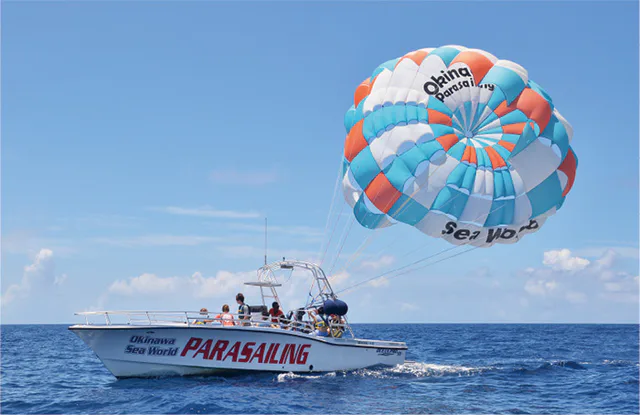
Choose the parasailing port that already sits inside your day. Naha is usually the cleanest choice for a city-based or car-free trip; Motobu belongs on a Churaumi/northern day; Ginowan fits Chatan and central Okinawa; Uruma makes sense when Kaichu Road and the east coast are already on the route. I would not cross the island just to buy a longer rope.
The second mistake is reading a 1-hour or 1.5-hour listing as flight time. Parasailing usually gives you only several minutes in the air; the rest is check-in, fitting equipment, boat travel, other guests taking turns and returning to port. That difference matters more than whether a product headline says 150 m or 200 m.
ValueNavi decision table: route fit before rope length
↔ Scroll table left or right
Area / reference operator | Current reference price | Listed time | Best when | Main trade-off |
Naha / Sea World | ¥7,000+ (about US$44+) | About 40–80 min; day-of conditions can extend it | Naha stay, no car, arrival/departure-side city day | Convenience is the value; do not assume the longest or most remote sea view |
Motobu / Sea World | ¥7,000+ (about US$44+) | About 40–80 min | Churaumi, Sesoko, Minna Island or northern hotel day | Poor fit if you drive north only to fly and then return to Naha |
Ginowan / Prince-listed operator | ¥6,500+ (about US$41+) | About 1 hour | Chatan, Ginowan or central-Okinawa base | Easy to overbuy marine-sport bundles you did not actually want |
Uruma / Marine Island 200 m plan | ¥8,000 (about US$50) | About 30–60 min | Kaichu Road, Hamahiga, Henza or Ikei self-drive day | Longer rope is not the same thing as proportionally greater altitude or value |
These are current reference products, not a universal Okinawa tariff. Seasonal pricing, inventory and operator rules can change. Approximate USD conversions use about ¥1 = US$0.00628 for orientation.
The real time-cost formula: hotel → port → boat → hotel, not “7 minutes in the air”
Before comparing two prices, write down four blocks: ground travel to the port, required arrival/check-in time, the full boat activity, then travel to the next stop. A supposedly cheaper port can lose if it adds an hour of driving each way. Conversely, a higher headline fare beside your hotel can be the lower-cost decision once fuel, parking and lost sightseeing time are counted.
This is also why a short flight is not automatically poor value. If the port already fits the route, the whole experience can be compact. If the port creates a cross-island detour, the same flight becomes an expensive half-day in time even when the ticket price is unchanged.
The biggest trap: a 1–1.5 hour activity does not mean 1–1.5 hours of flying
Current multi-area listings put actual airtime at roughly several minutes while the boat portion can be much longer. Sea World’s official Naha page lists about 40–80 minutes as the standard required time and notes that the day-of total can vary with participants, weather and sea conditions. Those figures are not contradictory: the shared boat is part of what you are buying.
Before paying, ask how many minutes you are expected to be airborne and how much total boat time to expect. If you get seasick, the second number can matter more than the first.
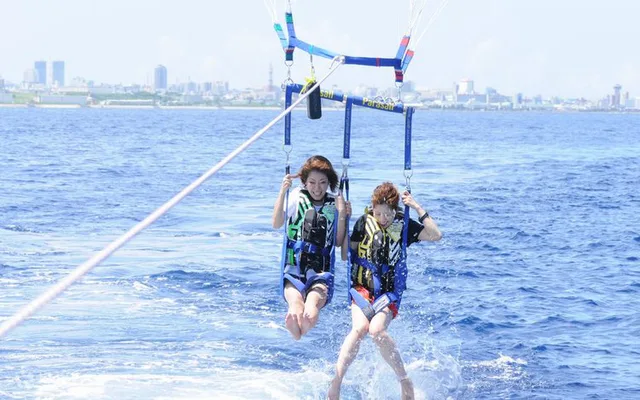
Naha: choose it for logistics, not because the city port is automatically “best”
Sea World currently departs from Miegusuku Port, about a 10-minute drive from Naha Airport and Kokusai-dori, with multiple departures through the day. The official Naha parasailing price starts at ¥7,000 (about US$44), and participation starts from age four for healthy guests subject to the operator’s medical and sea-condition rules.
For a Naha-based traveler without a rental car, that predictable ground cost is the reason to choose it. If your flight is very early or very late, first check the late-arrival and early-flight hotel plan around Naha Airport. A port near the airport does not turn a marine activity into a guaranteed pre-flight appointment.
Hidden Naha costs that a ticket comparison can miss
Sea World currently lists an observer-only boat seat at ¥3,000 (about US$19) when arranged in advance, a locker at ¥200 (about US$1.25), and a paid warm shower at ¥100 (about US$0.60) for three minutes at Miegusuku Port. These are small compared with the ticket, but they illustrate the right comparison method: compare the group’s actual day cost, not one adult headline fare.
If you are still deciding whether you need a car in Okinawa, Naha’s strongest advantage is that you do not need to rent one just to reach a short aerial activity.
Motobu: use it when the north is already the day
Sea World also operates a northern parasailing product near the Churaumi area, currently starting at ¥7,000 (about US$44) with a listed 40–80-minute activity window. Motobu makes the most sense when Churaumi Aquarium, Sesoko Island, Nago or a northern hotel is already part of the route.
If your 5-day Okinawa self-drive itinerary already gives the north a full day, fit parasailing into that day instead of fragmenting a Naha day and a northern day to chase a small price difference.
Some northern products combine parasailing with snorkeling or Minna Island activities. If all you want is a short flight, do not buy a full-day marine package because “more activities” looks like better value. Parasailing sells the aerial view; snorkeling sells the underwater experience.
Ginowan / near Chatan: strongest when central Okinawa is already your base
Okinawa Prince Hotel’s current activity page lists parasailing from Ginowan Port Marina at ¥6,500 and up (about US$41+), approximately one hour, ages 4–69, with prices varying by season. Those are conditions for that listed operator, not universal Okinawa rules.
If you are staying in Chatan, first compare Vessel Hotel Campana Okinawa vs LeQu, then decide whether the activity day was already meant to stay in central Okinawa. With a Chatan or Ginowan base, heading south to Naha solely for parasailing often solves no real problem.
Ginowan is also where bundle creep becomes easy. Stand-alone parasailing, towable marine sports and snorkeling can all sit beside each other on the same booking screen. A bundle is only better value if the group actually wants a half-day on the water. If one person wants to fly and another hates snorkeling, “more included” can mean more waiting rather than more enjoyment.
Uruma / Kaichu Road: pay for the east-coast route, not just a larger rope number
Marine Island’s current 200 m rope product is ¥8,000 (about US$50), lists roughly 30–60 minutes total, and describes an altitude of about 90 m. The operator also sells other rope-length plans. This is exactly why rope length and actual altitude must be separated.
The east-coast route around Kaichu Road, Hamahiga, Henza and Ikei Island is already suited to a self-drive day. If that route is on your itinerary, parasailing becomes a natural add-on. If you are staying in Onna, Chatan or Naha with no east-coast plan, driving across Okinawa only for a longer rope is usually poor total value. Use the Okinawa car-rental and driving plan and count fuel, drive time and the return.
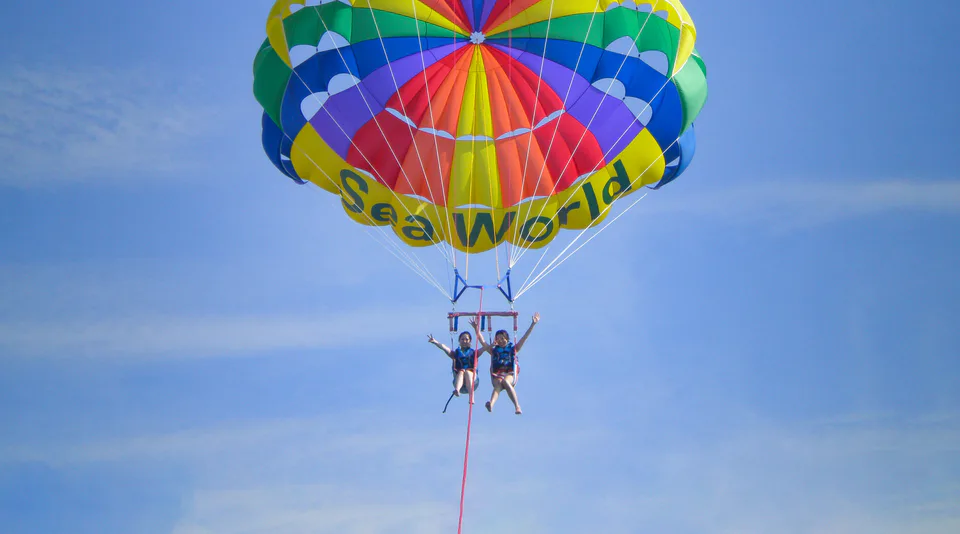
Rope length, altitude and flight minutes are three different numbers
Rope length is how much line is paid out from the boat. Altitude is your actual height above the sea. Flight time is the number of minutes you are genuinely being towed in the air. None alone tells you whether a product is worth the money.
If you want more thrill, look at how the operator describes actual altitude and whether line use can change with wind, waves and group weight. If photos matter more, check what is included. If you get seasick easily, total boat time matters more than an extra 50 m of rope.
Can two or three people fly together? Selecting the group size does not guarantee it
Parasailing can often be done in pairs or larger groups, but final pairing depends on combined weight, wind and sea conditions. Sea World’s current rules say staff may decide between one and four people according to conditions and weight. Treat “we must all be in the same frame” as a preference, not a guaranteed product feature.
Families should check each operator separately. Minimum ages, health questionnaires and upper-age handling can vary, and sea conditions can lead staff to refuse participation even when the age number appears to fit. Build this into your Okinawa family road-trip plan rather than stacking several high-stimulation activities into one day.
If you get seasick, put boat time ahead of altitude
For some travelers, the hard part of parasailing is the shared boat, not the flight. If you already learned from a Kerama diving or snorkeling day that you do badly on boats, do not dismiss the ride because parasailing itself is dry. The flight can be short while the boat remains the majority of the activity.
Parasailing only vs a bundle: ask whether you want to give up half a day
If you only want an aerial view and one high-angle photo, stand-alone parasailing is the cleanest purchase. Add a banana boat, tube ride or snorkeling and the total day expands because changing, waiting, entering the water and rinsing off all take time.
If you already want a full marine half-day, compare it with Kerama snorkeling, whale watching and marine-activity options. The worst bundle purchase is adding activities because the package looks fuller when half the group did not want them.
Weather is not just “cancelled or not cancelled”
Sea conditions can change line use, flight altitude, passenger pairing, boat time and departure delays. Sunshine does not guarantee suitable wind, and clouds do not automatically mean cancellation. Keep the next commitment flexible.
During typhoon season or unstable weather, prepare an Okinawa rainy-day and typhoon Plan B. If parasailing is cancelled, racing across the island to chase another exposed marine operator is usually not a useful backup.
Four NO-GO signs: if any one applies, do not pay yet
NO-GO 1 | You see 150 m or 200 m rope and assume it guarantees proportionally greater altitude or flight time.
NO-GO 2 | You treat the platform’s full activity duration as airtime.
NO-GO 3 | You are staying in Naha but plan to drive to Uruma only for a longer rope, or you are already in the north but intend to return to Naha to fly and then drive north again.
NO-GO 4 | You schedule airport check-in, a restaurant, wedding shoot, performance or other hard deadline immediately after the planned return to port.
Final 8 checks before paying
1 | Confirm the actual meeting port. 2 | Ask how many minutes are expected in the air. 3 | Separate rope length from estimated altitude. 4 | Confirm minimum booking and possible group pairing. 5 | Check age, health, individual-weight and combined-weight rules. 6 | Confirm photos, insurance and life jackets. 7 | Read weather cancellation and late-arrival rules. 8 | Leave enough transport buffer after the boat returns.
Final verdict: let your hotel and route decide, not the longest rope
Naha stay, no rental car or city-side day: start with Naha. Churaumi, Minna or Sesoko already on the route: start with Motobu. Chatan or Ginowan base: check Ginowan first. Kaichu Road already on the itinerary: that is when Uruma earns its geographic advantage.
If you still have not decided where to stay in Okinawa — Naha, Chatan, Onna, Nago or Motobu, do not change hotels just for parasailing. Your hotel affects every day; parasailing affects one or two hours. And if you are deciding between staying in Onna or moving to Naha for the final night, read Onna vs Naha for your last night in Okinawa before attaching the activity to departure day.
Next decision
Compare Okinawa’s higher-cost activities and day tours
Once you are sure you want parasailing, decide whether that specific day actually needs a rental car. The cheapest ticket can still be the highest total cost if it adds a cross-island drive.
Decide whether this day really needs a rental car
Minna Island Okinawa: Snorkeling, Parasailing or Just the Beach?
Okinawa Without a Car? Leave Naha Only If the Second Base Fixes Your Evenings
HOTEL STRATA NAHA: For Two Nights, Is a Twin Room Worth More Than a Compact Room?
Sources
Sea World | Official Naha and northern parasailing prices, timing and participation conditions
Okinawa Prince Hotel Ocean View Ginowan | Current Ginowan parasailing activity information
Marine Island | Official 200 m rope parasailing information for Kaichu Road