
For two people staying four winter nights at Tokyu Stay Sapporo Odori, I would choose the 23 m² Residential Twin when the room will hold two large suitcases, shopping bags and at least one in-room meal. I would keep the 19 m² Superior Twin when both travellers pack lighter and mainly want the washer-dryer and microwave. The important fact is that both rooms already have the same 1,100 mm twin beds, an in-room washer-dryer and a microwave. The 23 m² upgrade is not buying “long-stay equipment” from zero; it is buying 4 m² more published area, a kitchenette and a separate bath/toilet layout.
That 4 m² increase is about 21% over the 19 m² room. For two travellers, it is roughly 2 m² more published room area per person. Those figures do not equal clear floor space—beds, walls and furniture still consume area—but they are large enough that I would not dismiss the difference as cosmetic on a four- or five-night winter stay.
If you have not decided whether Odori is the right base at all, solve that before the room category. Sapporo Station vs Susukino is more important than choosing 19 vs 23 m² when every morning starts with a JR day trip.
The 30-second room decision
↔ Scroll table left or right
Your stay pattern | Start with | Why | What you give up |
1–2 nights, cabin bags, room mainly for sleep | 19 m² Superior Twin | Already has washer-dryer + microwave + two 1,100 mm beds | No kitchenette; less room for luggage accumulation |
4 nights, two large cases, shopping-heavy | 23 m² Residential Twin | 21% more published area plus kitchenette and separate bath/toilet | Upgrade premium may be wasted if you barely use the room |
4–5 nights, pack light, one laundry load, eat out | 19 m² can still win | Laundry is not exclusive to the 23 m² room | Less buffer when winter gear and shopping enter the room |
Need a third adult | Compare 26 m² Premier Twin | Official capacity is up to 3 | Do not pay for the larger category if there are only two of you and no space problem |
ValueNavi Four-Night Utility Score: the 23 m² room wins on workflow, not on beds or laundry
This is an editorial fit score for a defined profile: two adults, four winter nights, two large suitcases, one laundry load, some takeaway/grocery meals and evening shopping. It is not a hotel quality rating. Each dimension is scored out of 10 so the reason for the recommendation remains visible.
↔ Scroll table left or right
Decision dimension | 19 m² Superior Twin | 23 m² Residential Twin | Why the gap exists |
Laundry utility | 10 | 10 | Both have an in-room washer-dryer |
Sleeping equality | 10 | 10 | Both list two 1,100 × 2,000 mm beds |
Winter luggage tolerance | 6 | 9 | 23 m² gives a larger operating margin as bags and shopping accumulate |
Meal autonomy | 6 | 10 | Both have microwave; Residential adds kitchenette/electric cooker |
Bathroom workflow | 6 | 9 | Residential officially lists bath/toilet separation |
Total / 50 | 38 | 48 | For this exact four-night profile only |
Now change the profile to two carry-ons, two nights and every meal outside. Laundry and beds remain equal, while the space, kitchenette and bathroom-layout advantages are used less often. The score gap narrows sharply. That is why “four nights” is a useful decision context, not a magic rule that makes Residential automatically better.
The 4 m² upgrade is about room compression, not luxury
Official room information lists Superior Twin at 19 m² and Residential Twin at 23 m². Both sleep two and use the same published bed size. The difference is therefore unusually clean: you can ask what the extra 4 m² and added functions do to the routine instead of being distracted by a larger bed or extra occupancy.
↔ Scroll table left or right
Feature | Superior Twin | Residential Twin |
Published area | 19 m² | 23 m² |
Area per 2 travellers, gross | ~9.5 m²/person | ~11.5 m²/person |
Beds | 2 × 1,100 × 2,000 mm | 2 × 1,100 × 2,000 mm |
Washer-dryer | Yes | Yes |
Microwave | Yes | Yes |
Kitchenette / electric cooker | No | Yes |
Bath/toilet separate | Not listed | Yes |
I would not claim that two specific 28-inch suitcases can stay open in either room because the official site does not publish a guaranteed suitcase-clearance measurement. Instead use a compression test: if both cases, two winter coats, shopping bags and tomorrow's clothes need floor space at the same time, the 19 m² room is more likely to require repeated packing and moving. The hidden cost is not discomfort in the abstract; it is having to reset the room twice a day.
The washer-dryer should not be used to justify the 23 m² upgrade
This is the most important correction to the usual long-stay logic. Both Twin rooms already include the in-room washer-dryer. If your only reason for upgrading is “we are staying four nights and need laundry,” keep the 19 m² Superior Twin in the comparison.
Laundry still changes the packing decision. One load around Night 2 or 3 can let two travellers carry fewer base layers, especially in winter when indoor heating and layered clothing make re-wearing decisions less simple. But the appliance is a hotel-level advantage shared by both rooms, not a Residential-only advantage.
If the whole Hokkaido route has multiple hotel changes, think one step earlier: luggage forwarding may remove more friction than buying a larger room at every stop.
The kitchenette only earns money when it replaces a real meal task
Residential Twin adds a kitchenette; Tokyu Stay's official equipment list says rooms with a kitchenette have an electric cooker, while the hotel's current room information also lists microwave access. That can matter on nights when snow, fatigue or shopping makes another restaurant trip unattractive.
But a kitchenette is easy to overvalue. If every dinner is intentionally part of the Sapporo food itinerary, the cooker may never be switched on. A microwave already exists in the 19 m² room, so convenience-store food and simple reheating do not automatically require Residential.
I would therefore value the kitchenette only if you can name the use before booking: breakfast preparation, a simple late dinner, dietary control or several grocery meals. “It might be useful” is not enough reason to pay a four-night premium.
Separate bath and toilet: useful when two people prepare at the same time
Residential Twin officially lists the bath and toilet as separate. That creates more scheduling flexibility for two adults than a combined wet-area layout, particularly in the morning or after returning from cold weather. I would not exaggerate this into “two bathrooms”—it is not. The benefit is narrower: one function no longer occupies the same compartment as the other.
For travellers with completely different wake-up times, that can matter every day. For a couple who always get ready sequentially, it may matter very little. Again, the room upgrade earns value only through repetition.
Winter arrival: the large-luggage route is more important than the 3-minute claim
Tokyu Stay's official access page gives two routes from Odori Station. With little luggage, the normal route uses Exit 2. For guests with large or multiple bags, the hotel specifically recommends walking underground through Pole Town toward Susukino and using the escalator at the Tanukikoji 4-chome exit; from the surface it is then about a three-minute walk.
That is useful in winter because more of the vertical change and approach can happen underground. It does not mean the hotel is connected underground or that the final section is snow-free. Keep that distinction when comparing it with a station-connected property.
Odori works best when the evenings are genuinely in Odori, Tanukikoji and Susukino; a room upgrade cannot fix the wrong base.
If most mornings begin with JR day trips from Sapporo Station, compare Sapporo Station hotels or Hotel Gracery Sapporo vs Keio Prelia. The most comfortable room in Odori can still lose to a smaller room that removes a repeated subway transfer.
ValueNavi Repetition Test: one arrival transfer vs eight daily movements
For four nights, separate one-time friction from repeated friction. Arriving with large luggage is a one-time problem. Leaving and returning each day happens up to eight times. A traveller using Odori Park, Tanukikoji and Susukino most evenings can justify the Odori base even if airport-JR arrival requires an onward movement from Sapporo Station. A traveller taking three JR day trips may reach the opposite conclusion.
↔ Scroll table left or right
Itinerary pattern | Odori base value | Room-size implication |
Central Sapporo evenings every night | High | 23 m² can be worth more because you also accumulate downtown shopping/food |
Otaru + Asahikawa + airport/JR-heavy mornings | Lower | Fix the base before paying for 4 m² |
One airport arrival, then four local days | High | One extra arrival step is easier to amortise |
Breakfast: ¥2,100 only has value on mornings with time to eat it
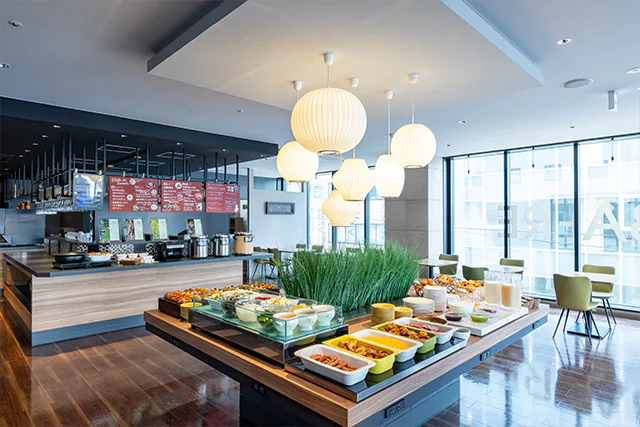
Breakfast should be matched to departure time, not automatically attached to every night.
The hotel currently lists its Japanese/Western buffet from 06:30 to 10:00, last order 09:30, at ¥2,100 including tax (about US$13.17 at the 27 August 2026 exchange rate). For a normal Odori morning, that is easy to use. For an early JR departure or airport day, the included breakfast can become a schedule constraint.
Compare room-only and breakfast rates on the exact dates. If breakfast is effectively priced below ¥2,100 per person in the package and you will use it, the bundle may make sense. If two of four mornings start too early, do not evaluate the package as though you receive four full-value breakfasts.
Parking: “has parking” is not the same as “parking is secured”
The hotel's current official parking information lists 24 spaces at ¥2,000 per night including tax (about US$12.55), with vehicle-size limits. Spaces cannot be reserved or guaranteed in advance, and the hotel states that nearby coin parking must be used if the facility is full; there is no affiliated overflow lot.
For winter drivers, that means the parking decision has a failure mode. Do not arrive assuming an on-site space is part of the room reservation. If the road trip depends on predictable parking, identify the fallback before arrival and use the Hokkaido winter driving guide for the separate road-safety question.
Housekeeping: the hotel is designed for more autonomy
For multiple-night stays, Tokyu Stay currently provides “simple cleaning” on request: towel/nightwear changes and trash removal. For stays of seven nights or more, full room cleaning is added once a week. That service rhythm fits travellers who value an in-room washer-dryer and home-like equipment; it can feel less attractive to someone who expects a full hotel-room reset every day.
This matters more than it sounds. If daily housekeeping is a priority, paying more for the Residential room will not change the cleaning model. Choose the hotel product first, then the room.
Upgrade break-even: divide the premium across both people and all four nights
Do not use a fixed yen threshold because room rates change by date. Hold dates, two-adult occupancy, breakfast, taxes and cancellation conditions constant, then calculate:
Residential upgrade per person per night = (Residential Twin total − Superior Twin total) ÷ 2 ÷ number of nights.
Then ask whether that nightly amount buys three things you actually reuse: 21% more published area, kitchenette access and separate bath/toilet. If you will cook zero times, travel with cabin bags and spend every evening out, the upgrade is mostly buying space. If two large cases stay in the room for four nights and you use the kitchenette twice, the same premium solves more than one repeated constraint.
Keep the booking totals in Japanese yen and add the current USD equivalent for budgeting rather than replacing the yen price. Exchange rates move.
When I would choose neither 19 nor 23 m²
If three adults need the room, compare the 26 m² Premier Twin because it is officially designed for up to three. If a large public bath or onsen is a priority, this is the wrong product comparison—look at ONSEN RYOKAN YUEN SAPPORO or another bath-led hotel. If repeated JR access dominates, move the base toward Sapporo Station before spending more on an Odori room.
And if the Hokkaido trip should move to Asahikawa or Furano after two nights, do not stretch Sapporo to four nights simply because the Residential Twin is comfortable. Use the Hokkaido itinerary by region to solve the route first.
Compare the same room before choosing the platform
Match the exact room category, two-adult occupancy, breakfast, taxes and cancellation deadline. A cheap Superior Twin and a flexible Residential Twin are not evidence that one platform is cheaper than another.
Booking.com — compare Superior and Residential Twin on the same dates
Trip.com — compare the same Tokyu Stay room categories
Agoda — match room, breakfast and cancellation terms
Final verdict
For two adults staying four winter nights with two large cases, I would price the 23 m² Residential Twin first. Its advantage is not the washer-dryer—Superior already has that—but the combination of about 21% more published area, a kitchenette and a separate bath/toilet layout. Those three benefits can be reused every evening as luggage, winter clothing and shopping accumulate.
For one or two nights, lighter luggage or travellers who eat out and return only to sleep, I would keep the 19 m² Superior Twin. It retains the hotel's most distinctive long-stay feature—the in-room washer-dryer—without paying for functions you may not use. If JR day trips dominate the itinerary, neither room decision should come first: fix the Sapporo base before optimizing four square metres.
Sources
Tokyu Stay Sapporo Odori — official room and housekeeping information
Tokyu Stay Sapporo Odori — official access, breakfast and parking information
Tokyu Stay — official Sapporo long-stay information
Official facts re-checked 27 August 2026. Room inventory, rates, parking availability and breakfast details can change. Currency conversions are approximate. This article may contain affiliate links; ValueNavi may earn a commission from qualifying bookings at no additional cost to you.