
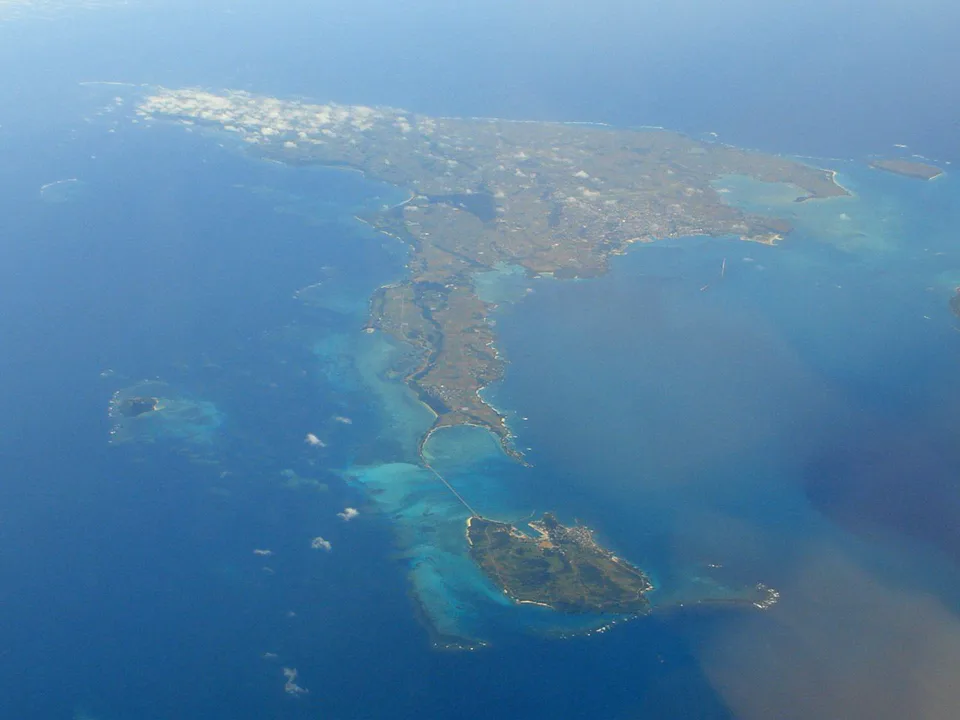
A good four-day Miyakojima itinerary should not have one fixed Day 1–4 order. The first decision is which airport you use, because Miyako Airport and Shimojishima Airport put you on different sides of the island group. The second decision is which marine activity matters most, because snorkeling, SUP and Pumpkin Cave need a weather or tide recovery slot before your flight home. Build the trip around one primary water activity, one Irabu–Shimoji block, one south/east or north road block, and one deliberately light airport edge. The bridges connect the geography; they are not a sightseeing checklist.
Miyakojima Tourism Association currently lists both Miyako Airport and Shimojishima Airport as gateways. It also notes that Miyakojima is linked by road bridges to Kurima, Irabu/Shimoji and Ikema, making rental-car routing unusually flexible. That flexibility is easy to waste if you cross the same bridge repeatedly just because an old itinerary assigned each island to a different day.
↔ Scroll table left or right
Your constraint | Best default | Why |
Arrive at Miyako Airport | Use Kurima / Yonaha Maehama or Hirara as the easy first-day block | Kurima Bridge and Irabu Bridge are both roughly 15 minutes by car from Miyako Airport, so you can keep the arrival day short without committing to a full island loop |
Arrive at Shimojishima Airport | Consider putting Irabu–Shimoji on an arrival or departure edge | The airport itself is on Shimoji Island; driving across to central Miyako and then returning for a separate Irabu day can create avoidable backtracking |
One must-do marine activity | Book it on Day 2 or early Day 3 | You preserve at least one realistic reschedule window if sea state, wind or tide changes the plan |
Two marine activities | Put them on different days | A single weather problem should not destroy both bookings, and changing/showering/transport make two major water sessions much larger than their advertised activity time |
Early flight home | Keep the final morning local to the departure airport | The last day should protect fuel, car return, luggage and check-in rather than recover missed attractions |
Late flight from Shimojishima | Use an Irabu/Shimoji stop only if it keeps you on the airport side | A final east-coast or Ikema detour creates the wrong-direction drive before departure |
Step 1: let the airport decide which edge of the itinerary is cheapest
The usual mistake is treating “Miyakojima” as one airport and one centre. It is not. Miyako Airport is on Miyako Island near the central road network; Shimojishima Airport is on Shimoji Island beside Irabu Island. The tourism association currently lists direct or seasonal air services to both gateways, so the flight you book can change the best sightseeing order before you even choose a hotel.
For a Miyako Airport arrival, the south-west side is easy to use without overcommitting. The tourism association lists Kurima Bridge at about 15 minutes by car from Miyako Airport. Irabu Bridge is also about 15 minutes from the airport, while Ikema Bridge is about 35 minutes and Higashi-Hennazaki about 35 minutes. Those published reference times expose a useful planning rule: do not spend an arrival afternoon driving to the farthest directional extreme just because it appears first in someone else’s itinerary.
For a Shimojishima Airport arrival, the geometry reverses. If you immediately drive to a Hirara or south-coast hotel, then dedicate a later full day to Irabu–Shimoji, then return again to Shimojishima Airport at the end, you may cross the Irabu Bridge more often than the trip requires. A lightly loaded arrival or departure block can absorb Sawada-no-hama, a Shimoji-side viewpoint or another Irabu stop without turning the airport day into a race.
This is derived itinerary logic, not an official route recommendation. Flight times, rental-car branch locations and hotel check-in can still make a central first night better. The point is to price the airport’s location into the route instead of treating it as dead time.
Step 2: put the most important marine booking where it can fail once
A four-day island trip should survive one cancelled water session. That means your must-do snorkeling, SUP or cave activity belongs in the first half of the stay whenever possible. Day 4 is the weakest place for a non-recoverable marine booking because the flight removes your reschedule option.
If sea-turtle snorkeling is the priority, treat turtle sightings as wildlife rather than an entitlement. If SUP is the priority, wind and surface conditions matter. If Pumpkin Cave is the priority, do not classify it as a rainy-day indoor attraction: access can involve coastal conditions, tide timing, wading, paddling or climbing depending on the operator and product. A wet forecast does not automatically make the cave the “safe backup.”
Before paying, record five things from the exact operator: meeting location, required arrival time, total block length rather than water time, age/health restrictions, and the weather/cancellation procedure. For a provider such as Miyakojima ADVENTURE PiPi, compare the exact tour rather than assuming every snorkeling, SUP and cave package uses the same meeting point or physical load.
The best four-day structure gives the activity somewhere to move. If the primary booking is Day 2, Day 3 may still absorb it. If it is Day 3, Day 2 can sometimes be swapped. If it is Day 4, a cancellation becomes a refund-or-miss outcome instead of an itinerary adjustment.
Day 1 should be a low-consequence geography day
Arrival day has hidden work: baggage, rental-car collection, driving orientation, hotel check-in, food and learning how long the group actually takes to move in heat. Use that day for a route that can be shortened without regret.
Miyako Airport version: Yonaha Maehama + Kurima works because Kurima Bridge is close to the airport side and the day can end whenever energy drops. Ryugujo Observatory on Kurima Island has parking and a view back toward Yonaha Maehama, but it does not need to become a fixed sunset appointment if the flight is late.
Shimojishima Airport version: use one or two Irabu/Shimoji stops only when luggage, daylight and rental-car timing cooperate. Sawada-no-hama is an official scenic spot near the Shimoji side, but the tourism association also warns that water can move quickly with the tide. Treat it as a landscape stop unless you have current, safe conditions for whatever water use you intend.
Do not put a prepaid cave or snorkeling tour on the arrival afternoon unless the booking is explicitly designed around your flight and the operator confirms the buffer. A delayed aircraft should cost you one beach stop, not the most expensive experience of the trip.
Day 2: make one water activity the main job
This is the day to spend energy on the activity you would be most disappointed to miss. Build the rest of the day around its actual operational block.
A “two-hour” water experience can consume substantially more than two hours after driving, parking, check-in, changing, safety briefing, the activity itself, showering, wet gear, food and the drive away. The correct planning unit is hotel departure to ready-for-the-next-activity, not the advertised time in the water.
For first-time snorkelers, families or anyone sensitive to heat, one main marine session plus an easy beach or hotel afternoon is usually stronger than stacking snorkeling + SUP + sunset driving. If the tour is moved because of weather, this lighter afternoon becomes the first recovery slot instead of collateral damage.
In hot months, water, shade, dry clothing and sunscreen are schedule items rather than packing trivia. If somebody becomes chilled after water time, dizzy in the heat or unusually tired, delete the optional afternoon drive. The itinerary is supposed to lose a viewpoint before it loses safety.
Day 3: Irabu–Shimoji is a full directional block, not a bridge photo
Irabu Bridge is 3,540 metres long and connects Miyako Island with Irabu Island. The value of crossing it is that the entire Irabu–Shimoji side becomes one road-trip zone. Use that geography instead of treating the bridge as a destination and then driving back immediately.
A sensible day chooses a limited set of stops—perhaps one high viewpoint, one serious beach or coast stop, Toriike / Shimoji-side scenery, and food—rather than trying to touch every social-media pin. The tourism association describes Sawada-no-hama as a sunset spot with parking, toilets, showers and a shop, but it also warns about currents farther offshore and rapid incoming water around large tides. A scenic beach with facilities is still not a guarantee of safe swimming conditions.
Every “quick beach” adds parking, changing, sunscreen, drying and sand management. Two real water stops can easily consume more useful time than five roadside photo stops. If weather worsens, cut the second beach first, then the lowest-priority viewpoint. Protect food, fuel, daylight and the drive back.
If you are flying out of Shimojishima Airport, this whole block may work better on Day 1 or Day 4 instead. The airport is the reason to move the day, not an arbitrary preference for Day 3.
Do not force Ikema into a four-day trip just because it is the third bridge
Miyakojima is famous for its bridge-linked islands, which tempts travellers into a “Kurima + Irabu + Ikema = complete” checklist. But Ikema Bridge sits farther north; the tourism association gives roughly 35 minutes by car from Miyako Airport. That makes an Ikema run a directional choice, not a free extra after a south-coast morning.
Include Ikema when the north is already part of the day, when weather makes the north coast the better land-based option, or when you deliberately prefer scenery/driving over another paid marine activity. Skip it when adding it creates a cross-island zigzag between a morning south-coast booking and an afternoon east-coast plan.
On a four-day trip, completing all three bridges has no intrinsic value. A route that crosses two bridges once each and leaves one out can be better than a route that repeatedly crosses all three while spending little time anywhere.
Day 4 should follow the departure airport, not unfinished sightseeing guilt
The final day has four non-negotiable tasks: finish the useful sightseeing block, refuel if required, return the rental car with the operator’s buffer, and reach the correct airport. Anything else is optional.
Departing Miyako Airport: an east-coast stop such as Higashi-Hennazaki can make sense with a sufficiently late flight because the tourism association places it roughly 35 minutes from Miyako Airport. A short south-side stop can also work. Do not then add Irabu just because the weather is clear.
Departing Shimojishima Airport: keeping the final block on Irabu/Shimoji can reduce backtracking. The airport itself sits on Shimoji Island, so an east-coast morning is the expensive direction unless the flight is very late and the rental-car plan has a large buffer.
The final-day stop-loss rule is simple: once the route requires crossing the island group away from the departure airport to recover a missed attraction, delete the attraction. A missed beach is recoverable. A compressed car return and flight check-in are not.
Hirara vs resort base: choose by repeated evenings, not the prettiest hotel photo
Four days do not automatically justify a remote resort, and they do not automatically justify Hirara. The right base depends on what repeats after 18:00.
Hirara gets stronger when the group wants independent restaurants, supermarkets, a central launch point and no repeated post-dinner drive. It is also easier when different days point in different directions and the hotel is mainly a sleep/repack base.
A resort gets stronger when breakfast, the beach, pool, room time or resort dinner are deliberately protected in the itinerary. If every morning leaves early and every evening drives back into Hirara for food, part of the resort premium is being paid for facilities you barely use.
Use the same deletion test as the activities: if removing the hotel beach/pool/resort breakfast would not change any planned hour, location and room functionality should outrank the resort label.
One hotel is usually better than a split stay for four days
Miyakojima’s bridges make large parts of the island group drivable without changing accommodation. A two-hotel split adds packing, checkout, luggage storage or car loading and another check-in. That move should have a job.
A split can make sense when the airport geometry and hotel experience align—for example, a final night on the Shimoji/Irabu side before a Shimojishima flight, or a resort night that genuinely creates a beach-and-dinner block you cannot reproduce from the first hotel. It does not make sense merely because Day 3 is “Irabu day.”
For a four-day trip, I would demand at least two benefits from the move: it should remove a major backtrack and unlock meaningful hotel/early-morning time, or solve departure logistics and improve the final evening. If it only saves one bridge crossing, keep the same room.
Families and first-time drivers should reduce hand-offs before reducing kilometres
With children, older parents, a stroller or large suitcases, the tiring part is often the repeated sequence of park → unload → change → reload rather than the road distance itself. One beach with toilets, shade and a meal plan can outperform three “must-see” beaches.
For a first left-side driving trip, do not use arrival evening to prove you can cover the whole island. Learn the car, navigation, parking and local road pace on a low-consequence route. The Okinawa car-rental guide covers licence, protection, child-seat and return-buffer decisions; the Okinawa family road-trip guide is the better companion when naps and child-seat time constrain the day.
Weather stop-loss: what moves, what stays and what gets deleted
A resilient four-day trip decides the order of sacrifice before the forecast deteriorates.
Move first: the single highest-priority marine activity, if the operator offers a safe reschedule.
Keep fixed: flights, car return, hotel dinner if it has a hard service time, and any non-changeable operator meeting point.
Swap freely: Kurima, north-coast, east-coast and general road blocks when conditions simply make one direction more pleasant.
Delete first: the third or fourth photo stop, a duplicate beach, and any bridge crossed only to say you crossed it.
If an operator cancels for safety, do not recreate the activity independently because you dislike losing the booking. Use a land-based block and the Okinawa rainy-day and typhoon guide. If mobile data is important for live changes, install the Okinawa eSIM before leaving airport Wi-Fi and keep offline maps as a backup.
Four-day templates by airport
Miyako Airport in / Miyako Airport out
Day 1: car + hotel + Yonaha Maehama/Kurima. Day 2: primary snorkeling/SUP/cave booking + light afternoon. Day 3: Irabu–Shimoji full block. Day 4: east or north only if flight time supports it, then fuel/car return/airport.
Shimojishima Airport in / Shimojishima Airport out
Day 1: easy Irabu/Shimoji edge + hotel. Day 2: primary marine activity. Day 3: Miyako south/east or north directional block. Day 4: only a light Irabu/Shimoji stop that keeps you moving toward the airport.
Open-jaw between the two airports
Use the arrival-airport side once and the departure-airport side once. This is the route shape with the strongest potential to remove redundant bridge crossings, but only if your rental-car provider accepts the branch/return arrangement you actually need. Do not assume the airport names are interchangeable on a booking page.
Final verdict
Four days are enough for Miyakojima when the itinerary protects two things: one marine priority and the flight home. Let the airport define the cheap edge of the trip, put the fragile water booking early enough to move once, give Irabu–Shimoji one coherent directional block, and use the last day only in the direction of the departure airport. Kurima, Irabu and Ikema are connected by bridges, but crossing all three is not the goal.
If the schedule only works when the flight lands on time, the sea stays calm, the tide fits, every beach stop takes 20 minutes and the rental-car return has no queue, it is not a four-day itinerary—it is a chain of assumptions. Delete one stop and make the trip recoverable.
Lake Towada Oirase 2 Day Itinerary: Buses, Walks, Cruise and Hotels
Naruko Gorge 2 Day Itinerary: 2026 Trains, Trails, Onsen and Hotels
5- or 7-Day Kyushu Autumn Leaves Itinerary: Fukuoka, Yufuin, Beppu and Mountain Routes
Hiroshima One-Day Itinerary: Peace Park, Castle and Shukkeien
References
Miyakojima Tourism Association — Miyako Airport and Shimojishima Airport access · Kurima Bridge · Irabu Bridge · Ikema Bridge · Higashi-Hennazaki · Sawada-no-hama · Miyakojima ADVENTURE PiPi — current tour information. Airport services, tours, sea conditions and access rules can change; recheck the exact travel date.