
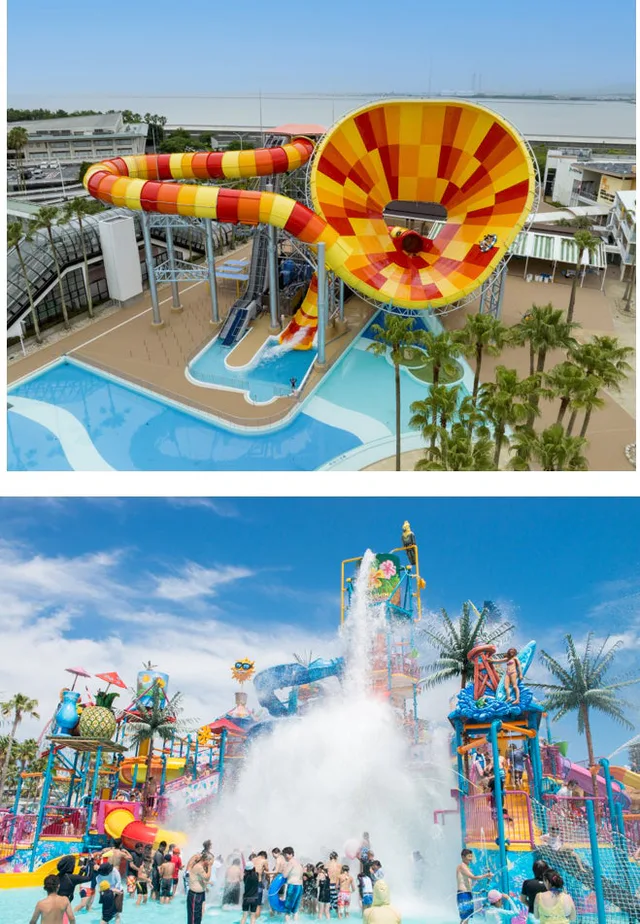
For most summer visitors, buy the ¥4,800 (about US$30) pool ticket, not the ¥8,000 (about US$50) Wide Passport. The Wide Passport only becomes the better purchase when amusement rides are a real second priority and you can name the rides before arrival. Nagashima Resort puts the water park, amusement park and outlet next to each other, but that geographic convenience creates a planning trap: showers, changing, lockers and queues all consume the same finite day.
There is also a useful piece of 2026 ticket math that the word “package” can hide. Meitetsu Bus sells a seasonal adult pool package for ¥7,500 (about US$47) and a Wide Passport package for ¥10,700 (about US$67). The normal Nagoya–Nagashima Onsen round-trip bus is ¥2,700. So ¥4,800 + ¥2,700 = ¥7,500, and ¥8,000 + ¥2,700 = ¥10,700. The package does not currently save an adult any yen versus those published component prices; it saves transaction friction.
USD figures here are rough localization using the August 27, 2026 JPY/USD rate; Japanese-yen prices remain the purchase reference and exchange rates move.
↔ Scroll table left or right
ValueNavi decision | Choose | Why / hidden cost |
First visit; pool is the main reason to go | Pool ticket ¥4,800 (~US$30) | The water park can fill the useful daytime hours by itself. |
You can name 2–3 must-ride amusement attractions | Wide Passport ¥8,000 (~US$50) | The extra ¥3,200 is buying unlimited rides, but only if you protect time to use them. |
You will travel from Nagoya by direct bus | Consider the ¥7,500 / ¥10,700 Meitetsu package | At current adult component prices it is convenience, not a cash discount. |
You want pool + outlet | Pool ticket | Every outlet hour makes an unlimited-ride product less useful. |
Storm risk is meaningful | Pool ticket + outlet backup | Lightning can suspend outdoor water/ride attractions even when the resort itself remains open. |
ValueNavi Score: excellent summer destination, fragile as a “do everything” day
These are ValueNavi editorial scores for an English-speaking visitor using Nagoya as a base. A higher score is more favorable; they are not official park ratings.
Decision factor | Score | Reason |
|---|---|---|
Pool-day uniqueness | A large seasonal water park is a genuinely different Chubu summer day, not a generic city attraction. | |
Transport simplicity from Nagoya | Direct buses run from Meitetsu Bus Center to the terminal stop Nagashima Onsen. | |
Ticket clarity | The main pool/Wide choices are clear, but resort combinations can tempt visitors to overbuy. | |
Weather resilience | Rain alone is not fatal, but lightning, strong weather and outdoor suspensions can remove high-value attractions. | |
Outlet pairing | Shopping works as a low-energy second act after changing; it is less compatible with maximizing an unlimited-ride pass. | |
“Everything in one day” realism | Pool + major rides + outlet + hot spring creates four competing time budgets. |
The 2026 pool season is July 11–September 28 — and the ticket already includes amusement-park admission
Nagashima Jumbo Seawater Pool is scheduled for July 11 to September 28, 2026. The adult ¥4,800 pool ticket includes entry to Nagashima Spa Land and the water park, but amusement rides cost extra. The ¥8,000 Wide Passport adds unlimited rides for the same day; it cannot be split across two days.
That distinction matters. Pool-ticket holders are not locked outside the amusement-park grounds. You can still walk through and pay separately for a ride. The Wide Passport is therefore not the price of “seeing Spa Land”; it is the price of turning rides into a second major mission.
Compare the live Nagashima Spa Land ticket option|Klook
The ¥3,200 Wide-Passport gap only pays back if rides survive the time budget
The visible price difference is ¥3,200 per adult. But “unlimited rides” is only valuable during the hours you are dry, changed and willing to queue. A group focused on Mega Abyss, the wave pool, rapid river and JAPAAAAN can use most of the pool day without feeling unfinished.
The Wide Passport makes more sense for an early-arriving coaster group that can say, before leaving Nagoya, “after the pool we are riding X, Y and Z.” It makes less sense when the plan is “maybe we will do rides if there is time.” In that second scenario, you are prepaying for the most fragile part of the day.
The Meitetsu package is a convenience bundle, not a hidden adult discount
From Meitetsu Bus Center, the published adult fare to Nagashima Onsen is ¥1,400 one way or ¥2,700 round trip. During the 2026 pool season, Meitetsu also lists a ¥7,500 adult Jumbo Seawater Pool package and a ¥10,700 adult Wide Passport package. Both include the Nagoya–Nagashima Onsen round trip.
↔ Scroll table left or right
Adult plan | Separate published prices | Meitetsu package | Cash saving |
Bus + pool | ¥2,700 + ¥4,800 = ¥7,500 | ¥7,500 (~US$47) | ¥0 |
Bus + Wide Passport | ¥2,700 + ¥8,000 = ¥10,700 | ¥10,700 (~US$67) | ¥0 |
That does not make the package pointless. Buying the day product at the Meitetsu Bus Center can simplify the morning and put transport plus admission into one decision. But call the benefit what it is: convenience. The published adult math does not currently justify choosing the package because you expect a discount.
Meitetsu says these seasonal packages are sold at the third-floor ticket counter at Meitetsu Bus Center, are not sold in advance, and the attraction portion is valid on the purchase day. That makes them a poor fit if your goal is to lock every ticket weeks before travel.
The direct bus protects the best hour — but stay on to “Nagashima Onsen”
The direct highway bus from Meitetsu Bus Center is the simplest no-car route. The timetable was revised from July 11, 2026, and weekday outbound services begin at 8:00. The exact journey varies by service and traffic, so the timetable—not a generic “50-minute” estimate—should control your morning.
Both the resort and current pool information explicitly warn visitors to use Nagashima Onsen, the terminal stop. Do not get off at “Nagashima Kaigan”; it creates a detour. This sounds minor until you are carrying swim gear with children and wasting the opening block on avoidable walking.
A reopenable locker is part of the route, not an afterthought
The changing complex has a large number of return-style lockers that can be reopened during the day. Pack in layers: sunscreen, cash and a dry towel near the front; travel clothes and purchases deeper inside. Free air pumps mean large floats do not need to be inflated before the bus ride.
The official pool page currently warns that the pool area is cash only: no debit or credit cards. That is a genuine failure mode for international travelers who otherwise spend most of Japan with cards or mobile wallets. Carry yen notes and coins before entering the wet zone rather than assuming the resort’s payment options are uniform.
Tattoos are another trip-changing rule. The official pool page states that guests with tattoos are not allowed to enter the water park. Do not treat this as a cosmetic packing issue to solve at the gate; verify the current policy before buying a pool-centered day.
Choose one headline splash before the queues choose for you
The park has enough slides and pools that “do everything” is the wrong objective. Mega Abyss, JAPAAAAN, the rapid river and wave pool serve very different group preferences. Pick the one attraction you would be disappointed to miss and place it early, before the day fragments into food, lockers, family separations and weather.
Families with young children can use Spa Kids and the rest areas as anchors instead of repeatedly moving the entire group. A fixed meeting point matters more than a perfect attraction order; water attractions, crowds and phones sealed inside cases make “we will just message each other” less robust than it sounds.
Pool + outlet works because the energy curves match; pool + unlimited rides often does not
Jazz Dream Nagashima is a clean second act after the pool because the work changes from physical to low-intensity. Shower, seal wet swimwear, change into dry footwear and enter with a short shopping list. The mistake is trying to browse every shop because the outlet happens to be next door.
Unlimited rides are the opposite. They are most valuable when you still have time, dry clothes and enough energy to queue. If you spend two outlet hours first, the economic case for a ¥8,000 Wide Passport weakens rapidly. “Next door” describes distance, not compatibility.
After 15:00, choose one ending: rides, shopping or hot water
Wide Passport holders who still want major rides should check both queue length and closing time before leaving the pool. Pool-ticket holders can pay for individual rides instead of turning the entire evening into a passport-recovery exercise.
Yuami no Shima is another possible finish, but it is a separate hot-spring facility with its own admission, hours and rules. It works best as a deliberate end-of-day choice for travelers who would rather stop walking than keep shopping. It should not become the fourth item in a pool + rides + outlet + onsen marathon.
Rain is not the main weather risk; lightning is the itinerary risk
Ordinary rain does not automatically close the water park. Heavy rain, lightning and severe weather can suspend slides or pools, and a bad system can close the facility. The expensive risk is therefore not “getting wet.” It is paying for a day whose highest-value outdoor attractions repeatedly stop.
When thunderstorms are plausible, the pool-only ticket is easier to defend than the Wide Passport because the outlet provides a credible weather-resistant second half. For a broader keep/shorten/reschedule framework, read What to Do When It Rains in Japan.
The most satisfying Nagashima day usually has only two main characters
Nagashima Resort becomes exhausting when the map is mistaken for a promise. A better day is pool + one deliberate ending: selected rides for thrill-seekers, outlet shopping and dinner for a slower finish, or a separately planned hot-spring visit. Let the water park own the morning and afternoon, then let the second choice close the day.
If Nagoya is also your transport or hotel base, the Aichi-Nagoya 2026 Asian Games travel guide can help with date-specific city transport pressure. For a completely different Nagoya-area day, compare Korankei in autumn or the Nagoya vs Takayama four-day decision.
Final verdict: buy time first, rides second
My default is the ¥4,800 pool ticket. Upgrade to ¥8,000 only if amusement rides are genuinely part of the day, not a fear-of-missing-out add-on. If you are taking the direct Nagoya bus, the ¥7,500 and ¥10,700 Meitetsu packages are operationally useful, but the current adult prices exactly equal the published ticket plus round-trip bus components.
The larger lesson is simple: Nagashima does not punish you for having too few attractions on the plan. It punishes you for paying for three different full-day products and then trying to use them in the same eight or nine hours.
Information and prices last checked: August 27, 2026.
More to read
For a quieter Chubu summer day built around clear water and walking, see Atera Valley: The Kiso Gorge With Water So Clear It Looks Shallow.