If your idea of a Japanese castle begins with a keep, stone walls or a gate, the Nemuro Peninsula Ainu Fortified Enclosure Sites may be the least castle-like stop in Japan’s 100 Famous Castles. That does not make No.1 a mistake. For collectors, travellers interested in Ainu history, and anyone willing to read terrain rather than architecture, it is one of the clearest reminders that a ‘castle’ can be a defended and deliberately shaped place rather than a surviving building. The first decision is therefore not whether to buy a ticket. It is whether you want to collect the stamp, actually visit the archaeological site, or do both. The official stamp can be collected at three facilities, while the representative Onnemoto site sits near the eastern end of the peninsula. From the Nosappu Cape area, the final approach is roughly a 30–40 minute walk each way. That gap between the stamp and the site is the cost first-time visitors most often underestimate.
30-second verdict: this does not belong in every first Hokkaido trip
↔ Scroll table left or right
Your situation | What I’d do |
You are collecting Japan’s 100 Famous Castles | Go. If conditions allow, see Onnemoto before crossing No.1 off your list. |
You already plan to drive to Nemuro and Nosappu Cape | Add it. This is when the extra transport cost is lowest. |
No car, only half a day, tight return bus | Secure the stamp and Nosappu Cape first; treat the archaeological site as conditional. |
You mainly want keeps, stone walls and gates | Skip it. No amount of extra time will turn this into a conventional castle visit. |
For a Japan 100 Castles collector, the answer is yes: No.1 is worth doing properly, and the best version is to see at least Onnemoto rather than treating the station stamp as the entire visit. For a general first-time Hokkaido traveller, the answer is much more conditional. If your trip is built around Sapporo, Otaru or Hakodate and you have no other reason to go deep into eastern Hokkaido, the number ‘1’ is not a good enough reason to spend the travel time reaching Nemuro.
The strongest reasons to go are very specific: you are collecting the list, you enjoy archaeological earthworks and landscape reading, or Nemuro and Nosappu Cape are already on your route. The people most likely to be disappointed are those who hear ‘Japan 100 Famous Castles’ and imagine a checklist of 100 photogenic castle buildings. Here, the meaningful remains are ditches, raised earth, flattened surfaces and the way those features work with coastal cliffs.
No.1 is not one castle — it is a group of 24 nationally designated sites
The Japan Castle Foundation’s official Japan 100 Famous Castles list places the Nemuro Peninsula sites at No.1 in Nemuro, Hokkaido. The listing classifies the site as a mountain castle and dates it broadly to the 16th–18th centuries. Nemuro’s current tourism information is more useful for planning: 32 chashi are known in the city, 24 of them form the nationally designated Nemuro Peninsula Chashi archaeological group, and the sites currently prepared for general visitors are Onnemoto plus Notsukamafu No.1 and No.2.
That means you should not try to turn ‘24 sites’ into a 24-stop sightseeing challenge, and you should not assume every chashi marked on a map is open for casual entry. For a first visit, Onnemoto is the most sensible representative target. If you have a car, extra time and a genuine interest in the archaeology, add Notsukamafu. Limiting yourself to the visitor-prepared areas is not cutting corners; it is following the current access framework.
The official Japanese listing uses the term chashi, commonly explained as an Ainu fenced or enclosed place. Translating it simply as ‘fort’ can make visitors look for the wrong thing. Current local interpretation notes that chashi may have served not only defensive purposes but also ritual, negotiation, resource-management, lookout and other functions. At the site, the useful question is therefore not only ‘where would an enemy attack?’ Look at why the enclosure occupies a projecting coast, how ditches divide the ground, and how visibility and natural cliffs become part of the designed space.
The thing worth seeing is Onnemoto’s ditch, earthwork and coastline — not a building
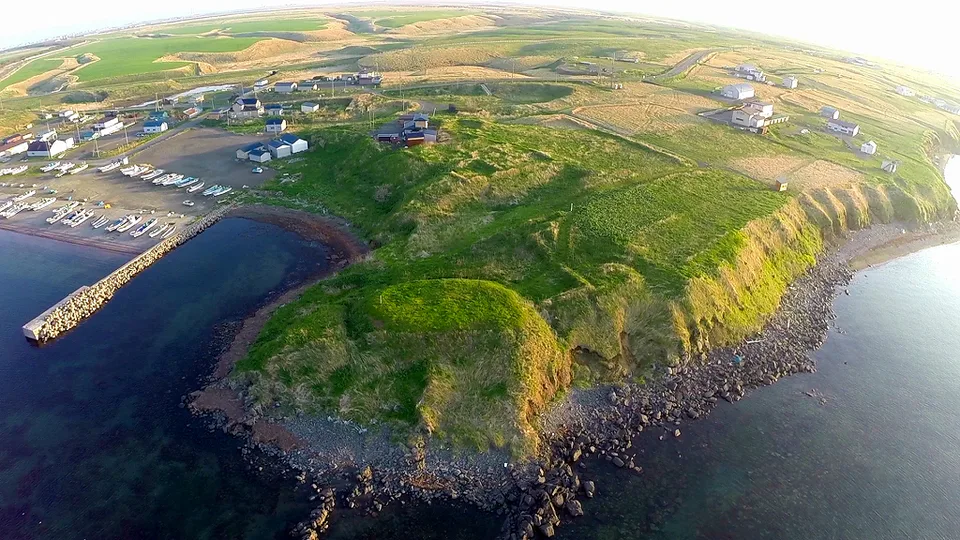
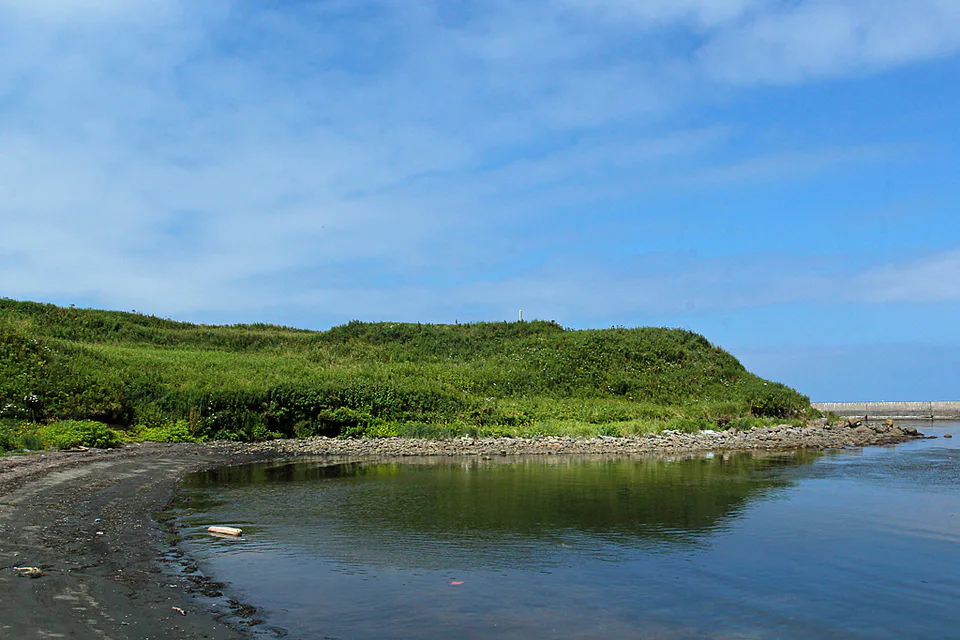
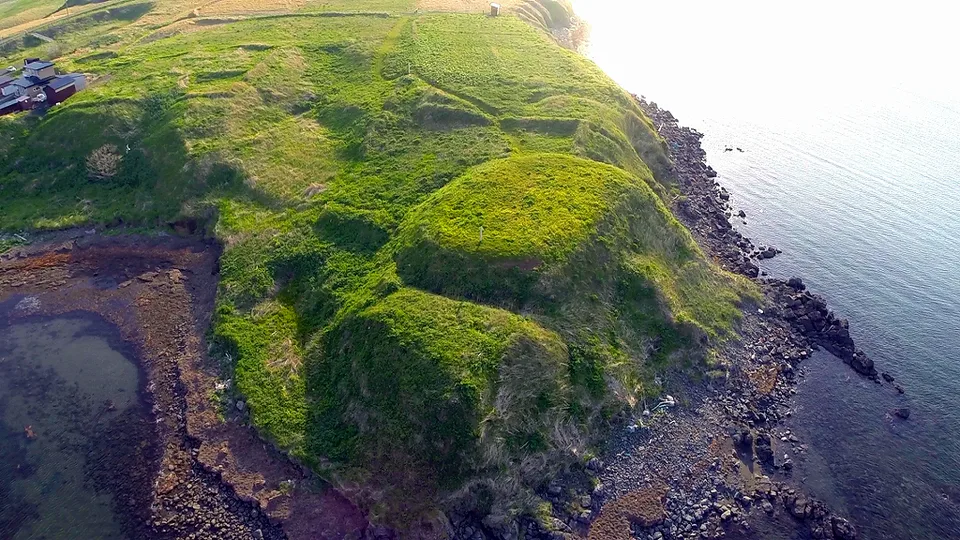
If you visit only one archaeological location, make it Onnemoto. Official local information describes it on a projecting headland on the western side of Onnemoto Bay, with earthwork and a ditch dividing the enclosure and two flattened areas on top. From the fishing-port side, the silhouette has even been compared to stacked ceremonial rice cakes. An aerial view explains the place far better than a close-up photograph: what first appears to be a natural coastal mound contains deliberate cuts, raised edges and usable platforms.
This is why a quick ‘grass and sea’ photo often leaves people wondering what they were supposed to see. Start with the interpretation board and the prepared path. Then move your attention from the depression and raised ground beneath your feet to the cliff line and the bay. With earth-built archaeology, the object is not a single wall or tower; the point is how people altered and controlled a piece of terrain.
With a car and enough time, Notsukamafu No.1 and No.2 are the logical second stop because they are also among the areas currently prepared for visitors. Seeing more than one site makes the regional pattern easier to understand, including the use of coastal cliffs and enclosure ditches. But if you have only an hour, do not force a second site into the day just to increase your count.
The easiest way to waste the trip: the stamp has three locations, but the ruins are somewhere else
Japan’s 100 Famous Castles No.1 currently has three official stamp locations: the Nemuro City Museum of History and Nature, the Nemuro Tourist Information Center, and the Northern Territories Museum at Nosappu Cape. You do not need to reach Onnemoto to get the stamp. The reverse is equally important: getting the stamp beside Nemuro Station does not mean you have physically visited the archaeological site.
↔ Scroll table left or right
Stamp location | Best for | What to check now |
Nemuro Tourist Information Center | JR/bus travellers who want to secure the stamp first | Beside Nemuro Station; the current city page checked in Aug 2026 lists 9:00–17:00 and a year-end/New Year closure. |
Nemuro City Museum of History and Nature | Travellers who want models and context before the site | Current official information lists 9:30–16:30 and free admission; fixed closures and a monthly calendar apply. |
Northern Territories Museum, Nosappu Cape | Anyone already visiting Nosappu Cape | From this area, Onnemoto is about 2.7 km / roughly 40 minutes on foot; confirm opening before travel. |
The Tourist Information Center is the best transport-risk backup because it sits by Nemuro Station and the bus terminal. If you arrive by JR and still need to connect to the Nosappu route, securing the stamp here first protects the collection part of the day before you commit to weather-sensitive walking.
The Museum of History and Nature is the better choice if your goal is to understand the site before you see it. The current official information checked for this article lists 9:30–16:30 and free admission, with regular closure days and a monthly calendar. It contains chashi-related material and models. But it is not simply a stop on the way to Onnemoto, so do not assume you can stamp there and then walk straight to the ruins.
The third stamp location is at Nosappu Cape. This is where distance is easy to misread. One official tourism reference gives the walk from the Northern Territories Museum to Onnemoto as about 2.7 km and roughly 40 minutes; another official attraction description has described the walk from the Nosappu bus area as around 30 minutes. You do not need to choose one number and pretend the other is wrong. For planning, treat the final approach as at least 30–40 minutes each way, not as a five-minute detour beside the cape.
You can do it without a car — but the real cost is walking plus the return bus
Driving is the simplest version. Current local sightseeing information puts central Nemuro to Onnemoto at roughly 40 minutes by car, with Onnemoto about 10 minutes back from Nosappu Cape toward Nemuro. If Nosappu Cape is already on your day, the efficient route is to keep the cape and Onnemoto in the same peninsula loop rather than bouncing back to Nemuro between them.
Without a car, separate the Nosappu bus from the final walk in your planning. After Nemuro Kotsu’s April 2026 fare revision, its current timetable page lists a discounted round-trip ticket between the Nemuro terminal and Nosappu Cape at ¥2,460. That ticket solves the long road journey from the city to the cape. It does not deliver you to the archaeological enclosure. You still need roughly 30–40 minutes on foot to Onnemoto and the same distance back, while also allowing time for the cape, the museum and the bus you must not miss.
That is why the key question for a no-car No.1 visit is not ‘can I get there?’ but ‘which return bus am I protecting?’ Read the current timetable first and work backwards. If you are planning the wider island by rail and bus, use our Hokkaido Without a Car: A Realistic 7-Day Winter Itinerary to decide whether a remote walking segment deserves a place in the route. If the buffer is too thin, cancel the site visit and keep the stamp plus Nosappu Cape. Missing an archaeological stop is a far better outcome than being stranded by a missed return connection.
Do you need a ticket? No — and there is no paid ‘upgrade’ that changes the experience
Onnemoto and Notsukamafu are not keep, museum or ropeway attractions, and the current official visitor information does not present a paid admission system for the archaeological sites. Your meaningful costs are getting to Nemuro, moving around the peninsula and deciding whether a taxi or rental car is worth paying for. If you want more context first, the Nemuro City Museum of History and Nature is currently free, so there is no conventional ‘pay extra for the tower or viewpoint’ decision here either.
That is useful because it exposes the real trade-off. If your Japan 100 Castles project is mainly about surviving architecture, there is no premium ticket that will turn No.1 into Himeji or Matsumoto. If you are willing to read archaeological terrain, put your money into making the transport reliable rather than hunting for a castle ticket that does not exist.
Counterargument: if I can stamp No.1 at Nemuro Station, why walk to the site at all?
If your objective is literally to complete the stamp book, you do not need to pretend that walking to Onnemoto is mandatory. The official system places the stamp at three facilities, which makes it entirely legitimate to separate ‘collecting the stamp’ from ‘entering the archaeological site’. In winter, strong wind, rain, poor bus connections or limited mobility, getting the stamp in town can be the sensible and safer Plan B.
But if you want to say that you have seen No.1, the answer changes. The value of the Nemuro Peninsula sites lies in how coastal cliffs, ditches, raised earth and flat working surfaces form a place. A stamp image cannot show that. For collectors, the best mental model is simple: the stamp is the record; the physical site is the content. They can be completed in different locations, but they are not the same experience.
Winter is the biggest no-go: the official guidance says the sites are not snow-cleared
Nemuro City’s official information gives a blunt warning that matters more than almost any other seasonal detail: the chashi sites are not cleared of snow in winter. This is not a minor ‘wear better boots’ note. It changes whether the outdoor archaeological visit should be a fixed part of the day at all.
For a winter trip without a car, make Onnemoto optional rather than mandatory. Keep the Nemuro Station stamp, museum or Nosappu Cape as the controllable parts, then decide on the site from current road, snow, wind and walking conditions. Even if you drive, do not copy a summer 40-minute estimate into a winter plan. Read our Hokkaido Winter Driving Guide first, because the road risk and the unsnow-cleared walking surface are two separate problems.
This is also not a managed theme-park environment. Current local guidance tells visitors to use the designated parking area, avoid parking outside the approved space, and stay out of fishing-port work zones, private land and kelp-working areas. The guidance goes so far as to warn that repeated parking and trespass problems could threaten future access at Onnemoto. The mistake to avoid is not ‘missing the perfect photo’; it is following a tyre track or apparent shortcut into an area visitors are not meant to use.
Three ways to schedule No.1 without letting it hijack the whole day
Driving + Nosappu Cape: secure the stamp first, put the outdoor site later
Start in Nemuro, collect the stamp at the Tourist Information Center beside the station, then drive to Nosappu Cape. After the cape and the Northern Territories Museum, visit Onnemoto on the way back toward Nemuro. The logic is risk management: once the stamp is secured, a sudden weather change can remove the outdoor archaeology from the day without also ruining the collection goal.
Driving + archaeology: see the museum model before the grass and earthworks
Start with the Museum of History and Nature, use its models and material to understand what you are looking for, then visit Onnemoto. Add Notsukamafu only if time remains. This is the better sequence for anyone genuinely asking why the site belongs on a castle list, because you arrive with a visual vocabulary instead of seeing only a grassy coast.
No car: the return bus is the hard limit; the archaeological site is the cancellable item
Confirm the day’s bus timetable and stamp access in Nemuro first, ride to Nosappu Cape, and walk to Onnemoto only if weather, walking ability and return timing all pass. If any one of those three fails, stay at Nosappu. There is no timed castle ticket here that justifies trading away the last reliable connection for a checkbox.
Who should go — and who can skip it without regret
Japan 100 Castles collectors: Go. No.1 is valuable precisely because it breaks the assumption that every castle is a keep. If conditions allow, see at least one prepared archaeological site.
Travellers already visiting Nemuro and Nosappu Cape: Go, especially by car. The marginal travel cost is far lower than making a dedicated detour from western Hokkaido.
Travellers interested in Ainu history, archaeology or topography: Go, but use the museum or official aerial material first so the earthworks make sense on arrival.
People who only enjoy surviving keeps and stone walls: Skip it. Staying longer will not reveal a more conventional castle hidden around the corner.
First-time Hokkaido visitors with only 5–7 days centred on Sapporo, Otaru or Hakodate: Skip it unless eastern Hokkaido already has another strong reason to be in your itinerary. The No.1 label should not override geography.
Winter visitors without a car, or groups that cannot handle a long outdoor walk: Make the site cancellable. The stamp has urban backups; collecting progress should not dictate safety.
Failure plans: museum closed, bad weather, or the bus connection does not work
If the Museum of History and Nature is closed, do not assume the stamp is lost. There are currently three official stamp locations, so the Tourist Information Center by Nemuro Station and the Northern Territories Museum at Nosappu Cape are alternatives. The museum’s closure calendar can change month by month, so check the current official page immediately before travel rather than relying on an old blog timetable.
If you reach Nemuro and the weather makes Onnemoto a poor walking choice, collect the stamp first and use Nosappu Cape or central Nemuro instead. The sunk-cost thought — ‘I came all this way, so I have to walk it’ — is exactly what turns a manageable itinerary problem into a transport or safety problem.
If the bus timings are unusable, the quickest rescue may be a taxi, rental car or simply abandoning the outdoor site. Local tourism information has previously listed sightseeing-taxi routes that can include chashi, but an old fare example on that page dates from 2019. This article does not present that historic number as a 2026 price. If you want a taxi, ask the operator for a current quote.
Put No.1 into an eastern-Hokkaido route — not a numerical castle route
The Nemuro Peninsula sites belong inside an eastern-Hokkaido itinerary, not a ‘castle No.1 then No.2’ itinerary. The official No.2 is Goryokaku in Hakodate, but those two sites are not neighbouring stops that naturally belong in one day or even one regional cluster. The numbering is a list order, not a recommended travel sequence. If you are still deciding whether your Hokkaido trip belongs in central, southern or eastern Hokkaido, start with our Hokkaido Travel Itinerary: Choose Regions by Season, Nights, Airport and Transport and make sure Nemuro was already inside your realistic travel radius.
In winter, having a car does not automatically make eastern Hokkaido the right extension. Compare a full-trip rental with a partial rental in Hokkaido Winter Rental Car: Full Trip or Partial Rental? before stretching the driving area. Remote-route navigation also deserves more redundancy than a city trip, so prepare offline maps and mobile-data backup with Best eSIM for Hokkaido: Sapporo, Rural Drives and Ski Trips.
The route that usually makes the most sense is a night in Nemuro combined with Nosappu Cape and Onnemoto, rather than attempting a same-day return from another major Hokkaido city. When our No.2 Goryokaku article is complete, the two articles can link into a wider Hokkaido castle cluster — but the actual trip should still be built by geography, not by the numbers printed in the stamp book.
Final verdict: separate ‘getting the stamp’ from ‘seeing the castle’ and the decision becomes easy
The Nemuro Peninsula Ainu Fortified Enclosure Sites are worth visiting, but not because they are No.1 and not because a single spectacular building waits at the end. Their value is that the first entry on the list forces a useful idea on you immediately: a castle can be a landscape that people selected, cut, raised and assigned functions to, not only a keep.
If you are a collector: secure the stamp, then visit Onnemoto; add Notsukamafu only if you have the car, time and interest.
If you are a general independent traveller: make the detour only when Nemuro/Nosappu is already in the trip or Ainu history and earthwork archaeology genuinely interest you.
If you have no car: count the 30–40 minute walk each way together with the return bus, not as an afterthought after arriving at Nosappu.
If you visit in winter: make the outdoor site optional because the official guidance says it is not snow-cleared.
If you only want keeps, stone walls and gates: skip No.1 and spend the time on a castle that matches what you actually enjoy.
Before departure, re-check three things: whether your chosen stamp facility is open, the latest Nosappu bus timetable, and whether current conditions make the Onnemoto walk sensible. When all three work, No.1 belongs in the itinerary. When they do not, the stamp backup gives you permission to change the day rather than forcing it.
Official sources and verification date
Last checked: 19 August 2026. Castle identity and numbering: Japan Castle Foundation — official Japan 100 Famous Castles list.
Site remains, visitor access, parking and walking context: Nemuro Tourism Association — Onnemoto site; winter/no-snow-clearance and historic-site information: Nemuro City — Nemuro Peninsula archaeological sites.
Stamp and opening checks: Nemuro City Museum of History and Nature closure calendar, Nemuro Tourist Information Center; bus fares and timetables: Nemuro Kotsu official timetable.