NIFREL is worth the detour when you already want an EXPOCITY / Expo ’70 Commemorative Park half-day, or when a design-led, close-observation animal museum fits your family better than a giant aquarium. For a first Osaka trip with only one aquarium-style attraction slot, I would still start with Kaiyukan if whale sharks, the huge Pacific tank and classic aquarium scale are the priority. NIFREL becomes the stronger choice when the smaller-format exhibits, mixed aquarium/zoo/art approach and the surrounding Expo area are part of the plan rather than an extra cross-city errand.
The ticket is not the hardest part of this decision. NIFREL’s current adult admission is JPY 2,400 (about USD 15.10). The larger opportunity cost is geographical: the museum is inside EXPOCITY in Suita and uses Bampaku-kinen-koen on the Osaka Monorail, so a central-Osaka traveller is committing a meaningful part of the day to the Expo area. Price that detour before deciding whether a JPY 2,400 attraction is “good value.” USD conversions in this guide use the August 26, 2026 reference rate of roughly JPY 1,000 = USD 6.29; card-network and issuer rates will differ.
↔ Scroll table left or right
Your trip | Better first choice | Why | What can reverse it |
First Osaka visit, one aquarium slot | Kaiyukan | Classic large-scale aquarium experience and whale sharks in the Pacific tank | You specifically prefer smaller, design-led exhibits or are already going to EXPOCITY |
Family day around EXPOCITY / Expo Park | NIFREL | The museum becomes one part of a coherent area day instead of a standalone detour | Your children mainly want one giant-aquarium spectacle |
Repeat Osaka visitor who has already done Kaiyukan | NIFREL | It offers a different exhibition format rather than a smaller copy of the same product | You have only a short central-Osaka stay and no other reason to travel north |
Rainy day | NIFREL can work well | The museum itself is indoors and EXPOCITY provides indoor follow-on options | Your original pairing was mostly outdoor Expo Park activity, reducing the value of the area detour |
Large suitcase on a transfer day | Reconsider the timing | NIFREL has lockers, but it does not accept luggage that exceeds the locker sizes | Your bag fits the available locker and the Expo area is genuinely on the transfer route |
ValueNavi attraction profile: NIFREL is strong on weather and pacing, weak on central-Osaka route fit
This profile is an editorial decision model, not an official NIFREL rating. It uses the same direction for every score: 10 means more useful or lower-friction for the named travel decision. Route fit assumes a visitor staying in central Osaka; change that score upward if EXPOCITY or Expo Park is already on your route. I do not average these into one overall score because a 5.8 route-fit problem matters far more to a two-day first visit than to a family already spending the afternoon in Suita.
Decision dimension | ValueNavi score | Why |
|---|---|---|
Experience distinctiveness | Aquarium, zoo and design-museum formats are mixed rather than copied from a classic large aquarium | |
Weather resilience | The core museum is indoors; rain mainly changes what you pair with it | |
Family pacing | Works as a lower-intensity two-to-three-hour block with food and indoor follow-on options nearby | |
Booking friction | Advance tickets are straightforward, but timed-entry availability and non-refundable third-party terms can reduce flexibility | |
Price transparency | Official age-based admission is simple; the larger hidden cost is transport time, not a complicated ticket stack | |
Central-Osaka route fit | The Osaka Monorail / Expo-area detour is the main reason a good attraction can still be a weak itinerary choice | |
First-trip priority | Good, but easier to cut than central Osaka icons when a first visit has only two or three usable days |
The useful conclusion is not “NIFREL scores 7-point-something.” It is that its strongest dimensions do not cancel its weakest one. If the route fit is poor, the attraction needs a second Expo-area reason to earn the half-day. If the route fit is already solved, its indoor resilience and family pacing become much more valuable.
NIFREL and Kaiyukan solve different attraction problems
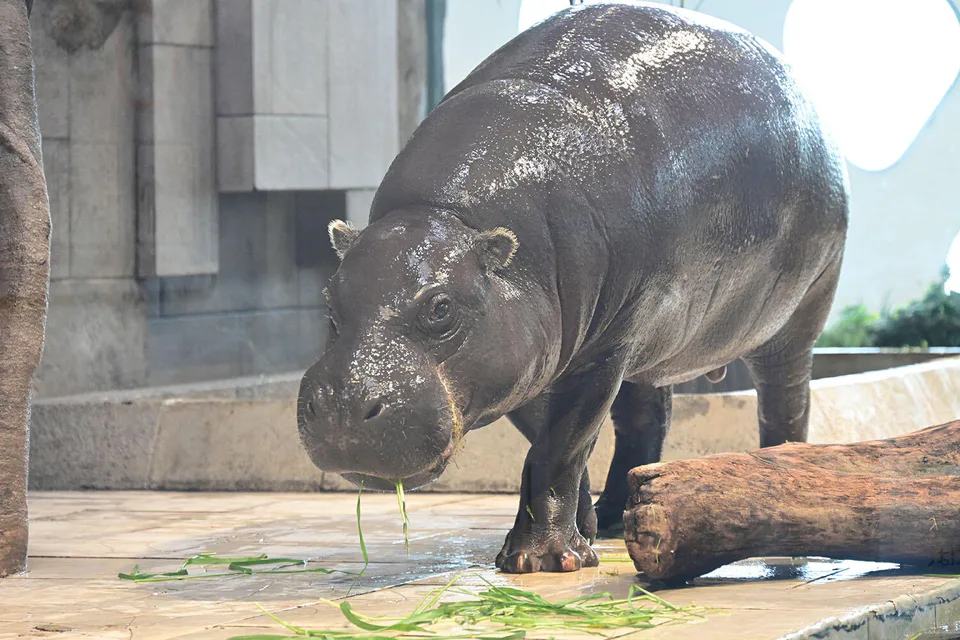
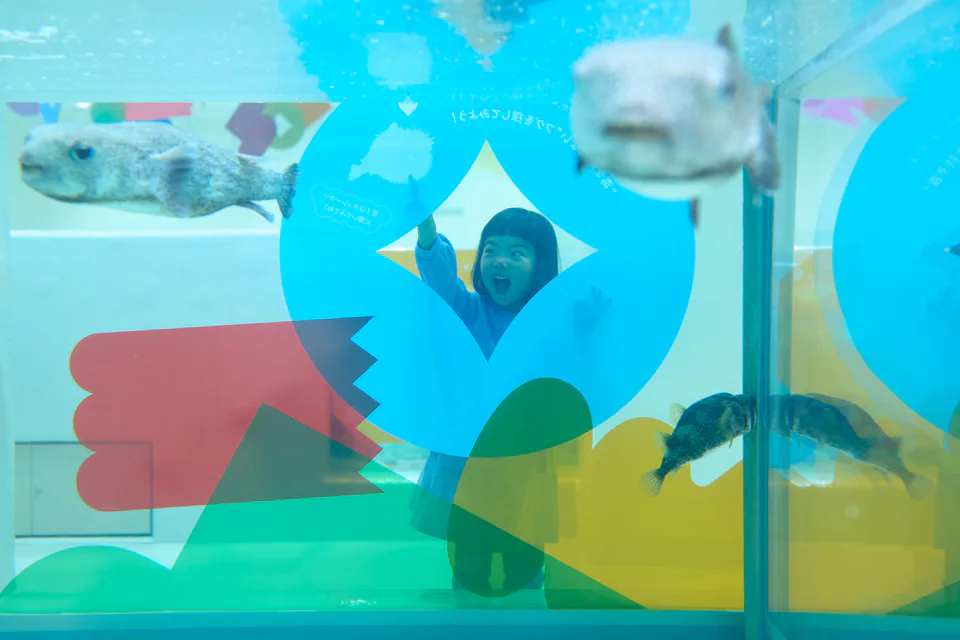
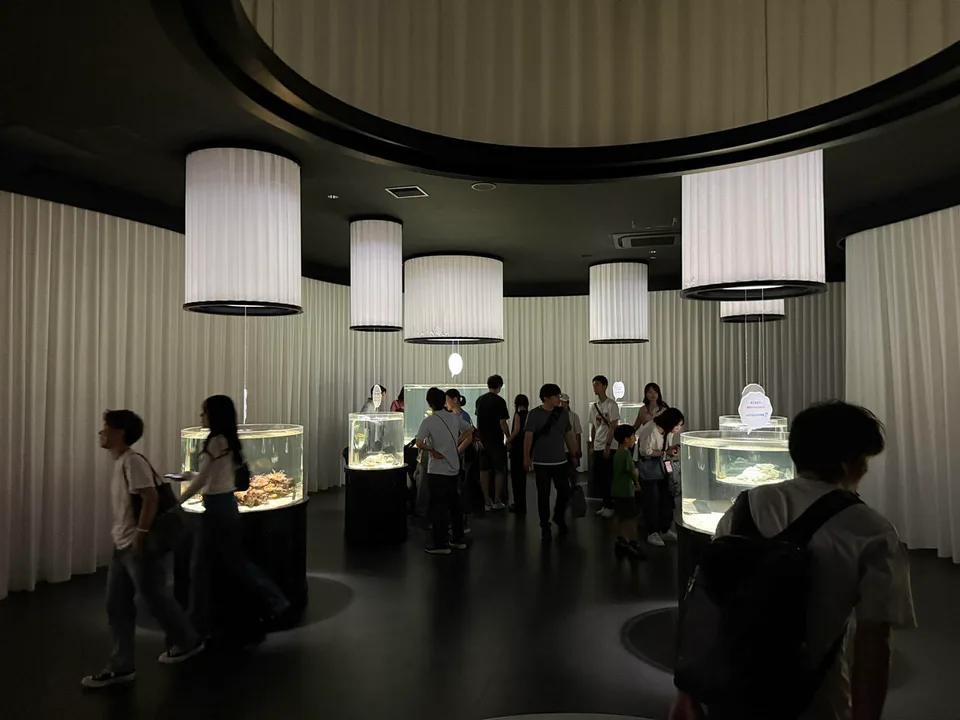
The most useful way to compare them is not tank size alone. NIFREL describes itself as an interactive aquazoo built around inspiration and the characteristics of living things. Its floor sequence mixes aquatic exhibits, animal spaces, visual installations and participation areas. That makes it closer to an aquarium-zoo-museum hybrid than to a conventional giant aquarium.
Kaiyukan’s current product is much easier to define: it is a large aquarium built around the Pacific Ocean tank and species including whale sharks. Kaiyukan says many visitors spend about two hours inside, and its current admission uses variable pricing. For a traveller who has never visited a major Japanese aquarium, that scale is a strong reason to choose Kaiyukan first.
NIFREL is better when scale is not the goal. The visitor moves between smaller-format displays, mixed species, lighting and design-led spaces. That can suit younger children, repeat Osaka visitors and adults who enjoy exhibit design more than one giant centrepiece.
ValueNavi rule: do not call NIFREL “a smaller Kaiyukan.” If you compare it that way, Kaiyukan wins almost automatically. Compare the experience format and the geography of the whole day.
The Expo-area detour is the real admission surcharge
NIFREL’s official access page places it inside EXPOCITY and directs visitors to the EXPOCITY access system. Current third-party ticket pages also describe Bampaku-kinen-koen Station as roughly a two-minute walk from the venue. Once you are at that station, access is straightforward. The cost is getting from your actual Osaka base onto the Osaka Monorail network.
This makes the attraction more natural from northern Osaka than from a Namba-heavy itinerary, but I would not choose an entire hotel for one museum. Use the Namba vs Umeda comparison for the full stay, then decide whether the Expo area deserves one day block.
The best pairings are geographically honest:
NIFREL + EXPOCITY: strong family / rainy-day combination because shopping, food and additional entertainment stay in the same complex.
NIFREL + Expo ’70 Commemorative Park: strong in good weather when the park is already a destination.
NIFREL + central Osaka + another distant district: weak. You are paying the monorail detour and then immediately paying another city transfer.
If the museum is the only reason you are travelling to Suita, the burden of proof should be higher than its JPY 2,400 (about USD 15.10) ticket price suggests.
Two to three hours is a planning allowance, not an official completion time
NIFREL does not require a fixed viewing duration. Klook currently suggests one to three hours, while the museum’s exhibition format allows visitors to move at their own pace. For itinerary planning, I would allow about two hours for an adult/couple visit and up to three hours for a family that stops often. Those are ValueNavi planning allowances, not official promised durations.
The key decision is what happens after those hours. If the day ends at EXPOCITY, three hours can be fine. If you have a 15:00 reservation back in central Osaka, the same three-hour museum visit creates a much tighter morning because the return journey is part of the booking.
Do not stretch the visit just to “get value” from the ticket. NIFREL’s value is attention, not floor area. When the group has seen enough, use the time elsewhere in the Expo area instead of circling exhibits to justify the admission.
The 2026 Poison zone makes a repeat visit more defensible
NIFREL opened its new Poison zone on March 18, 2026. The current official information lists 33 species and about 230 specimens across 18 tanks, using poisonous and venomous animals to explain survival traits rather than treating poison only as danger.
This matters most for repeat visitors. Someone who last visited before March 2026 now has a genuinely new permanent zone to see. For a first-time visitor, Poison is simply part of the current museum rather than an extra reason to add NIFREL to a crowded Osaka itinerary.
The distinction prevents a common event-planning mistake: a new zone can increase the attraction’s value, but it does not reduce the transport time required to reach it.
Current ticket price: compare the final trip, not the aquarium label
NIFREL currently lists standard admission at:
JPY 2,400 (about USD 15.10) for ages 16 and over;
JPY 1,200 (about USD 7.55) for ages 7–15;
JPY 700 (about USD 4.40) for ages 3–6;
free for children under three.
Regular hours are generally 10:00–18:00 with final entry at 17:00, although the museum tells visitors to verify the actual date because hours can change. NIFREL’s FAQ also says admission may use timed entry, especially on weekends and holidays, so a spontaneous arrival can have fewer time choices than an advance web ticket.
Kaiyukan currently uses variable pricing. Its official current group-information page lists adult admission at JPY 2,700–3,200 (about USD 16.98–20.13), with no group discount. That means the raw ticket difference between the two attractions is often smaller than the transport/opportunity-cost difference between Tempozan and EXPOCITY.
If NIFREL saves roughly JPY 500 (about USD 3.15) but adds a half-day detour you did not want, it is not the cheaper attraction. If you were already spending the day around Expo Park, the same JPY 2,400 can be excellent value.
Families should check the trip around the museum, not only the child price
NIFREL is structurally easy to use with families: the official guide lists accessible restrooms on both floors, nursing rooms and service-dog access. It also imposes behavioural rules such as no touching animals and no tapping on tanks; the closeness of the exhibits is visual, not a petting-zoo promise.
The more useful family decision is energy. Compared with USJ or a long outdoor park day, NIFREL is a lower-step, weather-protected block. It can work particularly well on the middle day of a trip when adults and children need something interesting without another high-intensity schedule.
That does not make it automatically better than Kaiyukan for children. A child fascinated by whale sharks may get more from the large aquarium. A child who tires of long dark aquarium corridors but responds to changing room formats may fit NIFREL better. Choose by attention style, not a “family-friendly” badge.
Large luggage is a hard boundary on a transfer day
NIFREL currently has 58 paid coin lockers on the first floor: 31 small, 21 medium and six large. The largest locker’s internal dimensions are listed as approximately W355 × D645 × H843 mm and costs JPY 600 (about USD 3.77). The museum explicitly states that it does not accept luggage that does not fit in the lockers.
This is a much more useful fact than “lockers available.” A full-size suitcase can exceed one of those dimensions depending on its shape, and only six large lockers exist. Do not build a Kyoto→Osaka or Osaka→airport transfer day around the assumption that NIFREL will hold any bag.
If the attraction falls on a hotel-change day, leave the main luggage with the hotel, forward it, or confirm another storage solution. The Japan luggage-forwarding guide covers that wider workflow.
Rain changes the best pairing, not necessarily the attraction
NIFREL itself is an indoor attraction, so ordinary rain does not remove its core value. The problem is what you planned to pair with it. If the second half of the day was a long outdoor Expo ’70 Commemorative Park walk, bad weather weakens the reason for making the trip north. If the fallback is EXPOCITY shopping, food, cinema or another indoor facility, the area remains more resilient.
Use the weather to change the pairing, not automatically cancel the museum. If the whole Expo-area day loses its purpose, stay central and use a closer indoor attraction instead.
NIFREL vs Kaiyukan: use the one-slot test
If there is room for only one of them:
Choose Kaiyukan for whale sharks, major-aquarium scale, a first-time aquarium experience and a Tempozan/Osaka Bay day.
Choose NIFREL for close-format observation, aquarium/zoo/art hybrid design, a lower-intensity family block or an EXPOCITY/Expo Park day.
Do not choose both by default on a short Osaka stay. Two aquarium-adjacent attractions can consume two scarce half-days while Namba, Umeda, Shinsekai, Osaka Castle, USJ or Kyoto are competing for the same trip.
If your Osaka stay is only two or three usable days, ask which one creates the more coherent day rather than which attraction has the better review score.
Ticket platforms: flexibility matters more than a tiny coupon
NIFREL sells official web admission, and Klook and KKday currently also list electronic tickets. As checked on August 25, 2026, both third-party products show a 120-day validity window. Klook currently states that its NIFREL voucher cannot be cancelled, refunded or changed; KKday likewise lists a non-refundable product and QR-code entry.
That makes unusually early purchase poor value when the attraction day is still weather- or itinerary-sensitive. Compare the final checkout price, any account credits and the flexibility you are giving up. A small discount is not useful if it locks in the wrong Expo-area day.
Compare the current NIFREL ticket on Klook
Compare the current NIFREL ticket on KKday
Three trip patterns where the answer changes
First Osaka trip, three usable days
I would not add NIFREL unless Expo Park / EXPOCITY is already one of the trip’s priorities. Kaiyukan is the easier one-slot aquarium choice when a major aquarium is on the wish list. Otherwise protect the central Osaka days.
Family trip, four to five Osaka days, one lower-intensity day needed
NIFREL gets much stronger. Pair it with EXPOCITY, keep food and shopping close, and use the day as a physical reset between higher-step attractions.
Repeat Osaka visit, Kaiyukan already done
NIFREL becomes a genuinely different attraction rather than a substitute. The 2026 Poison zone adds another reason for someone whose previous visit was before March 18, 2026.
Final verdict: buy the Expo-area half-day before you buy the ticket
NIFREL is worth it when the museum belongs to a coherent Expo-area plan. Its current JPY 2,400 adult ticket (about USD 15.10) buys a distinctive aquarium/zoo/art hybrid, and the 2026 Poison zone keeps the product current. What it does not buy is central-Osaka convenience.
For one aquarium slot on a first trip, choose Kaiyukan when the classic large-aquarium spectacle is the goal. Choose NIFREL when the exhibit format, family pacing and EXPOCITY/Expo Park day are the goal. If you cannot name what you will do before or after NIFREL in Suita, reconsider the detour before chasing a ticket discount.
Artizon Museum 2026: Don’t Let Sottsass’s Colorful Furniture Distract You From the Second Exhibition
Cup Noodles Museum Yokohama: The ¥500 Ticket Is the Easy Part — Secure Your Workshop First
Yamagata Castle Guide 2026: Get the Stamp Before Kajo Park’s 10 PM Closing Time
Yokohama Anpanman Children's Museum 2026: Age 1 Pays the Adult Price — Check the Free 1F First
References
NIFREL — official English site · NIFREL — floor, accessibility and lockers · NIFREL — 2026 Poison zone · Kaiyukan — current admission · Klook and KKday current NIFREL e-ticket listings. NIFREL and Kaiyukan official information checked August 26, 2026; third-party ticket terms checked August 25, 2026. Opening hours, timed-entry rules, animal exhibits and ticket conditions can change.