
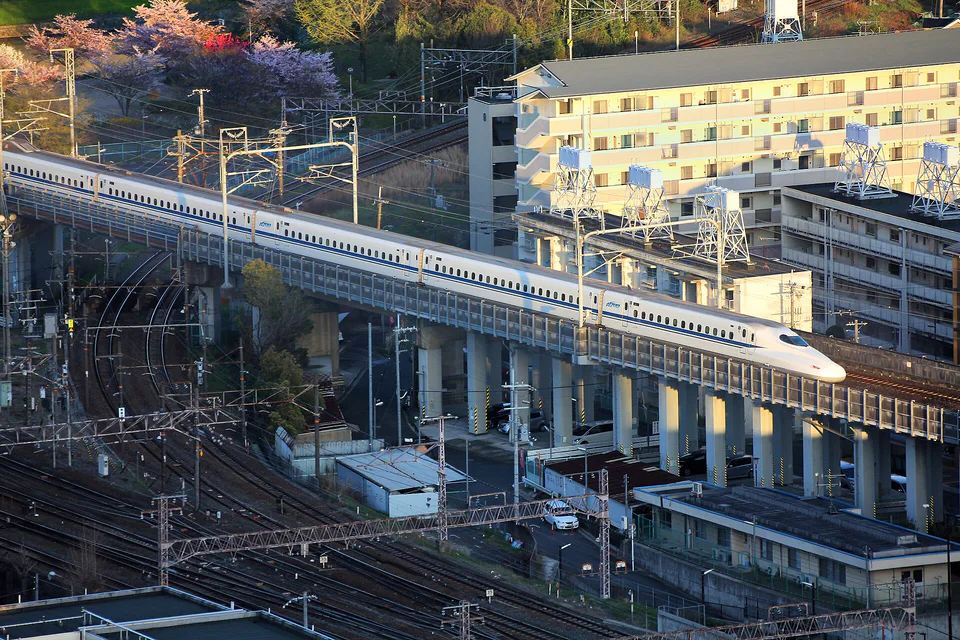
The 2026 Obon Nozomi reserved-only period is over. It ran from August 7 through August 16, 2026. The useful lesson is not to keep warning travellers about dates that have already passed; it is to understand how a peak-period Nozomi changes your fallback plan when every ordinary-car seat requires a reservation.
JR Central has already published later 2026 peak periods using the same reserved-only Nozomi structure, including September 18–23, October 10–12, November 21–23 and December 25, 2026–January 5, 2027. So the Obon framework still matters: book the hard intercity leg first, keep airport arrivals away from a fragile reservation, and treat oversized baggage as a seat-inventory problem.
The 30-second peak-period decision
↔ Scroll table left or right
Your situation | Best default | Why | Failure mode |
Fixed Tokyo–Kyoto/Osaka travel day | Reserve Nozomi early | The fastest train loses its normal non-reserved seating during the target period | Waiting until the day leaves only awkward times or standing |
Landing in Japan shortly before the train | Use a larger buffer or overnight first | Immigration, baggage and airport rail are outside JR's reservation clock | A flight delay turns a good seat into a missed-train problem |
No Nozomi seat available | Change time/day first; then compare Hikari/Kodama | Those trains retain non-reserved cars | Their non-reserved cars can still be extremely crowded |
160–250 cm suitcase | Reserve an oversized-baggage-area seat | Train-level availability does not prove baggage-seat availability | Ordinary seats remain while the required baggage seats are gone |
Standard SmartEX booking and schedule changes | Change before departure when eligible | A pre-departure change is much cleaner than a missed-train fallback | Hayatoku and picked-up/used tickets have different restrictions |
Reserved-only Nozomi does not mean “you cannot board without a reservation”
During JR Central's designated peak periods, Nozomi has no normal non-reserved-seat cars. If you want to sit on Nozomi, you need a reserved-seat limited express ticket.
There is an important nuance. JR Central says a traveller with a non-reserved limited express ticket may board an ordinary-car Nozomi and stand on the deck, subject to crowd control. That is a last-resort transport option, not a substitute for booking a seat. The operator explicitly warns that overcrowding can mean you cannot board the desired train at all.
Hikari and Kodama retain non-reserved seating during these peak periods, but JR also warns those cars can be crowded. So the fallback hierarchy is:
reserve a different Nozomi time with a seat;
if possible, shift the travel day outside the worst demand;
reserve Hikari/Kodama if a suitable service has seats;
use non-reserved/standing options only when you accept the crowd risk.
The 2026 calendar shows this is no longer an Obon-only problem
JR Central's current 2026 fiscal-year list applies all-reserved Nozomi operation to several major periods. After the finished August 7–16 Obon block, the published periods include:
September 18–23, 2026: Silver Week;
October 10–12, 2026: Sports Day weekend;
November 21–23, 2026: Labour Thanksgiving weekend;
December 25, 2026–January 5, 2027: New Year peak.
Do not generalise those dates into 2027 Obon. Peak-period dates are published by JR and should be checked for the actual travel year.
Reserve the journey whose failure changes the hotel, not every train in Japan
A peak-period reservation deserves priority when losing it changes the structure of the trip: Tokyo to Kyoto on a hotel-change day, Kyoto to Hiroshima before a fixed activity, or Shin-Osaka to Hakata before a non-refundable evening.
An ordinary local train after hotel check-in does not need the same booking anxiety. The useful principle is reserve by consequence of failure, not simply by distance.
If Tokyo is the departure base, compare Tokyo Station vs Shinjuku before moving hotels solely for one train. Shinagawa can also be the simpler boarding station after Haneda, depending on the route.
Airport arrival plus reserved Nozomi is a two-system connection
A Shinkansen reservation cannot protect you from a late inbound flight. Immigration queues, baggage delivery, customs and the airport-to-station journey all happen before JR can carry you.
That creates a simple risk test:
↔ Scroll table left or right
Arrival pattern | Planning call |
Domestic Japan flight with generous margin | A same-day reserved Nozomi can be reasonable |
International arrival + checked baggage | Protect a larger buffer; do not buy the prettiest tight connection |
Late international arrival before a long westbound move | Consider sleeping in Tokyo/Shinagawa and travelling next morning |
Non-refundable Hayatoku ticket | Use an even larger buffer because the missed-train protection is weaker |
If one missed train would also make you miss ryokan dinner or final local transport, the buffer should protect that downstream deadline as well.
Missing a standard SmartEX train is not the same as missing a Hayatoku train
SmartEX currently says that if you miss a reserved train on the standard product, you can normally use a non-reserved seat on a later train on the same day over the same section. Hayatoku fares are excluded: they are valid only for the reserved train and facility, so another train normally requires a new purchase.
During a reserved-only Nozomi period, the general missed-train rule meets the peak-period seating rule. JR Central separately explains that a missed reserved Nozomi can be followed by standing on the deck of a later Nozomi ordinary car, or by using non-reserved seating on Hikari/Kodama and the other eligible trains on the same day. To sit in a later reserved Nozomi seat, you need the appropriate new reserved-seat ticket.
Editorial rule: if you can see the connection slipping, change an eligible SmartEX reservation before the scheduled departure rather than treating the missed-train rule as your Plan A.
Oversized baggage can sell out before the train does
On the Tokaido, Sanyo and Kyushu Shinkansen, baggage with total dimensions of 160 cm or more and up to 250 cm requires a reservation for a seat with an oversized-baggage area. SmartEX warns that the train can still show general seat availability even when those specific baggage-area seats are unavailable.
This matters more in peak periods because your real inventory is not “two seats on the 09:00 Nozomi.” It may be “two adjacent seats, one with the required baggage space, on a train that still reaches Kyoto before hotel check-in.” That is a much smaller pool.
If large cases are not needed on the intercity leg, luggage forwarding can remove that constraint entirely.
Families should optimise adjacent seats before they optimise the departure minute
A solo traveller can often accept a later train, a separated seat or standing as a last resort. A family with children has fewer acceptable fallbacks. If sitting together matters, search a wider departure-time range rather than insisting on one exact Nozomi.
Likewise, a 15-minute faster departure is not useful if it forces the family to split across cars, loses the baggage-area seat or creates an airport connection with no recovery margin.
Final verdict
The 2026 Obon rule mattered because it removed the normal “I will just use a non-reserved Nozomi car” fallback. That period ended on August 16, but the same planning logic applies to JR Central's other published peak periods later in 2026.
Reserve the hard intercity move early, especially when you need adjacent seats or oversized-baggage space. Change an eligible SmartEX booking before departure when plans slip. If Nozomi is full, widen the time/day before relying on standing or a crowded non-reserved Hikari/Kodama. And after August 2026, do not keep treating Obon dates as current: check JR's live peak-period calendar for the journey you are actually taking.
Sources and verification date
Checked August 26, 2026 against JR Central's peak-period Nozomi guidance, SmartEX missed-train rules and SmartEX oversized-baggage rules. The 2026 Obon reserved-only period has finished. Peak-period dates, train inventory and fare-product conditions should be rechecked for the actual travel date.
40 Best Things to Do in Tokyo in 2026 — What’s Actually Worth Your Time by Area
Saitama Railway Museum 2026: The Advance Ticket Saves Only ¥100 — The Experiences Matter More
Kumagaya Fireworks Seats vs Free Viewing: What 2026 Prices Actually Bought
Japan Autumn Leaves in Early November 2026: What You Can Book Before the Forecast Exists
Nada no Kenka Matsuri 2026: If You Only Go One Day, Choose Oct 15