
As of August 26, 2026, Chofu on September 12 is the only future event among the four fireworks festivals compared here. Sumida River took place on July 25; Edogawa and Itabashi both took place on August 1. Do not use an old summer roundup that still presents those three as upcoming. For a traveller visiting Tokyo after August 26, the live decision is whether Chofu deserves the evening. The other events remain useful as evidence of four very different Tokyo fireworks models.
The right comparison is not launch count. A fireworks night is a crowd-management product: how certain is your viewing place, how long is the walk from the station, what happens after the finale, how much of the evening is exposed to weather, and whether the event's geography fits your hotel.
2026 status first: what is still actionable?
↔ Scroll table left or right
Event | 2026 date | Status on Aug 26 | Planning lesson |
Sumida River Fireworks | Jul 25, 19:00–20:30 | Finished | Central-city atmosphere comes with the heaviest pedestrian/exit friction |
Edogawa Fireworks | Aug 1, 19:15–20:20 | Finished | Large riverbank scale rewards arrival planning more than central-city convenience |
Itabashi Fireworks | Aug 1, 19:00–20:30 | Finished | Event-year map changes can invalidate old free-viewing advice |
Chofu Fireworks | Sep 12, 18:15–19:15 | Upcoming | Best live 2026 comparison between paid-seat certainty and suburban exit friction |
ValueNavi Fireworks Friction Score
This is a ValueNavi editorial planning score, not a ranking of firework quality. We score viewing-place certainty (20%), exit resilience (25%), route fit from central Tokyo (15%), weather recovery (15%), free-view predictability (15%) and schedule flexibility (10%). Higher means the night is easier to execute without hours of avoidable uncertainty.
2026 viewing model | Friction score | Why | Main failure mode |
|---|---|---|---|
Chofu paid seat | High viewing certainty and clearly assigned venue access | The seat does not solve the post-show station queue | |
Chofu free viewing | Upcoming, accessible and flexible before the event | Place-holding plus exit congestion remain uncertain | |
Edogawa free-view strategy | Large riverbank viewing model and strong show scale | Long crowd corridors and strict event-day movement conditions | |
Itabashi free-view strategy | Riverbank format can work well when the current-year map is understood | 2026 free-area relocation and movement restrictions punished old-route assumptions | |
Sumida general viewing | Exceptional central-Tokyo atmosphere | Very low place certainty and severe pedestrian/exit pressure |
A lower score does not mean a worse spectacle. Sumida can be the most memorable choice for somebody who wants Asakusa atmosphere. The score answers a narrower question: how much operational friction must you accept to get that experience?
ValueNavi Fireworks Time Cost: the show is only part of the night
Use this formula before calling an event “only one hour”:
True fireworks block = approach + early-arrival buffer + place-holding / entry + show + controlled exit + final ride to hotel
A 60-minute Chofu show can therefore consume most of the late afternoon and evening. The same applies to a 90-minute Sumida or Itabashi program. Fireworks are one of the clearest examples of an attraction where headline duration badly understates trip cost.
ValueNavi threshold: if the event requires you to leave your previous district more than two hours before launch and you cannot expect to resume normal sightseeing for roughly an hour after the finale, treat it as an evening anchor, not an add-on.
Chofu is the live 2026 decision: September 12, about 10,000 fireworks
The 41st Chofu Fireworks is scheduled for Saturday, September 12, 2026. The opening ceremony begins at 18:00 and fireworks run from 18:15 to 19:15, with approximately 10,000 launches. The official event states that severe weather cancels the event rather than moving it to another date.
That makes Chofu a strong choice for travellers whose Tokyo dates overlap September 12 and who actually want a Japanese fireworks night. It is a weak choice when the evening already contains a non-refundable dinner, airport transfer or another hard booking. Weather cancellation may protect you from attending a bad event; it does not restore the evening structure you built around it.
Paid Chofu seats: buy certainty, not a faster exit
Chofu currently offers multiple paid areas. Examples include the UEC Ground sheet at ¥4,500 (about US$28) per person, Keio-Tamagawa chair seats from ¥6,000 (about US$38), Panorama seats from ¥7,000 and Fuda S chairs at ¥8,000 (about US$50). Pair and table products cost more but split across multiple people.
The seat premium buys a known viewing area and removes the need to defend a free patch of riverbank. It does not remove the walk or station crowd afterward. The official access guidance warns that Keio-Tamagawa Station is expected to be extremely crowded after the fireworks and may impose entry restrictions.
↔ Scroll table left or right
Chofu choice | Best for | Trade-off |
Paid chair / sheet | First fireworks experience, families, travellers who dislike place-holding | ¥4,500–¥8,000+ before food/transport; same exit crowd remains |
Free viewing | Budget-first travellers comfortable arriving early and accepting uncertainty | Lower viewing certainty and more pre-show time cost |
Skip event | Very short Tokyo trip or fixed dinner/flight evening | You miss a seasonal experience but keep several usable city hours |
Chofu venue choice: the closest station is not automatically the easiest exit
The official access page lists Fuda venue at roughly 20 minutes on foot from Fuda Station or 25 minutes from Chofu Station; Keio-Tamagawa venue is about 10 minutes from Keio-Tamagawa Station or 20 minutes from Chofu Station; the UEC Ground is about 20 minutes from Chofu or Fuda.
That does not mean the 10-minute option automatically wins. The same official page specifically warns about heavy post-show congestion at Keio-Tamagawa Station. A slightly longer walk toward a different station can sometimes be a rational crowd-dispersal strategy if the official event routing allows it.
ValueNavi exit rule: choose the return corridor before the seat. Your paid viewing area and your intended station should form one plan.
Sumida: the central-city reference with the highest crowd tax
The 2026 Sumida River Fireworks ran on July 25 from 19:00 to 20:30 and is finished. Its official site later confirmed the event ended as scheduled. For general visitors, the key 2026 rule was that there were no ordinary seated viewing areas outside the civic-support seating; the event also actively asked spectators to use stations other than Asakusa after the finale because of crowding.
That makes Sumida the best example of atmosphere versus certainty. If the setting—Asakusa streets, river bridges, dense central Tokyo—is the experience you want, the crowd tax may be worth paying. If you mainly want a comfortable view of fireworks, a riverbank event with clearer paid/free zones can be much easier.
Edogawa: huge riverbank scale, but the exit corridor is part of the product
Edogawa's 51st event took place on August 1, 2026 from 19:15 to 20:20, with approximately 14,000 fireworks. The city confirmed on the event day that it proceeded as scheduled.
The official traffic guidance shows why this is not simply a “free viewing = easy” event. Road restrictions covered the evening, the area around Shinozaki Station had extended restrictions, and organisers warned that mobile connectivity could become difficult. The riverbank gives you scale; the trade-off is that arrival, meeting points and exit direction need to be settled before the crowd peaks.
Itabashi: 2026 proves that last year's free-view map can be wrong
Itabashi's 67th fireworks display took place on August 1, 2026 from 19:00 to 20:30. The official site now marks the event as finished. Its most important planning lesson is structural: the 2026 free-viewing area moved substantially, and the venue rules changed movement through the riverfront after 17:00 for people without paid-seat tickets.
This is exactly why a reusable fireworks guide must separate stable concepts from year-specific access. “Take the station everyone used last year” is not a robust plan.
ValueNavi Event-Year Change Penalty
For annual mass events, add one extra risk variable:
Event-Year Change Penalty = changed viewing zones + changed access routes + changed ticket rules + changed crowd-control rules
If any two of those have changed, do not use a prior-year route as your operational plan. Rebuild the arrival and exit from the current official map. Itabashi 2026 is the clearest case in this comparison.
Hotel location: do not change bases for one fireworks night by default
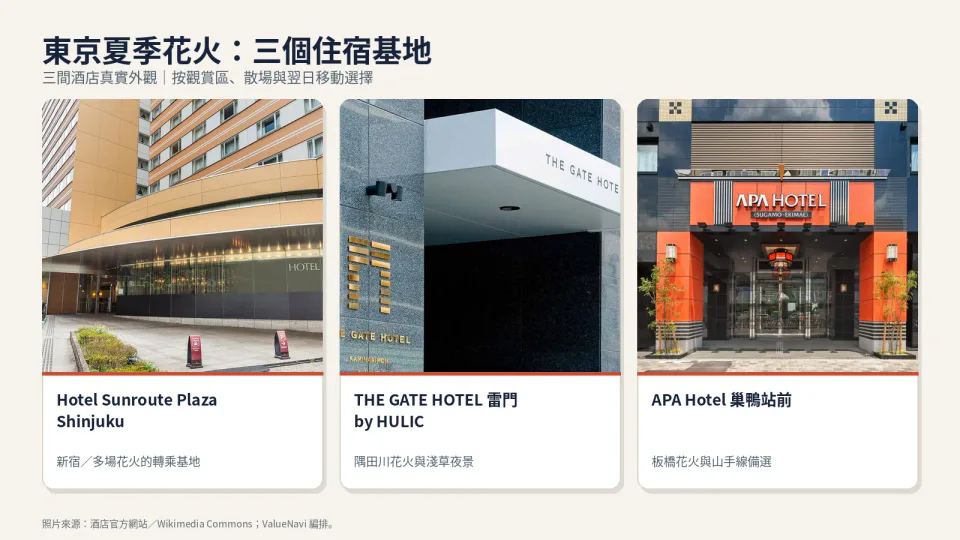
A west-side Tokyo base such as Shinjuku naturally reduces the Chofu journey. An east-side base can make Sumida or Edogawa feel more aligned. But one festival evening rarely justifies changing hotels if the rest of the trip points elsewhere.
Use the hotel as a tie-breaker, not the first decision. A 30-minute easier event ride is not worth a second checkout, suitcase move and new hotel check-in unless the same base also improves other days.
Weather and sunk-cost rule
All four events are outdoor mass gatherings with weather sensitivity. Chofu explicitly states severe-weather cancellation with no postponement; the 2026 Edogawa and Itabashi plans also used cancellation rather than a simple next-day fallback, and Sumida's official plan likewise specified cancellation if conditions prevented operation.
ValueNavi rule: never attach another non-refundable evening product immediately before or after a fireworks event. The fireworks already consume the day's weather and crowd-risk budget.
Final verdict
For travel after August 26, 2026, Chofu on September 12 is the only live option among these four. Buy a paid seat if viewing certainty matters enough to justify roughly ¥4,500–¥8,000+ per person; keep free viewing only if you are comfortable paying in arrival time and uncertainty instead of cash. Plan the exit station before the seat because the show ending is not the end of the event.
For future seasons, use the 2026 events as four different models: Sumida for central-city atmosphere and maximum crowd friction, Edogawa for large riverbank viewing, Itabashi as the warning to recheck annual access changes, and Chofu for the clearest current paid-seat-versus-free trade-off.
September Grand Sumo Tokyo 2026 Is Sold Out: Official Resale and No Walk-Ups
Nagaoka Fireworks 2026 Is Over: What August 2 vs 3 Teaches for Next Time
UNKO Museum Tokyo 2026: Go If Odaiba Is Already in Your Day — Think Twice If It Isn’t
Tokyo Yosakoi 2026: October 10 or 11? Use the Published Schedule Without Overplanning
Tokyo Itinerary 2026: 4, 5 or 7 Days — What Changes When You Add Disney or a Day Trip?
References
Verified August 26, 2026. USD conversions use approximately ¥1 = US$0.00629 and are planning aids only; yen prices and the current official event rules are authoritative.