
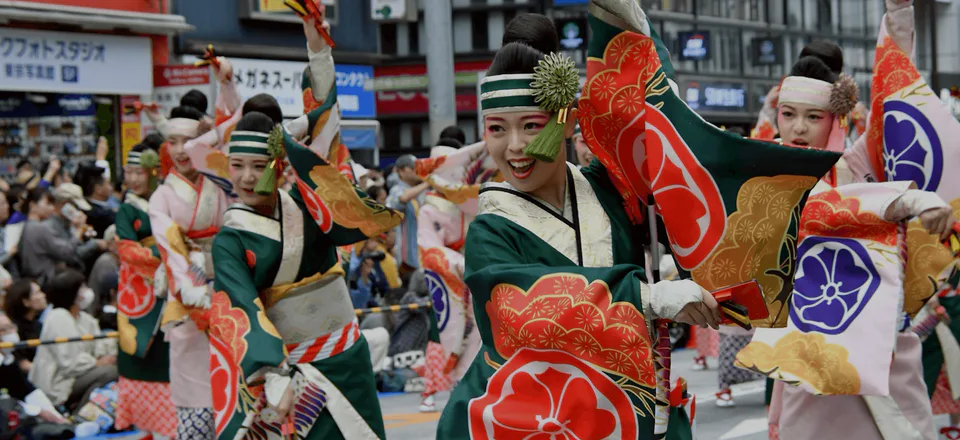
Tokyo Yosakoi 2026 runs October 10–11 in and around Ikebukuro, and the official timetable is now published. That changes the planning problem. You no longer need to build the day only from venue types and participation dates; you can now check the eve-festival timetable, main-festival timetable and the team-by-team main-festival schedule before deciding where to stand.
There is one first-party-source trap worth knowing. The Tokyo Yosakoi homepage still displays its schedule links as “preparing,” but the organiser published all three 2026 schedule files in an August 17 news post. The organiser identifies the current published version as ver.20260803 and warns that changes may still be made. For a current plan, use the dated news announcement rather than assuming the homepage placeholder means no timetable exists.
If I had only one day and no must-see team, I would still choose October 11. It is the main festival, all seven venues operate, the 2026 participant list includes many teams marked as main-festival-only, and the day leads into the awards and mass dance. October 10 becomes the stronger choice when a specific team, another fixed Sunday booking or a shorter Ikebukuro stop makes Saturday fit better.
Tokyo Yosakoi 2026 in 30 seconds
↔ Scroll table left or right
Your priority | Best starting plan | What to check now |
First visit, no target team | October 11 main festival | Choose one venue style, then use the main-festival timetable to set a broad viewing block |
Following one or two teams | Let the team decide the day | Use the official participant page first, then the published team-by-team schedule |
Photography | One procession venue plus one stage venue at most | Use the timetable to avoid chasing every appearance |
Want awards and mass dance | October 11, save energy for the finale | Work backward from the Azalea-dori finish rather than filling every earlier hour |
Only have 1–2 hours in Ikebukuro | Either day can work | Pick the best published block near the station instead of trying to sample every venue |
The schedule is published — but the homepage can still make it look unpublished
On August 17, the organiser announced that the results of the August 1 draw had been incorporated into the 2026 timetable. The news post links three documents: the October 10 eve-festival schedule, the October 11 main-festival schedule and a team-by-team schedule for the main festival. It labels the current version ver.20260803 and explicitly says revisions are possible.
At the same time, the homepage schedule section still says the October 10 schedule, October 11 schedule and team schedule are “preparing.” The organiser explains in the August 17 announcement that the homepage links will be connected later. These two official pages therefore look contradictory even though they are not: the schedules exist; the homepage navigation is lagging behind the news post.
For trip planning, save the August 17 announcement and check its version again shortly before travel. Do not screenshot one timetable in August and assume it is immutable in October. A version number is more useful than the date you happened to download the file.
October 10 or October 11? The published timetable makes a target-team exception easier
The default first-visit answer remains October 11. The official 2026 participant list includes many groups marked as main-festival-only on October 11, while many others perform on both days. That gives Sunday a broader programme and makes it the better one-day choice when you are interested in the festival as a whole rather than in one named team.
October 10 is not merely a weaker copy. It becomes rational when the team you care about is confirmed for Saturday, when Sunday contains an immovable museum, flight or other booking, or when Yosakoi is a side stop rather than the main purpose of the day. The newly published schedules mean you can now make that exception from evidence instead of guessing.
If you are still mixing up the September mikoshi weekend with the October dance festival, start with Fukuro Matsuri Ikebukuro 2026. September 27 is the mikoshi-led main day; October 11 is the Tokyo Yosakoi main day. They use the same broad Ikebukuro festival family but deliver very different experiences.
Separate the September mikoshi and October Yosakoi dates
Do not turn a team-by-team timetable into a team-chasing marathon
A published schedule creates a new failure mode: overplanning. It is tempting to circle six or eight favourite teams and bounce between venues for every appearance. In central Ikebukuro that can look plausible on a map because five of the main venues are concentrated within roughly a five-minute walk. Festival-day movement is not normal map movement.
Each switch can include crowd controls, barriers, waiting for a procession to clear, finding a legal place to stand and losing the sightline you had at the previous venue. The timetable solves “when is this team performing?” It does not erase the switching cost.
↔ Scroll table left or right
Plan | What you gain | Hidden cost |
Stay at one venue for 60–90 minutes | See several teams from a stable position and understand the differences | You miss appearances elsewhere |
One stage block + one procession block | Two genuinely different viewing styles | One deliberate transfer and a new sightline search |
Follow one target team | See how the same choreography changes by venue | Your day becomes dependent on that team’s route and your ability to move |
Chase many teams | Maximum theoretical coverage | Most time spent relocating; highest chance of fragmented viewing |
For most first-time visitors, I would use the schedule to choose one anchor block and at most one intentional move. The information should reduce uncertainty, not create a spreadsheet you have to obey.
Choose procession-style or stage-style viewing before choosing individual teams
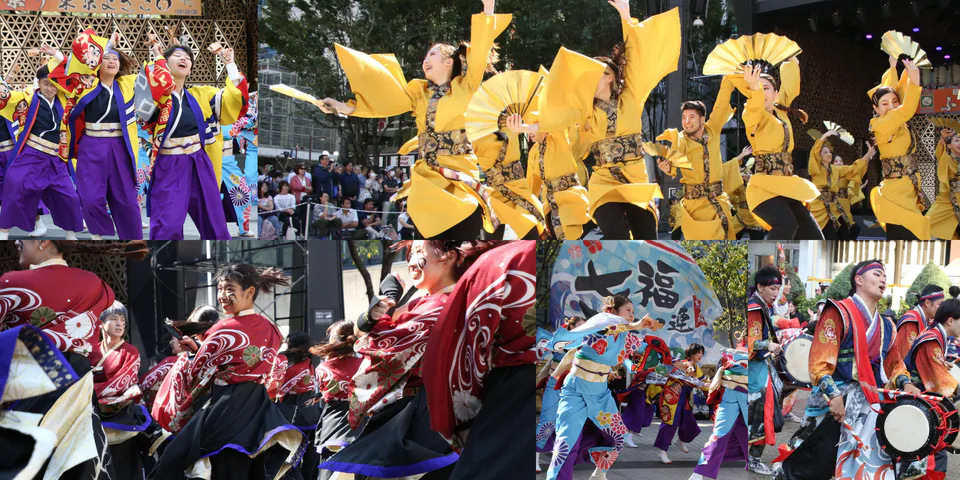
The October 11 main festival uses seven venues. The official festival explanation divides them into four procession-style nagashi odori routes, where teams move forward through the course, and three stage-style venues where teams perform toward a fixed audience.
Procession venues are stronger when you want momentum, street context, costumes moving through the city and photographs with changing formations. The trade-off is a less predictable sightline and more dependence on where you stand.
Stage venues are stronger when you want to understand a full piece from a stable viewpoint. Front-facing choreography and formation changes are easier to read, but you lose some of the feeling of a team advancing through Ikebukuro.
Decide that preference before opening the team-by-team timetable. Otherwise a favourite team can drag you to a venue format that does not actually match the experience you wanted.
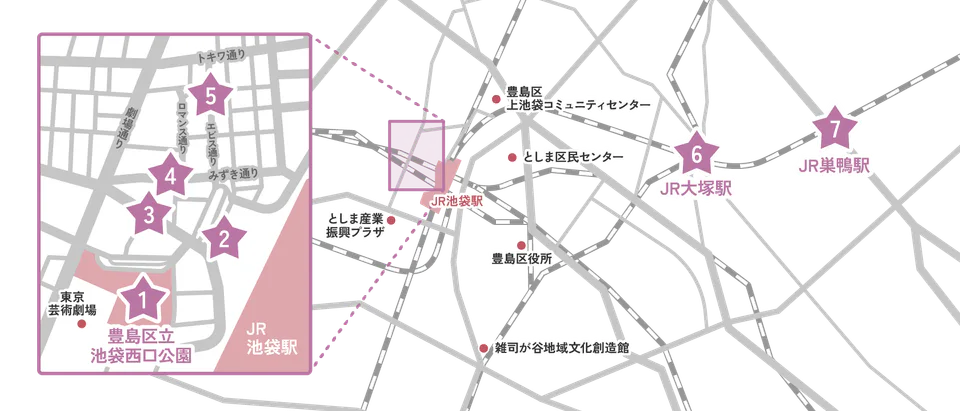
The five central venues are close; the real time cost is finding the next usable position
The official guide says the five main Ikebukuro venues are concentrated within roughly a five-minute walk. That is useful because you do not need another train between the central sites. But the five-minute number describes geography, not the full spectator transfer.
A realistic move is: leave your current position, flow with the crowd, cross or detour around any restriction, reach the next street or stage, identify where spectators are permitted to stop, then wait for a sightline. The walking portion may still be short while the usable-viewing-position cost is much longer.
That is why the published timetable should be used with buffers. If two desired performances are separated by only the map’s theoretical walking time, treat them as conflicting rather than “perfectly sequenced.”
If the finale matters, work backward from it
The October 11 main-festival finale is associated with the Azalea-dori venue, with the awards followed by Tokyo Yosakoi’s original mass-dance number “Hifumi.” If that ending is the reason you chose Sunday, build the rest of the day backward from it.
Do not use the new timetable to fill every hour from the earliest performance onward. Protect a sitting, food, toilet and water break before the final block. A full schedule can make an exhausted spectator feel as if leaving early is a failure; in reality, the finale only has value if you still have enough energy to enjoy it.
If the finale is not important, a two-hour focused visit is completely valid. On a short Tokyo trip, leaving after a strong stage or procession block can be better than sacrificing another neighbourhood simply to say you stayed until the end. Use How Many Days in Tokyo? if the festival is competing with a tight first-time itinerary.
Photography: publish fewer targets, not more
The team-by-team schedule is especially useful for photographers, but the strongest strategy is usually to narrow the shortlist. Pick one stable background or stage position and watch several teams from there. Then add one or two specific team appearances only if the transfer is genuinely worth the lost position.
Procession routes give you movement, spectators and city context. Stage venues make front-facing expressions and formations easier to anticipate. Trying to cover both styles for every favourite team produces a lot of walking and very little time in the best position.
A simple rule works well: one fixed-background block first, one team-led move second. If the second move becomes crowded or weather turns bad, keep the first block and delete the chase.
Do you need an Ikebukuro hotel? Usually no
Tokyo Yosakoi is centred around a major urban transport hub, not a remote fireworks field. If you already have a sensible Tokyo base in Shinjuku, Shibuya, Ueno or around Tokyo Station, moving hotels for one festival night usually creates more friction than it removes.
The exception is when Ikebukuro improves several days at once—for example, if you are also building a northwestern Tokyo or Saitama cluster and plan to stay through the October 11 finale. In that case the hotel helps the trip as a whole rather than solving one late-evening train ride.
If your base is still undecided, use Where to Stay in Tokyo for First-Time Visitors. If the choice is already narrowed to western Tokyo, compare Shinjuku vs Shibuya before letting one festival reshape the entire stay.
One indoor booking can fit the day; several fixed bookings make the schedule brittle
If you are already making a full Ikebukuro day, one timed indoor activity can work as a weather or stamina break. Chiikawa Park Tokyo is one example, but it is a timed-entry attraction. The new Yosakoi timetable does not make it safe to stack several fixed attractions, restaurant reservations and target-team appearances in the same afternoon.
Use one hard booking plus broad festival blocks. If the Yosakoi schedule changes version, you then move the viewing block rather than rebuilding the entire Tokyo day.
Fit a timed Ikebukuro attraction around the festival
What still needs a final check before October
The dates, 2026 participant list and August 17 timetable announcement are now published. The remaining uncertainty is operational rather than conceptual: the organiser warns that the timetable can be revised, and crowd-control, weather or transport details can still change closer to the event.
Before travel, check four things in this order:
Schedule version: is ver.20260803 still the latest?
Your target team: is its participation day and listed performance pattern unchanged?
Your venue type: are you still choosing stage versus procession for a reason?
Final operating notice: weather, crowd control and access instructions take priority over an August plan.
This sequence is more robust than repeatedly checking the homepage’s “preparing” labels, because the dated news post is currently the source that actually exposes the published schedules.
Final verdict
For a first dedicated Tokyo Yosakoi visit, choose October 11 unless a target team or fixed Sunday commitment gives you a concrete reason to switch to October 10. The important update is that the official timetable is no longer pending: it was published on August 17, even though the homepage schedule area still looks unfinished.
Use that timetable to reduce uncertainty, not to maximise venue count. Pick a viewing style, build one anchor block, add at most one deliberate move and work backward from the finale if the awards and “Hifumi” matter. Then check the schedule version again before October.
If what you want is a different Tokyo street-dance experience, compare Koenji Awa Odori 2026. If you want floats rather than dance, Kawagoe Festival 2026 solves a completely different autumn-event decision.