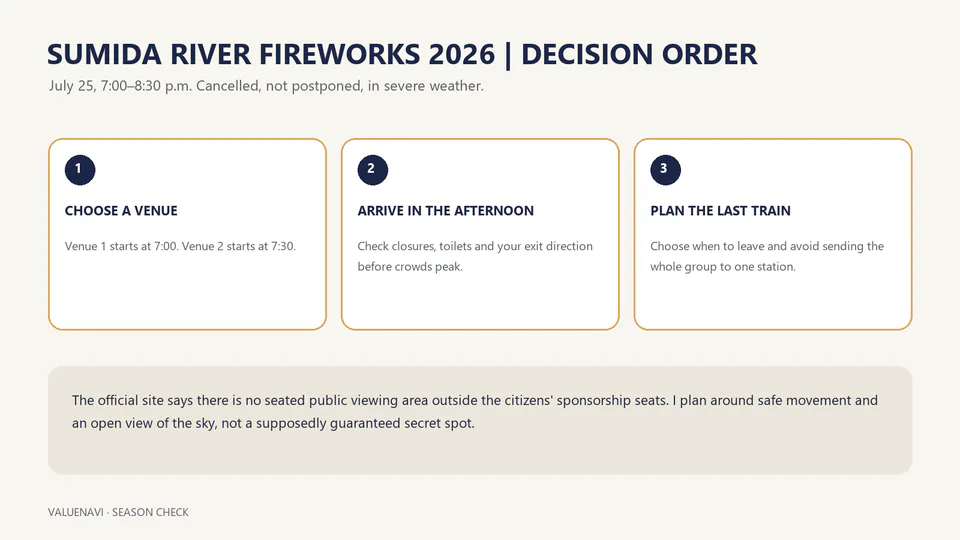
The 49th Sumida River Fireworks was held as scheduled on July 25, 2026 from 19:00 to 20:30. The practical lesson from this year is that Sumida is not a picnic-style fireworks night: outside the citizens’ sponsorship seats, the organiser did not provide a seated viewing area and explicitly asked general visitors to watch while moving through the controlled streets and bridges.
If you are deciding whether this kind of event fits a Tokyo trip at all, compare it with the broader Japan summer festivals guide first. Sumida rewards travellers who can tolerate dense pedestrian flow and a less predictable sightline; it is a different proposition from a reserved-seat riverbank show.
Choose Venue 1 or Venue 2 in 30 seconds
Venue 1: choose it for the earlier 19:00 start, fireworks competition and the 20:24 grand finale.
Venue 2: choose it when Kuramae, Ryogoku or Asakusabashi gives you the cleaner arrival and exit direction; it starts at 19:30.
Need a guaranteed seat: general street viewing was the wrong product in 2026; only sponsorship-seat areas provided seated viewing.
Hotel in western Tokyo: solve the return station before chasing the closest launch zone.
Venue 1 wins on programme; Venue 2 can win on the way home
The official 2026 programme listed 9,507 fireworks at Venue 1 between Sakurabashi and Kototoibashi, including the competition and 1,980-firework finale at 20:24. Venue 2, between Komagatabashi and Umayabashi, listed 10,650 fireworks and a 2,100-firework finale at 20:25. That does not make Venue 2 automatically better: the useful difference is how the launch zone lines up with the station you actually need after 20:30.
If you are still choosing a Tokyo base, use where to stay in Tokyo for first-time visitors before treating Asakusa as the default. Travellers based around Ueno can compare Ueno vs Shinjuku; travellers with a west-side hotel should also understand the Tokyo Station vs Shinjuku trade-off before festival night.
No sponsorship seat means no claim to a patch of pavement
The 2026 organiser explicitly said there was no seated viewing space outside the citizens’ sponsorship areas. The manners page also prohibited place-holding and told general visitors to expect walking observation. A large groundsheet, folding chair or attempt to mark a place was therefore not a legitimate substitute for a ticketed seat.
If free riverbank viewing is what you want, the Edogawa Fireworks guide solves that different problem more directly. If a formal riverbank seat is worth paying for, the Nagaoka Fireworks guide shows why the viewing product and the exit plan should be bought together.
Pair this with: How Many Days in Tokyo?
The official station advice matters more than the closest pin on a map
The official 2026 venue page listed Asakusa, Oshiage, Tokyo Skytree and Hikifune for Venue 1, and Asakusa, Kuramae, Ryogoku and Asakusabashi for Venue 2. After the event, the organiser specifically warned that Asakusa Station would be extremely crowded and asked visitors to use alternative stations where possible.
That is why a hotel decision such as Shinjuku vs Shibuya can matter more than which bridge looks closest to the fireworks. If the rest of the Tokyo plan is still unsettled, How to Plan a Trip to Japan is the better upstream decision.
Weather and heat are part of the viewing decision
The official plan said severe weather would cancel the event rather than postpone it, with the initial go/no-go decision normally made at 08:00. On July 25, 2026 the organiser confirmed at 08:00 that the fireworks would go ahead and separately warned visitors about heat and sudden heavy rain.
For a trip where weather threatens several days, use the Japan rainy-day itinerary backup guide rather than improvising after you enter the crowd. If a hotel change is adding baggage to the problem, the Japan luggage-forwarding guide can remove the suitcase before the fireworks evening.
The exit is the real final act
If you stay for Venue 1’s 20:24 finale or Venue 2’s 20:25 finale, accept that the next decision is crowd dispersal rather than another attraction. The Omagari Fireworks transport guide shows the same principle at a much larger transport bottleneck: an event is only as good as the route that still works after the finale.
For a first Japan trip, the 10-, 12- or 14-day itinerary guide helps decide whether a crowded Tokyo fireworks night deserves a full evening at all.
Final verdict
For Sumida River Fireworks, choose the venue from the route home backwards. Venue 1 had the earlier start and competition; Venue 2 had a larger published firework count and different station options. In 2026, general visitors should not have expected a seated free-viewing area. The strongest plan was one launch zone, one direction out and an alternative to Asakusa Station already chosen before the first firework.
Takachiho Gorge Autumn Leaves 2026: Boat Booking, Kagura and Overnight Strategy
Aichi-Nagoya Asian Games 2026: Tickets, Venues, Hotels and Transport
Japan Autumn Leaves Reservations 2026: What to Book Early and What to Keep Flexible
Japan Autumn Leaves 2026: Forecast Calendar, Regions and Route Planning
USJ Halloween with Kids 2026: Day Plan, Safe Routes and Age Limits