
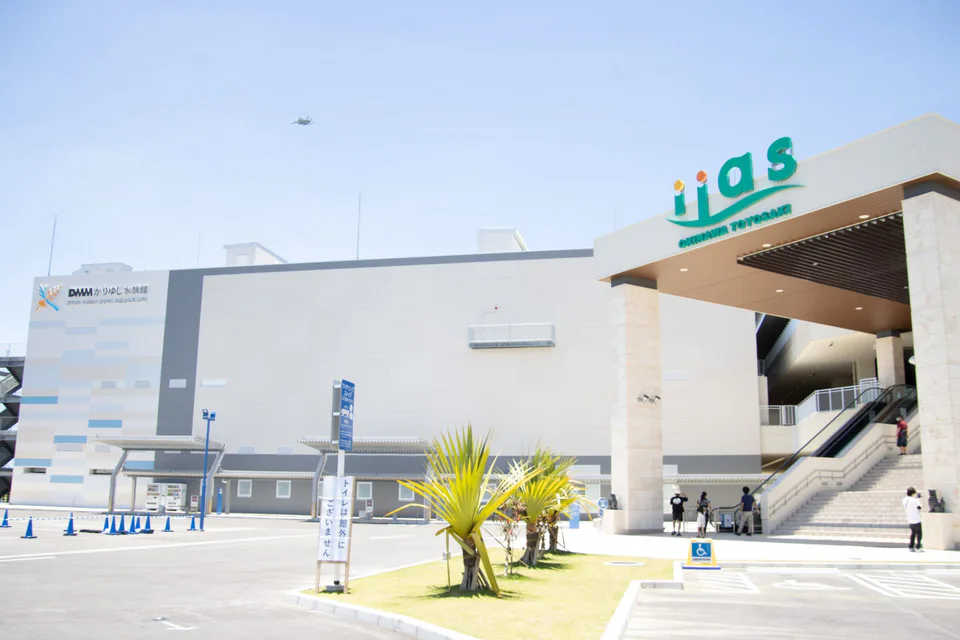
DMM Kariyushi Aquarium makes more sense when you stop asking whether it is “better than Churaumi.” It is smaller, closer to Naha Airport, almost entirely indoors and easy to fit into an awkward 1–2 hour gap. Churaumi is a destination-scale northern Okinawa day; DMM is a route-friction purchase.
If your trip structure is not fixed yet, start with the Okinawa guide for first-time visitors. Once Naha, Onna and Motobu are in the right places, DMM is easy to judge by the problem it removes.
30-second verdict: buy convenience only when it saves a real itinerary problem
↔ Scroll table left or right
| Use case | DMM fit | Ticket logic | When I would skip it |
|---|---|---|---|
| Rainy afternoon near Naha | Strong | Standard or advance ticket | If weather is still good and you are giving up a rare outdoor day |
| Arrival day | Strong if you have about 90 minutes plus transfer margin | Advance ticket if your flight timing is reliable | If immigration, bags or rental-car pickup make the window fragile |
| Departure day | Useful but higher risk | Only after protecting airport and car-return buffer | If the aquarium would sit inside your flight safety margin |
| After 17:00 | Potentially excellent value | Use the official late-entry discount only when the date calendar leaves enough open time | If closing time leaves a rushed visit |
| Big aquarium day | Weak | Do not buy on price alone | Plan Churaumi instead if scale is the goal |
2026 prices: the date tier changes the value calculation
From March 2026, official adult admission is ¥2,800 Value (about US$17.60), ¥2,950 Regular (about US$18.50) or ¥3,200 Peak (about US$20.10). Ages 13–17 are ¥2,200 / ¥2,350 / ¥2,600 (about US$13.80 / US$14.70 / US$16.30), while ages 4–12 are ¥1,700 / ¥1,850 / ¥2,100 (about US$10.70 / US$11.60 / US$13.20). Children 3 and under are free.
That matters because DMM is often bought for convenience. A Peak-day adult paying ¥3,200 for a rushed 40–45 minute visit is buying a very different proposition from someone protecting 90 minutes and avoiding a much longer northbound detour.
ValueNavi time-value test: compact is good only when compact solves something
This is an editorial framework, not an aquarium rule. I would classify DMM as a strong purchase when you can protect roughly 90 minutes inside and its Toyosaki location removes a bigger transport problem. I would downgrade it sharply if you have less than about 45 minutes once parking, ticket redemption and airport logistics are counted.
The useful comparison is therefore not “¥3,200 versus Churaumi admission.” It is ticket + actual visit time + transport time + schedule risk. A short attraction can be high value when it saves hours of route friction.
The aquarium’s visual strengths are compact by design
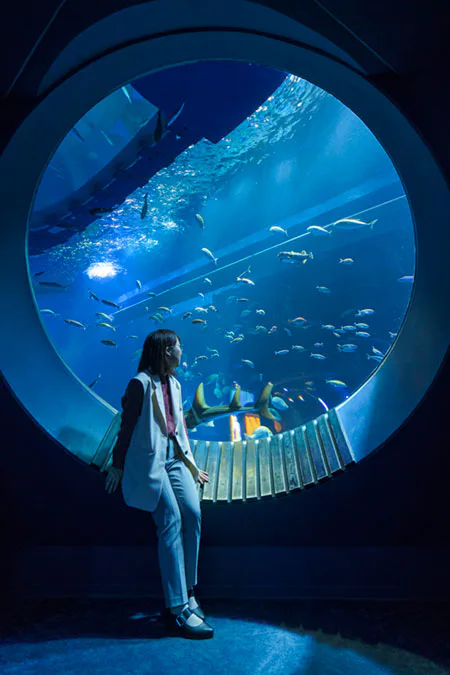
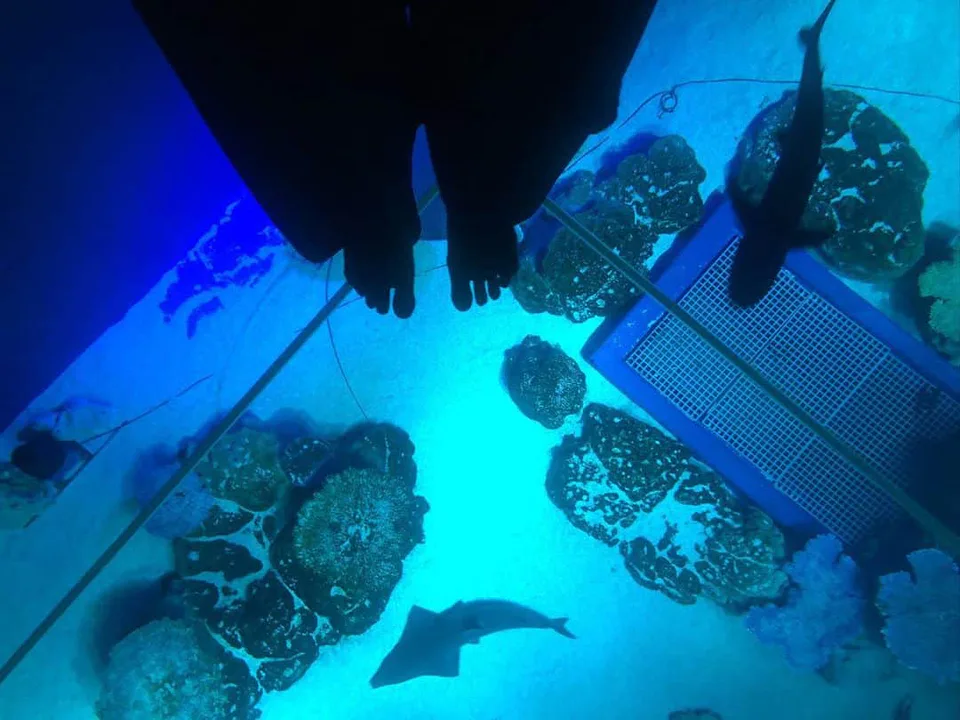
The circular viewing window turns the main tank into a framed moving scene, while the glass-floor section changes the experience by putting marine life below you rather than across a giant wall.
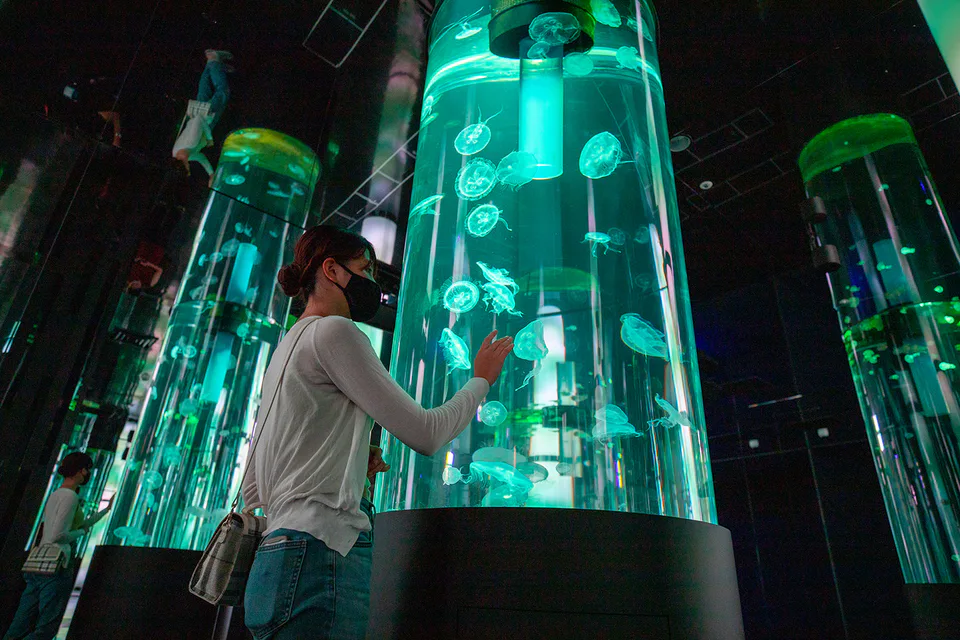
The jellyfish room is where the “digital aquarium” description becomes most useful: lighting, darker rooms and sound are part of the presentation rather than decoration around a giant collection.
This makes DMM a particularly clean fit for a rainy block. For a bigger weather disruption, use the Okinawa rainy-day and typhoon guide; one compact aquarium should not be expected to replace an entire cancelled outdoor itinerary.
Animal encounters: availability is the scarce resource, not the ¥1,000 fee
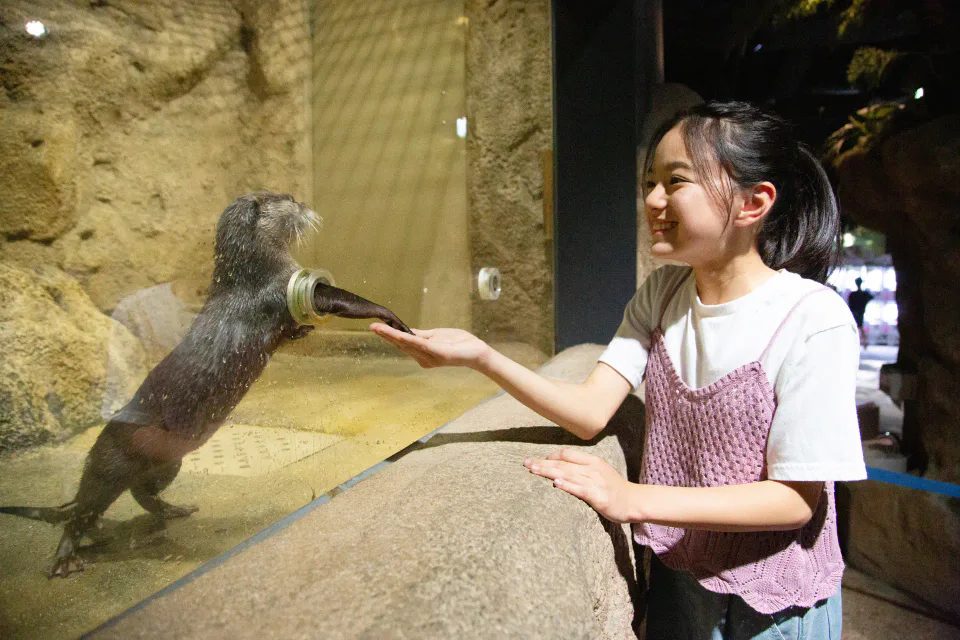
Paid feeding and photo experiences are sold from opening time on a first-come, first-served basis and stop when capacity is reached. Current examples include otter and sloth feeding at ¥1,000 (about US$6.30), with some photo-plus-feeding experiences at ¥1,500 (about US$9.40). Programmes can change or be cancelled depending on animal condition.
If one specific feeding experience is the reason for visiting, the real booking risk is arriving late after the limited slots have gone. Admission does not guarantee that add-on.

tetote has separate eligibility rules that matter to overseas visitors
The tetote interaction area normally runs 10:00–18:00 with final entry at 17:30. The current code of conduct allows open-toe footwear with caution, but its biosecurity restrictions are more important: entry can be refused if less than one week has passed since entering or returning to Japan from overseas, if you are carrying food containing meat products, or if you have had contact with pigs within the previous two days.
Those rules apply to tetote rather than the whole aquarium. If your plan depends on this specific interaction area, check current operating notices rather than assuming that an aquarium admission ticket guarantees access.
How long do you need? Ninety minutes is the useful planning number
One hour is possible if you move efficiently and skip paid animal encounters. Around 90 minutes gives the compact route room to breathe. Two hours is more comfortable for families, photography, tetote or feeding slots.
The mistake is stretching the aquarium into half a day just to force value from the ticket. If you want a longer block, let iias Okinawa Toyosaki, a meal or another nearby stop provide the extra time.
Arrival day and last day solve opposite problems
On arrival day, DMM can turn a too-short afternoon into a useful indoor stop without sending you north. The risk is that flight delay, baggage and rental-car pickup make a prepaid slot less attractive.
On departure day, proximity to Naha Airport is useful only after you count backwards from flight check-in, rental-car fuel and return, luggage and traffic. The often-quoted roughly 20-minute drive under normal conditions is not an airport guarantee.
If you are deciding whether to move back to Naha for the final night, compare Onna vs Naha for your last night. For very early flights, the Naha Airport hotel guide should be solved before adding another attraction.
Late-entry discount: cheaper is only better when enough visit time survives
Normal hours are currently 09:00–19:00 with last admission 60 minutes before closing, but the official calendar can use different hours on specific dates. That makes late-entry pricing a time problem, not just a discount.
Through January 31, 2027, the official after-17:00 promotion is 30% off. Using the Peak base, an adult drops from ¥3,200 to ¥2,240 (about US$14.10); ages 13–17 from ¥2,600 to ¥1,820 (about US$11.40); ages 4–12 from ¥2,100 to ¥1,470 (about US$9.20). The discount is excellent only if your date’s closing time still leaves enough visit time.
The official advance-ticket offer through the same period can also discount admission when bought by 23:59 the day before; for example, a ¥3,200 Peak adult ticket can be ¥2,880 (about US$18.10). Compare that against your schedule certainty rather than treating prepayment as automatic savings.
Klook or KKday? Compare redemption and flexibility, not just the first number
Both platforms currently list the exact DMM Kariyushi Aquarium product. Compare the final price for your date, cancellation policy, validity and whether a physical-ticket exchange is required. An after-17:00 ticket should win because the time window fits your route, not because the headline discount is larger.
Compare the exact DMM Kariyushi ticket options on Klook
Compare the exact DMM Kariyushi ticket on KKday
Who should skip it?
Skip DMM if your real goal is the largest possible aquarium experience and you already have a proper Motobu day. Skip it if the only available window is so short that parking, ticket redemption and airport logistics leave barely any visit time. And do not add it simply because it is close to the airport if your departure buffer is already tight.
It is strongest as a rainy-day replacement, arrival-day filler, final-day option with generous margin, or compact family attraction near Naha. Its small footprint is a feature only when you actually need a small-footprint attraction.
Final decision
DMM Kariyushi Aquarium is best bought for geography, weather resilience and scheduling flexibility. Protect about 90 minutes, check the date-based price and operating calendar, and treat animal encounters as limited add-ons rather than guaranteed parts of admission.
Next decision | Put DMM on your rainy day, arrival day or final day?
Best Dates for USJ Halloween 2026: Crowds, Prices and Hotels
Okinawa Honeymoon Hotels: Don’t Upgrade All Four Nights — Spend More on the Two You’ll Actually Use
Best Japan eSIM for Tokyo, Osaka and Kyoto: Data and Hotspots
Kerama Discovery Diving: Seasickness, SEASIR Naha and Your First Dive
Sources
DMM Kariyushi Aquarium official site|Current admission, hours, access and operating notices
DMM Kariyushi Aquarium|tetote operating information and code of conduct
Official DMM Kariyushi ticket information was rechecked in August 2026 for the March 2026 date-based admission tiers, advance-ticket campaign and after-17:00 promotion through January 31, 2027.