
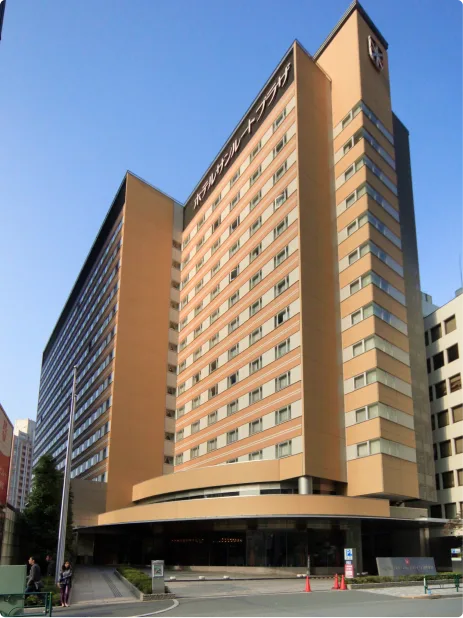
Hotel Sunroute Plaza Shinjuku is worth paying for when the South Exit transport corridor solves more than one difficult movement in your trip: airport arrival or departure, a Busta Shinjuku highway-bus day, and repeated use of southern Shinjuku. The hotel’s current official access is about three minutes from JR Shinjuku South Exit or Koshu-kaido Exit, one minute from Toei Oedo Line Exit A1 and three minutes from Busta Shinjuku. Airport limousine buses for both Haneda and Narita also use the hotel stop.
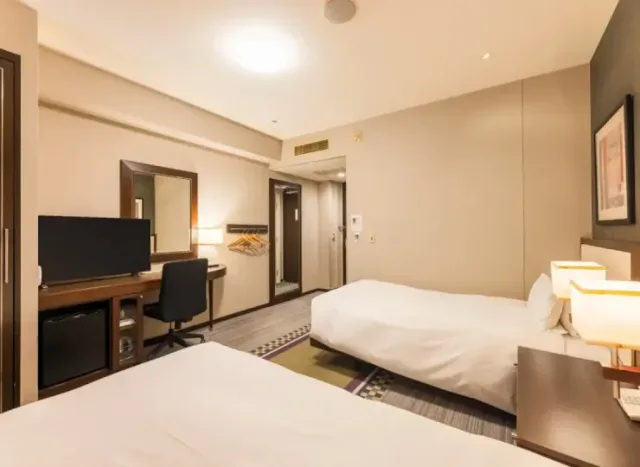
The trade-off is room size. The entry-level Standard Single is sold for two as an Economy Double but is only 15.7m² with one 140cm bed. Standard Double is 18.7m² with a 160cm bed; Standard Twin is 23.1m² with two 120cm beds. For two travellers with large suitcases or a stay of three nights or more, I would always price the Twin before choosing the cheapest room. The hotel’s location can remove outside friction, but it cannot make a 15.7m² room larger.
The 30-second decision: count how many times the transport premium actually pays you back
↔ Scroll table left or right
Your trip | Verdict | Why |
Airport bus + one or more Busta / South Exit days | Strong fit | The same location advantage is used repeatedly, not only on check-in day |
Two people, light luggage, 1–2 nights | 15.7m² can be rational | You are buying location first and living in the room for very few waking hours |
Two large cases, 3–5 nights | Price the 23.1m² Twin | The 7.4m² difference versus Economy Double becomes a repeated usability benefit |
Most days in Ueno / Asakusa / Tokyo Station | Compare another base | You may be paying for western-Tokyo transport advantages you barely use |
Very late airport arrival or very early flight | Do not assume the hotel bus solves it | The bus is useful only when the live timetable matches the flight; rail, taxi or an airport hotel may still be the real backup |
The airport bus is a schedule-dependent benefit, not a permanent door-to-door guarantee
The hotel currently publishes limousine-bus reference times of about 60 minutes for Haneda and 120 minutes for Narita, with current adult fares of JPY 1,400 and JPY 3,600 respectively. Those are planning references, not promised door-to-door times. Road conditions, waiting time and the exact terminal stop can change the result.
More importantly, the value is asymmetric on arrival and departure. On arrival, the hotel says airport-origin buses are not reserved through the hotel; travellers buy the appropriate ticket at the airport. On departure, the hotel directs guests to the Airport Limousine timetable/reservation system. That means “the bus stops at the hotel” should never be converted into “my flight is automatically covered.”
Before paying a room premium for the airport-bus benefit, test the actual flight:
Arrival: is there a hotel-bound bus after a realistic immigration-and-baggage window, not merely after scheduled landing?
Departure: is there a hotel pickup early enough to meet the terminal arrival target with a road-delay buffer?
Failure mode: if that bus is missed or cancelled, is the fallback still acceptable with your luggage?
If the answer fails on both the arrival and departure days, remove “airport bus” from the hotel premium and compare the property as an ordinary South Exit hotel. For a genuinely late Haneda arrival, use the Haneda late-arrival decision guide rather than assuming central Tokyo is always the right first night.
The South Exit advantage is exact: it does not make every part of Shinjuku equally close
The official walking route from JR Shinjuku South Exit crosses the Nishi-Shinjuku 1-chome intersection and continues roughly another 50 metres to the hotel. That is a much more useful instruction than the generic phrase “near Shinjuku Station.” A traveller who exits on the wrong side of the station can erase the advertised walking advantage before the hotel is even visible.
The location is particularly strong for South Exit, Koshu-kaido Exit, Toei Oedo Line A1 and Busta Shinjuku. It is less special if every evening ends deep in Kabukicho or around Seibu-Shinjuku. This is the boundary condition the old version underplayed: the hotel is a southern-Shinjuku transport product, not a magic shortcut to all of Shinjuku.
If your real decision is south-side convenience versus Kabukicho nightlife, compare Hotel Gracery Shinjuku vs JR Kyushu Hotel Blossom Shinjuku rather than using one city-level map pin.
Room choice: separate legal occupancy from comfortable occupancy
↔ Scroll table left or right
Room | Official size / bed | ValueNavi use case |
Standard Single / Economy Double | 15.7m²; one 140cm bed; up to 2 guests | Solo traveller or lightly packed couple on a short stay |
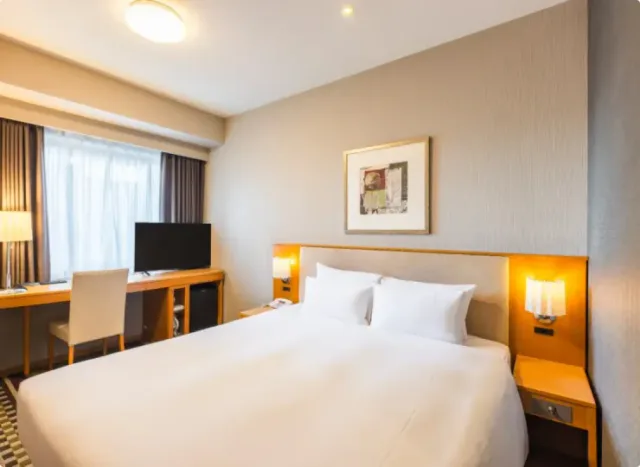
Standard Double | 18.7m²; one 160cm bed | Couple that values a wider bed more than separate sleeping surfaces |
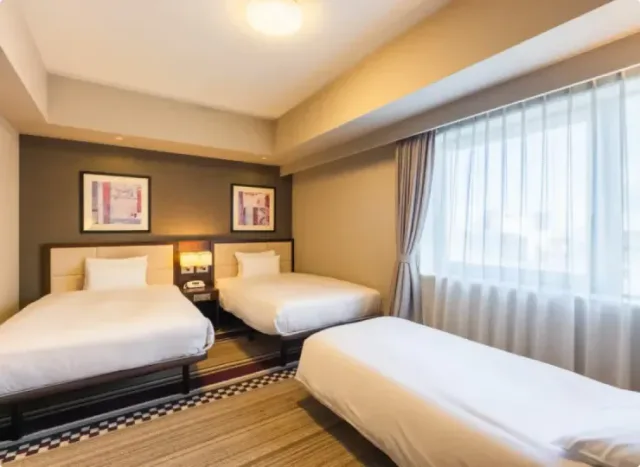
Standard Twin | 23.1m²; two 120cm beds | Two adults with more luggage, friends, or a multi-night stay |
Deluxe Twin / Triple | 28.2m²; two 120cm beds + sofa bed | Three guests or travellers with a real space requirement |
The hotel officially allows two people in the 15.7m² Economy Double, but that proves capacity, not suitcase comfort. There is no official claim that two 28-inch cases can remain fully open while preserving a clear walkway. Do not turn room photos into a fake measured test.
A useful derived comparison is that the Standard Twin adds 7.4m² over the Economy Double—about 47% more published floor area. That does not mean 47% more usable luggage space, because furniture layout differs, but it is large enough that the Twin should be in every same-date comparison for two luggage-heavy travellers. The 18.7m² Double adds only 3m²; its strongest upgrade is the wider 160cm bed rather than a transformation in room scale.
The decision rule is simple: buy the smallest room that solves your sleeping and luggage problem, then stop climbing the room ladder. If the Twin or Deluxe premium becomes large enough to erase the hotel’s value advantage, reopen the hotel comparison instead of continuing to upgrade inside Sunroute.
For four to seven nights, laundry helps — but it does not cancel the compact-room trade-off
The hotel currently lists 12 fully automatic coin-laundry machines across six floors, with machine status visible on the in-room TV. That can support lighter packing, which directly reduces the pressure on a compact room. Multi-night housekeeping is also request-based: the hotel FAQ uses cleaning cards for full cleaning or towel-only service, with a hygiene clean scheduled every four nights.
This makes Sunroute more viable for a long stay than the raw room area suggests, but the logic has a limit. Laundry can reduce the number of clothes in the suitcase; it does not create floor space for shopping bags, two open cases or remote-work equipment. If the room will function as a living space rather than a sleep-and-shower base, compare Tokyu Stay Shinjuku Eastside before paying purely for transport.
Breakfast and Busta can compete for the same morning
VILLAZZA currently serves breakfast from 06:30 to 10:00, with last entry at 09:30. The current adult price listed by the hotel is JPY 3,300. That is useful for a normal city morning; it can be poor value when the hotel was booked specifically for an early highway bus or airport departure.
Do not ask only whether the buffet is good value. Ask whether there is enough usable breakfast window after getting ready and before you need to walk to Busta, meet a tour or leave for the airport. A room-only rate plus a quick station breakfast can be the more coherent purchase on a departure-heavy stay.
Three nights: when the location compounds, and when it does not
High-value pattern: airport limousine bus on arrival → Shinjuku/Harajuku/Shibuya city day → Busta day trip to Kawaguchiko or Hakone → airport bus or South Exit departure. The hotel solves several high-friction hand-offs, so accepting a compact room can be rational.
Low-value pattern: arrive by rail → spend every full day in Asakusa, Ueno, Ginza and Tokyo Station → return only to sleep → leave by rail. The property remains convenient, but its most distinctive location benefits are underused. In that itinerary, an eastern Tokyo room with more space can beat Sunroute even if the Shinjuku hotel looks more famous.
The practical test is to write down the four hardest movements in the stay: arrival, departure and the two most awkward day trips. If Sunroute materially simplifies at least two, its location premium is doing real work. If it simplifies only one, compare another base.
Final verdict
I would book Hotel Sunroute Plaza Shinjuku when the South Exit/Busta/airport-bus corridor solves at least two real transport problems. For one or two lightly packed nights, the 15.7m² Economy Double can be a rational location-first purchase. For two large suitcases or three-plus nights, I would price the 23.1m² Standard Twin every time.
I would not pay a premium merely because the hotel has an airport-bus stop. The live bus schedule has to fit the actual flight in the correct direction. If it does not, remove that benefit from the calculation. Likewise, if most of the trip is in eastern Tokyo, Shinjuku’s line count does not automatically compensate for repeated cross-city travel.
The hotel’s strongest product is not “Shinjuku.” It is a very specific chain: correct station exit → short luggage walk → South Exit/Busta access → room sized appropriately for the party. When all four fit, the hotel is hard to fault. When the room or timetable breaks that chain, compare again.
Compare the same Sunroute room and cancellation terms
Tokyu Stay Hida-Takayama Musubi no Yu: Which Room Works for Two Suitcases and Three Nights?
Komatsu Airport or Noto Airport: Kanazawa, Wajima and Wakura
La Vista Furano Hills: Is a Small Room Worth It for a One-Night Furano Stay?
Sources
Hotel Sunroute Plaza Shinjuku — official access and airport-bus information · official room sizes and beds · official FAQ and breakfast information. Checked August 25, 2026. Airport-bus schedules, fares and hotel policies can change; verify the exact travel date before paying.