
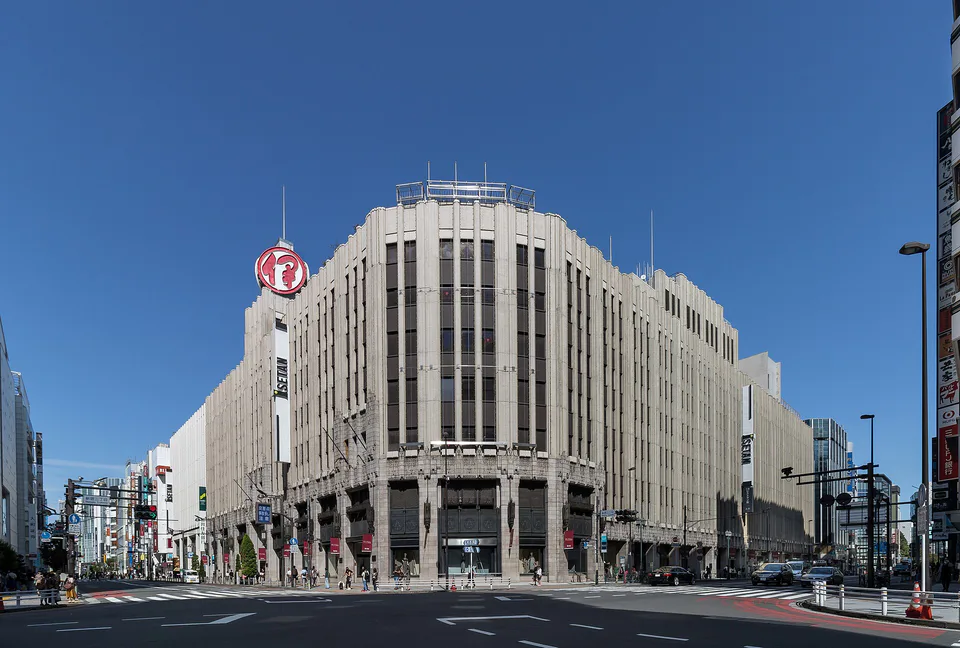
Japan’s summer sales are only a bargain when the saving survives transport, tax-free rules and the cost of carrying the item home. Department stores are usually the time-efficient choice for comparing several brands. Malls work when shopping needs to share the day with food or bad weather. Outlets make the most sense when you already know the brand, product category and acceptable size range.
There is also a current late-August 2026 opportunity worth separating from generic “summer sale” advice: Premium Outlets officially schedules its summer Premium Outlets Bargain for August 21–30, 2026. For travelers in Japan during that window, the bargain is still a live event. For anyone reading after August 30, treat those dates as historical and check the next official campaign rather than assuming the markdown continues.
ValueNavi 30-second decision: choose the shopping format before chasing the discount
↔ Scroll table left or right
Your goal | Best first choice | Hidden cost | When to skip |
Compare several brands quickly | Department store | Possibly shallower markdowns | You already know one exact outlet-only target |
Shopping + lunch + rain backup | Urban mall | Easy to overbrowse | The mall creates a cross-city detour |
Specific brand / category / size | Outlet | Transport time and uncertain stock | Your goal is only “see what is cheap” |
Bulky or fragile item | Buy only after baggage check | Extra bag, packing, damage risk | Take-home cost erases the saving |
The key principle is simple: the bigger the detour, the narrower your target should be. A central department store can be the better travel purchase even at a slightly higher shelf price because it preserves several hours of a short Japan trip.
What is actually still live in late August 2026?
The clearest nationwide-style official late-summer campaign is the Premium Outlets Bargain, scheduled for August 21–30, 2026. The operator’s current sale calendar was updated in August and warns that schedules can change, so check the specific outlet before traveling. Individual brands can also run their own final summer clearance dates beyond or inside the centre-wide campaign.
This makes late August different from early July. You should not travel to an outlet because an old blog says “Japan summer sales run in July and August.” You should travel because the exact outlet and target stores still show a campaign on your date.
For example, current outlet event calendars show some brand-level summer clearance activity continuing to August 30 or 31. That is useful evidence that late-summer stock clearance exists, but it is not a promise that your size, colour or product category remains available.
The bargain can deepen while the inventory gets worse
Late-season markdowns create an inverse relationship: price may improve while choice deteriorates. That matters differently depending on the purchase.
Travel essential: buy once the acceptable item is available. Saving another 10% is not useful if the required size disappears. Optional fashion purchase: waiting can make sense because walking away is acceptable. Specific model or colour: inventory certainty can be more valuable than the deepest final markdown.
This is why “wait until the last day” is not a universal summer-sale strategy. It optimizes the sticker, not the probability of getting the thing you actually want.
Before November 1, 2026: the current tax-free system still applies
Japan Customs currently states that eligible non-resident visitors use the existing tax-free-shop process: show the passport at purchase, and present the passport to Customs when leaving Japan. Customs may check that the tax-free goods are actually being exported.
Under the current rules, the minimum eligible purchase is ¥5,000 before tax at one tax-free shop—roughly US$31 at late-August 2026 exchange rates. Consumables are currently capped at ¥500,000 per non-resident at one tax-free shop, roughly US$3,140. These USD figures are only exchange-rate context; the legal thresholds remain the JPY amounts.
Consumables include categories such as food, beverages, health foods and cosmetics. General goods have the ¥5,000 minimum without the same ¥500,000 cap under the current system. If smaller general and consumable purchases are combined under the designated packaging rules, they can be treated as consumables for tax-free purposes.
November 1 changes the transaction: tax-free becomes a refund workflow
The National Tax Agency says Japan changes to a refund-based tax-free system on November 1, 2026. Under the new structure, the traveler pays the tax-included price at the shop. Tax-free treatment is completed only after Customs confirms that the eligible goods are exported within 90 days of purchase; the retailer then refunds the consumption-tax amount.
That means a summer-sale article should not be used as a November checkout manual. If your trip starts after October 31, recheck the shop’s actual refund method, timing and payment destination before buying. The policy change affects cash flow and procedure even when the underlying item price has not changed.
ValueNavi true-cost formula: the red tag is only layer one
True take-home cost = discounted shelf price − valid tax benefit + transport + baggage/packing + warranty/compatibility risk + time cost.
This formula is intentionally broader than money. Suppose an outlet saves you ¥4,000 on one item but requires a long suburban round trip, a meal you would not otherwise buy and the loss of half a sightseeing day. The ¥4,000 discount can still be real, yet the trip can be poor value.
The opposite can also happen. If the outlet is already on your airport, resort or road-trip route, transport cost is partly sunk. Then even a modest discount may be worthwhile because the detour is small.
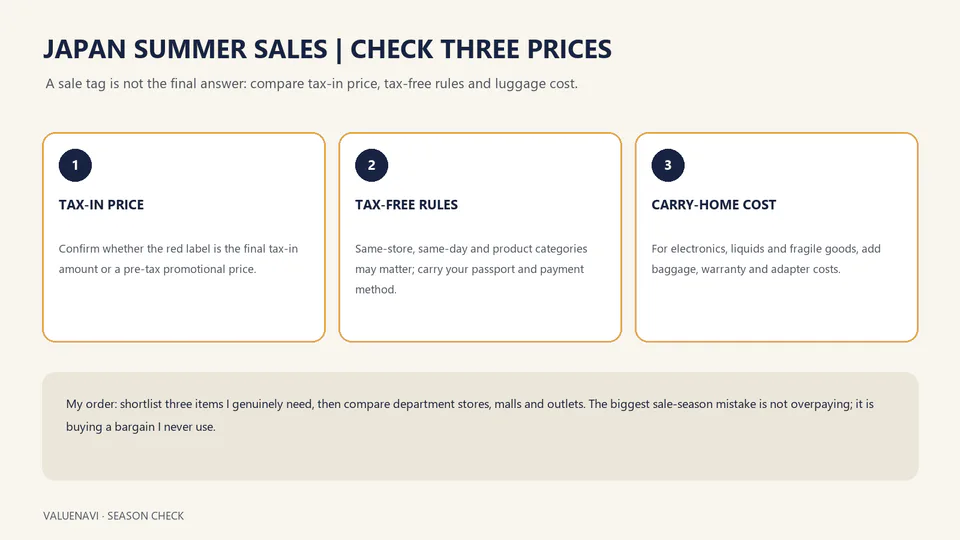
The outlet detour break-even test
Before leaving the city, write down three numbers: expected saving, extra transport cost, and extra travel time. Then ask whether you would still take the trip if your target item were sold out. If the answer is no, the outlet is a high-variance purchase: the whole detour depends on inventory you have not confirmed.
A stronger outlet case looks like this: several target brands, flexible sizes or categories, the outlet already fits the route, and walking away empty-handed would not ruin the day. A weak case is one exact item, no inventory confirmation and a two-way trip made only because “outlets are cheaper.”
Tokyo: choose the district from the hotel and next move
Shinjuku is efficient when your hotel and west-Tokyo itinerary already align with its department stores. Tokyo Station and Nihombashi are stronger around Shinkansen travel, arrivals or departures. Ueno can be more practical on a Narita-focused day. Use Where to Stay in Tokyo for First-Time Visitors, Tokyo Station vs Shinjuku and Ueno vs Shinjuku before crossing Tokyo for a small markdown.
The logic is not “which district has the most stores?” It is “which district lets shopping ride on top of transport you already need?”
Osaka: Umeda and Namba beat an outlet when the outlet creates a separate day
Umeda works naturally with Osaka Station and JR travel. Namba works with Dotonbori, Nankai airport access and a south-side hotel. Compare Where to Stay in Osaka and Namba vs Umeda before treating suburban shopping as automatically better value.
Rinku Premium Outlets can make more sense when it is genuinely integrated with a Kansai Airport day than when it requires a dedicated return journey from central Osaka. Route fit changes the economics more than the word “outlet.”
Large purchases: calculate the baggage penalty before tax-free savings
For shoes, clothing and compact goods, taking the purchase home may be trivial. For cookware, electronics, boxes, fragile items or large quantities, the second suitcase or airline baggage fee can erase a meaningful portion of the discount. Warranty geography, voltage, plugs and return policy also matter.
If luggage is already tight, use the Japan luggage-forwarding guide to solve movement inside Japan, but remember that forwarding luggage does not remove airline baggage limits on the final flight.
Red-team checklist: five reasons not to buy the “bargain”
Do not buy because the percentage is large when the item was not on your shortlist. Do not travel to an outlet without enough target brands to survive one stock failure. Do not assume tax-free eligibility from a sign without checking your status and purchase conditions. Do not buy a bulky item before checking airline baggage and protection. Do not let a sale replace a higher-value sightseeing block unless shopping itself is a trip priority.
Final decision: buy the item, not the discount
For late-August 2026 travelers, the official Premium Outlets Bargain through August 30 is a real current option. But the right venue still depends on route fit. Department stores win on comparison efficiency, malls on mixed-use convenience, and outlets on narrow, pre-defined targets.
Then apply the correct tax-free system to your travel date. Through October 31, the current process remains in place, including the ¥5,000 minimum. From November 1, the refund method changes how the transaction works. A good Japan summer-sale purchase should still look good after transport, baggage and time are added back in.
Next decision: check whether the purchase still fits your luggage plan
References
Premium Outlets — 2026 sale and bargain schedule
Japan Customs — current tax-free purchase thresholds and departure procedure
National Tax Agency — refund-method tax-free system from November 1, 2026
Approximate USD conversions use a late-August 2026 rate near ¥1,000 ≈ US$6.28. Exchange rates move; JPY amounts remain authoritative.