
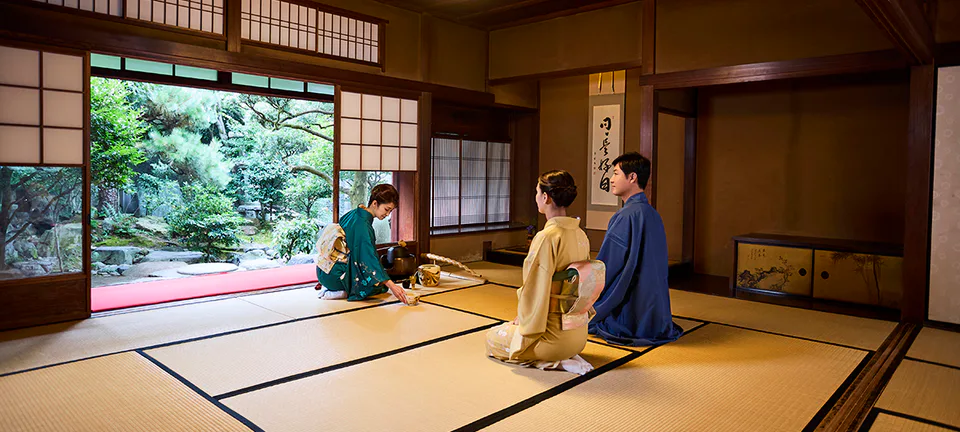
A Kyoto tea ceremony is worth adding when you want one deliberately slow, guided cultural hour more than one extra temple, market or photo stop. For most first-time visitors, I would choose a short casual-clothes session if the tea itself is the priority, and add kimono only when the clothing and photographs are part of the experience you actually want. At MAIKOYA, the current kimono tea-ceremony packages take roughly 90–120 minutes and begin with about 30 minutes of dressing; a casual-clothes format can be around 40–45 minutes. That difference is large enough to change the rest of a Kyoto day.
Do not book by the word “authentic” or by the best photograph. Book by five constraints: product format, exact branch, total protected time, party eligibility and cancellation risk. MAIKOYA currently operates Kyoto tea experiences at Nishiki, Gion Kiyomizu and Karasuma Shijo, and not every product is identical at every location. The exact product and address in the booking confirmation should control the itinerary.
↔ Scroll table left or right
Your actual priority | Start with | Why | Main trade-off |
Learn the tea ritual without giving up a large part of the day | Casual-clothes tea ceremony | Some MAIKOYA casual formats are around 40–45 minutes | You do not get the kimono-dressing and photo component |
Tea + kimono + photographs are all part of the memory | Group kimono tea ceremony | The current kimono package combines dressing, tea, wagashi and English guidance | Plan roughly 90–120 minutes, and other guests may join |
Privacy, questions and your own group rhythm matter | Private kimono tea ceremony | The ceremony room is exclusive to your party | Cancellation terms are much stricter than for regular experiences |
Travelling with a child under 7 | Choose another operator or activity | The MAIKOYA Kyoto tea packages checked here state that children under 7 are not admitted | Do not assume a “family” label removes the minimum-age rule |
Knee, hip or mobility issue | Tea ceremony can still be viable | MAIKOYA says chairs can be provided; special needs should be communicated in advance | Branch access and the rest of the Kyoto walking day still need separate planning |
Is a tea ceremony worth scarce Kyoto time?
The opportunity cost is the first decision. A visitor with three Kyoto days can usually absorb a 45-minute cultural session without changing the trip. A visitor with one rushed Kyoto day may be giving up part of Kiyomizu-dera, Gion, Fushimi Inari or another anchor to protect a fixed appointment.
The ceremony is strongest when it replaces something rather than being stacked on top of everything else. For example, a Higashiyama morning followed by a tea ceremony and an easy Gion/Kawaramachi evening is coherent. A Kinkaku-ji morning, Arashiyama lunch, cross-city tea booking, Fushimi Inari sunset and late Gion dinner is not improved by adding a cultural activity; it is simply overloaded.
I would use a simple test: if removing one secondary Kyoto stop makes the day calmer and you would still choose the tea ceremony, book it. If you are only keeping the ceremony because it fits between two other reservations on a map, skip it.
If the broader Kyoto day is not yet fixed, use the Higashiyama itinerary or the Kyoto area guide before locking a timed cultural experience.
Casual clothes vs kimono: the hidden cost is 45–75 extra protected minutes
MAIKOYA's current kimono packages list a total duration of roughly 90–120 minutes. The appointment starts with kimono dressing, and the tea ceremony begins about 30 minutes later once the group is dressed. MAIKOYA's Kyoto product catalogue also lists casual-clothes tea formats of roughly 45 minutes, while a current third-party listing for its casual tea product gives about 40 minutes.
That means the kimono decision is not a cosmetic add-on. Compared with a roughly 40–45-minute tea-only session, it can require about 45–75 additional minutes of protected appointment time before counting arrival buffer, photos outside or the time needed to return the clothing. This is ValueNavi's derived planning comparison, not a promise that every session lasts exactly the maximum.
Choose casual clothes when the tea itself is what you want, your Kyoto day already has another major attraction, it is very hot, or you want to keep walking afterward without worrying about clothing logistics.
Choose kimono when dressing, photographs and the feeling of doing the ceremony in traditional clothing are part of the purchase. It makes most sense on a light Gion/Nishiki/Kawaramachi half-day where you are not immediately rushing to a steep hike or a distant rail departure.
The red-team question is: would you still want the kimono if nobody could see the photos afterward? If the answer is no, you are primarily buying a photo experience. That can still be worthwhile, but it should be priced and scheduled as one rather than being described as necessary for the tea ceremony.
Group vs private: privacy has a much larger cancellation cost
The group kimono tea ceremony may include other guests. That is usually fine for couples and solo travellers who want a structured English-language introduction and do not need the host's attention exclusively.
The private product gives your party its own ceremony room, which is valuable when you want more questions, a quieter pace, a special occasion or a group that would be distracted by unfamiliar participants. Other parts of the facility can still be communal, so “private” should be read as a private ceremony session rather than a private building.
The hidden trade-off is cancellation flexibility. MAIKOYA's current cancellation policy gives regular experiences free cancellation or changes up to 24 hours before the reservation. Private experiences use a 14-day deadline, charge a 5% refund-processing fee even before that deadline, and charge 100% when cancelled inside 14 days.
That creates a clean decision rule: do not upgrade to private merely because it sounds more premium. Upgrade when the exclusive group format is itself valuable enough to accept a substantially less flexible booking.
This matters especially on a weather-sensitive or still-changing Kyoto itinerary. A regular session is easier to place while the surrounding days are unsettled; a private booking should be treated more like a fixed anchor.
Choose the branch by the half-day around it, not by the MAIKOYA name
MAIKOYA currently lists Kyoto branches at Nishiki, Gion Kiyomizu and Karasuma Shijo. The company name is the same, but the surrounding itinerary is different.
Gion Kiyomizu: strongest when the same half-day already includes Kiyomizu-dera, Sannenzaka/Ninenzaka, Yasaka Shrine or Gion. You are buying less cross-city movement before a timed booking.
Nishiki: strongest when Nishiki Market, Teramachi, Kawaramachi or central shopping is already part of the day. MAIKOYA places this branch at 329 Ebiyacho, between the Nishiki/Kawaramachi side and the Kamo River.
Karasuma Shijo: a useful central option when your transport and hotel rhythm already runs through Shijo/Karasuma rather than east Kyoto.
These are itinerary recommendations derived from the published branch locations, not claims that one branch provides a superior ceremony. Availability and product format should be checked for the exact branch.
The common failure mode is booking the only available slot, then discovering that the venue has pulled the day in the opposite direction. A tea ceremony is fixed-time; the surrounding sightseeing should bend around it, not the other way round.
Late arrival is more expensive when kimono dressing is included
MAIKOYA currently warns that the kimono appointment starts with dressing and that late arrivals may need to wait until after the ceremony to wear the kimono. That can remove the exact component you paid extra to add.
Do not schedule the session immediately after Arashiyama, a long bus journey or a temple route with an unpredictable queue. A 20–30 minute arrival buffer is reasonable ValueNavi planning margin, not an operator requirement.
The best preceding activity is one you can cut short without regret: a nearby market, shopping street, café or flexible walk. The worst preceding activity is another reservation or a distant attraction whose success depends on catching the final bus back across Kyoto.
Children under 7 are a hard veto for the MAIKOYA packages checked here
MAIKOYA's current group kimono, private kimono and family tea-ceremony pages all state that children under seven are not admitted to the tea-ceremony venue. The family product is aimed at children aged seven and older, not infants or preschoolers.
This is a booking-eligibility rule, not a judgement about whether a young child could sit quietly. If one member of the party is under seven, do not buy the reservation hoping the venue will make an exception at check-in. Choose another tea operator with a published younger-child policy, split the group only if that genuinely improves the family day, or choose another cultural experience.
For children who are old enough, MAIKOYA's family programme says chairs can be provided and the matcha can be substituted with orange juice for children if needed. The current family package still lasts roughly 90–120 minutes with kimono, so attention span and nap timing remain part of the decision.
You do not need to kneel in seiza for the whole experience
MAIKOYA's current pages say guests may sit comfortably and that bamboo chairs can be provided on request. The private product page also asks guests with special needs to contact the venue in advance.
That means knee, hip or back limitations do not automatically rule out the ceremony. But separate the tea-room problem from the Kyoto-day problem. A chair may solve the ceremony; it does not solve steep Higashiyama streets, summer heat or a long walk from the previous attraction.
If accessibility is decisive, confirm the exact branch entrance, stairs/elevator access and chair arrangement in writing before payment rather than assuming every MAIKOYA building has the same physical layout.
Kimono + tea + sightseeing: use one geographic loop
The strongest kimono day is geographically small. Do the ceremony in the same part of Kyoto where you want the photographs and the easy walk afterward.
A sensible version is Higashiyama/Gion sightseeing → tea ceremony → short Gion or Yasaka walk → dinner nearby. Another is Nishiki/Teramachi → tea ceremony → Kawaramachi/Kamo River. Both keep the clothing and appointment inside one local loop.
A weak version is tea ceremony → long train/bus transfer → Fushimi Inari summit walk or Arashiyama. The kimono has now turned a cultural activity into a transport constraint.
If your hotel is still undecided, the Kyoto Station vs Gion comparison helps decide whether east-Kyoto evenings are already naturally close to the room.
Should you add wagashi making or a geisha/maiko experience?
Only add another component when it changes what you want to learn. MAIKOYA's sweets-making + kimono tea package currently lasts about two hours and includes making wagashi before the tea ceremony. That is a different half-day commitment, not a slightly longer tea tasting.
A geisha/maiko tea experience is also a different product. Current MAIKOYA material lists geisha/maiko tea/performance formats with separate booking rules, and the operator's cancellation policy places geisha-related experiences in the stricter 14-day category.
If the original goal was “understand tea ceremony,” the simplest tea session may already solve it. If the goal is “one major hands-on cultural experience in Kyoto,” a two-hour sweets-making or kimono package can rationally replace another attraction. Do not stack upgrades until the cultural block consumes half a day by accident.
Booking checklist: the six details that can actually spoil the experience
Exact branch: Nishiki, Gion Kiyomizu or Karasuma Shijo are not the same location.
Group or private: group sessions may include other guests; private bookings have much stricter cancellation terms.
Kimono or casual clothes: protect roughly 90–120 minutes for current kimono packages, versus a much shorter casual format.
Age: the MAIKOYA Kyoto tea packages checked here do not admit children under seven.
Mobility: request a chair or other support in advance and confirm branch access when needed.
Cancellation clock: MAIKOYA measures requests in Japan Standard Time and requires the specified information by email; a message sent after customer-support hours can be handled the next business day.
Final verdict: buy the format that matches what you want to remember
If tea is the priority, I would choose the shortest suitable English-supported casual session and keep more of Kyoto flexible. If the clothing, photographs and ritual as one package are the memory you want, the 90–120 minute kimono experience earns its time. If privacy is genuinely important, private can be worthwhile—but its 14-day cancellation boundary means it should be booked as a fixed trip anchor, not a casual upgrade.
The most common mistake is not choosing the wrong etiquette. It is buying a product whose time, branch or party rules do not fit the surrounding day. A good tea ceremony should slow Kyoto down for an hour or two. It should not make the next four hours a race.
Free Autumn Leaves in Kyoto 2026: Parks, Paths, Ginkgo and Routes
Kyoto Autumn Leaves by Elevation: Takao, Kibune and City Sequence
Aso Hot-Air Balloon Guide: Aso Nature Land Booking, Meeting and Cancellation
Osaka Budget Itinerary: 7 Days With USJ, Kyoto, Nara and Kobe — Without Buying Every Pass
Osaka and Kyoto 4-Day Itinerary With USJ: Does Kyoto Still Fit?
References
MAIKOYA — group kimono tea ceremony, Karasuma Shijo · MAIKOYA — private kimono tea ceremony, Nishiki · MAIKOYA — current cancellation policy · MAIKOYA — family tea ceremony rules. Checked August 25, 2026. Product availability, session duration and operator rules can change; the exact booking page and confirmation govern the reservation.