For a first Kyoto stay without a car, Kyoto Station is the lowest-risk choice when luggage, Shinkansen travel, Nara or repeated JR mornings matter. Shijo-Kawaramachi is the better base when your evenings repeatedly end around Gion, Pontocho, Nishiki Market and downtown dining. Higashiyama is worth the extra friction only when early eastern-Kyoto streets, a ryokan stay or the atmosphere of the neighbourhood is itself part of the trip. If none of those jobs dominates, Shijo-Karasuma is the underrated compromise: direct subway access to Kyoto Station, central restaurants and easier rail-based movement without paying purely for Gion atmosphere.
The decision is not “which area has the most sights?” Kyoto’s official travel guidance explicitly recommends mixing trains, subway and buses because road congestion can make apparently simple bus routes much slower than a map suggests. The better question is: which hotel removes the most repeated hard journeys—especially the ones involving luggage, early starts and late returns?
↔ Scroll table left or right
Your trip shape | Start with | What you gain | What can reverse it |
Two nights, late arrival or early onward train | Kyoto Station | Fewer luggage-bearing transfers and the most resilient arrival/departure edges | Both evenings are the main reason you came to Gion or Higashiyama |
Three to five nights, food/shopping/Gion evenings repeat | Shijo-Kawaramachi | The hotel participates in the evening instead of requiring another ride after dinner | Two or more mornings begin on JR or you leave Kyoto early with large luggage |
Two or more dawn starts around Kiyomizu, Yasaka or eastern Kyoto | Higashiyama | You buy quiet morning and evening hours that day-trippers cannot reproduce as easily | The hotel sits on a steep or bus-dependent lane and luggage becomes the real problem |
Balanced first trip with no dominant hard edge | Shijo-Karasuma | Direct Karasuma Line access to Kyoto Station plus a central location | You specifically want Gion on foot every night or need immediate JR access |
Family, stroller, older parents or two large suitcases | Station or Shijo-Karasuma first | Rail/subway access and easier taxi fallback reduce transfer friction | A materially better family room elsewhere outweighs the location difference |
One special ryokan night | Higashiyama or Arashiyama can justify a split | The accommodation itself becomes part of the experience | You arrive late and leave early, so you barely use the neighbourhood or property |
Use the “two mornings + two evenings + departure” test
Kyoto accommodation is easier to choose when you stop averaging every hour of the trip. Weight five moments instead:
Where do the first two full sightseeing mornings begin?
Where do two likely evenings end?
Where do you go with luggage after checkout?
If two mornings begin with JR—Fushimi Inari, Nara, Arashiyama or an onward intercity train—Kyoto Station accumulates real value. Kyoto’s official accommodation guide specifically notes that JR from the station is convenient for Fushimi Inari, Tofuku-ji and Arashiyama, and that the station area has extensive luggage-storage options.
If two evenings clearly end around Pontocho, Gion, Shijo or Nishiki, downtown begins to win because the benefit repeats when you are tired. If two mornings genuinely start before the crowds around eastern Kyoto, Higashiyama can buy hours that a station hotel cannot reproduce without an early transfer.
The important asymmetry is that luggage journeys count more than ordinary sightseeing rides. A ten-minute transfer with a daypack is cheap. The same transfer after a long Shinkansen ride with two large suitcases, a stroller or an older parent can be the hardest movement of the day.
Kyoto Station: the default when the hotel must absorb travel mistakes
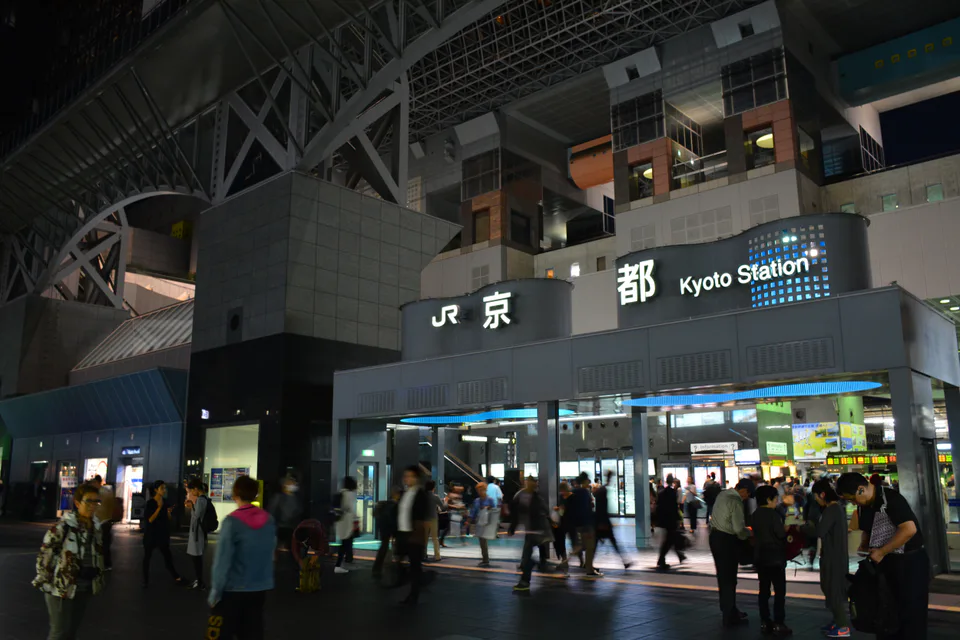
Kyoto Station is the safest base for a short first visit because it solves the fragile parts of the stay: arrival, departure, luggage and regional transport. It also gives you direct JR options toward several major sightseeing corridors rather than forcing every morning onto a city bus.
That matters because Kyoto’s own tourism guidance warns that road congestion can make route-planner estimates unreliable and recommends using trains and subway close to the destination before switching to a bus or walking. A station hotel therefore should not be judged by the old stereotype that “you will take the bus everywhere.” The stronger version of a Kyoto Station stay uses JR and subway aggressively.
I would pay a Station-area premium when it removes at least two hard edges: a late Shinkansen arrival plus an early Nara morning, a luggage-bearing checkout plus onward Shinkansen, or several JR-led sightseeing starts. I would not pay it simply because Kyoto Station is the city’s biggest transport hub.
The trade-off is repetition in the opposite direction. If almost every night ends around Gion, Kawaramachi or Pontocho, the station can create a final journey after dinner on three or four consecutive nights. That is when a theoretically “convenient” base starts charging you in fatigue instead of fare.
Shijo-Kawaramachi: choose it for repeated evening value, not the word “central”
Shijo-Kawaramachi is strongest when the room sits inside the part of Kyoto you will reuse after 17:00. Kyoto Travel highlights the district for dining and shopping, with Nishiki Market nearby and Gion/Yasaka within walking reach. Kyoto’s official Gion access page gives roughly 13 minutes on foot from the Shijo-Kawaramachi intersection to Yasaka Shrine and warns that buses along Shijo-dori can take unexpectedly long in traffic.
That is the real case for Kawaramachi: you can finish dinner, cross the Kamo River, walk Pontocho or Gion and return to the hotel without turning the evening into one more transport task.
But Kawaramachi is not “Kyoto Station, only more central.” Kyoto-kawaramachi is a Hankyu station, not a stop on the Kyoto City Subway Karasuma Line. If your hotel is farther west around Shijo-Karasuma, Kyoto Station is directly connected by subway; if it is farther east around Kawaramachi, you are buying stronger evening access and accepting a slightly less direct relationship with Kyoto Station.
Choose Kawaramachi when downtown is the repeated endpoint. Do not choose it because a map places it in the middle of the city. A central point that you do not actually use can still produce two medium journeys every day.
Shijo-Karasuma: the missing compromise many first-time comparisons skip
Shijo-Karasuma deserves separate treatment from Kawaramachi. Shijo Station sits on the Kyoto City Subway Karasuma Line with Kyoto Station on the same line, while Hankyu Karasuma Station connects the east-west commercial corridor. This makes the area useful when no single attraction district deserves to dominate the hotel decision.
The trade-off is that you give up the immediate Gion edge of Kawaramachi and the JR/luggage edge of Kyoto Station. In return, you reduce the chance that the hotel is excellent for one half of the trip and irritating for the other.
For a four-night first trip with one Fushimi Inari morning, one Arashiyama day, two central evenings and no early Shinkansen departure, I would often price Shijo-Karasuma before automatically choosing either extreme. It is not the most atmospheric answer, but it can be the most balanced one.
Higashiyama: buy the hours, not the postcard
Higashiyama is the area most likely to be chosen for the right emotional reason and the wrong logistical reason. Staying near Gion, Yasaka, Kiyomizu-dera or the eastern temple lanes can make early morning and evening Kyoto feel fundamentally different. If you want to walk through the district before buses and tour groups dominate the day, the hotel location itself can create the experience.
That is worth paying for when you will use it at least twice. One dawn walk does not automatically justify three nights of awkward luggage handling.
Kyoto’s official transport guidance is a useful warning here. For Kiyomizu-dera and Gion, it recommends rail/subway combinations and walking because direct-looking bus routes are often congested. That means a Higashiyama hotel should be evaluated by its actual nearest useful rail station, slope and final 500 metres, not by the district label alone.
A hotel near Gion-Shijo or Higashiyama subway access can behave very differently from a machiya or ryokan higher on a narrow Kiyomizu-side lane. With a small overnight bag, the atmospheric property may be exactly the point. With two 29-inch suitcases in rain, the same address can turn check-in and checkout into the most difficult movement of the stay.
My rule: Higashiyama wins when the stay buys at least two high-value quiet periods or a special ryokan experience. It loses when you will leave after breakfast, return after dinner and spend most waking hours elsewhere.
Do not let buses decide the hotel
Kyoto buses remain useful, but the official travel guide warns that they are especially crowded during spring cherry-blossom season, autumn foliage season and commuting periods. Kyoto also recommends baggage storage or delivery before boarding.
That changes how to judge a hotel. A property described as “one direct bus from Kyoto Station” can be less resilient than a hotel that requires a short train or subway ride plus a walk. During peak periods, I would rather stay near a rail/subway station that gives multiple route options than depend on one famous sightseeing bus for every morning.
This is also why hotel-area articles that compare only kilometres are misleading. In Kyoto, operator choice and congestion exposure matter almost as much as distance.
Nara, Fushimi Inari and Arashiyama push the answer toward rail access—but by different amounts
A single outside-downtown day should not choose the hotel for the whole trip. Repetition is what matters.
Fushimi Inari: Kyoto Station is strong because JR gives a clean early start. One Fushimi morning alone is not enough to veto a Kawaramachi hotel that improves three evenings.
Nara: a full Nara day makes Station or Shijo-Karasuma more attractive, especially when the departure is early or reserved activities are involved. If Nara is the only rail-heavy day, downtown can still win overall.
Arashiyama: Kyoto Station has direct JR access, while central Kyoto can use other rail combinations. The important question is whether Arashiyama is one morning or one of several westbound days.
If the whole Kansai plan is still unsettled, use Kyoto vs Osaka: Where Should First-Time Visitors Stay? before optimizing a Kyoto neighbourhood. The wrong city base cannot be repaired by choosing a better station exit.
Large luggage can reverse the ranking—and luggage forwarding can reverse it back
Kyoto Station’s official accommodation guide specifically notes its lockers and baggage-check facilities, while Kyoto Travel’s getting-around guidance encourages hands-free sightseeing. That makes the station disproportionately useful on arrival and departure days.
But this advantage is not permanent. If you forward the large suitcase to Osaka, Tokyo or the next hotel and carry only an overnight bag, Higashiyama becomes much easier to justify. Luggage forwarding does not make every ryokan convenient, but it can remove the strongest argument against an atmospheric location.
Use the Japan luggage-forwarding guide before paying several nights of station-area premium solely because one checkout day looks difficult.
Families and older travellers should inspect the room and the final 500 metres before the neighbourhood name
For a family of four, the second-best area can be the better booking if the room solves a real problem: four usable beds, enough floor space for luggage, a separate bath-and-toilet layout, reliable lifts or easier breakfast timing.
The same applies to older travellers. “Walkable to Gion” has little value if the hotel approach involves slopes, uneven lanes or a long final walk after a full sightseeing day. Conversely, a station hotel is not automatically accessible if the practical route from platform to lobby involves a huge station crossing.
Before paying for any area, check the exact entrance, lift route and taxi drop-off. A two-minute map difference can matter more than a twenty-minute train difference when it is repeated with mobility constraints.
Two nights, three nights and five nights produce different winners
Two nights: protect the edges
Arrival and departure consume a large share of a two-night stay, so Kyoto Station is the default. I would override it only if the accommodation itself is the experience—for example, a ryokan night in Higashiyama—or if both evenings are deliberately built around downtown.
Three nights: let repetition vote
With two full sightseeing days and two useful evenings, Kawaramachi or Shijo-Karasuma becomes much more competitive. If one day is Nara and checkout is an early Shinkansen, Station may still win. If both evenings are Gion/Pontocho and the rail mornings are ordinary, downtown usually has the stronger repeated value.
Four or five nights: depth can justify atmosphere
A longer stay gives Higashiyama time to repay its friction because you can use multiple early mornings and slower evenings. But longer does not mean you should split hotels automatically. One stable base is normally better unless the second property buys a genuinely different experience.
Do not split Kyoto hotels unless the second hotel has a job
Station → Kawaramachi is usually a weak split. You pay with checkout, packing, luggage storage, transit and another check-in to move across a city you could cross without changing hotels.
A stronger split is functional: three nights in a practical central or station base, then one ryokan night in Higashiyama or Arashiyama where the dinner, bath and quiet evening are part of the product. Another valid split is a final Station night before a very early Shinkansen when the previous accommodation is deliberately remote.
The test is simple: what new hours does the hotel move create? If the answer is only “a different neighbourhood,” keep one base.
Peak spring and autumn: buy route resilience before the perfect postcode
Kyoto’s official travel guidance highlights congestion as a practical planning issue and provides live/forecast tools for busy sightseeing areas. During cherry-blossom and autumn-foliage peaks, I would put more weight on rail/subway access and cancellation flexibility than on shaving a few minutes from a bus ride on a normal-season map.
If the best-located room is dramatically overpriced, do not assume any central Kyoto rate is justified. Use the Kyoto autumn leaves timing guide to identify which mornings truly need a location advantage, and the sold-out hotel backup guide before paying a large premium for a weak room.
Four realistic first-trip examples
Late Tokyo arrival, Nara day, early Hiroshima departure
Choose Kyoto Station. The hotel protects three hard edges: arrival, the Nara rail morning and the onward luggage-bearing departure. A Gion dinner does not outweigh that repetition.
Four nights, no day trips, restaurants and Gion every evening
Choose Shijo-Kawaramachi. The room participates in the trip every night. One or two station transfers are cheaper than four tired returns from downtown.
Three nights, photography-led trip with two dawn eastern-Kyoto walks
Choose Higashiyama if the exact property has a manageable luggage route. Here the quiet morning hours are the product, not an incidental convenience.
Four nights, mixed first trip with one Fushimi morning, one Arashiyama day and two central evenings
Price Shijo-Karasuma first. No single edge dominates, so the balanced subway/central position can beat paying for either maximum station convenience or maximum Gion atmosphere.
Final verdict: choose the hotel that removes repeated hard journeys
Kyoto Station is the safest first-time default when transport and luggage are fragile. Shijo-Kawaramachi is the strongest evening base when downtown repeats. Higashiyama is the experiential choice when you will actually use the early and late hours. Shijo-Karasuma is the best compromise when no single pattern dominates.
Do not choose by “most central,” by one famous temple, or by the shortest Google Maps time. Count two mornings, two evenings and the luggage-bearing departure. Then red-team the result: if one cancelled bus, one rainy suitcase transfer or one late dinner makes the area choice look bad, the base is not resilient enough.
Search Kyoto hotels
Search Kyoto hotels on Booking.com
Search Kyoto hotels on Expedia
Official sources checked
Kyoto Travel — choosing accommodation by area · Kyoto Travel — getting around Kyoto and congestion guidance · Kyoto Travel — comfortable access to Gion / Yasaka Shrine · Kyoto Travel — comfortable access to Kiyomizu-dera / Higashiyama · Kyoto City Transportation Bureau — Karasuma Line stations · Hankyu Railway — Kyoto-kawaramachi Station. Checked August 25, 2026.
Where to Stay in Furano: Furano Station, Nakafurano, Asahikawa or Sapporo?
Where to Stay in Okutama Without a Car: Ome, Mitake Gorge or Okutama Station?
Where to Stay for Tohoku Autumn Leaves: Sendai, Morioka, Aomori and Hachinohe
Where to Stay in Kamakura or Fujisawa: The Best Base for Two Nights, With Enoshima as the Wild Card
Sendai Tanabata Festival 2026: Fireworks, Three-Day Plan and Where to Stay