
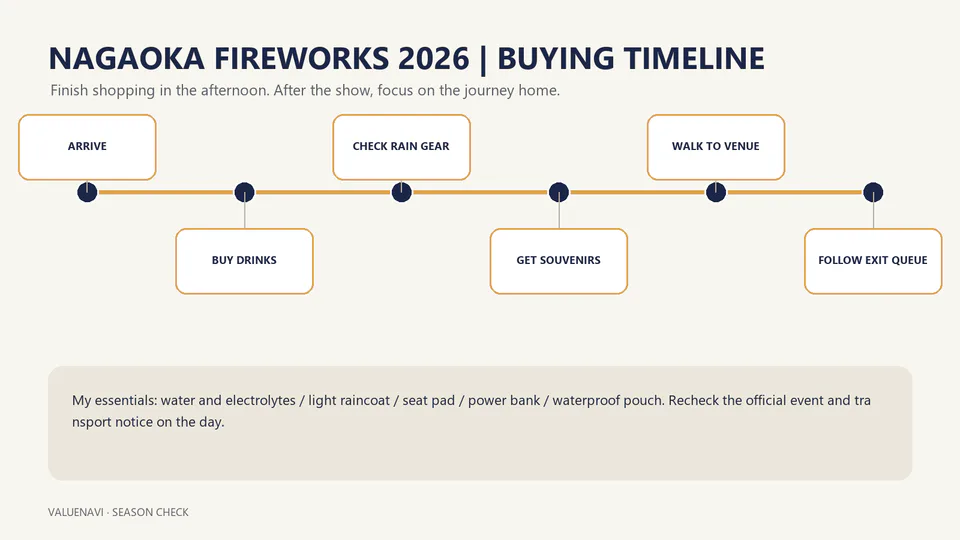
The 2026 Nagaoka Fireworks are over. What remains useful is the packing logic that the organiser's own crowd guidance makes obvious: the bag has to survive the walk to the river, several hours outdoors and a controlled return that can take far longer than the normal station walk. This is not the event to carry a full sightseeing-day backpack simply because every item might be useful.
The 2026 organiser warned that toilets and shops become heavily congested close to launch time, that the normal walk from Nagaoka Station to the A venue is about 30 minutes, and that the return can take more than an hour because of restrictions and crowd flow. For drivers, the official congestion data is even harsher: a 4.4 km stretch toward Nagaoka Interchange that normally takes about seven minutes has taken more than three hours at peak post-show congestion.
If the bank, ticket, hotel and return mode are not already solved, use the Nagaoka Fireworks ticket and exit guide first. Packing cannot repair a seat on the wrong riverbank.
Nagaoka packing in 30 seconds: carry for the queue, not the photo
↔ Scroll table left or right
Item | Carry? | Why |
Ticket / phone / ID / medication | Essential | The venue is all-ticketed and connectivity can deteriorate as the crowd builds |
Water + small salty/electrolyte snack | Essential | Buying everything at the last minute means joining the worst queues |
Compact meal | Usually yes | Lets you stop treating the final pre-show hour as a food hunt |
Light rain layer | Yes when weather warrants | Hands-free protection works better in a dense riverbank crowd than managing a large umbrella |
Seat pad / small towel | Useful | High comfort-to-weight return during a long outdoor wait |
Large suitcase | No | Every extra kilogram is paid again on the station walk and exit queue |
Bulky souvenir haul | Usually no | The purchase must still survive rain, crowds and the late return |
The real bag limit is the walk home after the show
On the station side, the ordinary reference is roughly 30 minutes between JR Nagaoka Station and the A venue. The organiser's pre-event guidance says the return can exceed one hour once restrictions and crowd flow are added.
That means a bag that feels comfortable at 15:30 can become expensive at 22:00. The useful test is not “can I carry this to the fireworks?” but “would I still choose to carry it after standing outside for hours and then walking in a slow queue?”
For most visitors, that pushes the bag toward essentials, a compact meal, weather protection and one small comfort item. It pushes spare shoes, heavy camera extras, large shopping bags and full-size luggage out.
Buy supplies before the last approach, not at the final possible shop
In its July 23, 2026 pre-event notice, the Nagaoka Fireworks Foundation specifically warned that toilets and sales areas become heavily congested immediately before the display. That is a timing problem, not an availability problem.
The robust sequence is:
buy water and food before the final riverbank approach;
use a toilet before entering the densest crowd;
confirm the ticket and meeting point while mobile service still works reliably;
enter the correct bank with enough time that you do not need to solve basic needs at the last minute.
The organiser also warned that phone connectivity can become difficult as launch time approaches. If travelling as a group, agree on a physical meeting point and save the seat/entrance details offline before splitting up.
Separate the no-failure pouch from the convenience items
A useful Nagaoka bag has two layers.
↔ Scroll table left or right
Layer | Examples | Rule |
No-failure pouch | Ticket, phone, ID, medication, payment method, small power bank | Keep together, weather-protected and reachable without unpacking the whole bag |
Comfort layer | Water, food, towel, seat pad, light rain layer | Cut anything whose benefit is smaller than the burden of carrying it through the exit |
This matters because the worst time to discover a ticket buried under wet food packaging is at a controlled entrance. A small sealable pouch turns several critical items into one check before leaving the hotel.
Weather protection should protect the ticket and electronics first
Nagaoka is an outdoor riverbank event. The 2026 organiser also warned that wind direction can carry firework debris, residue and dye onto clothing. Dress for an outdoor event rather than a formal night out and avoid bringing clothing that would be ruined by a small stain.
For rain, protect the phone, ticket and paper goods before worrying about keeping every part of the bag perfectly dry. A compact rain layer keeps both hands available in a crowd. Recheck the actual event-year weather and organiser rules rather than assuming 2026 operations apply unchanged.
If poor weather affects the wider itinerary, use the Japan rainy-day backup guide rather than turning one fireworks night into the only acceptable outcome.
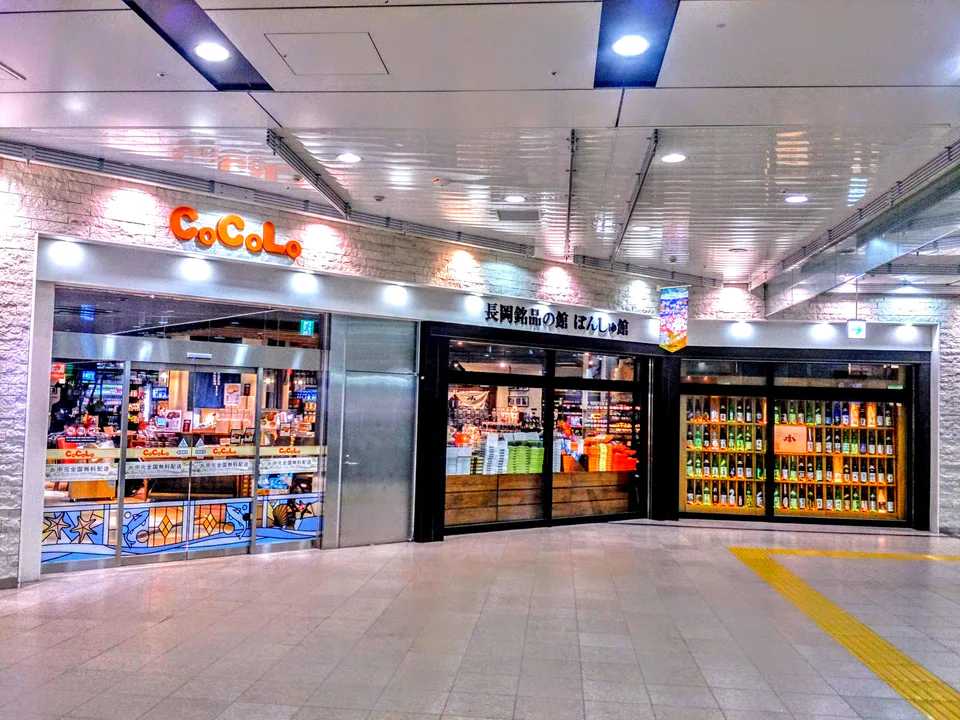
Souvenirs are worth buying only when they stay on the route
Official Nagaoka Fireworks merchandise has been sold through locations including the Nagaoka Fireworks Information Room at Aore Nagaoka and the museum shop at the Nagaoka Fireworks Museum roadside station. Future stock and opening arrangements should be rechecked.
For a rail traveller, the decision rule is more important than the shop list: do not create a cross-town detour for a souvenir on event day. If a merchandise point is already on the station-side route, a light flat item can be easy to carry. If reaching it adds another bus, taxi or long walk, buy on another day or skip it.
A folding tote is useful because it separates clean paper goods from food and wet items. But the tote should stay a small overflow tool, not permission to double the amount you carry.
Large luggage should leave the fireworks problem before you leave the hotel
A suitcase adds friction at exactly the worst points: station corridors, ticket checks, riverbank paths and the post-show queue. If the event falls on a hotel-change day, solve the case separately with hotel storage or Japan luggage forwarding.
The hidden benefit is not just easier walking. Removing the suitcase gives you more freedom to follow staff-directed routes when crowd controls change. A rigid case turns every detour into a negotiation with wheels, curbs and people.
After the finale, stop adding errands
The show ending is the beginning of the exit. The organiser uses controlled station-entry flows, and the ordinary 30-minute walk is explicitly not a return-time guarantee when the crowd is heavy.
So the post-show rule is simple: no final convenience-store browse, no souvenir detour and no tightly timed restaurant booking before a train you cannot miss. The highest-value action is to join the correct exit flow with the group intact and the essentials already in the bag.
This is the same logic behind the Omagari Fireworks transport guide and the Edogawa Fireworks guide: a good viewing position is only good if its exit still works.
Drivers should pack for waiting, but route choice matters more than supplies
The official Nagaoka traffic page records a historical peak where the 4.4 km approach toward Nagaoka Interchange took more than three hours instead of the normal seven minutes. It recommends avoiding Nagaoka Interchange and warns that nearby interchanges can also become congested.
No amount of snacks turns a wrong-bank parking plan into a good plan. For drivers, the hierarchy is bank → parking/shuttle → exit direction → bag. If those first three are wrong, packing is a minor variable.
What I would cut first from an overloaded bag
full-size luggage;
duplicate drinks that can be bought earlier near the route;
camera gear without a specific shot plan;
heavy souvenirs bought before several hours of crowd movement;
extra clothing that does not solve a likely weather problem.
I would keep medication, ticket/phone, water, a compact food option, rain protection when needed and one lightweight seating/comfort item. The exact list can change; the weight hierarchy should not.
Final verdict
Use 2026 as proof that Nagaoka packing is an exit problem disguised as a festival checklist. Buy essentials before the final crowd wave, keep ticket/phone/ID/medication together, carry only weather and comfort items with a clear job, and remove large luggage from the event day entirely. The organiser's own guidance says the return to Nagaoka Station can take more than an hour and road congestion can become extreme. The best souvenir is not worth making that final hour harder.
For a future edition, recheck the official ticket, access, traffic and pre-event visitor guidance before copying any year-specific timing.
Sendai Tanabata 2026 Is Over: What Downtown vs Aobayama Taught Us
Gujo Odori 2026: What Dates Are Left After the All-Night Dance?
Morioka Sansa Odori 2026 Is Over: What Free vs Reserved Viewing Taught Us
Japan Autumn Leaves in Early November 2026: What You Can Book Before the Forecast Exists
Ghibli Park Tickets 2026: Before You Buy Standard, Name the Buildings You Refuse to Miss