For three or four friends in Okinawa, I would choose the room configuration before I choose the pool. Three friends can justify one large room when the hotel itself is part of the trip. Four adults leaving together every morning should compare two Twin rooms before booking any room that merely “sleeps four.” The reason is not a stereotype about how long anyone takes to get ready; it is concurrency. Four people can need the shower, mirror, hair dryer, toilet, floor space and open suitcases at the same time.
The second decision is the base. Naha is the safer default when the group wants independent late-night returns, Kokusai Street, the monorail and minimal hotel-moving friction. Chatan becomes worth sleeping in when two real evenings belong in American Village or when resort facilities are genuinely scheduled into the day. A one-night Chatan move often buys less than the packing it creates.
If you have not chosen a base yet, start with where to stay in Okinawa. If the only question is how four adults should fit into one or two rooms, use the four-adult room configuration guide. This article focuses on the repeated friction that changes a friends’ trip: morning bottlenecks, unequal beds, luggage floor space, laundry, splitting up after dinner and whether paid hotel facilities will actually be used.
ValueNavi decision table: solve the repeated bottleneck first
↔ Scroll table left or right
Trip pattern | Start with | Why | What can reverse it |
3 friends, real hotel time | One large room such as Southwest Grand’s Grand Twin | 45 m² gives the shared room a real job beyond sleeping | The third guest still uses a sofa bed; two rooms may win if bed equality matters |
4 friends, same departure time | Two Twin rooms | Two bathrooms and two closed sleep zones remove the biggest daily queue | One-room social time matters more and the group accepts mixed bed types |
4 friends who insist on one room | JR Blossom Family Room | It is purpose-built for 3–4 guests and keeps everyone together | Two regular beds + bunk + sofa bed are not four equivalent beds |
Late Kokusai Street nights | Naha base | People can return independently without coordinating one driver or resort transfer | Most evenings are actually in Chatan or Onna |
Two American Village evenings | Two nights in Chatan | The hotel move now improves two evenings and two mornings | Chatan is only one dinner stop in an otherwise Naha-heavy trip |
Pool is the main reason to upgrade | Put a two-hour hotel block on the itinerary first | A facility only earns its premium if you have time to use it | If no usable block exists, treat the pool as a bonus |
ValueNavi Group Logistics Score: compare room setups, not hotel stars
This is a ValueNavi editorial model, not an official hotel rating. It is designed for multi-adult room decisions and can be reused across our group-hotel guides. The score measures bathroom/getting-ready concurrency (30%), bed equality and sleep privacy (20%), luggage/dressing space (20%), independent late-night recovery (15%), and shared-hotel-time payoff (15%). A higher score means less repeated group friction; it does not mean the hotel is more luxurious.
Room setup | Group Logistics Score | Best feature | Main penalty |
|---|---|---|---|
4 adults in two well-located Twin rooms | Two bathrooms, two sleep zones, easier suitcase separation | Less spontaneous one-room social time; usually higher total price | |
3 adults in Southwest Grand Grand Twin | 45 m² shared space and genuine hotel-time potential | One bathroom and third guest on sofa bed | |
3 adults in HOTEL COLLECTIVE Superior Twin | Central location plus guest bath/shower area as a backup lane | 30 m² and one in-room bathroom still create a morning bottleneck | |
4 adults in JR Blossom Family Room | Everyone stays in one 33 m² room near Kokusai Street | Mixed bed hierarchy and one-room concurrency |
The score is deliberately harsh on “sleeps four” rooms. Capacity tells you whether four people are allowed to sleep there; it does not tell you whether four adults can shower, dress, open luggage and sleep on equivalent beds without negotiating the room twice a day.
Start with one question: what time are all of you trying to leave?
If four people all need to be out by 08:30, one bathroom, one main mirror and one narrow path between open suitcases can turn a relaxed morning into a serial process. The issue is simultaneous demand: one person showers while another needs the sink, someone is drying hair, someone is changing clothes and another person is trying to repack a day bag.
That is why two Twin rooms can be worth more than one larger room. You are not only buying extra square metres. You are buying parallel capacity: two bathrooms, two doors that can close, two places to organise luggage and two sleep zones if part of the group wants to go to bed earlier.
Before paying for a view, lounge or bigger television, price the two-room option on the same dates with the same breakfast and cancellation terms. Divide the difference by four people and by the number of nights. A room split that looks expensive as one total can be a modest per-person premium once it removes the same queue every morning and evening.
ValueNavi one-room vs two-room formula: when is the second bathroom worth paying for?
Use this simple derived check after you find comparable rates:
Extra privacy cost per person per night = (two-Twin total − one-room total) ÷ travellers ÷ nights.
Then compare that number with the value of what the second room actually buys: a second bathroom, two quieter sleep zones, more luggage floor space and less coordination. There is no universal “correct” yen threshold because hotel rates move by date, but the formula stops the group from reacting to the intimidating total price.
Example: if two Twins cost ¥24,000 more than one four-person room over a three-night stay, four friends are paying an extra ¥2,000 per person per night. At the August 26, 2026 exchange rate, that is roughly US$13. I would usually pay that premium for four adults with the same morning schedule. If the gap is ¥8,000 per person per night, the case for staying together becomes much stronger.
This is ValueNavi analysis, not a hotel rule. The point is to convert “two rooms are ¥24,000 more” into the smaller decision unit each traveller is actually paying for the extra bathroom and privacy.
For three friends, Southwest Grand works when the hotel itself is part of the itinerary
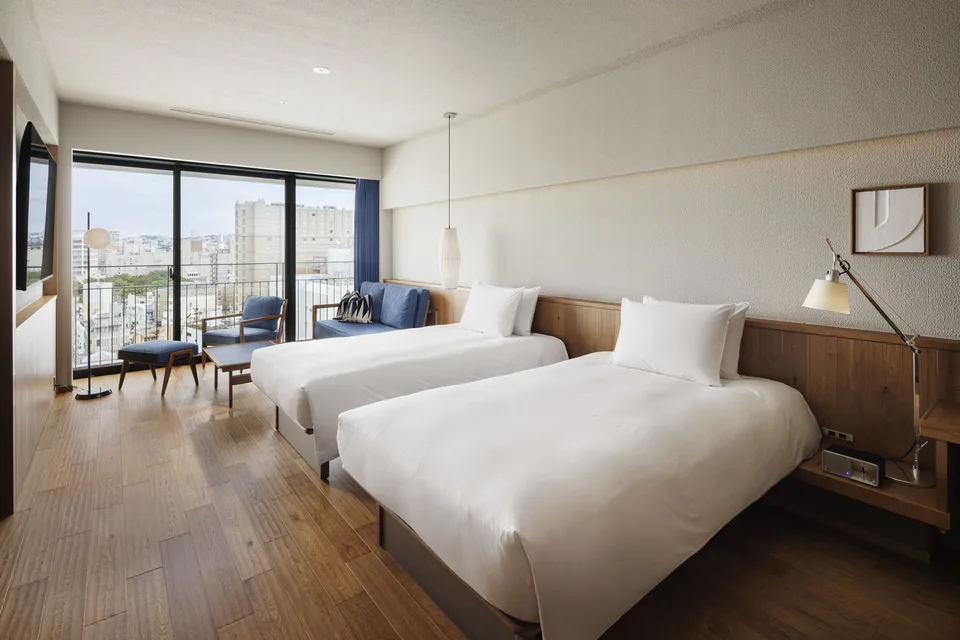
Southwest Grand Hotel’s current Grand Twin is 45 m² for up to three guests, with two 120 cm Twin beds and a sofa bed used for the third guest. The guest-only indoor pool, outdoor jacuzzi and sauna operate from 06:00 to 22:00. That is a coherent three-person setup when the group intends to return early, change, spend time together at the hotel or deliberately use the pool.
The room does not automatically win because it is large. The third sleeping position is still a sofa bed, and there is still one in-room bathroom. If the trip leaves the hotel at 08:00 and returns near midnight every day, much of the 45 m² and resort-style facility value disappears. In that itinerary, a cheaper, well-located room—or two rooms if the budget allows—can be more rational.
ValueNavi verdict for three: pay for Southwest Grand when at least one substantial hotel block is real. Do not pay the premium just because the group chat likes the room photos.
Check whether Southwest Grand fits your hotel-time plan
Four friends often love one room until everyone needs the bathroom
The social upside of one room is real. Nobody needs to decide which room everyone hangs out in, and late-night conversation is easy. But that benefit is concentrated around the end of the day. Bathroom, dressing and luggage friction happens in both directions—before leaving and after returning—every day.
The decision therefore hinges on what the group values more:
Choose one room when staying together is important, nobody cares about bed hierarchy, the schedule is relaxed and the room has enough floor space for luggage.
Choose two rooms when everyone leaves together, equivalent beds matter, light sleepers have different bedtimes, or several large suitcases will remain open.
If the price gap between one quad-style room and two Twins is small after dividing by four, I would normally buy the second bathroom before buying a better view.
HOTEL COLLECTIVE: the useful feature is a backup getting-ready lane
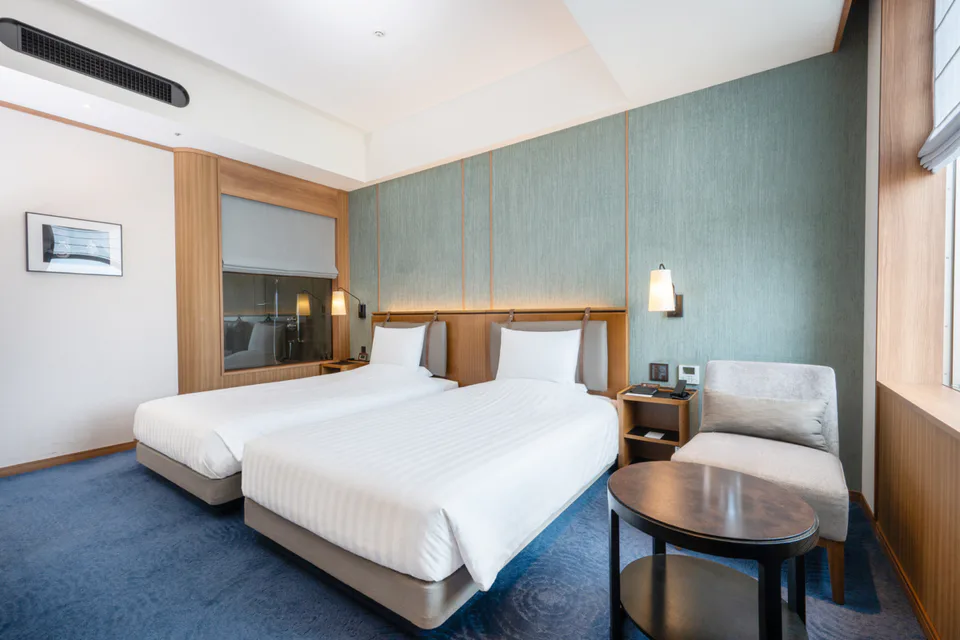
HOTEL COLLECTIVE’s Superior Twin is currently 30 m² for one to three adults. The more unusual group-travel advantage is outside the room: the guest-only Sauna, Bath & Shower Room lists three makeup seats in the women’s area, two shower stations plus one shower booth, and operates 08:00–13:00 and 15:00–24:00, with final entry at 23:30.
That does not magically turn one room into two bathrooms. It does create a backup lane if the in-room bathroom is occupied or someone wants to finish showering and getting ready separately. For a three-friend stay, that can matter more than another decorative room feature.
Location reinforces the same logic. The hotel is on Kokusai Street and the official access page lists about a seven-minute walk from Kenchomae Station. It is not the shortest possible monorail walk, but a central Kokusai Street address can be more valuable when friends split after dinner and return independently.
There is one useful counterpoint: HOTEL COLLECTIVE’s own FAQ says there is no laundromat inside the hotel. If the trip involves repeated swimwear, several outfit changes and self-service laundry every other night, that can move JR Blossom ahead despite HOTEL COLLECTIVE’s stronger bath/shower backup.
Compare HOTEL COLLECTIVE for late nights and getting-ready space
JR Blossom: practical for four, but “four beds” are not four equal beds
JR Kyushu Hotel Blossom Naha’s Family Room is currently 33 m² for three to four guests. The setup is explicit: two regular 120 cm beds, one 97 cm bunk bed and one 95 cm sofa bed. That is useful information because “capacity four” can otherwise hide a major social negotiation.
If the group genuinely does not care who gets which bed, the room solves the one-room requirement cleanly. If everyone expects an equivalent mattress and equivalent personal space, this is not a four-equal-bed room. Two Superior Twins become the more defensible configuration even if the total is higher.
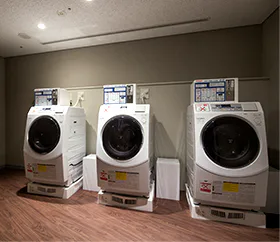
JR Blossom’s location is also practical for independent evenings: the hotel lists about one minute on foot to Kokusai Street and five minutes to Miebashi Station. It also has a 24-hour coin laundry on the 11th floor, and current hotel information says guests can check machine operating status and finishing time from the room. On a beach-and-city trip with repeated outfit changes, that can remove repeated wasted trips to the laundry floor.
ValueNavi verdict for four: use the Family Room when one-room atmosphere is a real priority and the group has agreed on the mixed beds before booking. Otherwise, price two Twins first.
If your shortlist is already down to JR Blossom and HOTEL COLLECTIVE, use the JR Blossom vs HOTEL COLLECTIVE comparison instead of reopening a twenty-hotel list.
Lequ: choose Chatan for two real evenings, not for one rooftop-pool photo
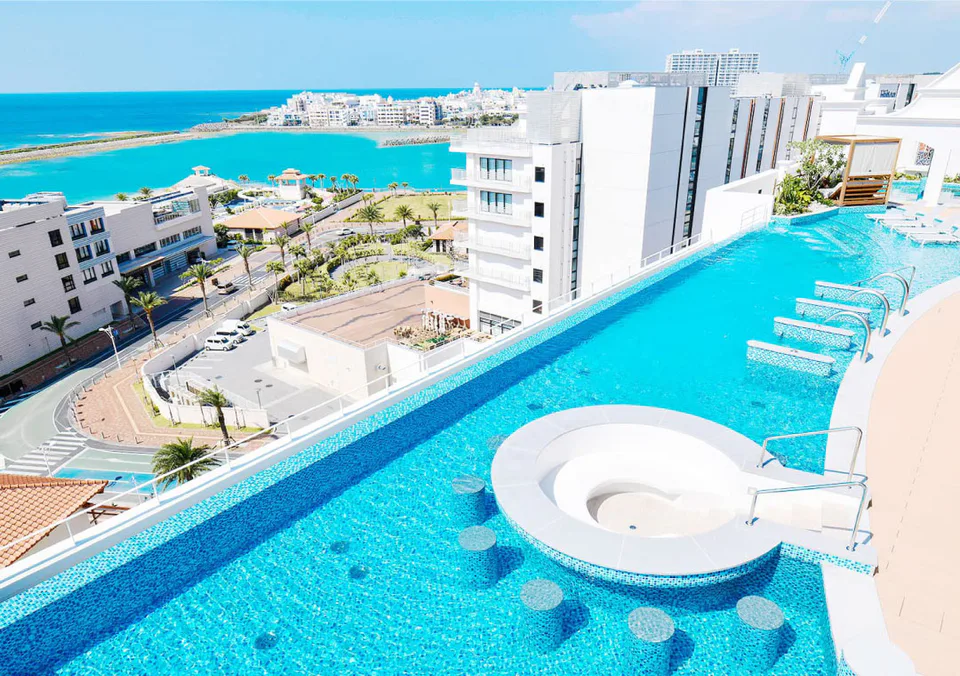
Lequ Okinawa Chatan Spa & Resort makes sense when the group wants two evenings around American Village for dinner, sunset and walking. The hotel’s current facility page lists its natural hot-spring bath from 15:00 to 25:00 in the evening period and a laundry facility in the hotel. Those are facilities that can still be useful after a long sightseeing day.
The pool is now more relevant outside summer than older planning advice suggests. Lequ lists the regular 2026 rooftop-pool season as March 20–October 31, with 08:00–20:00 hours and an extension to 21:00 from July through September. It also now publishes a winter heated-pool period from November 1, 2026 through February 20, 2027, operating 08:00–18:00.
For staying guests, the adult pool fee is ¥2,000 (about US$13). The USD figure is a rough reference using the August 26, 2026 exchange rate; your card or cash rate will differ.
That winter extension changes one decision: a November or January friends’ trip can no longer dismiss Lequ’s pool as a summer-only feature. It does not change the bigger base rule. If American Village is only one dinner on a five-night Naha trip, moving all the luggage to Chatan can still cost more time than the heated pool adds back.
My threshold is two useful Chatan evenings. One evening can usually be done as a visit. Two evenings plus a late hot spring, laundry and planned pool time can justify the hotel move because the location is earning value repeatedly.
Travelling without a car? Use the Okinawa without a car hotel-split guide before moving your base. If Chatan is already fixed, compare Vessel Campana vs Lequ or the three-hotel Chatan decision guide.
ValueNavi hotel-move threshold: a second base needs to improve at least two time blocks
This is the rule I use to stop an Okinawa itinerary turning into a chain of checkouts:
Do not move hotels for one attraction or one dinner. Move when the new base improves at least two meaningful time blocks that are hard to reproduce from the old base.
For Chatan, those blocks are usually evening + next morning, or two separate evenings. For Onna, they may be beach/resort afternoon + dinner + morning. If the move only improves one sunset dinner, the cost side includes checkout, luggage storage, transfer, new check-in and reopening every bag.
↔ Scroll table left or right
Proposed move | Meaningful blocks gained | ValueNavi call |
Naha → Chatan for one dinner | 1 | Usually no — visit from Naha |
Naha → Chatan for sunset + dinner + next morning | 2 | Conditional yes — especially without an early departure elsewhere |
Naha → Chatan for two evenings + hotel pool/hot spring | 3+ | Yes — the move has a clear job |
Naha → Chatan one night → Onna next morning | Often only 1 | Usually no — too much repacking for too little recovered time |
This rule is intentionally stricter for a friends’ trip than for a solo traveller. Every hotel move multiplies the packing event across the whole group.
Four suitcases can ruin a room faster than four beds
A friends’ trip often produces more floor-demand than the occupancy number suggests: shoes, shopping bags, swimwear, day bags, chargers and several large suitcases may all remain active during the stay. A room can technically fit four beds and still function badly once four 26–29 inch cases are open.
Use a simple floor test when looking at room plans and photos: can the suitcases open without blocking the bathroom door, the main aisle or the only place where someone can get dressed? If not, either the bags need a deliberate storage plan or the group needs two rooms.
Do not assume a larger number of square metres solves this automatically. Bed placement matters. A 33 m² four-person room with extra sleeping surfaces deployed can have less usable luggage space than two compact Twins whose floor area is split across two rooms.
A photogenic pool is worth paying for only if you can place it on the itinerary
Southwest Grand’s indoor pool, Lequ’s rooftop pool and HOTEL COLLECTIVE’s seasonal outdoor pool can all influence the booking decision. The test is not whether the facility looks good. The test is whether you can point to the hours when you will use it.
Before paying a resort or facility premium, put a two-hour hotel block on the itinerary: which day, what time, and what outside activity will you give up? If nobody can identify that block, treat the pool as a bonus with zero booking value.
This also prevents a common false economy: choosing a less convenient hotel because its facilities look better, then spending every daylight hour away from the property. You paid the location cost and the facility premium while using neither.
Late-night independence can be worth more than a bigger room
Friends do not always return to the hotel together. One pair may stay for drinks; another may go back early; someone may want to shop longer. A hotel that is easy to reach independently becomes more valuable every night this happens.
This is why a central Naha base can outperform a visually better resort room for an urban-heavy trip. JR Blossom is close to Miebashi and Kokusai Street; HOTEL COLLECTIVE sits directly on Kokusai Street and is about seven minutes from Kenchomae. The group does not need to coordinate one rental car departure or one taxi every time people split.
The trade-off is obvious: Chatan and resort areas can give you a stronger stay experience when the entire group wants the same evening. Choose central Naha for independence; choose Chatan when the evening itself is shared destination time.
Laundry is not glamorous, but it can change the hotel ranking
On a beach-and-city trip, laundry can be used repeatedly rather than once. JR Blossom has 24-hour coin laundry and lets guests check machine status from the room. Lequ includes laundry among its hotel facilities. HOTEL COLLECTIVE, by contrast, says in its FAQ that there is no laundromat inside the hotel.
That does not make HOTEL COLLECTIVE worse overall. It changes the answer for a specific trip: four friends carrying swimwear, activewear and several outfits may value self-service laundry more than travellers staying two nights before flying home.
ValueNavi boundary condition: if you expect to wash clothes twice or more during the stay, treat on-site laundry as a core facility. If you will not wash anything, give it zero score rather than rewarding a hotel for a feature you will never use.
Before paying: eight checks every friends’ group should agree on
The booking is entered as the correct number of adults, so the bed setup is not based on child occupancy.
Everyone knows whether they are getting a regular bed, bunk bed, extra bed or sofa bed.
The luggage plan still works after all beds are deployed.
You know how many real bathroom/getting-ready lanes are available at 08:00.
People who return separately can reach the hotel without depending on one driver.
Pool, bath and sauna dates/hours match the actual stay dates.
One-room and two-room prices are compared on identical breakfast and cancellation terms.
If two rooms must be adjacent, same-floor or connecting, the hotel has confirmed the request rather than the group assuming it.
Final verdict: optimise the friction that repeats twice a day
For three friends who will genuinely spend time at the hotel, Southwest Grand’s 45 m² Grand Twin is a strong one-room choice because the shared space and facilities can become part of the itinerary. If the room is only a place to sleep, the premium is much harder to justify.
For four friends leaving together every morning, I would start with two Twin rooms. The ValueNavi Group Logistics Score favours that setup because two bathrooms, two sleep zones and split luggage space solve problems that repeat every day. The answer reverses when one-room social time is the priority and everyone accepts unequal beds; that is when JR Blossom’s Family Room becomes rational.
Between the Naha hotels, HOTEL COLLECTIVE is more interesting when Kokusai Street access and its guest bath/shower room can relieve the getting-ready bottleneck. JR Blossom becomes stronger when mixed beds are acceptable and 24-hour self-service laundry plus a shorter Miebashi walk are repeated-use advantages.
For Chatan, use the two-block rule. One sunset dinner rarely justifies a hotel move. Two evenings, or evening + next morning plus facilities you will actually use, can. Lequ’s newly published winter heated-pool period means the pool can now contribute to that calculation even from November 2026 to February 2027, but it should still be a planned block rather than a booking-page fantasy.
The core rule is simple: pay for the bathroom, floor space, location or facility that you will use repeatedly—not the feature that looks best once.
Sources and what to recheck before booking
Official information rechecked August 26, 2026: Southwest Grand Hotel — Grand Twin · Southwest Grand — Pool & Sauna · HOTEL COLLECTIVE — Superior Twin · HOTEL COLLECTIVE — Sauna, Bath & Shower Room · HOTEL COLLECTIVE — FAQ · JR Kyushu Hotel Blossom Naha — Rooms · JR Blossom Naha — Facilities · JR Blossom Naha — Access · Lequ Okinawa Chatan — Facilities and 2026/27 pool periods.
Room capacity, extra-bed arrangements, pool seasons, facility hours and adjacent-room requests can change by booking plan or maintenance period. Keep JPY as the booking reference; USD equivalents in this article are only approximate localisation using the August 26, 2026 exchange rate.
Osaka Shopping Hotels: Why the Last 10 Minutes Back from Dotonbori Matter More Than the Metro Map
Sapporo Family Hotels: Four Beds, Snowy Walks and Laundry Matter More Than “Family-Friendly”
Fukuoka Guys’ Trip Hotels: Four Adults, Real Beds, Late Nights and Whether a Sauna Is Worth It
Osaka Girls Trip Hotels: Count Beds, Sinks and Shower Queues Before Square Metres
Nada no Kenka Matsuri 2026: If You Only Go One Day, Choose Oct 15