
Okinawa without a car works best when you stop trying to make every day look like a road-trip day. For a first five-day visit, the most reliable structure is four nights in Naha, one full northern day for Churaumi, one central or marine-activity day, one flexible Naha/Shuri day, and a final morning that stays close to the airport. The biggest trade-off is simple: you give up spontaneous remote stops, but you gain a trip that does not depend on driving on the left, finding parking or returning a rental car before a flight.
If you are still undecided about whether to avoid driving completely, start with the Okinawa car-or-no-car decision rather than treating “no car” as a rule you must obey for all five days. If you already know you will not drive, the most useful companion article is how to split an Okinawa stay without a car, because hotel location matters far more here than it does in Tokyo or Osaka.
The 30-second plan: four nights in Naha is the default, not a compromise
Most reliable version: four nights in Naha. Day 1 Naha, Day 2 Churaumi and Motobu, Day 3 one central or marine activity, Day 4 Shuri plus a flexible backup, Day 5 Naha and the airport.
Add a resort night only when the hotel itself is part of the trip and you are happy to spend the evening there instead of chasing another neighbourhood.
Treat Churaumi as a full northern day. Do not plan Kokusai-dori again that evening just because the map makes Okinawa look small.
Choose marine activities by meeting point and transport first, then by the activity itself.
Keep at least one day movable for wind, heavy rain or typhoon-related cancellations.
Day 1 | Stay inside the Yui Rail zone and let arrival day stay easy
Naha Airport to central Naha is the easiest part of an Okinawa trip without a car, so there is little value in turning arrival day into a long transfer. The Yui Rail QR one-day ticket is currently ¥1,000 for adults and the two-day ticket is ¥1,800, valid for 24 or 48 hours from purchase. That does not automatically mean you should buy one. If your first day is only airport to hotel plus a walk around Kokusai-dori, point-to-point fares may be the better choice.
Use the afternoon for Kokusai-dori, Makishi, the public market or Tsuboya in one walking cluster. If you arrive early enough, Shuri can work, but the more useful first-day question is whether your hotel makes late arrival and the next morning simple. This two-day Naha route without a car shows how to group Shuri, Tsuboya and Kokusai-dori without wasting the first two days on backtracking.
Shuri Castle also has a date-specific change that older itineraries will miss. From November 23, 2026, the reconstructed Seiden interior opens to the public with timed advance reservations, and admission prices change from that date. Before November 23 and after November 23 are therefore not the same itinerary. If the Seiden interior matters to you, allow roughly 90–120 minutes for the full visit and do not bolt it onto a late arrival afternoon.
Day 2 | Make Churaumi your one deliberate long-distance day
This is the day when a no-car itinerary should accept a long transfer instead of pretending every major Okinawa sight is a short hop from Naha. Okinawa Airport Shuttle currently links Naha, the Onna resort area and Okinawa Churaumi Aquarium, with multiple departures each day. The important constraint is not the aquarium closing time; it is your return seat and the bus you can realistically catch back south.
Lock the outbound and return options first. Then decide how much time remains for Bise or Motobu. If you are tempted to stay in Motobu simply because the aquarium is in the north, read whether Churaumi should be an early, mid-trip or final-day stop before adding a hotel move. One overnight can be useful, but only when it removes another long transfer rather than creating a luggage problem.
For 2026, Churaumi operates 8:30 a.m.–6:30 p.m. in the off-season, with last admission at 5:30 p.m. August 1–31 is an extended-hours period, 8:30 a.m.–9:00 p.m., with last admission at 8:00 p.m. The longer August hours are not permission to leave Naha late: a no-car traveller is usually limited by the transport home, not by the final hour of aquarium admission.
If you use the Okinawa Airport Shuttle two-rides ticket, the current published price is ¥3,800 for the Naha Airport–Churaumi/Bise section and ¥2,800 for the Naha Airport–Onna resort section. The catch matters: the two-rides ticket does not reserve a seat, and you cannot board if the bus is full. On a tight itinerary, a cheaper ticket is not automatically the safer choice.

Day 3 | Pick one paid experience, but let the meeting point choose the product
Day 3 is the best place for a paid marine experience because it can sit between the long northern day and the flexible fourth day. The mistake is choosing the most exciting product first and checking transport later. Without a car, the order should be: where you sleep, where the operator meets, whether there is pickup, how long the boat or activity takes, and only then the activity price.
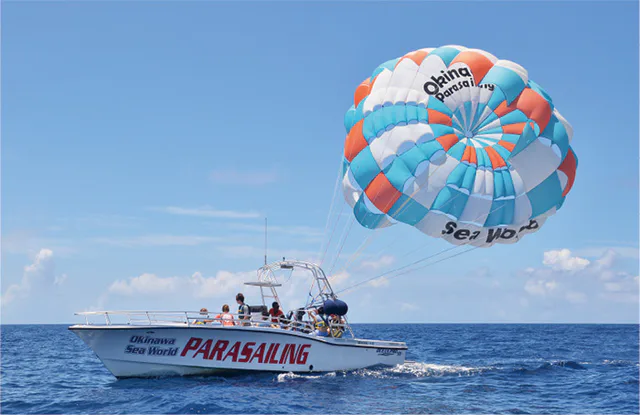
For parasailing, compare Naha, Motobu, Uruma and Ginowan by actual route and boat time. If seeing whale sharks is the priority, use the snorkel vs intro-dive vs Fun Dive comparison to check the Yomitan format, qualification rules and transport before committing. These are better next steps than adding a generic “Okinawa activities” booking button to the itinerary itself.
If an activity starts in Naha or includes a clear pickup, keeping all four nights in Naha remains efficient. If your chosen operator is firmly tied to Onna or Yomitan and you already want resort time, moving one night can make sense. What usually does not make sense is paying for an oceanfront night and then spending the evening on taxis because nothing you want is reachable on foot.
Day 4 | Keep one day flexible enough to absorb weather, Shuri or a missed marine activity
A five-day Okinawa trip should contain at least one day that is not chained to a long-distance bus or marine departure. On a clear day, use the morning for Shuri and keep the afternoon for Naha or a south-island plan that fits the transport you actually have. If Day 3 is cancelled because of wind or sea conditions, Day 4 can absorb the activity instead.
If the weather turns into more than a passing shower, do not replace every outdoor stop with a random indoor attraction list. Use the Okinawa rainy-day and typhoon decision guide to separate ordinary rain from strong wind, marine cancellations, ferry disruption and flight risk. That distinction matters much more on Okinawa than the simple label “rainy day.”
For Shuri visits from November 23, 2026 onward, the Seiden interior requires a timed reservation. The official guidance recommends choosing a slot well after your expected arrival at Shuri Station because the walk, entrance sequence and paid-area access take time. If you only want the paid area without entering the Seiden interior, the reservation rule is different. Recheck the current ticket option before your trip.
Day 5 | The safest no-car departure day stays in Naha
The final day is where the four-night Naha plan earns back all of its convenience. If your flight leaves in the afternoon or evening, use the morning for shopping, coffee, a meal or anything you missed around Naha, then return to the hotel for luggage before heading to the airport. You remove the two things that are hardest to control on a no-car trip: a long intercity bus and the risk that road congestion consumes your airport buffer.
For an early flight, staying in Naha the previous night is even more valuable. For a late flight, an Onna resort can work only when you have checked the exact airport-shuttle stop and service that matches your hotel. “There is an airport shuttle” is not the same thing as “there is a departure that gets me to my terminal with a safe buffer.”
Four nights in Naha vs one resort night: the real difference is what happens after dinner
For most first-time visitors without a car, four nights in Naha is the default because it protects evenings, food choices, bad-weather alternatives and the departure day. A split stay only becomes better when the second base changes how you use the trip. The detailed decision is in Okinawa without a car: when a second hotel base is actually worth the move.
If you are still comparing Naha, Chatan, Onna and Motobu more broadly, use the Okinawa hotel decision hub before comparing individual properties. The right area should remove repeated friction; it should not simply give you a prettier pin on the map.
A no-car trip does not have to be a five-day public-transport challenge
Some travellers do not actually dislike driving; they dislike driving immediately after a flight, driving in central Naha or keeping a car while it sits in a hotel car park. In that case, a hybrid plan can be better: Day 1 in Naha without a car, Day 2 as a northern tour or shuttle day, then rent for only the days when the car unlocks places you genuinely want.
If that starts to sound more sensible than staying car-free for the sake of staying car-free, compare the practical pickup, insurance, NOC, ETC and luggage issues in the Okinawa car rental guide. Once you decide to drive, switch to the five-day self-drive itinerary from Naha to Churaumi rather than forcing this bus-based route into a half-driving plan.
Who should use this itinerary — and who will probably regret it
Good fit: first-time visitors who do not have the right licence, do not want to drive on the left, are travelling solo or as a couple, and are comfortable giving each day one main direction.
Good fit: travellers whose priority list is Naha, Churaumi and one marine experience rather than a string of remote beaches and cafés.
Poor fit: larger families with several suitcases, babies with strict nap schedules, older travellers who struggle with long transfers, or groups who want three remote stops every day.
Poor fit: anyone treating Kouri, Nakijin, Motobu, Onna and Chatan as if they were neighbourhoods that can be casually stacked into one day by public transport.
No rental car does not automatically mean the cheaper Okinawa trip
The comparison that matters is total transport cost plus time, not the daily car-rental headline. Naha rail days can be cheap and simple, but Naha–Churaumi, Naha–Onna and activity transfers add up. For a solo traveller or couple, avoiding a car can still be a good trade because it removes driving stress, parking and rental-return risk. For four adults, the per-person economics can move in the other direction.
If the budget is becoming the deciding factor, use the five-day Okinawa trip-cost breakdown and compare the whole trip rather than one transport line. The cheapest route on paper can become the expensive one if it creates taxi legs, hotel moves or a missed prepaid activity.
What to decide next once the five days are fixed
First, choose the base with the no-car hotel-split guide. Next, decide whether Churaumi is a day trip or a hotel-move trigger with the Churaumi timing and Motobu/Nago stay guide. Then choose one marine activity by location using the parasailing comparison or whale-shark diving comparison. This order keeps the booking decisions attached to the route instead of letting individual products redesign the trip after you have paid.
Recheck these four moving parts before departure
Yui Rail ticket types and current fares — current QR day passes are ¥1,000 / ¥1,800 and run for 24 / 48 hours from purchase.
Okinawa Airport Shuttle timetable and fares — departures, rapid-stop patterns and seat availability shape the northern day.
Okinawa Churaumi Aquarium opening hours — August 2026 has extended hours; ordinary periods do not.
Shuri Castle Seiden reservation information — the interior opens November 23, 2026 with timed advance reservations and revised admission.
Final verdict: in Okinawa without a car, remove one cross-island day before adding one more sight
For a first five-day no-car trip, the cleanest version is four nights in Naha: Naha on Day 1, Churaumi and the north on Day 2, one central or marine activity on Day 3, Shuri plus a flexible backup on Day 4, and Naha before the airport on Day 5. Move one night to a resort only when the resort itself is part of what you are travelling for.
The goal is not to prove that every Okinawa attraction is reachable without a rental car. The goal is to build five days in which only one or two days depend on long-distance transport, the paid activity matches the meeting point, and your final day cannot be ruined by a bus you were never supposed to rely on.