
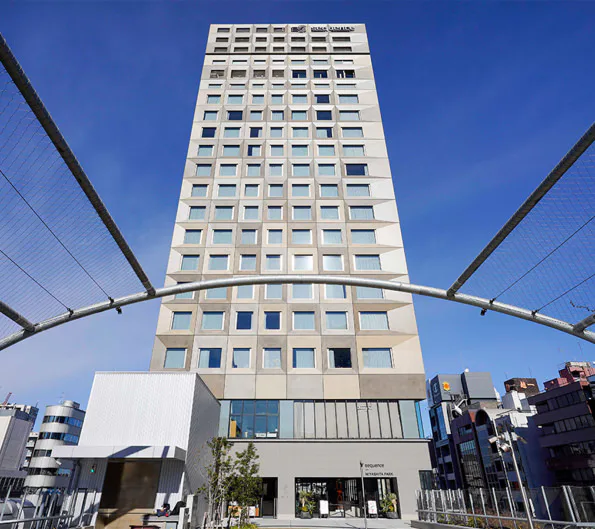
sequence MIYASHITA PARK front entrance and MIYASHITA PARK North. Photo source: Mitsui Fudosan.
sequence MIYASHITA PARK is worth its unusual 17:00 check-in / 14:00 checkout only if your trip actually uses the shifted hours. The hotel works best when Shibuya is where your evenings finish, your first afternoon can be spent outside after dropping luggage, and your departure day starts late enough to keep the room through lunch. It is a weaker fit after a long-haul arrival when you need a private room at 14:00, or before an early Shinkansen, airport transfer or day trip that makes the 14:00 checkout worthless.
The location is excellent, but location alone is not the decision. For an international visitor, the useful question is: how many private-room hours do you lose on arrival, and how many do you actually recover on departure? If the answer is “lose two hours, recover none,” choose a more conventional hotel. If the answer is “store bags, enjoy Shibuya, then use a slow final morning,” the sequence schedule becomes part of the value rather than an inconvenience.
ValueNavi clock-fit table: does 17:00 → 14:00 work for your trip?
↔ Scroll table left or right
Arrival / departure pattern | Fit | Why |
Arrive around 14:00 after a long-haul flight and need a nap | Poor | Luggage storage solves the bags, not the need for a private recovery space before 17:00 |
Arrive 14:00–16:00, happy to shop or explore before check-in | Good | The late check-in costs little if those hours were going to be city time anyway |
Several Shibuya / Harajuku / Omotesando nights + no early mornings | Strong | The hotel puts sleep, breakfast and checkout later, matching the way you use the neighbourhood |
Check out for a 07:00–09:00 Shinkansen, bus or flight | Weak | You pay the 17:00 check-in cost but redeem almost none of the 14:00 checkout |
Tokyo is your final stop and your flight leaves late afternoon or evening | Strong | A 14:00 room can absorb packing, shopping and a shower before the airport instead of forcing an early bag-drop routine |
Tokyo is followed by an early Hakone / Kawaguchiko / Kyoto transfer | Usually poor | The onward transport clock, not the hotel clock, determines your morning |
ValueNavi rule: do not value “late checkout” as a feature in isolation. Value only the portion you can physically use. A 14:00 checkout is worth almost nothing on a 07:30 departure day and can be genuinely useful on a 16:00 airport-transfer day.
The 17:00 check-in is most expensive after a long-haul arrival
The hotel’s official check-in starts at 17:00, and its FAQ confirms that luggage can be stored before check-in. That makes an early arrival logistically manageable, but it does not make the room available. This distinction matters more to international visitors than to someone arriving from another Tokyo hotel after a normal night’s sleep.
If you land at Narita or Haneda in the morning after an overnight flight, reach Shibuya around lunch and want a shower, a nap or a quiet room, the gap until 17:00 can be the single biggest reason not to book sequence. The “just leave your luggage and explore” solution is sensible only when you still have the energy to explore.
By contrast, if you arrive from Kyoto or Osaka around 15:00 and already planned to spend the afternoon around Shibuya, Harajuku or Omotesando, the late check-in is much cheaper. Store the bags, use the neighbourhood, then return once the room is available. The same hotel rule creates two completely different experiences because the traveller arrives with a different energy budget.
If first-night recovery is the real issue, compare the wider Tokyo base decision in Where to Stay in Tokyo for First-Time Visitors rather than forcing a Shibuya hotel to solve an arrival problem it was not designed around.
14:00 checkout is valuable only when your onward clock allows it
The other half of the trade is unusually generous: checkout is 14:00. That can remove the common final-morning sequence of packing early, checking out, storing bags, finding somewhere to sit and then returning to collect luggage. For travellers flying home later in the day, the room can remain useful through lunch.
This is particularly relevant on open-jaw or multi-city Japan itineraries. If Tokyo is your final stop after Kyoto or Osaka and your international flight leaves in the evening, a late checkout can protect the last usable morning. If Tokyo is the middle of the trip and your next leg is an early Shinkansen, the benefit disappears.
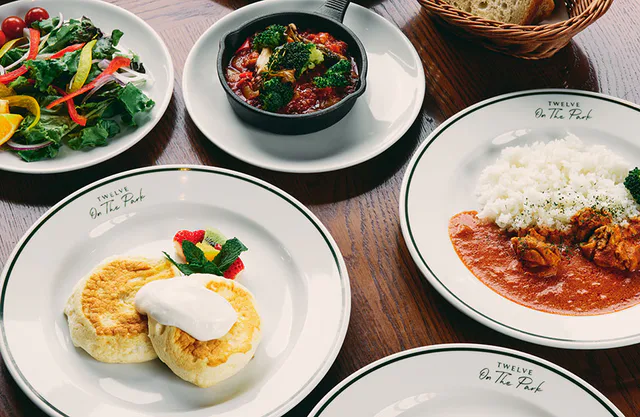
Breakfast reinforces the late schedule. The hotel currently serves breakfast from 07:00 to 12:00, with last order at 11:00. A late breakfast followed by packing and a 13:30 departure is a coherent use of the product. Eating at 07:00 and leaving at 08:00 is not wrong; it simply means the hotel’s most unusual benefit is going unused.
TWELVE ON THE PARK BAR & GRILL breakfast. Photo source: sequence MIYASHITA PARK official website.
Shibuya location: the real premium is the repeat return, not the station name
Official access information puts the hotel about three minutes on foot from Tokyo Metro Shibuya Station Exit B1, about seven minutes from JR Shibuya Station Hachiko Exit and about eight minutes from Meiji-jingumae Station Exit 7. Those are useful reference points, but the location earns its premium when you use it repeatedly rather than once.
A traveller who spends two or three evenings around Shibuya, Harajuku and Omotesando can return to the hotel, drop shopping, recharge and go back out without crossing Tokyo again. A traveller who leaves at 08:00 for Disney, Nikko, Hakone or another long day and comes back only to sleep may be paying for a Shibuya address that the itinerary barely uses.
This is the same location-utilisation test that matters at lyf Shibuya Tokyo, but the products solve it differently. lyf asks you to accept a much smaller private room in exchange for its Shibuya routine; sequence gives more room categories and a very different 17:00/14:00 clock. If Shibuya itself is not a repeated evening endpoint, neither location premium deserves automatic priority.
After 23:00, the entrance route changes
One operational detail is more important than another “minutes from station” claim. The official access page says the MIYASHITA PARK-side entrance is closed from 23:00 to 08:00. During those hours, guests should use the hotel-only elevator at the north edge of RAYARD MIYASHITA PARK near the Jingumae 6-chome intersection.
This is a classic first-night failure mode: a guest learns the daytime route, goes out late, then returns to the mall-side entrance after it has closed. Save the late-entry point before the first night out. Once you know it, the rule is simple; discovering it at midnight with shopping bags is the avoidable version.
Twin vs Large Twin: pay for space only when the stay can use it
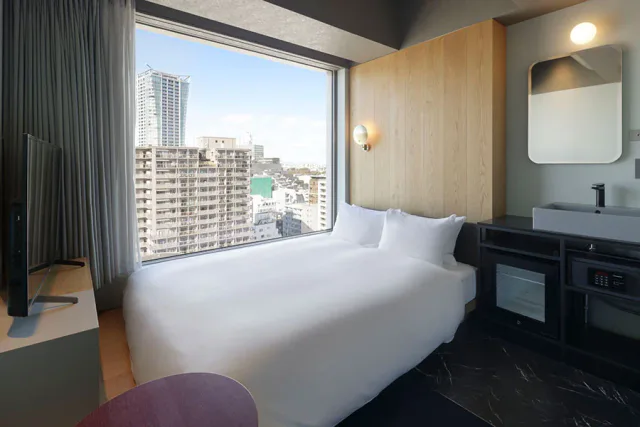
The official Twin is 23.7m² with two 1220mm beds and a capacity of two. Large Twin is 30.2m² with the same two 1220mm beds and a capacity of three; the third guest uses a studio couch. The important upgrade is therefore about roughly 6.5m² of additional room area and third-person flexibility, not wider twin beds.
↔ Scroll table left or right
Room | Official area / capacity | ValueNavi fit |
Twin | 23.7m² / 2 guests | Start here for a short two-person stay with moderate luggage |
Large Twin | 30.2m² / 3 guests | More persuasive for several nights, two large cases, regular shopping or a third guest |
For two travellers staying one or two nights, I would not pay a large premium just for the word “Large.” For a four- or five-night Japan stop with two full-size suitcases and accumulated shopping, the extra floor area can be used every day. The official room size is evidence of the space difference; it is not a guarantee that a particular suitcase size will fit in a particular position.
Bunk 4 and Bunk 6: occupancy is not the same as group comfort
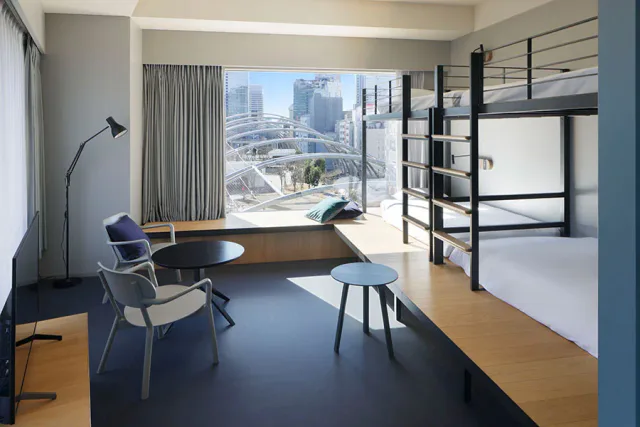
The Bunk rooms are one of the property’s more distinctive group options. Current official sizes are 16.9m² for Bunk Bed 2, 18.3m² for Bunk Bed 3, 30.5m² for Bunk Bed 4 and 40.6m² for Bunk Bed 6, with occupancy matching the number of beds.
For international groups, the hidden variable is luggage. Four or six friends may also mean four or six suitcases, different shower times and different sleep schedules. Keeping everyone in one room can lower the per-person room cost and make late-night socialising easy, but it also concentrates every bag and every routine in one shared space.
ValueNavi group rule: choose the bunk room because your group actively wants to stay together, not merely because “sleeps six” appears cheaper than two or three rooms. If privacy, early sleepers or large luggage dominate, splitting rooms can be the better purchase even when the headline nightly total is higher.
The hotel also states that rooms are cleaned every two days from the date of check-in. That matters little for a one-night stay and more for a longer group stay; travellers expecting conventional daily full-room cleaning should factor the operating model into the decision.
What the hotel does not try to be
The official FAQ confirms that sequence MIYASHITA PARK does not have a large public bath. It does have paid self-service laundry. Those two facts are useful because they stop the comparison from drifting into generic hotel-feature counting.
If the purpose of the stay is an onsen-style evening routine, ONSEN RYOKAN YUEN SHINJUKU solves a different problem. If the purpose is easy JR Shinjuku access before early departures, compare Hotel Century Southern Tower. sequence wins when the late Shibuya rhythm is the product.
Three ways the booking goes wrong
1. You treat luggage storage as early check-in. Bags can be stored, but a traveller who needs a private room at 15:00 still has a two-hour mismatch.
2. You choose the hotel for 14:00 checkout, then leave at 08:00. The headline benefit exists on paper but delivers no value to that itinerary.
3. You book a Bunk room by occupancy alone. Six beds do not answer six-person luggage, privacy or bathroom timing. The group has to want the shared format.
Five checks before paying a Shibuya premium
Write down the time you expect to reach Shibuya on check-in day and whether you will need a private room before 17:00. Write down the time you actually need to leave on checkout day. Count how many evenings end in Shibuya rather than elsewhere. If any night may end after 23:00, save the hotel-only elevator route. Finally, compare the exact room category—not just “sequence MIYASHITA PARK”—because Twin, Large Twin and Bunk rooms solve different space problems.
Only after those checks should you compare the same dates, guest count, room type, breakfast, taxes and cancellation terms across booking channels.
Compare the same sequence MIYASHITA PARK room
Booking.com: compare sequence MIYASHITA PARK rooms
Trip.com: compare sequence MIYASHITA PARK rooms
Agoda: compare sequence MIYASHITA PARK rooms
Final verdict: would I book sequence MIYASHITA PARK?
Yes, when the trip itself runs late. I would shortlist sequence when Shibuya is a repeated evening endpoint, I can use the first afternoon outside the room, and the final morning does not force an early departure. In that pattern, 17:00 is a manageable cost and 14:00 becomes a usable benefit.
I would compare alternatives after a red-eye or long-haul arrival if I expect to need a room before 17:00. I would also move it down the list before an early Shinkansen, airport transfer or west-of-Tokyo day trip, because the hotel’s most unusual benefit disappears.
The simplest test is a two-line itinerary: “When do I need privacy on arrival day?” and “When do I physically leave on departure day?” If the hotel’s clock fits both answers, sequence MIYASHITA PARK is unusually coherent. If it fights both, the Shibuya address is not enough to rescue the booking.
NIFREL Isn’t a Kaiyukan Substitute — The Detour to Expo Park Is the Part You Need to Price In
Sakura Castle: The Stamp Is Open 24/7 — The Castle Is in the Moats, Not a Keep
Swissotel Nankai Osaka: Is Nankai Namba Access Worth Paying More For?
Snow Peak YAKEI SUITE ABURAYAMA FUKUOKA: Is It Worth Giving Up a Fukuoka City Night?
Mt Fuji Day Trip or Overnight: When an Extra Night Is Worth It
Sources
sequence MIYASHITA PARK official website
Official station access and late-entry instructions
Official Twin and Large Twin room information
Official Bunk room information
Room rates, availability and cancellation terms vary by date. Recheck the exact room and conditions before booking.