
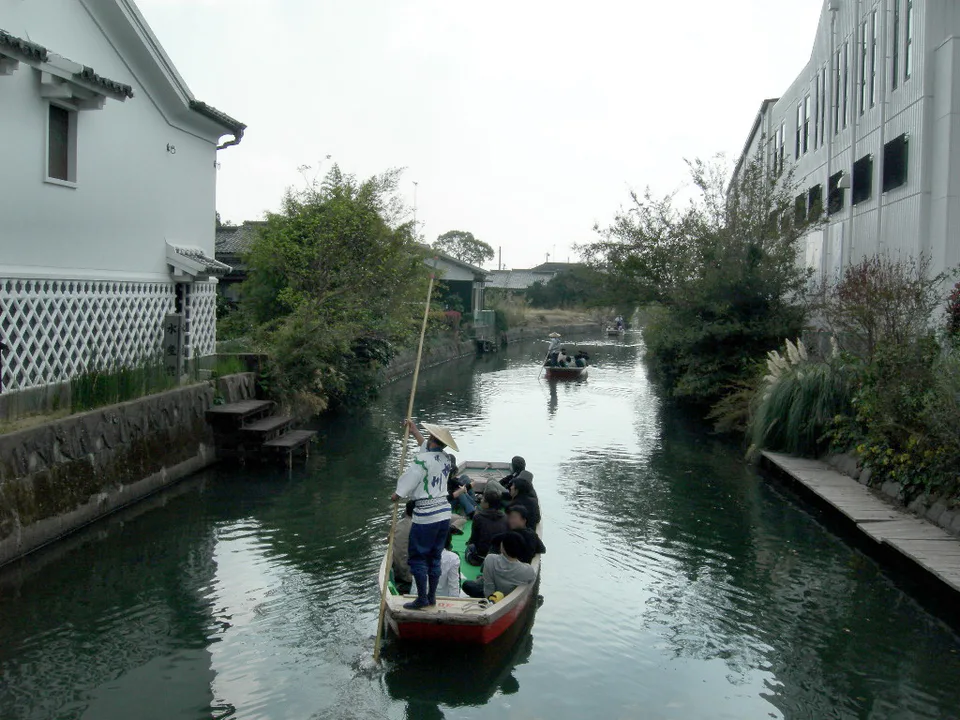
Yanagawa is worth a Fukuoka day trip when you want the canal ride and seiro-mushi eel lunch as the centre of the day, not when you are simply collecting another historic town. For a first visit, I would normally take one standard cruise, eat one proper eel lunch in the downstream Okinohata area, add one cultural stop, then return to Fukuoka. The operator matters mainly because the standard cruises are one-way products: where you board, where you finish and how you get back to Nishitetsu Yanagawa Station are part of the purchase.
There is also a second decision that should be made before you buy anything: Yanagawa on its own and the Nishitetsu Dazaifu–Yanagawa sightseeing ticket are not the same itinerary. The current digital ticket locks you into a defined two-destination route, uses one specific cruise operator and has a 15:00 cruise受付 cutoff. If you only want Yanagawa, or you want a slow eel lunch and flexible afternoon, a normal train + cruise plan can be the more resilient product.
↔ Scroll table left or right
Your actual day | Start with | Why | Main catch |
First Yanagawa visit, 5–7 usable hours | Standard 60–70 minute cruise + lunch + one stop | You get the town’s distinctive canal-and-food experience without turning it into a checklist | The cruise is normally one way, so the return to the station must be solved |
Very hot summer day | Check the operator’s current summer course before leaving Fukuoka | Some operators shorten or alter routes in summer | Old “60–70 minute” itineraries may not match the day’s actual operation |
You also want Dazaifu | Consider the Nishitetsu Dazaifu–Yanagawa sightseeing ticket | It packages rail movement and a designated Yanagawa cruise into one route | The ticket has route restrictions and is not a general Fukuoka-area pass |
You want a slow lunch, museum time or flexible café stops | Yanagawa-only day | You control the return time instead of protecting a second city | You lose the efficiency of combining two destinations |
Rain but normal boat operation | Conditional go | Operators provide rain measures and the canals can still function as the main experience | Comfort and photography value fall; stronger weather can alter operation |
The standard cruise is one way, so the landing is part of the ticket
Yanagawa’s official tourism site currently lists multiple boat companies rather than one municipal cruise. That means “book a Yanagawa cruise” is incomplete advice. The useful comparison is the full chain from Nishitetsu Yanagawa Station to the boarding point, through the canal route, and from the downstream landing back to the station or your next stop.
Yanagawa Kanko Kaihatsu currently lists its normal shared cruise at JPY 2,000 for adults and JPY 1,000 for children aged 6–12, with reception from 09:30 to 15:00. Its strongest car-free feature is the two-sided transfer: a free shuttle from Nishitetsu Yanagawa Station to the Shogetsu boarding point and another free shuttle from the downstream side back toward the station or boarding-area car park.
Suigo Yanagawa Kanko currently lists the normal cruise at the same JPY 2,000 adult fare, plus a summer-only shorter 40-minute course at JPY 1,800. Its shuttle geometry is different, including a return service from the Ohana area toward the boarding point.
For a first visit, I would not choose between these companies because one fare is JPY 100 cheaper on a specific product. I would choose the company whose landing and return shuttle match lunch and the next fixed part of the day. A cheap cruise that strands you at the wrong side of town before a train deadline is not the cheaper itinerary.
Put the eel lunch after the cruise unless there is a specific restaurant reason not to
One-way canal trips naturally deliver visitors toward the Okinohata / Ohana side, where several well-known eel restaurants and cultural sites cluster. That creates a clean sequence: cruise first, lunch second, one cultural stop third.
The opposite order can work if a restaurant reservation or opening time requires it, but it often creates more transport decisions because you must reach the downstream district before boarding and then decide what to do after the boat. For a first visit without a hard reservation, let the boat determine the geography rather than crossing the town twice for a famous restaurant name.
Seiro-mushi is also slow-travel food. Grilled eel and rice are steamed together so the meal is richer and softer than a quick bowl. Treat a popular lunch wait as part of the day rather than squeezing it between two fixed-time attractions. If your plan cannot absorb a 30–60 minute restaurant delay without missing the return, the itinerary is too full.
The Dazaifu–Yanagawa sightseeing ticket is a route product, not a generic discount pass
Nishitetsu currently sells digital Dazaifu–Yanagawa sightseeing tickets through my route and Paymul. The current conditions matter more than the “value ticket” label.
The rail component starts from Nishitetsu Fukuoka (Tenjin) or Yakuin.
After activation, the ticket is valid for two days including the activation day.
You can travel Tenjin/Yakuin → Dazaifu → Yanagawa → Tenjin/Yakuin or the reverse order.
You cannot return to Fukuoka (Tenjin)/Yakuin between Dazaifu and Yanagawa and then resume the ticket.
Intermediate stations outside the designated route are not general hop-on/hop-off stops.
The included Yanagawa cruise is specifically with Yanagawa Kanko Kaihatsu from Shogetsu, with cruise受付 ending at 15:00.
This is a good product when you genuinely want both destinations and are willing to let the ticket shape the sequence. It is a poor reason to rush a Yanagawa lunch, skip a museum or leave Dazaifu early simply because both names appear on the same pass.
ValueNavi rule: buy the combo ticket after you decide to combine the destinations. Do not combine the destinations because you discovered the ticket.
Combining Dazaifu and Yanagawa is an efficiency play, not the best version of either place
Dazaifu and Yanagawa can fit into one long sightseeing day because Nishitetsu designed a through itinerary around them. The trade-off is obvious: each destination receives less slack.
Yanagawa works best when the boat, lunch and downstream area can breathe. Dazaifu works best when you have enough time for the shrine and, if it matters to you, Kyushu National Museum. Combining them is rational when you value variety and have only one free excursion day. It is weaker when one destination is a high-priority experience on its own.
If you are still deciding which side trip deserves the scarce day, compare Dazaifu vs Itoshima and How Many Days in Fukuoka? before treating every excursion as mandatory.
Summer is the season most likely to make an old Yanagawa itinerary wrong
Nishitetsu’s current ticket conditions explicitly warn that roughly July through September the Yanagawa cruise operating hours,受付 cutoff and course can differ substantially from the normal period. The official Yanagawa tourism site also lists summer-specific shorter products from some operators.
That means the familiar online template—“arrive, take a 70-minute boat, lunch at 12:30”—should not be copied into a July or August itinerary without checking the exact operator on the day. Heat is part of the reason: a shorter cruise can be a better experience when the alternative is spending over an hour exposed on the water in peak summer conditions.
If the standard long cruise is the part you most want, choose the season or departure time that makes that experience pleasant rather than insisting that the longest product is always best value.
Winter reverses the comfort problem
Yanagawa’s official tourism information says kotatsu boats generally operate from December through February. Nishitetsu’s current ticket guidance specifies roughly December 1 through the end of February for the designated cruise, except that rain or snow may cause a switch to chair boats rather than kotatsu boats.
That makes winter a genuinely different product, not simply “the same cruise but cold.” If a kotatsu boat is the reason you are going, confirm the day’s operating format rather than treating the seasonal label as a guarantee. On a wet winter day the cruise may still operate, but the experience you imagined can change.
Rain is a comfort decision until the operator says it is an operations decision
Yanagawa Kanko Kaihatsu currently provides raincoats for wet-weather passengers, so light rain does not automatically cancel the cruise. The official tourism site likewise presents rain measures as part of normal operation.
Do not take that to mean weather never matters. Strong wind, water conditions or other safety issues can change service. The distinction is useful:
Light rain, boats operating normally: decide whether the canal atmosphere is still worth the lower comfort and photo quality.
Operator changes or suspends service: follow the live notice rather than a pre-written itinerary.
The canal was the only reason to go and weather removes its value: keep the day in Fukuoka rather than forcing a rural checklist.
Tenjin is the cleanest rail origin, but one Yanagawa day should not choose your Fukuoka hotel
Nishitetsu’s own suggested Yanagawa course currently uses roughly 50 minutes between Nishitetsu Fukuoka (Tenjin) and Nishitetsu Yanagawa. Tenjin therefore gives this particular day a clean start.
That is not enough reason to move a whole Fukuoka stay from Hakata to Tenjin. If your other mornings begin with Shinkansen, JR or airport-heavy movement, the hotel base has a larger job than one excursion. Use Hakata vs Tenjin based on what repeats across the stay.
Yanagawa should fit the base you already need, not force the wrong base for three nights to save one city transfer.
One cultural stop after lunch is usually enough
The downstream district includes Ohana, Shoto-en, the Kitahara Hakushu birthplace and other historic streets. On paper they all fit after a morning cruise. In practice, lunch is the variable that expands: a queue, a slower meal or a cruise departure wait can consume the margin.
Choose one cultural stop that changes the day. Pick Ohana when the Tachibana family residence and garden are the draw. Pick Kitahara Hakushu when literature and local history are more interesting. If neither matters strongly, walk Okinohata slowly and return earlier.
The deletion test is simple: if removing the second museum makes the canal ride and lunch feel better, remove it.
Final verdict: solve the downstream return before you choose the famous restaurant
For a first Yanagawa visit, take one standard cruise, eat seiro-mushi after landing, add one cultural stop and return to Fukuoka. Choose the cruise operator by boarding point, downstream landing and return-shuttle logic rather than a tiny fare difference.
Use the Dazaifu–Yanagawa ticket when you genuinely want both places and accept its route rules. Skip the combo when Yanagawa itself deserves a slow day, especially if lunch, winter kotatsu boating or a specific cultural stop is the point. In summer, recheck the exact cruise because the normal route and cutoff can change substantially.
The red-team question is: if the boat ride were shortened, delayed or made less comfortable by the weather, would Yanagawa still beat your best alternative day? If the answer is no, keep this excursion flexible rather than letting a prepaid transport bundle decide the trip.
Sources and verification date
Yanagawa City Tourism Association — current cruise operators, fares, shuttles and seasonal operation · Nishitetsu — Dazaifu–Yanagawa digital sightseeing-ticket rules · Nishitetsu — current Yanagawa suggested-course transport. Checked August 25, 2026. Cruise courses, summer受付 times, shuttles and weather operation can change; verify the chosen operator for the actual travel date.
Kishiwada Danjiri October 2026: Districts, Transport and How to Plan the Day
Takayama Autumn Leaves: Old Town, Hida Folk Village, Transport and Hotels
Okinawa Girls’ Trip Hotels: Bathrooms, Luggage and Late Nights Matter More Than the Pool
Nada no Kenka Matsuri 2026: If You Only Go One Day, Choose Oct 15
Suzuka Circuit Park Is Better for a 5-Year-Old Than an F1 Fan — Height Rules Decide the Day