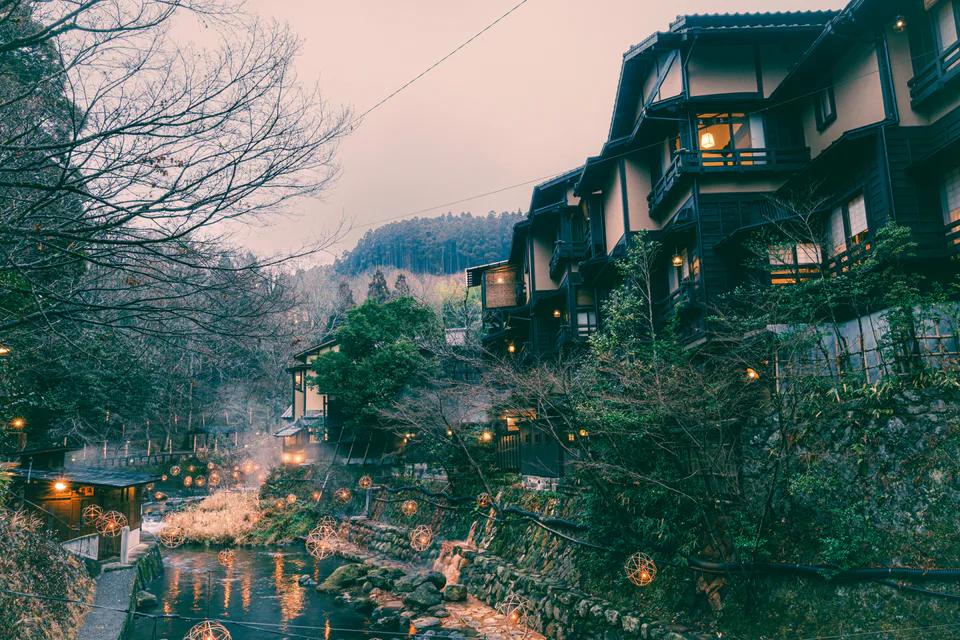
The hardest part of a first public onsen is often the transition from “I know the rules” to actually undressing, washing and stepping into a shared bath. That does not mean everyone becomes comfortable after five minutes. Some travellers relax quickly; others never enjoy communal nudity, and that is a perfectly useful decision signal. Japan offers three different products: the public bath, a reservable private bath, and a room with its own bath. Your first onsen should be the version that lets you experience the water without turning privacy anxiety into the whole event.
For a low-stress first try, learn only the essential sequence before you go: undress in the changing room → wash and rinse thoroughly → enter without swimwear → keep the small towel and long hair out of the water → soak quietly → leave when you feel too hot or uncomfortable. JNTO’s current guidance also says phones and cameras should stay out of the bathing area, tattoo rules must be checked facility by facility, and private baths are a normal alternative for people who do not want a shared nude bath.
The 30-second first-onsen decision
↔ Scroll table left or right
Your main concern | Best first format | Why | What to verify |
You are mainly worried about making an etiquette mistake | Hotel/ryokan public bath | Guest facilities usually make the sequence easy to understand and your room is nearby | Bath hours, towel setup and posted rules |
Communal nudity is the real barrier | Reservable private bath | You keep the bathing ritual without sharing the bath with strangers | Reservation method, fee and session length |
You want privacy whenever you choose | In-room onsen / private bath room | No shared-bath timetable or private-bath slot | Confirm the room bath actually uses hot-spring water if that matters |
You have tattoos | Facility with written tattoo policy | Rules vary; some allow tattoos, some accept cover sheets, some restrict entry | Exact public-bath and private-bath rules before payment |
You are curious but do not want to pay for a ryokan | Day-use onsen | You can test the experience without changing hotels | Day-use hours, towel rental and tattoo policy |
What the first five minutes can feel like—without pretending everyone reacts the same way
The awkwardness usually comes in stages, and knowing those stages is more useful than being told “you will get over it.”
Stage 1: the changing room feels more exposed than the bath
For travellers from cultures without routine communal bathing, undressing can be the point with the most self-consciousness. JNTO notes that most onsen baths are separated by gender and that bathing is normally nude. A small towel can be used for modesty while walking, but it does not go into the bathwater.
The practical coping strategy is not to memorise ten etiquette rules. Put away your phone, valuables and clothes; keep the small towel with you; and follow the same direction everyone else is moving. If communal nudity itself is a hard no rather than temporary nerves, switch products. A kashikiri-buro (private rental bath) is not “failing the authentic experience”; it is a legitimate Japanese bathing format.
Stage 2: the washing area gives you a job to do
Before the bath, you sit at a washing station and clean yourself thoroughly with soap and shampoo, then rinse completely. JNTO also describes kakeyu—pouring hot water over the body before entering—as a way to adjust to the bath temperature.
This stage often makes the experience easier because there is a clear task. You are no longer wondering what to do with your hands or where to look; you are simply washing. Rinse the stool/basin for the next person, keep your voice low and move on when you are ready.
Stage 3: the water may be a bigger surprise than the nudity
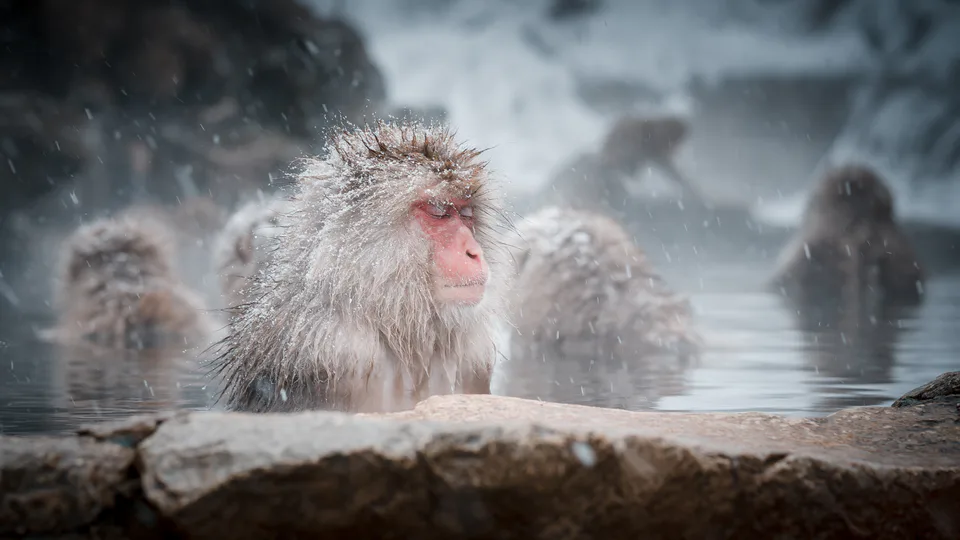
Japanese baths can feel very hot to someone who is not used to them. JNTO advises entering slowly, taking breaks and getting out for cool water if you feel too hot. There is no prize for staying in longer than is comfortable.
The useful first-time rule is therefore short and reversible: enter slowly, see how your body responds, step out when you want, and only soak again if you still feel well. If you feel light-headed or unwell, leave the bath. JNTO also advises avoiding alcohol before bathing because it can affect judgement.
Stage 4: the social part is usually less interactive than beginners imagine
A public onsen is a shared space, but it is not normally a networking event. JNTO’s etiquette guidance emphasises quiet behaviour, no swimming/splashing, and respect for other guests’ privacy. That creates a relatively low-interaction environment.
Do not turn that into a promise that “nobody will ever look at you” or that every first-timer becomes relaxed. The better expectation is that you do not need to perform socially. Follow the bathing routine and give other people space.
The five rules worth remembering—and the rules you can read on site
You do not need to memorise a cultural manual before your first bath. The five high-impact rules are:
Wash and rinse before entering the shared bath.
Do not wear a swimsuit in a normal public onsen unless that specific facility says otherwise.
Keep towels and long hair out of the bathwater.
Keep phones/cameras out of the bathing area.
Follow the facility’s tattoo, child and gender-area rules rather than assuming one national policy.
Everything else can usually be handled by the signs and the people around you. For the full sequence, use the Japanese onsen etiquette guide before the visit instead of trying to turn this article into a second rulebook.
Public bath, private rental bath or in-room onsen: the best first experience is not universal
Choose the public bath when curiosity is bigger than discomfort
A public bath gives you the standard communal experience and often the property’s largest or most scenic bathing area. If your only worry is “I might do something wrong,” a well-run ryokan or hotel bath is a sensible first test because the process is contained inside the stay.
Do not pay for an in-room bath simply because public bathing sounds unfamiliar from home. Read the sequence first. You may discover that the rule anxiety was the main barrier.
Choose a reservable private bath when privacy is the real constraint
JNTO specifically recommends private rental baths for travellers who feel uncomfortable undressing in front of others, and notes that they can also be useful for some tattooed travellers. Private baths are often booked for a limited session, so check availability before assuming the hotel has one ready whenever you arrive.
This is often the best first compromise: you learn the washing/soaking rhythm without paying for an expensive in-room onsen for the entire night.
Choose an in-room onsen when flexibility is part of what you are buying
An in-room bath is strongest when the ability to bathe repeatedly and privately is itself part of the trip—before dinner, after dinner, early morning, or while one parent remains close to a sleeping child.
But “private bath” is not automatically the same as “natural hot-spring water.” If the onsen water itself is why you are paying a premium, verify the exact room description. The broader Japanese ryokan selection guide explains that distinction in more detail.
Tattoos: do not turn uncertainty into a stressful walk-in experiment
JNTO’s current guidance is clear that tattoo policies vary by facility. Some baths accept tattoos, some accept small tattoos covered by approved sheets, and others restrict entry. Private baths can provide another route, but the existence of a private bath does not automatically mean the public bath permits tattoos.
If tattoos affect the decision, check the specific property before the free-cancellation deadline. Ask which baths you may use, whether a cover sheet is accepted and whether there is a size/number restriction. Keep the answer. That is far better than arriving at a rural ryokan after dinner and discovering the main bath is unavailable to you.
Families need to check bath rules before promising children the experience
Many onsen welcome families, but JNTO advises checking the individual facility’s rules. Properties can differ on diapered children, opposite-sex parent/child bathing ages, family/private bath use and opening times.
A private bath can be more useful than a public bath when parents want to bathe with children together or when supervision would otherwise split the family. Again, this is a facility decision rather than a universal Japan rule.
When is an onsen actually worth adding to the itinerary?
The strongest onsen is the one that fits an existing slow period rather than forcing another transfer.
Ryokan night: strong fit because the bath can be used around dinner and breakfast.
After skiing or a winter outdoor day: strong fit when the bath is already at the hotel or in the resort area.
Rainy or low-energy afternoon: useful when the facility is easy to reach and the booking does not consume the whole day.
Late arrival before an early departure: weak fit when the bath hours, meal and morning are all being compressed.
Massive detour solely to “try onsen once”: often weak. Use a day-use bath or hotel bath that is already on the route.
If the bath requires a separate mountain transfer, luggage move and expensive one-night ryokan, ask whether you want the whole ryokan experience—not just hot water. The Kinosaki one-night vs two-night guide and Hakone private-onsen guide are examples of when the accommodation itself changes the answer.
Three ways a first onsen goes wrong—and how to remove each risk
Failure mode 1: you arrive and discover your tattoo is not accepted.
Fix: verify the exact bath policy before payment.
Failure mode 2: you pay for a private-bath room because you are scared of the rules, then realise a simple public bath would have been fine.
Fix: learn the five essential rules first; upgrade only if privacy itself matters.
Failure mode 3: you build a tight schedule around “relaxing at the onsen.”
Fix: place the bath where you have spare time. Relaxation stops being the product when you are watching the train clock.
Final verdict
For most first-timers whose main concern is etiquette, start with a hotel or ryokan public bath and keep the experiment small: learn the basic sequence, enter slowly and leave whenever you have had enough. If communal nudity—not uncertainty about the rules—is the real barrier, skip the forced exposure and reserve a private bath. If tattoo rules, family supervision or repeated private bathing make time slots inconvenient, an in-room onsen can justify its premium.
The goal is not to prove you can tolerate the most traditional version. It is to choose a first bath that lets you decide whether Japanese hot-spring culture adds value to your trip. If you enjoy it, the next onsen town or ryokan becomes a better-informed choice. If you do not, you have learned that without turning one uncomfortable hour into an expensive itinerary commitment.
35 Best Things to Do in Osaka 2026: What’s Worth Your Time by Area, Budget and Trip Style
Tokyu Stay Osaka Hommachi: Is It the Right Base for Five Nights?
Sapporo Shopping Hotels: Stay Where You Can Drop Your Bags, Not Just Where the Shops Are
Itabashi Fireworks 2026 Is Over: What the Takashimadaira Change Means for Future Visits
Tokyo First & Last Day Itinerary: What to Do With 3, 5 or 7 Usable Hours
References
Japan National Tourism Organization — How to Best Enjoy Japan’s Onsen · JNTO — bathing manners and private baths · JNTO — Hot Springs in Japan. Facility-specific tattoo, child, towel and private-bath rules can differ; verify the actual onsen before travelling.