A Japanese ryokan is worth the premium when the night itself is one of the trip’s experiences, not when it is simply a more expensive place to sleep. Before comparing properties, decide whether you will genuinely use the meal, bathing and slow-time windows you are paying for. If you expect to arrive after dinner, leave before breakfast, avoid the public bath and spend almost no waking time at the property, a normal hotel plus a day-use onsen can be the better purchase.
For a first ryokan stay, I would choose in this order: 1) protect the arrival and departure window, 2) decide whether half board has value, 3) choose public bath vs reservable private bath vs in-room onsen, 4) verify tattoo and family rules, 5) check the real sleeping layout and luggage route, and only then compare room aesthetics. This prevents the most common mistake: paying for an attractive room whose expensive features do not fit the way you will actually spend the night.
The 30-second ryokan decision
↔ Scroll table left or right
Your real priority | Start with | Why | Main check before paying |
First onsen, comfortable with communal bathing | Good ryokan + public bath | You may not need to pay heavily for an in-room tub | Bath hours and whether the property actually uses hot-spring water |
Nervous about nudity / couple wants privacy | Reservable private bath | Often buys privacy without upgrading every hour of the stay | Reservation method, session length, fee and availability |
Privacy and flexible repeated bathing are the main experience | In-room onsen | No timetable or shared-bath dependency | Confirm the specific room bath is natural onsen water, not merely a private tub |
Tattooed traveller | Property with written tattoo policy; private bath if needed | Rules vary by facility | Do not infer public-bath access from the existence of a private bath |
Late arrival / early departure | Transport-first hotel or room-only stay | The ryokan’s most valuable windows may be unusable | Latest dinner-compatible arrival and earliest workable checkout/transfer |
Family / 3–4 adults | Room with confirmed beds/futons + bath plan | Maximum occupancy does not tell you how everyone sleeps | Actual bedding, child meal charges, bath access and luggage floor space |
First decide whether the ryokan night has enough usable hours
A ryokan premium is easiest to justify when you protect several parts of the stay rather than arriving only to sleep. I use a simple ValueNavi test: count four possible ryokan windows.
Arrival window: enough time to reach the property, settle in, change into yukata and use the bath before dinner if you want to.
Dinner window: the in-house meal is part of the reason you booked the property.
Evening window: a second bath, lounge, garden, town walk or simply quiet room time after dinner.
Morning window: breakfast, another bath and an unhurried departure rather than a dawn checkout.
For a premium one-night stay, I would want at least two of those windows to matter. Three or four makes the booking much easier to defend. If only the sleeping window survives, the ryokan is competing against every good hotel in the area while carrying a higher price and more timing constraints.
This is why a ryokan night is usually a poor place to absorb a long-haul late arrival or a pre-dawn airport departure. Put the more flexible city hotel on the fragile edge of the itinerary, and place the ryokan where you can actually arrive on its terms.
Half board is not a free add-on: it changes the shape of the day
JNTO describes a ryokan stay as commonly including a multi-course dinner and a Japanese breakfast. That is why comparing a half-board ryokan with a room-only hotel by headline room rate is misleading: you are comparing different bundles.
But meals only have value if your schedule can use them. Ryokan dinner procedures are property-specific. Some properties set meal times; some impose a latest arrival for dinner; some cannot simply re-serve a full multi-course meal whenever a delayed guest appears. Do not use a generic “check-in until…” time as proof that your dinner will still be served. Read the exact meal plan and ask for the latest dinner-compatible arrival when the transport day is uncertain.
When deciding between half board and room only, compare the whole evening:
Half board wins when dinner is part of the experience, local dining is limited, you want to stop making decisions after check-in, and your arrival has a comfortable buffer.
Room only can win when the town has restaurants you specifically want, you are arriving late, dietary constraints make the fixed meal difficult, or the ryokan is mainly being used for its bath and location.
Also compare on a party-total basis. JNTO notes that ryokan rates are commonly priced per person with meals included. A “JPY 30,000 room” and a “JPY 30,000 per person ryokan plan” are not remotely the same family budget.
Public bath vs private bath vs in-room onsen: buy the privacy level you actually need
JNTO’s current onsen guidance describes public bathing as normally nude, with most baths separated by gender. For some first-time visitors that becomes comfortable once the sequence is understood; for others, privacy is the whole reason a ryokan becomes bookable. Read the first onsen experience guide and the onsen etiquette guide before assuming you must pay for an in-room bath.
Public bath: best value when communal bathing is genuinely fine
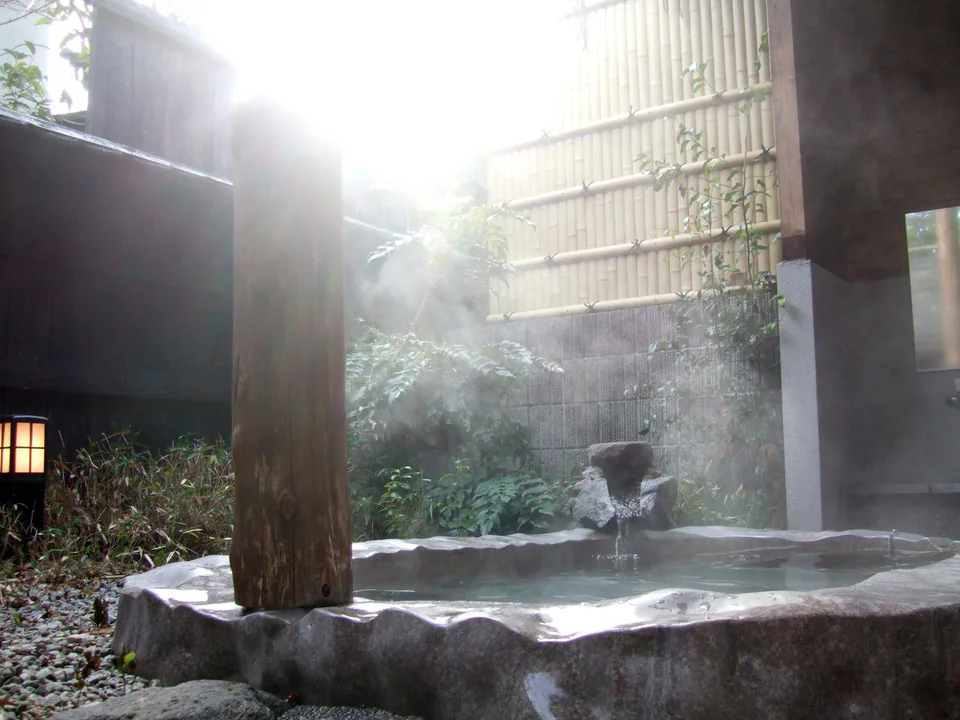
If everyone who matters is comfortable using the public bath, the cheapest room category can sometimes preserve almost all of the onsen experience. The large bath may have the better view, larger rotenburo or more bathing variety than a small room tub. Paying a large room premium only to use the private tub once can be weak value.
Reservable private bath: the middle option many first-timers should check first
A kashikiri-buro or family/private bath gives you the space for a limited session without requiring the most expensive room category. JNTO specifically points to private baths as an option for travellers who are shy about communal nudity and as a possible solution for tattooed visitors.
The limitation is scheduling. “Private bath available” does not mean it is guaranteed whenever you want it. Ask whether it is free or paid, advance-reservable or first-come, how long each session lasts, and whether the booking is made before arrival or only after check-in.
In-room bath: strongest when flexibility is itself the premium
An in-room bath earns its price when you expect to use it repeatedly: before dinner, after dinner, early morning, or whenever a child is asleep and one adult cannot leave the room. It also removes the risk that a popular private-bath time slot is unavailable.
But “private bath” is a privacy description, not proof of natural hot-spring water. Japan’s Ministry of the Environment defines onsen by the Hot Spring Act, while JNTO distinguishes natural geothermal onsen from ordinary heated-water baths. Before paying an onsen-room premium, look for explicit property wording that the specific room bath uses onsen / hot-spring water and check whether the water is supplied continuously, filled on request or otherwise operated under the hotel’s stated system.
Tattoos are a booking rule, not an etiquette guess
There is no useful nationwide shortcut such as “foreign tattoos are fine” or “all onsen ban tattoos.” JNTO currently advises travellers to check each facility in advance because some public baths restrict tattoos, some accept covered small tattoos and others are tattoo-friendly.
If public bathing matters, ask the property in writing before the free-cancellation deadline. Include the approximate size and location if relevant. If the answer is “private bath only,” then price the stay on that basis rather than mentally counting the public bath as an amenity you may use.
A private bath can solve the privacy problem, but it does not automatically change the property’s public-bath rule. Keep those two questions separate:
Can I stay at this ryokan with my tattoo?
Which specific baths may I use?
That distinction prevents an expensive surprise after check-in.
Room capacity is not a sleeping plan
Ryokan rooms range from traditional tatami rooms with futons to Japanese-Western rooms with regular beds plus tatami space. JNTO notes that both futon and Western-bed formats are common. For couples that may be a preference; for four adults or a multigenerational family it is a hard planning variable.
Before booking, identify:
how many permanent beds there are;
how many additional guests sleep on futons or sofa-style bedding;
whether staff lay out futons during dinner;
where two or three large suitcases can sit once the bedding is down;
whether the toilet, washbasin and bath are separated enough for the group;
the child occupancy, meal and bedding rules for the exact rate.
A maximum occupancy of four does not tell four adults whether they will receive four equivalent sleeping surfaces. If sleep quality matters, treat the actual bedding diagram as a veto before scenery or room style.
The last mile can erase the romance premium
Many ryokan are in mountain, lake or onsen-town settings precisely because they are not beside a major station. That can be part of the appeal, but it makes the transfer a component of the room.
For every shortlisted property, write the full chain: intercity arrival → local train/bus → station exit → hotel shuttle/taxi/walk → latest pickup → dinner-compatible arrival. A free pickup is valuable only if its operating window matches your train. A ten-minute taxi can be a better purchase than building the whole afternoon around a sparse shuttle.
This matters even more with large luggage. If the ryokan night sits between Tokyo and Kyoto, Fukuoka and Beppu, or another two-city sequence, consider forwarding the main cases and carrying an overnight bag. The Japan luggage-forwarding guide is the right place to solve delivery lead time and hotel acceptance. Do not make a scenic onsen town into a suitcase-transfer day unless the luggage really needs to travel with you.
Where should the ryokan night sit in a longer Japan itinerary?
The best ryokan night usually sits between two flexible travel days, not beside the itinerary’s hardest deadline.
↔ Scroll table left or right
Placement | Verdict | Reason |
After a normal sightseeing day ending nearby | Strong | You can arrive in time to use dinner and the bath |
Immediately after a long-haul late flight | Usually weak | Immigration, baggage and delays attack the most time-sensitive part of the stay |
Night before an early flight or dawn train | Usually weak | You pay for breakfast and morning bathing you may not use |
Between two city hotels with luggage forwarded ahead | Strong | The ryokan becomes a light overnight stop rather than a logistics exercise |
After a strenuous ski/hike/outdoor day | Strong if access is simple | The bath and meal replace additional evening movement |
This is also why I would not add a ryokan merely because a Japan itinerary “should have one.” If inserting it creates two hotel moves, a risky dinner arrival and an early departure, the cultural experience is being purchased with too much itinerary friction.
One night or two? The second night needs a second job
For many first-time visitors, one well-placed ryokan night captures the core rhythm: arrival, bath, dinner, sleep, breakfast and morning bath. A second night becomes worthwhile when it unlocks something that the first night cannot.
Good reasons for two nights include a full onsen-town day without luggage, a ski or hiking day returning to the same bath, a resort whose facilities you will use for many waking hours, or a weather buffer in a destination where the property itself remains enjoyable.
A weak reason is simply “two nights sounds more relaxing.” If Day 2 is spent away from the property from 08:00 until 20:00, the premium ryokan may be functioning as an expensive bed for half the stay. The second night should have a second job.
Destination choice should come before room-upgrade choice
Do not compare a JPY premium for an in-room bath until the destination itself has won. Different onsen towns solve different trips. Kusatsu, Ikaho and Shima have very different walking, access and town-night patterns; use the Kusatsu vs Ikaho vs Shima comparison when Gunma is the question.
In Kyushu, the difference between Yufuin and Beppu is equally important. Yufuin makes a property-led dinner-and-bath night easy to justify; Beppu can work better as a flexible transport and onsen base. Use Beppu vs Yufuin: Where Should You Stay? before spending hundreds more on a room feature in the wrong town.
On the Izu side, Shimoda vs Shuzenji Onsen is another example: beach/coast access and onsen-town rhythm are destination questions. Solve them first. The room cannot repair the wrong geography.
A practical ryokan premium test
When two properties or room categories differ sharply in price, do not ask whether the expensive one is “better.” List what the premium buys.
Meal premium: are dinner and breakfast included, and would you have bought comparable meals anyway?
Privacy premium: are you paying for a reservable bath or an always-available in-room bath?
Water premium: does the specific private bath use natural onsen water?
Space premium: are you actually getting a larger usable room or only a bath/terrace?
Location premium: does the property remove a bus, taxi or steep final walk?
Time premium: how many of the four ryokan windows will you actually use?
If the expensive room wins only one line—perhaps a private tub you expect to use once—reopen the comparison. If it wins privacy, repeated bathing, dinner, scenery and transfer simplicity, the higher total can be rational even when the room rate looks extreme.
Ten questions to answer before the free-cancellation deadline
What is the latest arrival time that still preserves my booked dinner?
Is breakfast included, and will I still be at the ryokan when it is served?
Does my exact room have a private bath, and does that bath use onsen water?
If using a reservable private bath, when and how do I reserve it, for how long, and is there a fee?
What is the written tattoo policy for the public bath and private bath?
How many real beds and/or futons will my party receive?
Are child meals and bedding included in the selected child rate?
What is the station-to-property route with full-size luggage?
Does a shuttle require advance booking or operate only at fixed times?
What exactly changes if the train, flight or weather makes me late?
If the answers to those questions are clear, ryokan booking becomes much less mysterious. If the expensive features are still described only by vague labels such as “private bath,” “Japanese room” or “free shuttle,” the booking is not ready.
When I would skip the ryokan entirely
I would skip or downgrade the ryokan when the trip requires a late arrival, a very early departure, several hours of backtracking just to reach it, a meal plan nobody really wants, or a private-bath premium that solves no real privacy need. I would also skip it when the destination has not earned the hotel move: one extra checkout and check-in can consume more useful time than a day-use onsen would.
The strongest ryokan stay is the opposite. The destination already fits the route, the arrival is early enough to slow down, the meal replaces another dinner decision, the bath matches the group’s privacy and tattoo needs, and the next morning is intentionally left open. In that case the hotel is no longer accommodation around the itinerary. It is the itinerary for that night.
Final verdict
Choose a ryokan by the expensive features you will actually use, not by the number of traditional features it advertises. Comfortable public-bath users can often save money on the room. Privacy-focused travellers should first check a reservable private bath before paying for the most expensive in-room onsen category. Half board is valuable when arrival and departure protect the meal windows. Tattoo rules, actual bedding and the final transfer should be verified before payment, not after.
For a first stay, one well-placed night is usually more valuable than two badly placed nights. Protect the arrival, dinner, evening and morning; then pay for the room feature that removes your real constraint.
Hotel Sonia Otaru: Is a Canal-View Room and Rooftop Onsen Worth the 8-Minute Station Walk?
Sapporo Budget Hotels: Snow, Laundry, Public Baths and Hotel Tax Matter More Than the Lowest Rate
ONSEN RYOKAN YUEN SHINJUKU: Is Hakone Onsen Worth a 16-Minute JR Walk?
Tomamu Private Ski Lessons: 2, 3 or 6 Hours? Compare Group, Private and Photo Lessons
References
Japan National Tourism Organization — Japanese Ryokan Guide · JNTO — How to Best Enjoy Japan’s Onsen · JNTO — current visitor FAQ on onsen and tattoos · Ministry of the Environment — legal definition of onsen under the Hot Spring Act. General ryokan customs are stable, but meal times, private-bath reservations, tattoo rules, child policies, transfers and room-bath water sources are property-specific; verify the exact plan before payment. Checked August 25, 2026.