
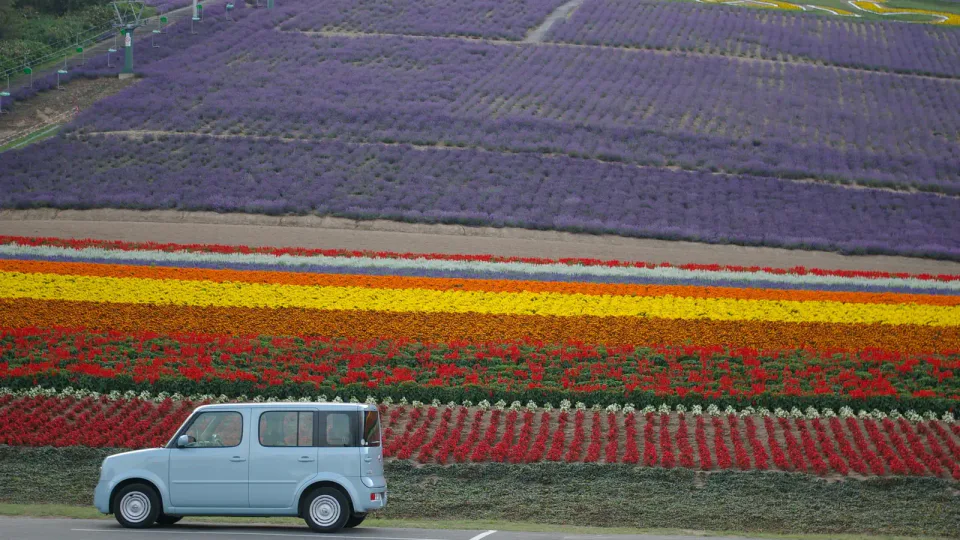
One night in Furano is enough when Furano itself is the job; two nights are worth it when the second night buys a full Biei day, a weather buffer or freedom from fixed public-transport timings. If your list is basically Farm Tomita, one or two nearby flower stops and a good meal, I would not automatically book two nights. On selected 2026 summer dates, JR Hokkaido’s direct Furano Lavender Express leaves Sapporo at 07:41 and reaches Furano at 09:44, and JR itself publishes same-day sightseeing models. That is an important reality check: for a focused Furano visit, the question can be “day trip or one night,” not necessarily “one night or two.”
The second night earns its keep when it removes a different kind of friction: a complete Biei half-day without luggage, an early start at a flower field, room to move the Blue Pond around weather, or protection against a fixed sightseeing-bus schedule. If Furano and Biei are both real priorities—especially without a car—I would usually choose two nights. If the second night has no specific job, give it to another part of Hokkaido instead.
Fact-checked August 26, 2026. JPY is kept as the primary currency; approximate USD figures use the live working rate of about ¥159 = US$1. Seasonal train dates, flower conditions, bus schedules and facility hours change, so recheck the official operator for your exact travel date.
Furano 1 night or 2 nights: the 30-second decision
↔ Scroll table left or right
Your actual trip | My default | Why |
Farm Tomita + one or two core Furano/Nakafurano stops | 1 night | You can protect one evening and one morning without tying up a second full hotel night. |
Farm Tomita only, arriving early from Sapporo on an operating day | Consider a day trip | JR’s current direct train and published day-trip models prove that an overnight is not automatically necessary. |
Furano + Blue Pond + Shirahige Falls + Shikisai-no-Oka all matter | 2 nights | Biei is a separate last-mile problem; the second night prevents the Biei day from competing with checkout and onward travel. |
No car, using Norokko + Biei View Bus | 2 nights strongly preferred | You are travelling on fixed departures and reservations, so timetable slack is worth more than another attraction. |
Rental car, early arrival, only 2–3 priorities | 1 night | Direct point-to-point driving removes much of the waiting that makes the public-transport version slow. |
Peak lavender, photography, family or older travellers | Lean 2 nights | You gain a luggage-free middle day and a chance to move outdoor stops around crowds, heat or weather. |
Late August or September with no strong Biei plan | Re-test the second night | Lavender-specific value is lower after the main peak; a second night needs another clear purpose. |
If you are still deciding whether Furano and Biei belong together at all, use the Furano and Biei without a car vs rental car guide. The number of nights is downstream of that transport decision.
The ValueNavi night-job test: what exactly does the second night buy?
A second hotel night should solve a real problem. “Furano is far from Sapporo” is not enough on its own because the distance also exists on a day trip or one-night trip. I would book the second night when it buys at least one of these:
↔ Scroll table left or right
Job for Night 2 | Real benefit | Weak reason |
Full Biei day | No checkout, luggage or onward intercity departure competing with Blue Pond/Shikisai-no-Oka. | “Biei looks close on the rail map.” |
Weather buffer | You can move hills, flowers or Blue Pond to the clearer half-day. | “Two nights feels safer” without any movable stops. |
Peak-season early start | You can use the first operating hours at Farm Tomita or start driving before the day becomes fragmented. | Staying two nights but still leaving the hotel late both mornings. |
Public-transport slack | A delayed bus or missed connection does not automatically destroy your onward hotel move. | Booking Night 2 but scheduling every hour just as tightly as a one-night trip. |
Family/rest day | One complete day without packing, checkout or another hotel reception. | Adding more distant attractions simply because the room is already booked. |
If none of those applies, the second night may be dead inventory. This is the most useful way to answer “is two nights too much?”: the second night is justified by the problem it deletes, not by how famous Furano is.
One night can mean very different amounts of usable time
The label “one night” hides the most important variable: when you arrive and when you leave. A 15:00 arrival plus a 10:00 departure is barely an overnight stop. A 09:44 arrival plus a next-afternoon departure is closer to a full sightseeing day plus a useful morning.
On selected 2026 operating dates, JR Hokkaido’s Furano Lavender Express gives a concrete example. The published model route leaves Sapporo at 07:41 and arrives Furano at 09:44. JR also publishes a same-day return pattern using a 16:53 Furano departure and 18:52 Sapporo arrival. In other words, the railway itself demonstrates that a traveller can get roughly seven daytime hours in the Furano area without sleeping there at all.
↔ Scroll table left or right
Trip shape | What you really get | My verdict |
Sapporo day trip on a direct-train day | Roughly late morning to late afternoon in the area | Enough for a focused flower day; weak for a complete Furano+Biei sweep. |
1 night, early arrival | Day 1 largely usable + evening + Day 2 morning | Very efficient for core Furano. |
1 night, afternoon arrival | One late afternoon/evening + next morning | Easy to overestimate; keep the stop list short. |
2 nights | Arrival day + one complete luggage-free middle day + departure morning | The cleanest structure when Biei has a full job. |
This is why I would not use a blanket rule such as “Furano needs two nights.” The arrival clock can change the value of Night 1 more than the hotel itself.
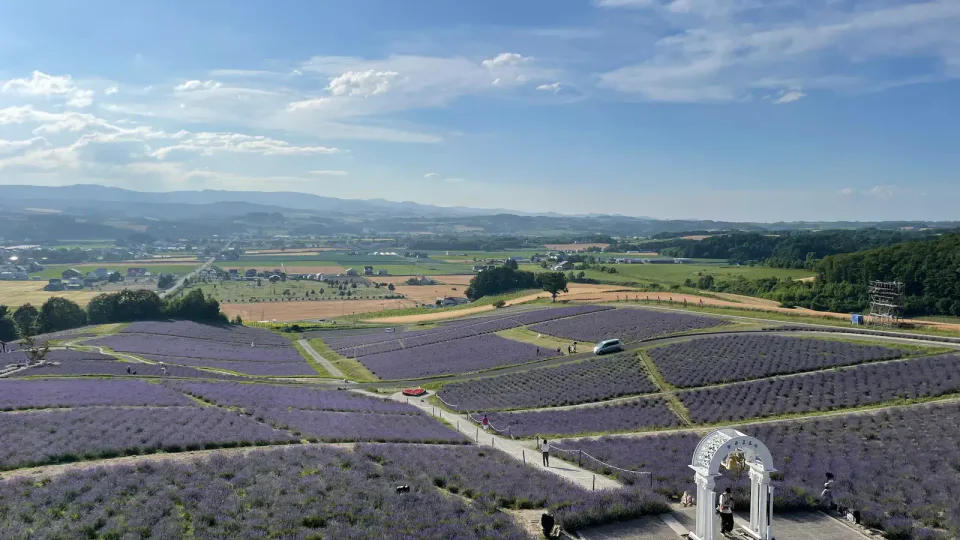
If Farm Tomita is the main reason for coming, test one night against a day trip first
Farm Tomita is much easier to reach by public transport in the 2026 summer season than a generic “rural Hokkaido” description suggests. The seasonal Lavender Farm Station is only about a 7–8 minute walk from the farm. On the 2026 Norokko timetable, trains from Furano stop at Lavender Farm Station at selected times during the operating season.
The current Farm Tomita site lists main opening hours of 08:30–17:30 at the time of this update, with facility-specific and seasonal hours varying. If the farm is your one non-negotiable stop, an early-arriving one-night trip can already give you a long usable window. Two nights do not automatically improve that visit enough to justify another hotel night.
The second night becomes stronger when the farm is only one part of a broader route—especially if you also want Biei, a separate flower area, sunset photography or a slower hotel stay.
Peak lavender is a narrower window than “summer,” so the answer changes by month
JR Hokkaido notes that Furano’s main lavender season runs from late June into early August, with peak viewing generally around mid-July and some fields starting to cut lavender once August arrives. Farm Tomita’s separate Lavender East gives an even sharper 2026 boundary: it is scheduled to open only from June 20 to July 20, 2026, from 09:30 to 16:30, with best viewing listed as early to mid-July.
Lavender East is also 4 km from Farm Tomita. That matters because it exposes the difference between “Furano has good public transport” and “every flower field is rail-accessible.” A driver can connect the two quickly; a car-free traveller needs to solve the last mile separately.
↔ Scroll table left or right
Travel period | What Night 2 is buying | Recommendation pressure |
Late June–mid July | Peak flower timing, more reason for early starts and schedule flexibility | Strongest case for 2 nights if Biei also matters. |
Late July–early August | Still summer flower value, but some lavender-specific windows begin narrowing | 2 nights still useful, but justify them with the wider route. |
Late August–September | Scenery, food, Biei, hills and general Hokkaido travel rather than peak lavender | Do not buy Night 2 purely because a July itinerary said Furano “needs” it. |
The month is a boundary condition. A two-night July recommendation should not be copied mechanically into September.
Two nights become much more rational when Biei is a real destination, not a name on the map
Furano Station and Biei Station are only transport nodes. The sights are spread around them. Blue Pond and Shirahige Falls sit toward Shirogane; Shikisai-no-Oka is elsewhere; the hills cover another area. The hidden cost is the last mile, not the rail segment between town centres.
For car-free travellers, Biei Tourism Association’s 2026 View Bus packages three major stops into a fixed half-day. The morning course currently runs 09:40–12:45; the afternoon course 14:10–17:10. Both cover Blue Pond, Shirahige Falls and Shikisai-no-Oka with fixed sightseeing allocations.
From July through September, the adult fare starts at ¥5,000 (about US$31.50); in June and selected October dates it starts at ¥4,500 (about US$28.30). Prices can fluctuate by booking date, travel date and fuel cost, so the booking screen is the final price.
This bus is useful because it solves the dispersed last-mile problem. It also creates schedule friction. The online booking window is currently from 90 days before travel until 17:00 four days before departure. All seats are reserved. There is no waiting list. Cancellation fees begin ten days before the tour. The operator explicitly warns that road or weather delays can shorten sightseeing and may cause you to miss a connecting train or bus.
That warning is exactly why two nights help. If Day 2 includes the Biei bus and you also have to check out, collect luggage and reach another city that evening, every delay attacks the same narrow margin. With Night 2 already secured, the bus is just the day’s main activity instead of one link in a fragile chain.
The 2026 Norokko is useful—but it is not flexible transport
The Furano–Biei Norokko Train is running its final season in 2026, with its last day of operation on September 23, 2026. It is a sightseeing train, not a metro. All seats are reserved, and a reserved-seat ticket is required in addition to the basic fare. For Furano → Biei, JR currently lists a basic one-way fare of ¥800 (about US$5.00) plus a ¥1,000 reserved-seat charge (about US$6.30), so the total is roughly ¥1,800 (about US$11.30) one way.
There is another small but important failure mode: IC cards cannot be used on the Asahikawa–Furano section. JR advises travellers to buy a paper ticket before boarding; onboard fare adjustment is cash only. That is not a reason to avoid the train, but it is exactly the sort of friction that appears when a tight one-night itinerary assumes every Japan train works like an urban IC-card ride.
The Norokko schedule is also limited by date. In 2026 it runs daily through August 11 after the early-summer start, then only on selected weekends and late-September dates. Farm Tomita’s own access page publishes the same selected operating pattern. If your trip falls outside those dates, the “easy seasonal station” version of the plan changes.
One night works best with a car when you already know what to cut
Driving does not make every attraction fit. It does remove the waiting between them. If you arrive early, have a rental car and choose only a few priorities, one night can be extremely efficient: one Furano/Nakafurano cluster on Day 1, dinner and hotel, then one short Biei or flower-field block on Day 2 before leaving.
The important condition is restraint. “We have a car” is not a license to turn one night into Farm Tomita + Lavender East + Shikisai-no-Oka + Blue Pond + Shirahige Falls + Biei hills + cheese factory + winery. Road time, parking, food and walking still exist. The one-night version works because you choose, not because the car erases geography.
If you are still deciding between a Furano base and a Biei base, the Furano vs Biei overnight guide is the next decision. If your bigger question is whether to rent at all, use the Hokkaido full-vs-partial car-rental guide.
Two nights work best without a car because waiting time becomes itinerary time
A driver can leave when finished. A car-free traveller leaves when the next usable service leaves. That difference is why I give the second night more value to public-transport travellers even if both groups visit the same places.
Imagine two people both want Farm Tomita and a Biei View Bus. The driver can change the order based on weather and move directly between areas. The no-car traveller must line up the Norokko/local train, the bus check-in, the three-hour tour, the return rail service and possibly an onward hotel. One delay can turn into several missed choices. Night 2 does not make the trains faster; it reduces the number of consequences attached to each timetable.
The best two-night version is not “more attractions”—it is one protected middle day
The clean structure is:
Day 1: arrive, drop luggage, keep the sightseeing local and low-risk.
Day 2: one complete Furano or Biei day with no checkout.
Day 3: use the morning for whichever nearby theme did not fit, then leave.
The middle day is the product you are buying with the second hotel night. If you immediately fill it with a distant third region, you have paid for stability and then thrown the stability away.
Weather is one of the strongest arguments for Night 2—but only if you actually keep the plan movable
Flower fields, hill views and Blue Pond are all outdoor-heavy. Two nights let you reverse the order of Furano and Biei when cloud, rain or visibility is poor. That option value is useful because the “best” half-day cannot be guaranteed months in advance.
But the buffer is real only if your bookings allow movement. A fixed Biei bus reservation with cancellation penalties and a fully pre-booked restaurant can reduce the flexibility you thought you bought. If weather resilience is the reason for Night 2, keep at least one half-day comparatively loose.
Families and older travellers should value the luggage-free day more than the attraction count
For a family, the second night can be valuable even when the driving distance is not ideal. One day without packing, hotel checkout, luggage storage, car repacking and another check-in removes a lot of invisible work. The same applies to older travellers who are fine with scenic drives but dislike repeated hotel moves.
I would use two nights for a family when Biei is a genuine full-day priority. I would not use two nights just to add more stops. If the group is already tired after one flower field and lunch, the correct response is to cut the route, not to exploit every remaining hour because the hotel is paid for.
Your hotel location changes the value of the extra night
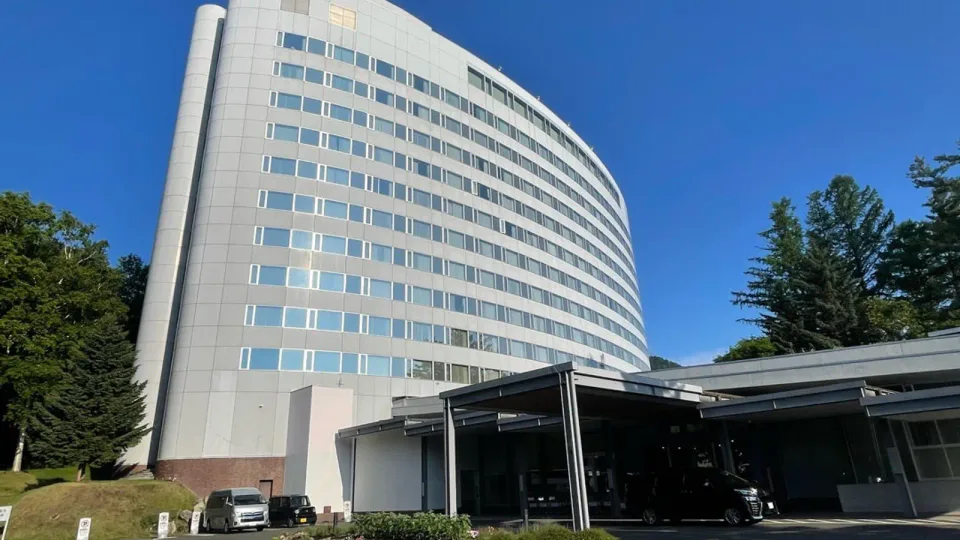
For one night without a car, I would usually prioritize low-friction arrival and departure around Furano Station rather than paying for a scenic property that creates another taxi or shuttle dependency. The shorter the stay, the more expensive every extra transfer becomes in percentage terms.
With two nights and a car, the hotel can do a different job. You can widen the radius for scenery, onsen or a resort atmosphere because you are not moving luggage again the next morning. If the property itself is part of the reason for staying—onsen, breakfast, views or a slow evening—the second night may also increase the percentage of the hotel you actually use.
The Where to Stay in Furano guide compares Furano Station, Nakafurano, Asahikawa and Sapporo. For a concrete one-night property trade-off, see the La Vista Furano Hills one-night guide.
Red-team: when my two-night recommendation is wrong
↔ Scroll table left or right
Condition | Why the answer flips |
You only care about Farm Tomita | A direct-train day trip or one night can already solve the trip; Night 2 has no job. |
You arrive early by car and leave after lunch next day | One night can contain plenty of usable hours if the stop list stays disciplined. |
Your Hokkaido trip is only 4–5 days and Sapporo/Otaru are the real priorities | Two Furano nights can crowd out higher-priority nights elsewhere. |
You travel after the main lavender period and have no Biei plan | The flower-specific reason for a second night is weaker; reassess from zero. |
You hate hotel changes but are already based in Asahikawa | Day trips from a stable northern base can be more rational than adding Furano purely to avoid train time. |
You book two nights but schedule Day 2 as a long trip to another region | You paid for a protected middle day and then did not use it. |
Final verdict: one night is enough for Furano; two nights are for the Furano–Biei system
If your trip is genuinely “Furano,” one night is often enough—and for Farm Tomita alone, a day trip can even be enough on the right 2026 operating dates. I would choose two nights when the trip becomes “Furano + Biei,” especially without a car, with children or older relatives, during peak flower season, or when weather flexibility matters.
The most useful distinction is not “one night is rushed, two nights are relaxed.” It is this: Night 1 creates an overnight stop; Night 2 creates a complete day with no hotel move. If that complete day has a clear job, the second night is valuable. If it does not, the extra room night is just taking budget and time from somewhere else.
Okinawa Girls’ Trip Hotels: Bathrooms, Luggage and Late Nights Matter More Than the Pool
Mt Fuji Day Trip or Overnight: When an Extra Night Is Worth It
Biei Day Trip or Overnight? When Staying One Night Is Worth It
Okinawa Hotels With Washer-Dryers: On a 3-Night Trip, the Kitchen Usually Matters Less
References
JR Hokkaido: 2026 Sapporo–Furano/Biei same-day model route
Farm Tomita: current opening information
Farm Tomita: Lavender Farm Station walking time and 2026 Norokko dates/timetable
Farm Tomita: Lavender East 2026 operating dates, hours and bloom timing
Biei Tourism Association: 2026 Biei View Bus schedule, fares, booking rules and disruption warnings
Train operating dates, flower conditions, bus prices, road conditions and attraction hours can change. Recheck the official sources for your exact travel date before paying for non-refundable transport or hotels.