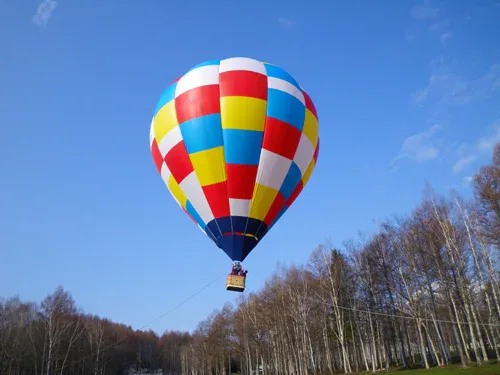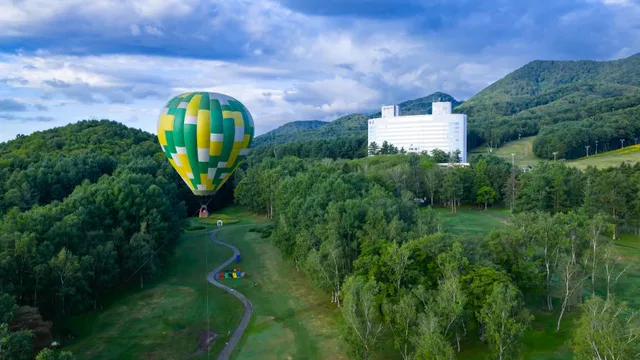
For most summer visitors already staying in Furano, I would treat the ¥2,800 tethered balloon as a low-commitment bonus: try the early-morning session, leave 60–90 minutes of schedule space, and let the rest of the day survive if wind cancels it. I would choose the winter Free Flight only if the balloon itself is a trip priority, you are willing to sleep in Furano, sacrifice most of the morning and accept a meaningful chance of cancellation.
The two products should not be compared as “5 minutes versus 30 minutes.” The summer balloon is tethered to the ground, rises to roughly 40 metres and returns to the same field. The winter product is untethered: the pilot controls ascent and descent while the wind determines the route, and a ground crew must recover the balloon after landing. One is a short aerial viewpoint; the other is a weather-dependent flight operation.
There is also a 2026 planning trap: the winter operator’s English and Japanese pages currently show different prices for the season that has already ended, while neither page has formally announced the 2026–27 season. Do not build a winter budget around either old figure yet.
Fact-checked August 27, 2026 against Shin Furano Prince Hotel, Furano Nature Club and Furano Tourism Association. JPY remains the primary price reference. Approximate USD conversions use ¥1,000 ≈ US$6.27 and are only planning equivalents.
Furano balloon decision in 30 seconds
↔ Scroll table left or right
Your actual goal | Start with | Why | What can reverse it |
“I just want to try a hot-air balloon once” | Summer tethered flight | ¥2,800 adult, no advance reservation, about five minutes in the basket | You are travelling only in winter or specifically want real drift over snow |
“I want an actual balloon flight over a winter landscape” | Winter Free Flight | Untethered flight, wind-driven route, potentially much higher altitude | You cannot leave the morning flexible or tolerate weather cancellation |
“I want a predictable aerial sightseeing route over specific landmarks” | Neither | A hot-air balloon cannot follow a fixed route like an aircraft with directional propulsion | You value the uncertainty of a wind-driven route as part of the experience |
Summer day trip from Sapporo only for the balloon | Usually skip | The transport commitment overwhelms a five-minute local add-on | Furano already has several other reasons to occupy the day |
Winter bucket-list attempt | Stay in Furano + keep a Plan B | The operator checks weather around 6:00 and estimates only about a 60% operating rate | You need a guaranteed timed activity that morning |
ValueNavi Score: these are different products, not different ticket tiers
Editorial score for trip planning, 10 = more favourable for that dimension. “Weather resilience” and “booking simplicity” score the traveller’s planning risk, not the beauty of the flight. Winter price value is left unscored because 2026–27 pricing has not been formally announced.
↔ Scroll table left or right
Dimension | Summer tethered | Winter Free Flight |
Money cost | 9/10 — ¥2,800 adult | Not scored — next-season price unresolved |
Time efficiency | 8/10 if already in Furano | 3/10 — treat 7:00–10:00 as the operating window, with possible overrun |
Booking simplicity | 10/10 — no reservation required | 4/10 — reservation + same-morning weather call |
Weather resilience | 5/10 — can cancel before or during the session | 3/10 — operator cites about 60% success |
Crowd / queue resilience | 6/10 — first-come and waits can stretch on busy mornings | 8/10 — booked tour, but weather dominates instead |
Route fit | 9/10 if staying near Shin Furano Prince | 8/10 if sleeping in Furano and leaving the morning open |
Uniqueness | 7/10 — unusual viewpoint but no horizontal travel | 10/10 — genuine wind-driven winter free flight |
The score explains why the cheap product can be the better trip decision without being the “better balloon experience.” Summer wins on friction. Winter wins on uniqueness. A traveller who values schedule certainty should not automatically choose either one as the anchor of a tightly timed day.
Summer 2026: ¥2,800 buys five minutes in the basket, not a five-minute calendar slot
Shin Furano Prince Hotel lists the 2026 tethered flight at ¥2,800 for adults (about US$17.60) and ¥2,500 for children aged 3–12 (about US$15.70). The main 2026 morning periods are April 25–May 6, selected weekends in May and then late May / June through October 12, with flights from 6:00 to 7:00. July and August add an evening session from 18:00 to 19:00.
The basket ride itself is about five minutes and the balloon is anchored by ropes, rising roughly 40 metres. No advance reservation is required; you check the day-of status and pay on site. That makes the product easy to add to a Furano stay, but “five-minute flight” should never become “I only need ten minutes in my itinerary.”
↔ Scroll table left or right
Published element | Planning interpretation |
About 5 minutes of airtime | The aerial part is short; this does not include registration, queueing or waiting on wind |
6:00–7:00 operating hour | You join the first-come flow; 6:00 does not mean guaranteed takeoff at 6:05 |
Status checked around 5:30 | The activity cannot be treated as confirmed the night before |
Operator notes waits can reach about an hour on busy days | ValueNavi planning budget: leave roughly 60–90 minutes if the ride matters to you |
Flights can stop after operations begin | Being physically in the queue is not the same as having secured a flight |
That 60–90 minute recommendation is ValueNavi planning analysis, not an official minimum. The point is to protect the rest of the day. If you schedule a rental-car pickup, timed tour or restaurant immediately after the balloon hour, you convert a low-commitment attraction into a fragile morning.
Morning vs evening: choose probability or convenience
Furano Nature Club explicitly says the early-morning session has a higher operating rate than the evening. The evening session exists only in July and August, so its main advantage is itinerary rhythm: you can visit flower fields during the day and try the balloon later without a dawn alarm.
↔ Scroll table left or right
Priority | Better slot | Trade-off |
Maximise the chance of actually flying | Morning | Wake before 6:00 and protect the first part of the day |
Keep the morning for Farm Tomita / Biei | Evening | Lower operating reliability and only Jul–Aug availability |
Balloon is only a nice bonus | Whichever fits | Do not redesign the whole day for a weather-sensitive five-minute ride |
If the balloon is one of the main reasons you booked Shin Furano Prince, use the morning. If it is merely an optional add-on after flowers and food, the evening can be a rational convenience trade.
The first-party age-rule mismatch matters for very young children
Shin Furano Prince Hotel currently states that participants must be at least 3 years old. Furano Nature Club’s English tethered-flight page, however, also displays “free for under 2 years old.” Those statements do not fit neatly together.
For a child under three, do not infer eligibility from the word “free.” Treat the hotel’s explicit minimum-age rule as the safer planning assumption and confirm directly with the operator before travelling to the field for a toddler. This is exactly the kind of small first-party discrepancy that a generic price list misses.
For a family where only one parent or older child wants to ride, the operator says visitors are welcome to watch and take photos. The group does not have to turn one person’s interest into four paid rides.
Winter Free Flight: the real product is a Furano night plus a weather-sensitive morning
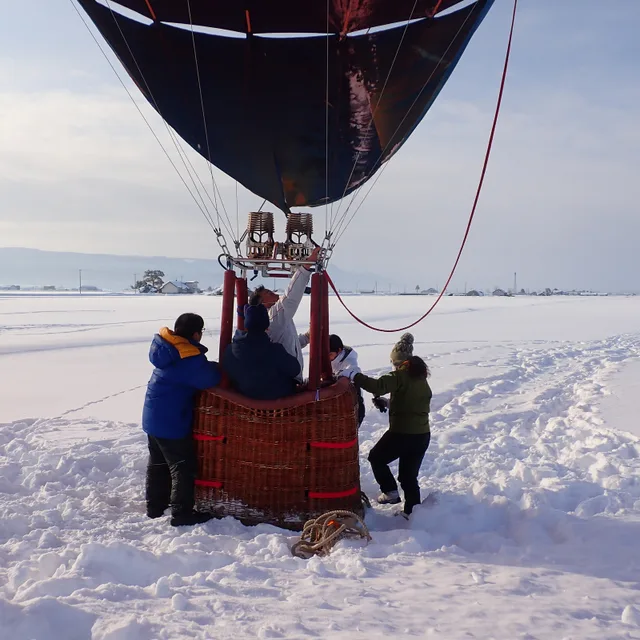
The winter Free Flight is a different operational product. The current Furano Nature Club page describes a season running from around December 23 to late March, with a tour window around 7:00–10:00, minimum two participants and eligibility from elementary-school age. The operator checks weather around 6:00, picks guests up around 7:00, reaches the launch site around 7:30 and targets takeoff around 8:00.
Flight duration is not presented with one perfectly consistent number even on the same official page: the tour table says approximately 30 minutes, the itinerary says roughly 15–30 minutes depending on wind, and the FAQ says about 20 minutes while warning that landing may take up to an hour. The correct planning conclusion is not to choose one number; it is to leave the morning open.
The operator also says hotel breakfast often cannot be taken and estimates the flight operating rate at roughly 60%. Strong wind, snow or rain can cancel the tour. In favourable conditions the balloon may reach around 1,000 metres, but that is not a guaranteed altitude purchased with the ticket.
For an international visitor with only one Furano night, the ticket therefore buys more than basket time:
a Furano overnight base;
a 6:00 weather decision;
an early pickup and launch setup;
a potentially variable landing and recovery time;
the possibility of losing the flight entirely to weather.
If that sounds like too much itinerary exposure, the right answer is not a cheaper winter balloon. It is to decide that the experience does not fit this trip.
Do not budget the 2026–27 Free Flight from either current official price page
As of August 27, 2026, both Furano Nature Club pages state that the latest winter season has concluded. The next 2026–27 season has not yet been formally announced on those pages. More importantly, the operator’s current language pages disagree about the concluded season’s displayed fare:
↔ Scroll table left or right
Current official page | Adult price shown | Elementary-school child price shown | How to use it now |
English | ¥25,000 (~US$157) | ¥18,000 (~US$113) | Historical / concluded-season reference only |
Japanese | ¥28,000 (~US$176) | ¥22,000 (~US$138) | Historical / concluded-season reference only |
ValueNavi rule: when two live first-party pages conflict and the next season is not open, the correct price is “not confirmed yet.” Do not average the two numbers, and do not treat whichever page is cheaper as a valid 2026–27 quote.
Wait for the new season’s booking page or direct operator confirmation before using the winter fare to decide whether to stay an extra night in Furano. The important information you can use today is the product structure: high weather dependence, elementary-school age minimum, early pickup and a flexible morning.
ValueNavi Commitment Ladder: how much of the trip should the balloon be allowed to control?
↔ Scroll table left or right
Commitment level | Reasonable plan | Too much commitment |
Low — “nice if it flies” | Summer tethered ride while already staying nearby | Changing hotels or making a pre-dawn Sapporo run just for it |
Medium — “one of my Furano highlights” | Sleep in Furano, use the morning tethered slot, keep the next activity flexible | Non-refundable timed booking immediately after 7:00 |
High — “winter bucket-list experience” | Reserve Free Flight once 2026–27 opens, stay in Furano, hold the morning and create a Plan B | Assume clear skies mean the balloon will fly or that the tour ends at a fixed minute |
The ladder prevents an attractive activity from becoming the wrong reason to distort the whole Hokkaido route. A balloon should control only as much of the itinerary as its personal importance justifies.
Where to stay: the night before matters more than the hotel after
For the summer tethered flight, Shin Furano Prince is the simplest geometry because the launch area is in the hotel’s Picnic Garden, roughly a five-minute walk from the hotel. But this does not automatically make it the best hotel for every Furano itinerary. If your main priorities are Furano Station, restaurants in town or an early onward train, the hotel decision still needs to serve the rest of the stay.
If you have not fixed the stay length, use Furano: one night or two in summer? before paying a location premium for one activity.

For winter Free Flight, the operator offers complimentary pickup from Furano hotels or Furano Station. That reduces the need to choose a hotel solely beside a launch field. What matters more is being inside Furano before the 6:00 weather decision and having breakfast / checkout arrangements that survive an uncertain return time.
If skiing is the larger purpose of the trip, compare Furano Zone vs Kitanomine. The balloon should not make a skier choose the wrong base for three or four nights just to improve one morning.
Furano vs Biei: protect one sunrise priority, not two
A common itinerary conflict is trying to use the same morning for both the balloon and early Biei photography. The two goals compete for the same low-wind / low-crowd hours. A nominal five-minute flight does not solve that conflict because registration and weather waiting still occupy the early window.
If your main summer goal is Biei’s hills before tour buses arrive, use Biei day trip vs overnight before committing the morning to Furano. If you still cannot decide where to sleep, compare Furano vs Biei as an overnight base.
ValueNavi itinerary rule: when two activities both become dramatically better at dawn, do not pretend they are compatible because one advertises only five minutes of airtime. Choose the morning hero and move the other activity.
Five failure modes worth checking before you leave the hotel
You expect horizontal sightseeing from the summer ride. It is tethered and returns to the same field.
You use an old winter price as the 2026–27 fare. The upcoming season is not formally announced and the current English/Japanese pages disagree.
You hard-code the next booking immediately after the balloon. Summer queues and winter landing/recovery can both overrun the advertised airtime.
You assume a sunny day means the balloon will operate. Wind matters as much as visible weather.
You add a Furano hotel move solely to protect a low-priority balloon attempt. If the flight is a bonus, keep the stronger accommodation base and accept that you may skip it.
What to do if the balloon is cancelled
Cancellation should have a pre-written replacement rather than trigger a scramble at 6:00. In summer, the easiest fallback is to bring forward the day’s Furano / Biei ground itinerary: flower fields, a café, a ropeway day when operating, or the first drive toward the next stop. In winter, use the morning for the ski area, a slower breakfast, onsen or another weather-appropriate activity.
The key is to avoid a fallback that requires a new long transfer. A weather-sensitive activity is most resilient when its cancellation improves the rest of the same local day rather than creating a hole you must fill from another city.
Final decision tree
Do you want a real wind-driven flight? If no, use the summer tethered experience when it fits the route. If yes, winter Free Flight is the relevant product.
Are you already staying in Furano? If no, calculate the overnight / transport commitment before valuing the ticket itself.
Can the next morning remain flexible? If no, do not make winter Free Flight a core booking.
Is the balloon important enough to survive cancellation? If no, treat summer as a bonus and winter as a skip.
For winter 2026–27, has the operator actually published the new season and fare? If no, do not budget from the old English or Japanese page.
Final verdict: summer is the better add-on; winter is the better balloon experience
I would recommend the summer tethered ride to far more Furano visitors because its failure cost is low. At ¥2,800, with no advance reservation and a five-minute basket ride, it can be attempted without letting one activity control the trip. The correct mindset is: “I am already here, I will check the wind, and the day still works if it is cancelled.”
I would recommend winter Free Flight only to travellers who specifically want the balloon itself. It asks for a Furano night, an early weather decision, a flexible morning, possible breakfast sacrifice and acceptance that the flight may not operate. In exchange, it gives you the thing the summer ride cannot: genuine untethered travel over the winter landscape.
If you have to redesign the entire Hokkaido itinerary to make the balloon fit, decide the regional route first with the Hokkaido regions and itinerary guide. The experience is special; it should not become the reason the rest of the trip is inefficient.
Official sources
Shin Furano Prince Hotel — 2026 tethered balloon schedule, price and age rule · Furano Nature Club — tethered balloon operations and day-of process · Furano Nature Club — English winter Free Flight page · Furano Nature Club — Japanese winter Free Flight page · Furano Tourism Association. Checked August 27, 2026; winter 2026–27 dates and pricing must be rechecked once formally announced.
Premier Hotel -CABIN- Asahikawa: Is the Overnight Hot Spring Worth a 14m² Room?
Okinawa Parasailing: Naha, Motobu, Uruma or Ginowan? Don’t Mistake Boat Time for Flight Time
Fukuoka Tower: Is the ¥1,000 Ticket Worth the Detour? Timing Changes the Answer
Mt Fuji Paragliding 2026: Tandem Flight, Pickup Package or Full-Day Tour?
Where to Stay for Kyoto Summer Events: Station, Kawaramachi, Otsu or Kibune