
For a 2026 Japan trip, do not treat Tsukimi as one dinner on one night. The modern commercial food season starts weeks before the traditional moon-viewing date: KFC has confirmed that its five-item 2026 “Torori Tsukimi” range goes on sale nationwide from August 26 while supplies last. The traditional Chushu-no-Meigetsu (Jugoya) falls on September 25, but the astronomical full moon is not until September 27 at 01:49 Japan time. Japan’s second traditional autumn moon-viewing night, Jusanya, falls on October 23.
That calendar changes how a traveller should plan the food. If you are in Japan in late August or early September, a modern egg-and-moon limited menu may be the easiest seasonal experience even though Jugoya is still weeks away. If you are there around September 25, add one traditional dango or wagashi moment and let the cultural date matter. If your only free evening is September 27, you have missed Jugoya itself but not the full moon. For a first trip, one traditional item plus one modern seasonal menu is enough; the aim is to understand the two layers of Tsukimi without turning the holiday into a limited-edition collection run.
Checked August 25, 2026. Product launches and stock can change quickly. The National Astronomical Observatory of Japan (NAOJ) dates are calendar facts; restaurant and convenience-store availability is commercial inventory and must be rechecked on the day.
↔ Scroll table left or right
2026 date / window | What is actually happening | Best traveller decision |
From Aug 26 | KFC’s five-item “Torori Tsukimi” range launches nationwide, quantity limited | Good modern Tsukimi option if a KFC is already on your route; do not assume stock lasts until Sep 25 |
Late Aug–early Sep | Commercial Tsukimi season can already be visible before the traditional moon-viewing night | Try one confirmed limited menu; do not pretend the date itself is Jugoya |
Sep 25 | Chushu-no-Meigetsu / Jugoya | Best night to prioritise traditional dango, wagashi, taro/harvest imagery and a simple moon-viewing evening |
Sep 27 | Astronomical full moon; exact full-moon moment is 01:49 JST | If this is your free night, enjoy the full-moon experience without calling it the Sep 25 Jugoya date |
Oct 23 | Jusanya, Japan’s second traditional autumn moon-viewing night | A useful second cultural window for October travellers; check local confectionery offerings rather than assuming September chain menus remain |
Commercial Tsukimi season and traditional moon viewing run on different calendars
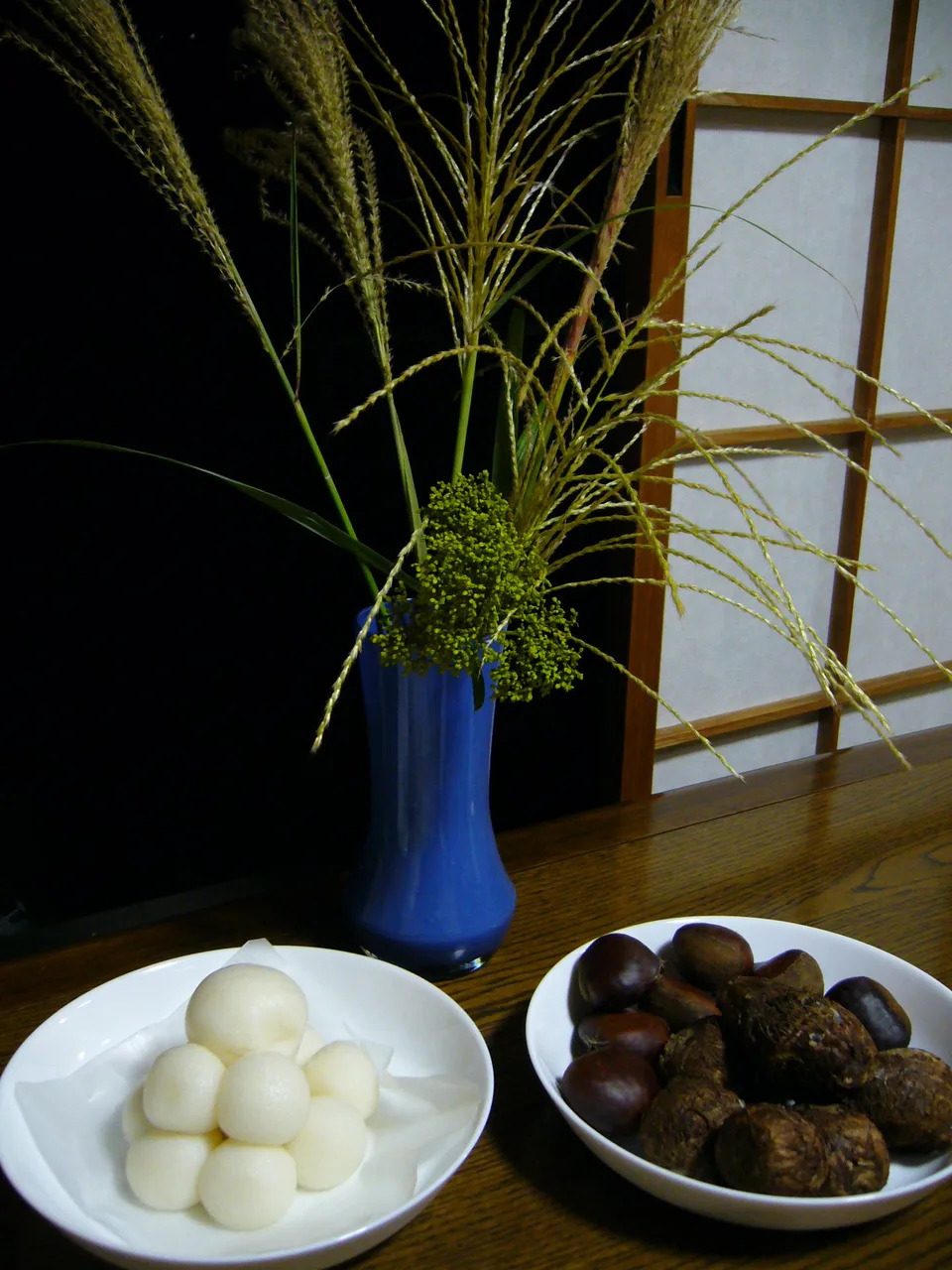
Traditional Tsukimi is tied to the old lunisolar calendar and harvest-season customs. Round dango, susuki (pampas grass) and seasonal produce such as taro are familiar symbols. Modern commercial Tsukimi uses the same moon imagery much more loosely: a round egg yolk, a soft-cooked egg, a moon-shaped pie or a campaign name can turn a burger, twister or dessert into a seasonal product.
Both are worth understanding, but they answer different travel goals. A neighbourhood wagashi shop on September 25 gives you a closer connection to the traditional seasonal idea. A fast-food chain item on August 28 gives you a contemporary Japanese autumn campaign that happens to begin well before Jugoya. Neither experience needs to invalidate the other.
This distinction also prevents a common planning mistake: waiting until September 25 to look for a commercial product that launched a month earlier and was sold “while supplies last.” The cultural date is fixed; stock is not.
Pick the Tsukimi experience by your actual travel dates
If you are in Japan from August 26 to early September
Start with the modern seasonal side. KFC is already a confirmed 2026 option from August 26. Traditional confectioners may also begin seasonal displays on their own schedules, but there is no reason to manufacture a special September 25-style evening several weeks early. If a moon-themed menu interests you and the branch is already beside the hotel, station or sightseeing route, try it and move on.
The trade-off is context. You are tasting the commercial season, not attending the calendar date associated with Chushu-no-Meigetsu. If cultural timing matters more than the limited menu, save the deeper Tsukimi explanation for a future September trip.
If you are in Japan around September 25
This is the strongest window for combining the two layers. Buy one fresh dango or seasonal wagashi item that can be eaten the same day, then treat any chain product as the modern comparison rather than the main event. Keep the evening geographically compact: sweet shop near the hotel or final station, dinner nearby, then an optional open-sky viewpoint if the weather is good.
Do not carry delicate fresh sweets from breakfast until a late-night illumination. The cultural significance does not improve because the food spent ten hours warm in a bag.
If your free night is September 26 or 27
Do not conclude that the moon-viewing opportunity has vanished. NAOJ explicitly notes that in 2026 the traditional Chushu-no-Meigetsu date and the astronomical full moon are two days apart. The full moon occurs at 01:49 on September 27. A traveller free on the evening of the 27th can therefore have a visually strong moon night even though the formal Jugoya date was the 25th.
This is one of the clearest 2026-specific planning points: choose whether you care more about the traditional date or the astronomical full moon. They are not the same target this year.
If you are travelling in October
Do not assume every September “Tsukimi” burger or pie is still available. Quantity-limited items may disappear, and campaign calendars vary by brand. October travellers still have a real traditional date: NAOJ gives October 23 as Jusanya in 2026. That is the better reason to look for seasonal wagashi, chestnut/bean imagery or a local moon-viewing event later in the season.
KFC is confirmed for 2026; do not copy last year’s McDonald’s calendar
KFC Japan has published a current 2026 release for its “Torori Tsukimi” series. The five products go on sale nationwide from August 26 and are explicitly quantity limited. The line includes the Torori Tsukimi Filet Burger, a Japanese-style cutlet burger with increased tartar, a Torori Tsukimi Twister, a mochi-and-custard Tsukimi pie and a triple Japanese-style cutlet burger variant.
From a travel-planning perspective, the important facts are not the advertising slogans. They are confirmed launch date + limited quantity + nationwide chain footprint. That makes KFC useful when a branch is already convenient, but weak as a cross-city destination. A limited burger should not cost you a Shinkansen, airport or timed-attraction buffer.
McDonald’s needs more caution. As of the August 25 check for this guide, McDonald’s Japan’s official 2026 news index did not yet show a 2026 annual Tsukimi launch announcement. That does not mean there will be no McDonald’s Tsukimi campaign. It means a traveller should not copy the 2025 launch date, menu or sale window into a 2026 itinerary before the company publishes the current year’s details.
If you are reading this later than August 25, recheck the official McDonald’s Japan news page. Seasonal fast food is exactly the kind of information where a guide can become stale in days.
The full moon is September 27, not September 25 — decide what you actually want to experience
In everyday travel writing, “Tsukimi night” and “full moon” are often blurred together. In 2026 that shortcut is particularly misleading. NAOJ gives September 25 as Chushu-no-Meigetsu but September 27 at 01:49 as the astronomical full moon, and notes that a two-day date gap is relatively unusual.
This creates three valid traveller choices:
Culture-first: plan the seasonal sweet and simple moon-viewing evening for September 25.
Moon-first: if September 27 is the clear-weather night or the only free night, prioritise the sky rather than forcing the cultural date.
Food-first: if your dates are nowhere near either night, enjoy the commercial autumn products that are actually on sale and do not manufacture a calendar ritual around them.
There is no need to cross Tokyo or Kyoto on the 25th just to stand in a specific “moon-viewing spot.” The 2026 date fact is useful because it helps you decide what matters; it should not create another transport mission.
Traditional Tsukimi food is regional — do not use one dango shape as an authenticity test
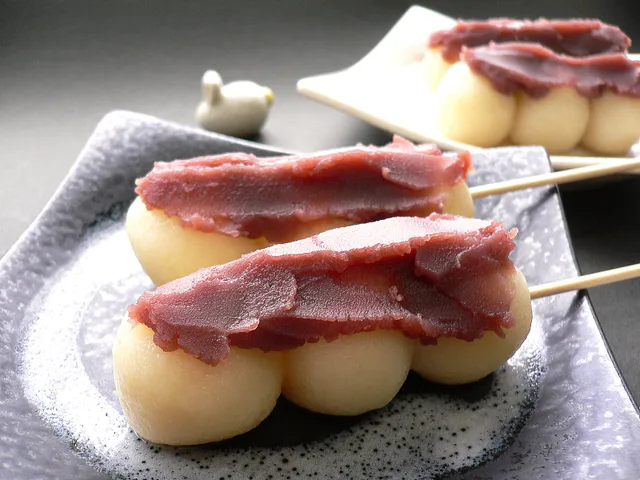
JNTO’s cultural explanation highlights moon-viewing dango and susuki among the familiar Tsukimi symbols, and NAOJ notes the agricultural connection behind names such as imo-meigetsu. In practice, confectionery traditions vary by region and maker. A traveller can encounter differences in shape, coating, filling and presentation between Kanto, Kansai and individual shops.
That variation is a reason to buy locally, not a reason to hunt a nationwide “correct” version. A neighbourhood wagashi shop that fits the evening can deliver more travel value than a famous shop that requires forty minutes of transport each way.
Choose the shop by the job the food has to do
↔ Scroll table left or right
Where to buy | Best use | Main failure mode |
Neighbourhood wagashi shop | Fresh traditional seasonal sweet for same-day eating | Short opening hours or sold-out fresh stock |
Department-store depachika | Compare several makers, packaging and gift formats in one stop | Overbuying before checking shelf life and luggage space |
Supermarket | Family portions, hotel-room snack, low-detour purchase | Less specialised presentation if a formal gift is the goal |
Convenience store / chain restaurant | Contemporary seasonal campaign with minimal planning | Annual menu/date changes; product may sell out before your travel date |
For Tokyo shopping days, a department food hall or a shop on the existing route is usually stronger than adding another district. If Tsukiji or Kappabashi is already part of the day, use the Kappabashi vs Tsukiji decision guide to protect the main route before adding a seasonal food stop.
Fresh dango and a flight-home gift are different products
Before buying, decide whether the food is for tonight or for transport. Fresh dango and namagashi may have short use-by windows and can be temperature-sensitive. Shelf-stable monaka, yokan or individually wrapped baked sweets are usually easier before a Shinkansen journey, hotel move or flight.
A fresh seasonal sweet can be excellent value at 17:00 when you will eat it near the hotel at 19:00. The same sweet can be a poor purchase at 09:00 before a full outdoor sightseeing day. The decision is not about quality; it is about whether the logistics let the food remain the product you paid for.
If the purchase is a gift, check shelf life, storage temperature, package rigidity and suitcase volume before judging the artwork. A smaller shelf-stable box can outperform a more photogenic fresh tray if it still reaches the recipient in good condition.
Read the ingredient label; “moon-shaped” tells you nothing about allergies
Seasonal products can contain egg, dairy, wheat, soy, nuts, red bean paste and other ingredients depending on the recipe. The same warning applies to traditional wagashi and modern chain desserts: visual moon branding is not an allergy label.
If the item is for someone else and the ingredient information is unclear, choose a packaged product whose label can be reviewed later rather than relying on a translated product name or staff guess.
Clouds do not cancel Tsukimi food — and a clear night does not justify a bad route
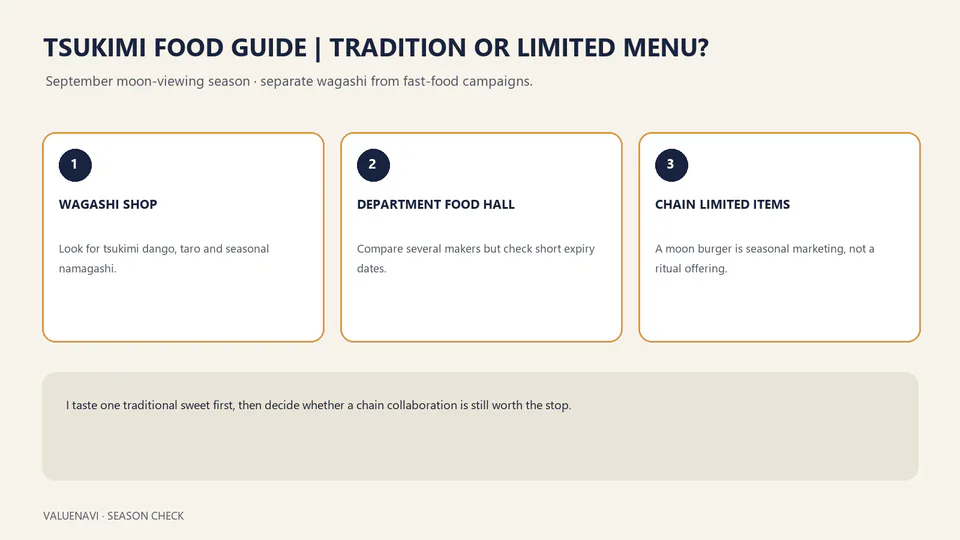
A cloudy September 25 does not make the seasonal food meaningless. Keep the wagashi or dinner plan, move the eating portion indoors and treat outdoor moon viewing as optional. The reverse is also true: a clear full moon does not justify travelling an hour to a famous garden if the hotel terrace, river near the final station or a safe neighbourhood park already gives you open sky.
The Japan rainy-day itinerary backup guide is a better recovery tool than forcing a weather-exposed plan simply because the calendar says Tsukimi.
Four failure modes to avoid in 2026
1. Treating September 25 as the astronomical full moon. It is the traditional Chushu-no-Meigetsu date; the full moon is September 27 at 01:49 JST.
2. Copying a 2025 fast-food launch date into 2026. KFC has a confirmed 2026 release. McDonald’s had not yet published its 2026 Tsukimi launch on the official 2026 news index at the August 25 check.
3. Assuming an August 26 quantity-limited product will still exist a month later. A launch date is not a stock guarantee. If that exact KFC item matters, check the app/store close to the travel date and keep another seasonal option nearby.
4. Turning a seasonal snack into a cross-city attraction. A limited product earns a detour only when collecting it is genuinely part of the trip. Otherwise choose the product that fits the existing sightseeing and transport corridor.
Three simple 2026 Tsukimi plans
Late-August / early-September city trip
Try one confirmed modern menu such as KFC’s 2026 range if it is convenient. Add ordinary sightseeing and dinner as planned. Do not build a moon-viewing ritual around a date that is still weeks before Jugoya.
September 25 culture-first evening
Buy one fresh traditional sweet in the late afternoon, keep dinner in the same rail corridor, and leave one low-friction outdoor viewing option. If weather fails, eat indoors and preserve the rest of the trip.
September 27 moon-first evening
If clear skies and the full moon matter more than the old-calendar date, use the 27th. Keep the food flexible: a seasonal wagashi, supermarket sweet or whatever current chain menu is still actually available. Do not label a sold-out commercial product as essential to the moon experience.
Final verdict: buy by date first, then by route
For 2026, the most useful Tsukimi decision is to separate the calendars. KFC’s confirmed commercial season begins August 26; Chushu-no-Meigetsu is September 25; the astronomical full moon is September 27; and Jusanya is October 23. Those are four different reasons to encounter “moon-viewing” food, not one deadline.
For a first Japan trip, I would plan one traditional dango or wagashi experience when the dates make sense and one modern seasonal menu only if it is already convenient. Buy fresh sweets late enough to protect them, buy travel gifts for shelf life rather than appearance, and never let a quantity-limited burger or pie steal a transport buffer. The seasonal food should make the autumn evening more Japanese; it should not make the itinerary less rational.
Osaka Shinsekai Food Tour 2026: Which Guided Dinner Is Actually Worth It?
Nagoya Osu Kannon Food Tour 2026: Is ¥19,119 / US$133 Worth It?
Sapporo Autumn Fest 2026: The One-Kilometre Food Route That Leaves Room for Dessert
References
National Astronomical Observatory of Japan — Chushu-no-Meigetsu 2026 · KFC Japan — 2026 Torori Tsukimi launch · McDonald’s Japan — 2026 official news index · Japan National Tourism Organization — Tsukimi cultural background. Product status checked August 25, 2026; limited menus and stock can change after publication.