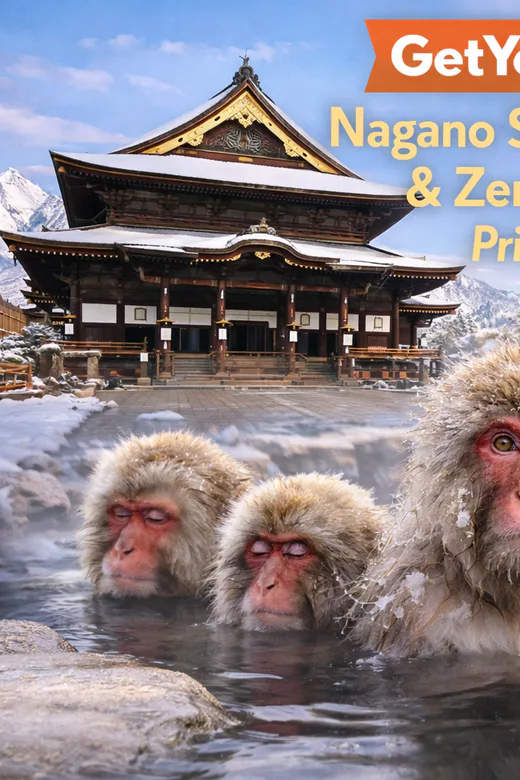
A Nagano snow monkey day trip is worth booking as a tour when your real goal is to compress Nagano into one controlled day — not when you think a tour removes the forest walk or guarantees bathing monkeys. The official approach still involves roughly 35 minutes on foot from the Snow Monkey Park bus stop, and the macaques are wild animals that can simply stay away. What the tour buys is fewer transfers, a fixed sequence and a realistic way to combine Zenkoji, lunch and Jigokudani before returning to Nagano.
Among the things to do in Nagano, the snow-monkey trip has an unusual hidden cost: not the final walk, but how much of the rest of Nagano you are willing to compress into one day.
If you only care about the monkeys, are comfortable with Japanese trains and buses, and do not mind building the day around connection times, DIY can be enough. If you are already wondering whether Nagano deserves more than a checklist visit, that is the more important decision: a one-day tour solves logistics, but an overnight stay gives the region room to breathe.
The Nagano snow monkey day trip only makes sense after you decide what you are trying to save
The easy mistake is to compare a guided day tour with DIY transport as if the only difference were the ticket price. They solve different problems. DIY asks you to coordinate the Shinkansen to Nagano, the onward train or bus, the final walking window, park opening hours and your return to Tokyo. A guided day from Nagano Station removes most of that sequencing after you reach Nagano, then fills the spare space with Zenkoji, food and a guide.
That matters most if you are sleeping in Tokyo. An early Shinkansen day already starts with the question of where you wake up. If you have not chosen your Tokyo base yet, the practical comparison is not “tour versus no tour” but whether Tokyo Station or Shinjuku creates the cleaner departure morning. Tokyo Station is the more natural launch point for the Hokuriku Shinkansen; Shinjuku can still be the better overall base if the rest of your trip lives in west Tokyo. One day trip should not be allowed to dictate five nights of hotel friction.
If you are still choosing among several Tokyo neighborhoods, use the broader first-time Tokyo area comparison before locking your hotel. The snow-monkey day is only one morning; your nightly returns and airport route happen more often.
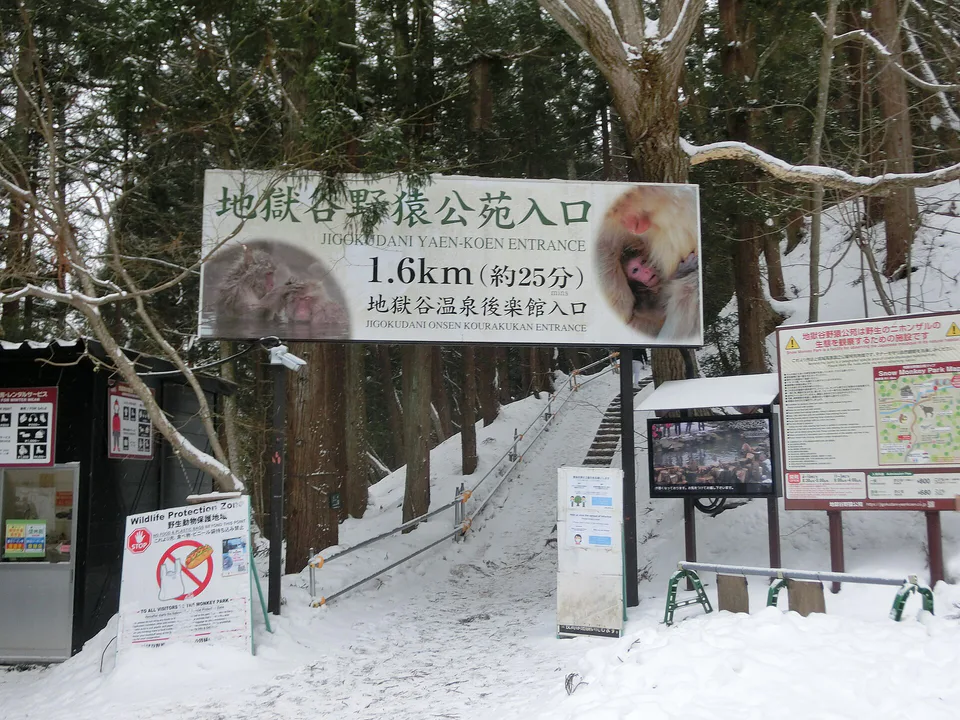
The tour does not remove the 35-minute approach — and that changes who should book
Jigokudani is not a drive-up wildlife attraction. From the Snow Monkey Park bus stop, the official route still requires about 35 minutes of walking to the park. Parts of the approach are unpaved or uneven, with steps and gradients. In winter, snow and ice can turn an ordinary walk into the most physically demanding part of the day. A tour transfers the navigation risk; it does not erase the terrain.
This is the first hard NO-GO. If someone in your group uses a wheelchair, has significant mobility limitations, or is already uneasy about a long winter walk, do not buy a guided tour assuming the vehicle will take you to the monkeys. It will not solve the problem you actually have. The current tour listing itself warns of substantial walking and says the experience is not suitable for wheelchair users or people with mobility impairments.
For everyone else, footwear matters more than whether you booked a guide. A dry autumn trail and an icy January trail are not the same task. The value of the guide is knowing where the group is going and how the day is sequenced; the value of proper shoes is getting there without turning the final approach into a miserable hour.
“Snow monkey” does not mean “monkey in a hot spring” on demand
The second buying mistake is treating the famous hot-spring image like a bookable feature. The park’s own guidance explains that the monkeys use the warm water most often during the coldest part of the year, especially roughly December through March. Outside that period, you can still see the troop, but a soak is not something a ticket or guide can promise.
There is a second layer of uncertainty: the monkeys are not confined like zoo animals. The official park warns that on some days the troop may not appear at all. Autumn is a particularly useful reminder because natural food is plentiful in the mountains and the animals may stay away. If your trip is in early November, read the broader Nagano and mountain-Japan autumn timing guide with that in mind; autumn can be a beautiful Nagano trip even when the iconic bathing scene is not the main event.
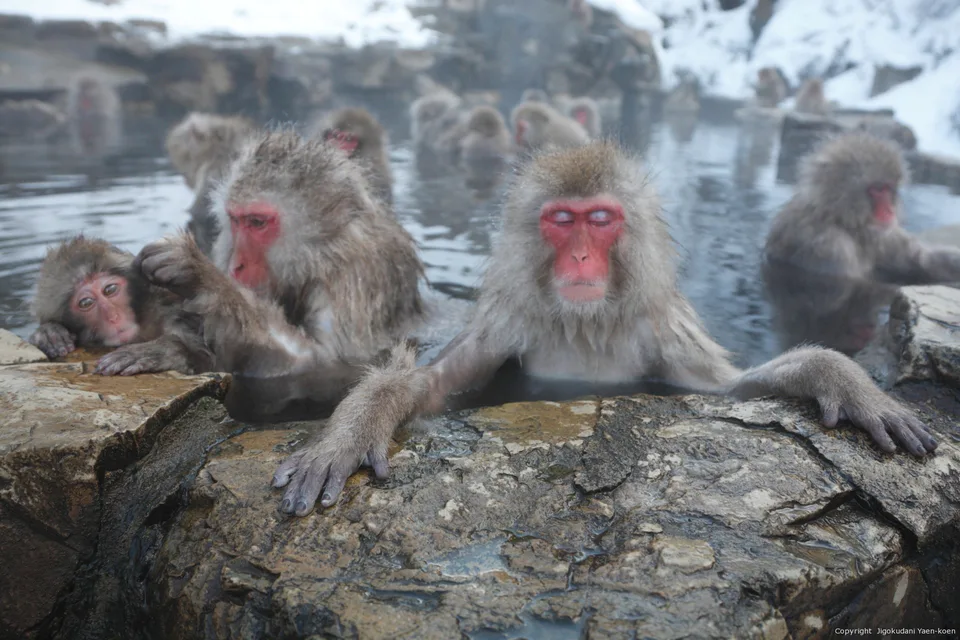
A guide can explain behavior, keep the schedule moving and improve the day around the wildlife. It cannot summon the troop. If your satisfaction depends on one exact photograph, the product is a poor fit because the central outcome is controlled by animals and weather rather than the operator.
DIY wins when the monkeys are the whole point
From Tokyo, the clean DIY logic is straightforward on paper: take the Hokuriku Shinkansen to Nagano, continue toward the Snow Monkey Park area by train and bus or by express bus, then walk the final approach. The fastest Tokyo–Nagano rail segment is short enough to make a same-day return possible. The friction comes from stacking independent timetables and leaving enough buffer for the walk, the wildlife visit and the journey back.
If you travel light, read timetables confidently and want two unhurried hours around Jigokudani rather than a multi-stop cultural day, DIY gives you something the tour cannot: control over how long you stay. You can also skip lunch, sake tasting and temple time if none of them matter to you. That is not “missing inclusions”; it is refusing to pay time for parts of the itinerary you never wanted.
DIY is also stronger for travelers who want to turn Nagano into a longer regional route. Instead of racing back to Tokyo, you can move onward and treat the snow monkeys as one stop inside a Central Japan trip. The five-day Toyama–Tateyama–Matsumoto route is a useful example of the opposite philosophy: move through the region rather than repeatedly returning to Tokyo.
The guided option earns its price when you want Nagano “done” in one day
The current guided product is built around exactly that compression problem. Its standard Nagano Station option currently starts in the morning and returns around early evening, with Zenkoji, food, lunch, Jigokudani and transport between the main stops folded into the day. The exact meeting time and itinerary can change by date and option, so treat the current listing as a booking-time check rather than a permanent timetable.
The important exclusion is the Tokyo–Nagano Shinkansen. The day tour does not include your bullet-train tickets from Tokyo. If you are staying in Tokyo, you still need to buy the intercity rail portion and build a buffer before the Nagano meeting time. That hidden step is why “Nagano tour from Tokyo” can sound more door-to-door than it really is.
For the right traveler, however, that separation is fine. You handle one high-speed train in each direction; the operator handles the messier local sequence. This is where the tour has real value for first-time visitors, families who can manage the walk but do not want to manage several connections, and travelers who want Zenkoji and a proper meal without researching each stop separately.
Check the current Nagano tour times for your date
The strongest counterargument to the tour is an overnight stay, not DIY transport
There is a point where optimizing a Tokyo day trip becomes the wrong problem. If Nagano interests you beyond the monkeys, returning to Tokyo the same evening can be the most expensive choice in time even if the rail tickets are easy to buy. You spend the day obeying a return deadline instead of using the region as your next base.
An overnight changes the decision tree. You can visit Jigokudani on one side of the day and leave room for an onsen town, a ryokan evening or another Nagano stop instead of compressing every meal and transfer. If the idea of a slower hot-spring stay sounds more appealing than a fixed same-day loop, compare Ueda and Bessho Onsen for a two-night Nagano stay. It is not a substitute for Jigokudani geographically; it is a reminder that Nagano can be a destination rather than a Tokyo excursion.
Next decision | Decide whether Nagano deserves an overnight
This is the reversal point: if the tour price feels high but you are also paying for a same-day Tokyo return because you assume you “must” sleep in Tokyo, compare the whole itinerary rather than the activity price. One hotel night in the region may buy more usable time than a more expensive guided day.
Winter Hakuba travelers have a different decision entirely
The current product also lists winter Hakuba pickup and return options on selected dates. For skiers already sleeping in the valley, that can make the snow-monkey day much easier than backtracking through Tokyo or independently stitching together buses. But the relevant hotel decision is then inside Hakuba, not Tokyo.
If lift access and evening atmosphere are still unresolved, compare Happo and Echoland for a Hakuba ski base. If your ski days revolve around Goryu and Hakuba47, the more useful comparison may be Happo versus Goryu. The snow-monkey excursion should fit the ski base you already need; it should not force the wrong ski accommodation.
And if you are arriving with skis or a snowboard, the day-tour question comes after luggage. The Tokyo-airport-to-Hakuba ski-bag guide helps decide whether to forward gear or carry it through the rail-and-bus chain. Solving that first can remove more friction than obsessing over the excursion itself.
NO-GO: four cases where the guided day is the wrong buy
Do not book it because you believe the van removes the forest walk. It does not. Do not book it because you need a guaranteed image of monkeys bathing; wildlife does not work that way. Do not book it if Zenkoji, lunch and sake are simply schedule filler to you and you would rather stay longer at the park. And do not book it if the Tokyo return is the only reason you are forcing Nagano into one day even though the region itself interests you.
There is also a softer NO-GO: travelers who hate fixed pacing. A multi-stop group day is efficient precisely because it gives up some autonomy. If you regularly want to linger for another hour, change lunch plans or leave early when weather turns, DIY or an overnight base is a better personality fit.
30-second choice: tour, DIY or overnight
Choose the guided Nagano day if you want one efficient cultural-and-wildlife day, can comfortably manage the final walk, and would rather pay to remove local-transfer planning. Choose DIY if the monkeys are the main goal, you are comfortable with Japanese transport and you want control over your time at the park. Choose an overnight if Nagano itself is part of the trip rather than a box to tick before dinner in Tokyo.
For a first Japan trip, there is one more sanity check: if a single Nagano day is making you change hotels or choose an inferior Tokyo base, go back to the Tokyo neighborhood decision first. Your accommodation affects every day; this excursion affects one.
Verdict: the tour removes transfer anxiety, not nature
The Nagano snow monkey day tour is easiest to justify when you value a pre-built day more than absolute freedom. Its strongest benefit is not exclusive access and not a shorter walk. It is the ability to arrive at Nagano Station, hand over most of the local sequencing, see Zenkoji and Jigokudani in one plan, then return without spending the previous night comparing local connections.
The worst fit is the traveler buying certainty that nobody can sell: no icy trail, no long walk, guaranteed bathing monkeys and perfect timing. The best fit is the traveler who accepts the physical and wildlife uncertainty but wants the logistics made simple. Before paying, recheck your booked option’s meeting point, start time, walking conditions, return time, inclusions and cancellation terms — and separately secure the Tokyo–Nagano rail segment if you are coming from Tokyo.
Next decision | Make the Tokyo departure morning work
FAQ
Can I do the Snow Monkey Park from Tokyo without a tour?
Yes. The Shinkansen gets you to Nagano quickly enough for a same-day trip, then you continue by local transport and walk to the park. DIY works best when Jigokudani is the main goal and you are comfortable coordinating independent connections.
Does a Nagano snow monkey tour take you all the way to the monkeys?
No. The official approach from the Snow Monkey Park bus stop still includes roughly a 35-minute walk. Guided transport simplifies the local transfer chain, but it does not eliminate the final trail.
Are the monkeys guaranteed to be in the hot spring?
No. The macaques are wild and are not confined to the park. Cold winter months are the classic hot-spring period, but bathing is not guaranteed and on some days the troop may not appear at all.
Is the Tokyo–Nagano bullet train included in the day tour?
Not in the current Nagano Station tour listing. Travelers coming from Tokyo need to arrange the Shinkansen separately and leave enough buffer to reach the meeting point. Always check the exact option you book in case inclusions change.
What to recheck before you book
Park access, opening hours and monkey conditions can change with season, weather and animal behavior. Tour meeting times, pickup options, route order, meal details, language, cancellation rules and winter arrangements can also change by date. Recheck the Snow Monkey Park’s official access and daily information, then compare them with the exact tour option shown on your travel date.
lyf Tenjin Fukuoka Review: Is a 12m² Room Worth the Shared Kitchen and 24-Hour Lounge?
Kyoto Gozan Okuribi: What the 2026 Viewpoint and Exit Plan Teaches
Hotel Hankyu RESPIRE OSAKA vs CANDEO HOTELS Osaka The Tower: Osaka Station or 31F SkySpa?
Okinawa Hotels With Washer-Dryers: On a 3-Night Trip, the Kitchen Usually Matters Less
Hotel Emion Sapporo vs Keio Prelia Hotel Sapporo: Which Works Better with Snow and Large Luggage?