An Okinawa hotel pool is worth paying more for only when the pool has a real job in your itinerary. For a family that protects half a resort day, a large pool complex can replace another paid activity. For a couple that wants a quiet afternoon and sunset, an adults-only pool can change the quality of the stay. But if you leave every morning and return after dinner, the same pool may be nothing more than a photo on the booking page.
The cleanest way to judge it is not by hotel nights. Judge it by usable pool sessions: how many times will you actually change, swim, shower and still have enough time left for the rest of the day? A ¥15,000 room-rate premium spread across three real swims is ¥5,000 per session. The same premium for one rushed swim is ¥15,000 for that single use.
Fact-checked August 26, 2026. JPY remains the primary currency; approximate USD figures use about ¥159 = US$1 as a working reference. Pool seasons, weather closures, fees and child rules can change.
If you have not chosen your base yet, start with Where to Stay in Okinawa. A pool should not rescue a bad location decision.
The 30-second decision: when should a pool change the hotel?
↔ Scroll table left or right
Trip pattern | Pool priority | Why |
Family with a protected half-day at the hotel | High | The pool can become the activity instead of a decorative extra. |
Couple reserving an afternoon and sunset for the resort | Medium-high | Adult-only or sunset-oriented pools can create a distinct stay experience. |
Early-out, late-back sightseeing every day | Low | Location, parking and return time affect every day; the pool may be used once. |
One Chatan swim at Lequ | Price separately | The rooftop pool is currently charged per use rather than automatically included. |
Winter or shoulder-season trip | Verify the exact pool | “Hotel has a pool” says nothing about whether the specific pool is open, heated or indoor. |
ValueNavi pool decision matrix: money, time, weather, route fit and uniqueness
I would not score pools by size alone. These five dimensions are more useful because they determine whether the feature changes the trip.
↔ Scroll table left or right
Pool example | Money cost | Time cost | Weather / season risk | Route fit | Unique value |
Oriental Garden Pool | Low once booked; hotel guests use it free | Medium: works best with a real resort block | Medium-high: outdoor and season-dependent | High for Onna/Nago resort days; low for Naha-heavy itineraries | High for families because the complex can fill several hours |
Halekulani Quiet / Ocean Terrace | Bundled into a high-end resort stay rather than separately ticketed | Medium: needs an afternoon or sunset at the hotel | High for outdoor pools; indoor pool provides a fallback | High only when the resort itself is part of the itinerary | High for couples because the two pools exclude guests under 16 |
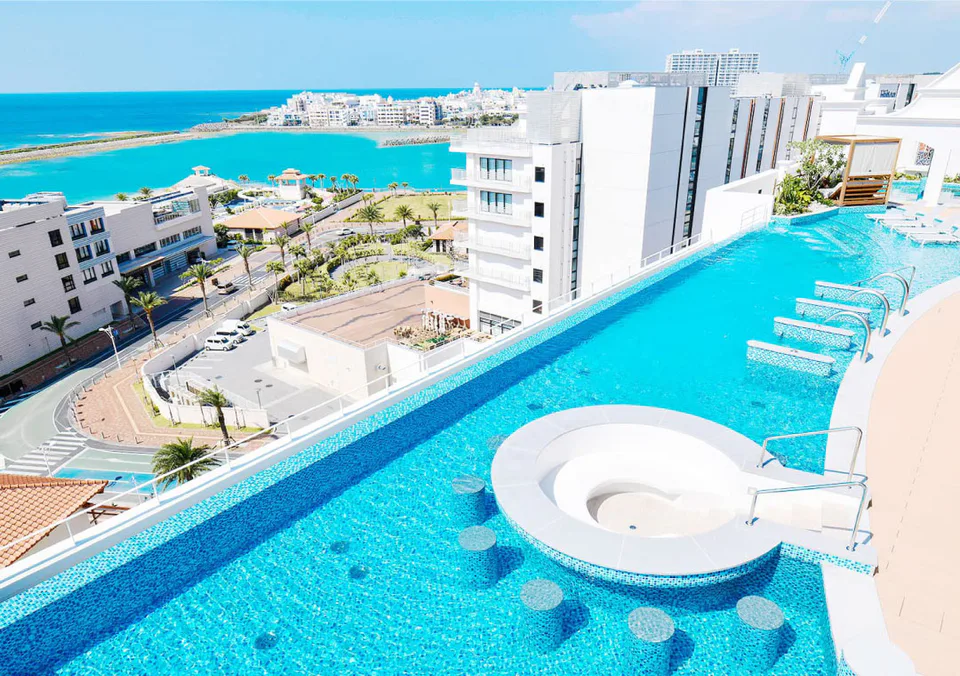
Lequ rooftop pool | High per session: ¥2,000 adult | Low-medium because it is inside the hotel | Medium-high; outdoor but with a published heated winter period | High for a Chatan evening | Medium-high if a rooftop swim is specifically wanted |
Southwest Grand indoor pool | Included for hotel guests | Low if you return to central Naha early enough | Low for the indoor pool | High for a Kokusai-dori city stay | Medium: useful urban reset rather than a destination resort pool |
The important point is that a pool can score well in one dimension and still be the wrong booking. Oriental may be excellent for a family resort afternoon but poor value if it forces extra driving every evening. Southwest Grand is much smaller as a pool proposition, yet its route fit can be better for a city itinerary.
The session-cost formula is more useful than “pool included”
Compare equivalent rooms on the same dates, guest count and cancellation terms, then use:
Effective pool premium per use = extra hotel cost + separate pool fees + meaningful extra route cost, divided by the pool sessions you realistically expect to use.
Example: Hotel A is ¥15,000 (about US$94) more than a comparable hotel but its pool is included. If your family will swim after arrival, on the full resort day and again before departure, the premium works out to ¥5,000 (about US$31) per session before considering other hotel differences. If your itinerary only leaves one usable swim, all ¥15,000 sits on that one session.
This is why a “free” pool is not necessarily cheaper than a paid one. If a farther resort creates extra driving, dinner friction or a worse final-night route, those hidden costs belong in the decision too.
Oriental: the pool earns value because check-in and check-out days are usable
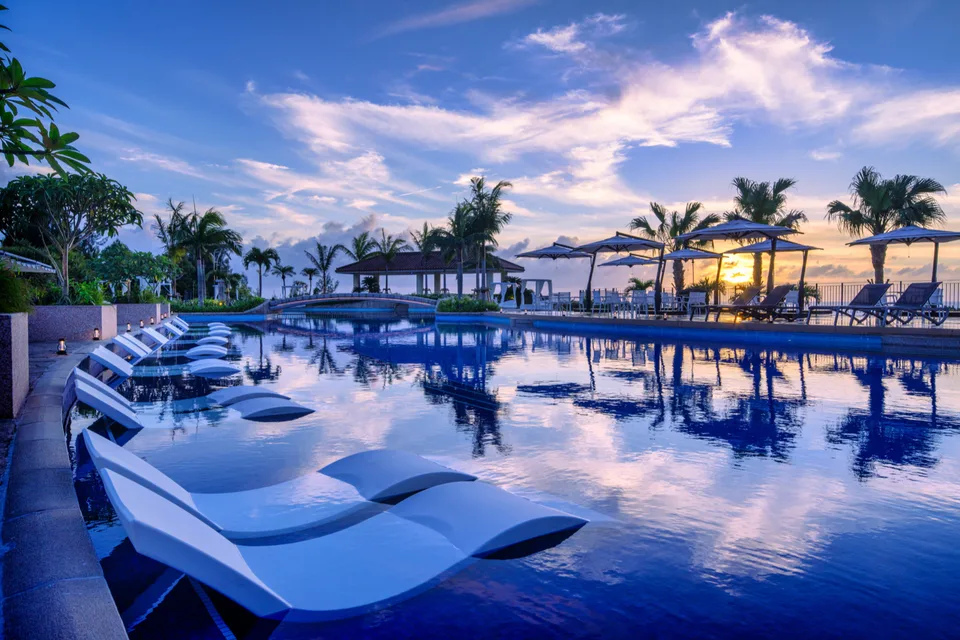
Oriental Hotel Okinawa Resort & Spa currently describes a 170m Garden Pool complex with six pools plus a kids' area. Hotel guests use it free. For 2026, the hotel moved pool access earlier on arrival day and later on departure day: guests may swim from 11:00 on check-in day and until 15:00 after check-out.
That changes a two-night stay. You are no longer relying only on the single full day in the middle. A family arriving early can swim before the room is ready; a family leaving later can use another pool block after checkout. The feature therefore has more chances to produce value without stealing the main sightseeing day.
Season matters. The hotel publishes different pool areas and hours through the year. Selected areas are heated, but there is a full swimming maintenance closure from January 4 through February 28. A January booking should therefore not value the Garden Pool from summer photos.
There are also family-specific rules that can change the practical value: the waterslide is limited to guests at least 120cm tall, and children under 13 require an accompanying adult aged 20 or over.
For the full hotel trade-off, continue with Oriental Hotel Okinawa Resort & Spa: Is the 170m Pool Worth a 7-Minute Beach Walk?.
You will keep half a day free: compare Oriental’s pool against its location trade-off
Halekulani: couples get something genuinely different, but only on the right dates
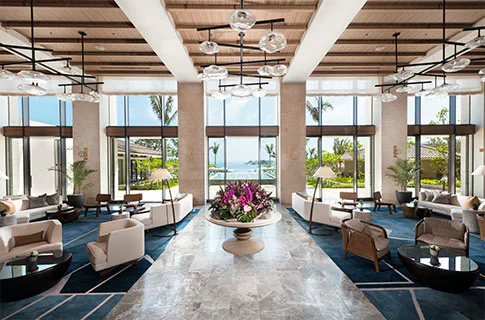
Halekulani is one of the clearest examples of why the name of the pool matters. Quiet Pool and Ocean Terrace Pool are not available to guests under 16. For a couple who deliberately protects a quiet resort afternoon, that age separation is materially different from a general family pool.
But the 2026–27 operating calendar can completely reverse the value. Quiet Pool closes from December 1 through March 31. Ocean Terrace Pool closes from November 1 through March 31. Orchid Pool also closes in December through February. The Indoor Pool remains open year-round.
For June through September, Quiet Pool runs to 19:00, while Ocean Terrace is open until sunset. If you plan a long northern-Okinawa sightseeing day and return after those windows, neither pool should be a major reason to accept a higher room rate. If you are back by mid-afternoon and the resort is the plan, they can be one of the main reasons the hotel works.
If the real decision is Beach Front Wing versus Sunset Wing, use Halekulani Okinawa: Beach Front or Sunset Wing for a 50 m² Stay?.
Lequ: add the pool fee before comparing Chatan hotels
Lequ Okinawa Chatan Spa & Resort is the cleanest reminder that “hotel has a pool” does not mean “pool is included.” The current 2026 rooftop-pool fee is ¥2,000 (about US$12.60) per adult per use, ¥1,000 (US$6.30) for ages 6–12, and free for children 5 and under.
Two adults therefore add ¥4,000 (about US$25.20) for one swim. Two adults plus one child aged 6–12 add ¥5,000 (about US$31.45). If the booking comparison shows Lequ only ¥3,000 above another Chatan hotel, the pool still does not come “free”; one family swim pushes the effective hotel difference higher.
The main 2026 season is March 20 through October 31, from 08:00 to 20:00, extended to 21:00 from July through September. Lequ also publishes a heated Winter Pool period from November 1, 2026 through February 20, 2027, 08:00–18:00, with the same adult and child fees.
There is an easy-to-miss family cost rule: when a child aged 12 or under uses the pool, an accompanying guardian is required, and the hotel states that the normal adult charge applies even if that guardian is not swimming. That can materially change the cost for one parent supervising children.
Compare Vessel Hotel Campana vs LeQu if the hotel choice is still open, or use the Lequ rooftop pool guide if you already prefer Lequ.
Southwest Grand: a city pool is valuable because it does not require a resort detour
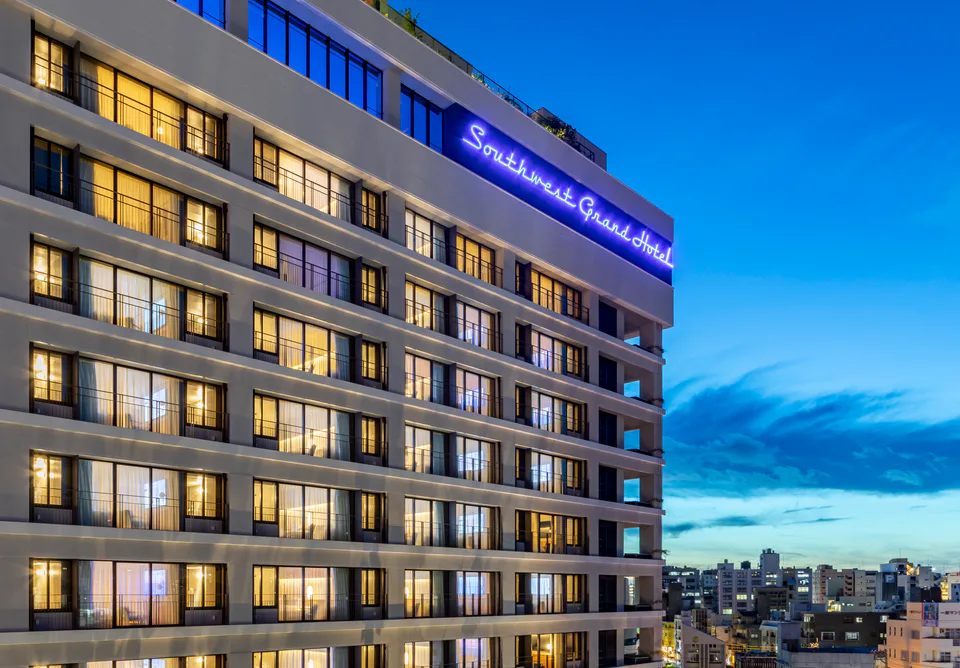
Southwest Grand currently lists an indoor pool, outdoor Jacuzzi and sauna from 06:00 to 22:00 for staying guests. That is a different product from a resort pool. The value is not that it can fill half a day; it is that it can fit around a Naha day without changing the base.
If you return to Kokusai-dori around 18:00, an hour at the pool before dinner is plausible. If you repeatedly return at 21:30, the published 22:00 closing time leaves almost no resilient window. From 20:00, the hotel also restricts pool use for guests under 18, which matters for families planning a late swim.
This is why “pool quality” is not the only comparison. A modest city pool that fits the route can produce more real use than a spectacular resort pool an hour away from where your evenings actually end.
To weigh the room size, central Naha location and pool together, read the Southwest Grand Hotel Okinawa review.
Beach days can make a hotel pool a duplicate purchase
Travellers often treat “I like water activities” as proof that they need a hotel pool. It can mean the opposite. After snorkeling, diving, SUP or several hours at the beach, changing into swimwear again after returning to the hotel may be the last thing you want to do.
The strongest pool hotels are therefore not automatically for the most water-heavy itineraries. They are for itineraries with hotel time. If you want beach and pool to function as one resort block, compare Hotel Monterey Okinawa Spa & Resort or The Busena Terrace. A beach-and-pool cluster is easier to justify when the resort itself replaces outside sightseeing.
Winter pool planning: “open” is not enough
For a winter booking, ask four separate questions: which pool is open, is it indoor or outdoor, is it heated, and is there a separate fee?
↔ Scroll table left or right
Hotel | Winter reality | Decision impact |
Halekulani | Indoor Pool remains open; major outdoor pools close for part of winter | Do not book a December–March stay mainly for Quiet or Ocean Terrace Pool. |
Oriental | Selected heated areas operate in late autumn/winter, but no swimming Jan 4–Feb 28 | Excellent seasonal flexibility except during the maintenance blackout. |
Lequ | Heated Winter Pool Nov 1, 2026–Feb 20, 2027, ¥2,000 adult | Winter access exists, but it remains a paid session. |
Southwest Grand | Indoor pool 06:00–22:00 | Lowest season risk of these four examples, but it is a city-hotel pool rather than a resort complex. |
When should the pool fall below location, room size and cancellation?
Put the pool near the bottom of the booking list when three conditions are true: you leave before 09:00 most days, you return after dinner, and the trip already includes beaches or marine activities. In that pattern, higher-frequency benefits matter more: where you park, how quickly you reach the room, how easy dinner is, whether luggage fits and whether the final night works for the airport.
If Chatan is tempting mainly because of the pool, compare the Hilton Okinawa Chatan Resort review. If Ginowan appeals for a year-round water-focused hotel but transport is the concern, use the Okinawa Prince Hotel Ocean View Ginowan guide.
Seven failure modes before you pay a pool premium
1. Summer-photo bias. You assume the pool in the hero image is open on your January dates.
2. “Included” bias. You choose Lequ for the rooftop pool without adding the per-use fee to the hotel comparison.
3. Night-count bias. You divide the hotel premium by three nights even though only one pool session is realistically usable.
4. Route blindness. You accept extra driving every evening for a resort feature used once.
5. Water-duplication. You schedule snorkeling, beach time and a hotel pool on the same day and overestimate how much swimming the group wants.
6. Child-rule mismatch. The pool exists, but age, supervision or slide-height rules remove part of what you thought you were buying.
7. Closing-time optimism. A pool closing at 22:00 is treated as useful even though the hotel return is 21:40.
Final verdict: pay for pool sessions, not pool photos
For most Okinawa trips, I would only let a pool change the hotel when I can schedule at least one deliberate swim block without weakening the route. Families who reserve hotel time can extract unusually high value from a large complex such as Oriental. Couples can get genuinely distinct value from Halekulani’s adults-only pools when the dates and afternoon schedule align. Lequ works when you specifically want the rooftop swim and accept the per-use cost. Southwest Grand works when you want a pool without leaving a Naha city itinerary.
The recommendation flips for sightseeing-heavy travellers. If the pool adds a farther base, repeated driving or a room-rate premium but the itinerary only leaves one rushed swim, location wins. The most expensive pool is not necessarily the one with an admission fee; it can be the “free” resort pool that quietly costs several hours of extra travel across the stay.
If you still have not settled on your base, go back to the Okinawa hotel decision guide and re-run the choice by your last stop, driving frequency and travel party.
Sources and What to Recheck Before Booking
Oriental Hotel Okinawa Resort & Spa — Garden Pool
Oriental Hotel — 2026 check-in/check-out pool-hour change
Halekulani Okinawa — Pool, Beach & Fitness
Halekulani Okinawa — 2026–27 pool and beach operating calendar
Lequ Okinawa Chatan Spa & Resort — rooftop-pool season, hours and fees
Southwest Grand Hotel — pool, Jacuzzi and sauna facilities
Pool seasons, opening hours, prices, child restrictions, weather closures and check-in/check-out access can change. Recheck the official page for your exact stay dates before paying.
Osaka and Kyoto in 7 Days: 3 Nights Each — When One Hotel Move Is Actually Worth It
Tokyo Helicopter Night Tour: 23, 30 or 55 Minutes? Check Where You Actually Depart
Tokyo Luggage Storage: Don’t Pick the Biggest Station — Pick Where You’ll Need the Bag Next
Sanrio Puroland Tickets 2026: Save on the 2 PM Pass Only If You Know What You’ll Skip
Artizon Museum 2026: Don’t Let Sottsass’s Colorful Furniture Distract You From the Second Exhibition