
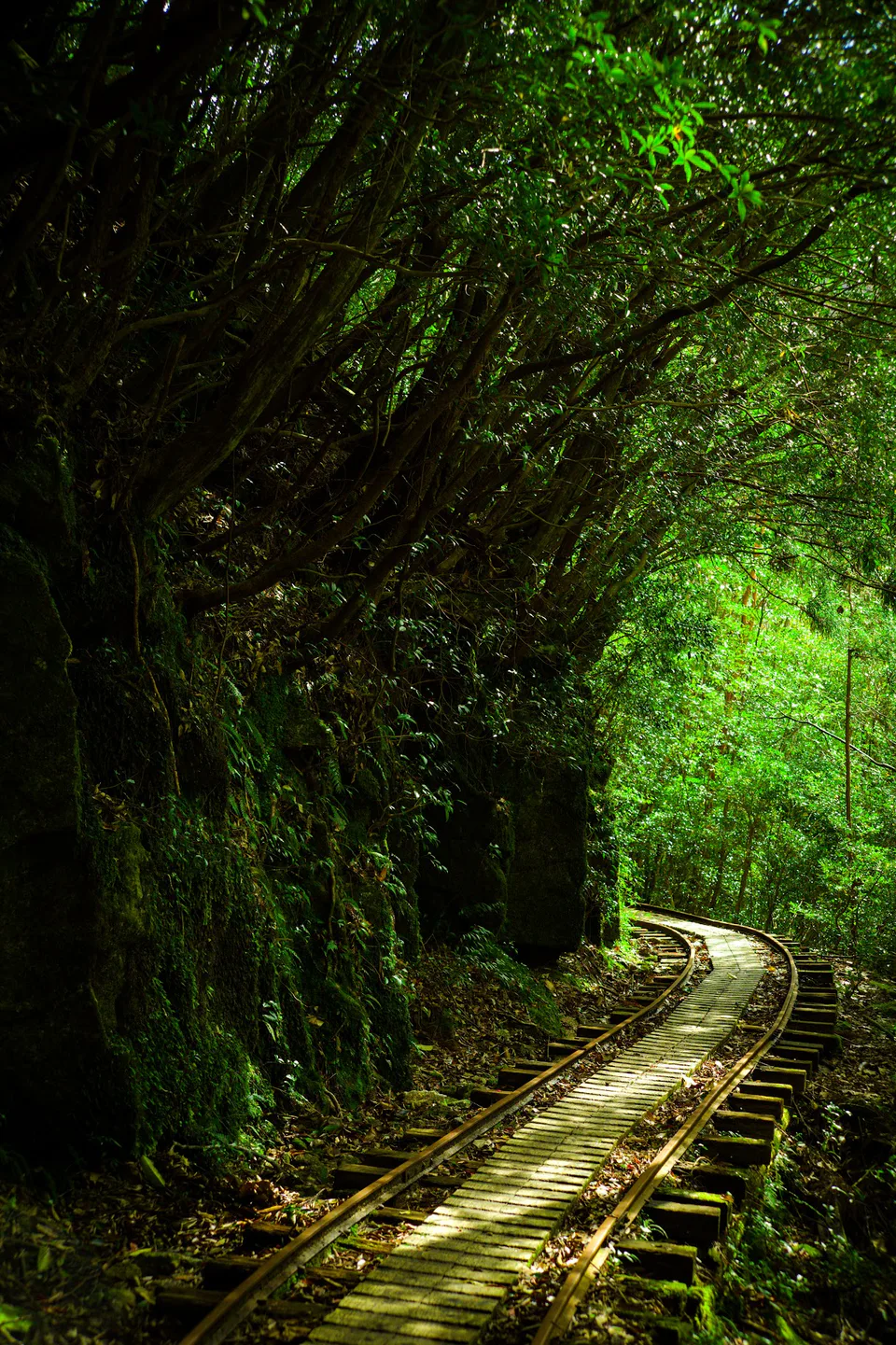
The easiest way to choose the wrong Yakushima hike is not by buying the wrong shoes or rain jacket. It is by treating every product labelled a ‘day tour’ as if it demanded the same fitness. Yakushima’s forest walks run from 30-minute maintained trails to the roughly 22 km Jomon Sugi day, which the town currently estimates at about 8–10 hours round trip. Similar-looking tour cards do not mean you should compare prices first. Start with a harder question: how many hours and how much energy are you willing to spend for the kind of forest experience you actually want?
If you have not even decided how many nights to stay on Yakushima or whether Anbo or Miyanoura makes more sense, start with this 5-day Yakushima itinerary. This article does not rebuild the whole island plan; it focuses on the decision you make before paying for a hiking day: which route is actually right for you?
30-second verdict: Jomon Sugi is the most famous, not automatically the best choice
If you have normal hiking fitness, accept a very early start, are comfortable giving roughly 8–10 hours to a long day, and the sentence ‘I came to Yakushima for Jomon Sugi’ genuinely describes you, choose Jomon Sugi. If you want moss forest, streams and the Taiko-iwa viewpoint without committing to a 20 km-plus day, choose Shiratani Unsuikyo. If your group has mixed fitness, older travellers, or you simply want more weather flexibility, start with Yakusugi Land.
The easiest way to waste money is to be the fourth type of traveller: you only want to walk through a Yakushima forest, but because several guided products look similarly priced, you automatically upgrade yourself to Jomon Sugi. Similar guide fees do not mean similar physical cost.
Jomon Sugi: you are buying an endurance day plus pre-dawn transport, not just one famous tree
Yakushima Town currently lists the Jomon Sugi route from Arakawa Trailhead as about 11 km each way and roughly 8–10 hours round trip. The first section follows the old logging railway for a long distance before the steeper mountain trail begins. It is not technical climbing, but the duration and repetition matter. For first-time long-distance hikers, the common problem is less ‘can I climb it?’ and more starting too fast, eating too late and discovering on the return leg that your energy has dropped faster than expected.
Transport is also what separates Jomon Sugi from the other two options. Every year from March 1 to November 30, ordinary vehicles are prohibited from entering the Arakawa Trailhead road all day. Rental-car users leave the car around the Yakusugi Museum area and transfer to the paid Arakawa hiking bus. Renting a car therefore does not let you drive to the trailhead. Where you sleep the night before, when you wake up, when you collect breakfast or a bento, and how much return-bus buffer you leave are all part of the Jomon Sugi product.
Do not sandwich this long hiking day between two hard transport commitments, especially a flight or high-speed ferry to or from Kagoshima. If you still need to decide where to sleep in Kagoshima, compare Kagoshima-Chuo vs Tenmonkan as part of the same logistics chain.
Shiratani Unsuikyo: not a ‘lighter Jomon Sugi,’ but a different kind of reward
Shiratani Unsuikyo is attractive because the reward changes, not simply because the distance gets shorter. Yakushima Town currently lists a roughly 1-hour Yayoi Sugi course, a 3-hour Bugyosugi course and a 4-hour Taiko-iwa course; the separate Taiko-iwa page gives about 5 hours as the round-trip reference. Think of Shiratani as a forest hike with clear room to scale up or down, rather than a route with only success or failure.
If the image in your head is moss, clear streams, damp forest and finally opening the view from Taiko-iwa, Shiratani is more directly aligned with that goal than Jomon Sugi. You begin getting forest payoff without first walking many kilometres of relatively flat railway. Photography and lingering are easier to build into the day too. But if your biggest regret would be ‘I came to Yakushima and never saw its most famous cedar,’ even an excellent Shiratani day may not remove that feeling.
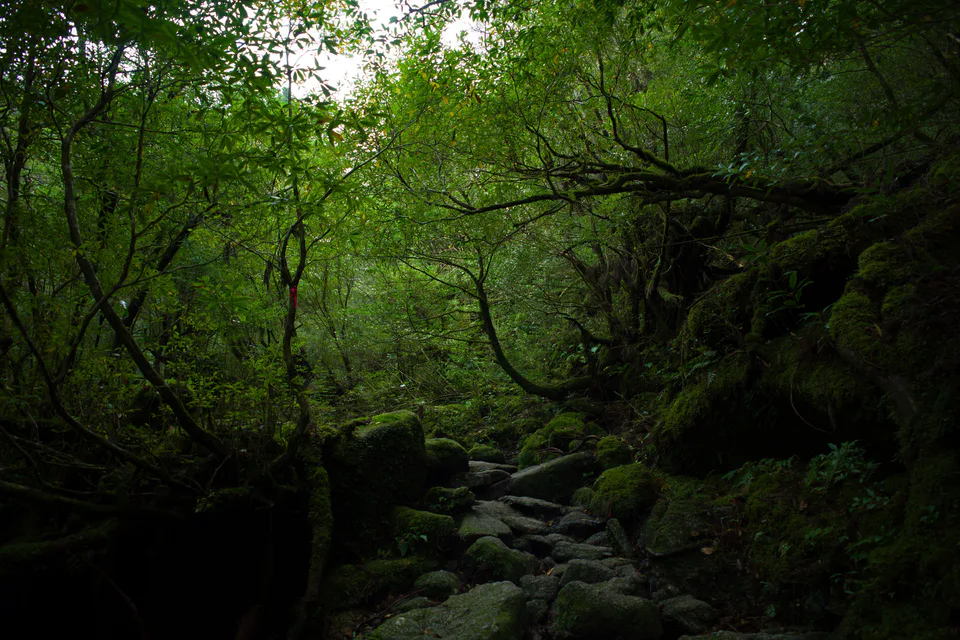
There is also a 2026 update worth knowing. The Satsuki suspension bridge and Bugyosugi route sections that had been closed after Typhoon No. 10 damage reopened from May 2, 2026. That does not make every long route guaranteed on your date: Shiratani can still restrict routes when water levels rise, so ‘the entrance is open’ does not mean your longest planned course will always operate normally.
Yakusugi Land: its real advantage is that you can shorten the commitment, not that it is ‘less worth doing’
Yakusugi Land is easy to underestimate because it lacks the single famous endpoint of Jomon Sugi or Taiko-iwa. But the current official information lists five courses—30, 50, 80, 150 and 210 minutes—at roughly 1,000–1,300 metres elevation. That built-in range is extremely useful for mixed-fitness groups. You can shorten the day because of rain, knees, a child’s pace or fatigue from the previous day instead of locking everyone into an all-day endurance route from the start.
The shorter trails are better maintained and work for lighter trekking; if you want a fuller forest experience and already have some hiking fitness, move toward the 150- or 210-minute routes. The important point is that ‘Yakusugi Land’ is not one 30-minute walk. The same entrance contains five levels of commitment. When a guided tour turns it into a fuller day, the extra time usually comes from transfers, interpretation, stops and a longer route—not because everyone must spend a full day walking inside the forest.
Its counter-intuitive weakness is public transport. Yakushima Town currently lists only two local buses a day to Yakusugi Land, while Shiratani Unsuikyo has around seven daily services from the Miyanoura side. Anbo is about a 30-minute drive from Yakusugi Land. For travellers without a car, the easiest trail choice can come with the hardest bus timetable. That is where paid transport or a guided pickup can genuinely be worth money.
Similar-looking guided hikes are buying different kinds of help
Klook’s current Yakushima hiking product lists all three route choices—Jomon Sugi, Shiratani Unsuikyo/Taiko Rock and Yakusugi Land. The page also lists hotel pickup, hiking equipment available on request at no extra charge, and groups of up to six. Treat the tour price as a service bundle, not as an admission ticket. You are paying for meeting logistics, transport, equipment coordination, pace management, route judgement, weather decisions and someone watching the return time.
For Jomon Sugi, a guide’s value is strongest in managing a very long day and the pre-dawn logistics. For Shiratani, it is more about slippery conditions, route flexibility and Taiko-iwa timing. For Yakusugi Land, transport can be a larger part of the value because the public bus timetable is thin. Similar guide prices therefore do not mean you are buying the same service.
Where you stay—Anbo or Miyanoura—changes how these hikes feel
If Jomon Sugi is the priority, Anbo is usually the more practical base: the Yakusugi Museum transfer point is close, reducing friction before the early Arakawa bus, and Yakusugi Land is also on the Anbo side. If Shiratani Unsuikyo is the main event, Miyanoura has the simpler access, with a drive of roughly 20–25 minutes and more bus services.
Do not choose the pre-hike hotel only because the property itself looks nicer. The night before Jomon Sugi, sleep, breakfast or bento pickup, early transport and getting your equipment sorted the day before matter more. Shiratani gives you more flexibility to stay around Miyanoura and still keep port access and evening food convenient.
Next decision | Plan your Yakushima base and hiking days first
If you only have 5–7 days in Kyushu, first ask whether Yakushima deserves 3–4 of those nights
Yakushima is not a Fukuoka side trip. On a 5–7 day Kyushu itinerary, adding the island means combining a ferry or flight, island accommodation and at least one full hiking day. Start with a 5- or 7-day Kyushu itinerary and decide whether Fukuoka, Yufuin, Beppu, Aso or another stop should actually be removed.
If what you really want is one high-payoff nature day and you are still unsure whether Yakushima deserves the extra sea or air connection, compare a two-day Takachiho route with night kagura or a Fukuoka-to-Aso trip. Neither is a reduced version of Yakushima; they trade away the island logistics for a different kind of nature experience.
If you have not even given Fukuoka enough time yet, first decide how many days you need in Fukuoka, whether a three-day Fukuoka plan already fills your available time and whether Fukuoka belongs in this Japan trip at all. Yakushima can absolutely justify a dedicated detour, but it performs badly when squeezed into an itinerary that was already too dense.
Four NO-GOs: if any one applies, do not book Jomon Sugi yet
NO-GO 1 | Your longest recent walk is around 10,000 city steps, but you are treating a roughly 22 km mountain day as something you can simply ‘take slowly.’
NO-GO 2 | The morning after Jomon Sugi is a non-refundable flight or high-speed ferry, with no weather or fatigue buffer.
NO-GO 3 | What you really want is moss forest and Taiko-iwa, but you pick Jomon Sugi automatically because it is the famous name.
NO-GO 4 | Your group includes an older traveller, someone with knee issues or a wide fitness gap, but you insist everyone take the longest route so the tour fee does not feel ‘wasted.’
Eight checks before payment
1 | Do you actually want the completion feeling of a giant cedar, moss forest plus a viewpoint, or a scalable old-cedar forest? 2 | Is your real walking day roughly 22 km and 8–10 hours, around 4–5 hours in Shiratani, or 30–210 minutes in Yakusugi Land? 3 | During the March 1–November 30 Arakawa vehicle restriction, who handles the hiking bus? 4 | Does hotel pickup really cover your accommodation around Anbo or Miyanoura? 5 | Is equipment truly free to borrow, and do you need to request shoe sizes or rain gear in advance? 6 | What is the maximum group size and how is pace managed? 7 | In heavy rain, high water or road closure, is the route changed, postponed or cancelled? 8 | Does the next day have enough buffer so mountain conditions do not destroy a flight or ferry booking?
Final choice: replace ‘which hike is best?’ with ‘which one matches today’s fitness budget?’
On a first Yakushima trip, if you are healthy and genuinely want to spend the whole day on one goal, Jomon Sugi delivers the strongest completion feeling. If you care more about moss forest, photography, streams and a viewpoint while keeping the effort moderate, Shiratani Unsuikyo to Taiko-iwa is usually the better balance. For families, mixed fitness, rainy-season backup planning, a tired day after another hike, or simply wanting to see old Yakusugi forest, Yakusugi Land’s 30–210 minute flexibility can be the smartest choice.
The important thing is not to choose based on the fact that all three can be sold as ‘day tours.’ The scarce resources on Yakushima are your early morning, your legs, your weather window and the next day of your itinerary. Choose the mountain day that suits you first, then decide whether it is worth paying to outsource transport, equipment and pace management.
Next decision | Put Yakushima back into your full 5–7 day Kyushu itinerary
Okinawa Split Stays: Change Hotels Only If You Remove Two Long Backtracks
Tokyo Budget Hotels: A Cheaper Night Can Cost More If You Add a Transfer Every Day
Japan Travel Insurance: Don’t Start With the Price — Start With the Medical Gap
Hotel Monterey Okinawa Spa & Resort: How Much Resort Time Do You Need?
Sources
Yakushima Town | Jomon Sugi and mountain access information
Yakushima Town | Shiratani Unsuikyo 2026 routes and access
Yakushima Town | Yakusugi Land 2026 routes and access
Klook | Yakushima hiking tour, pickup and equipment information