
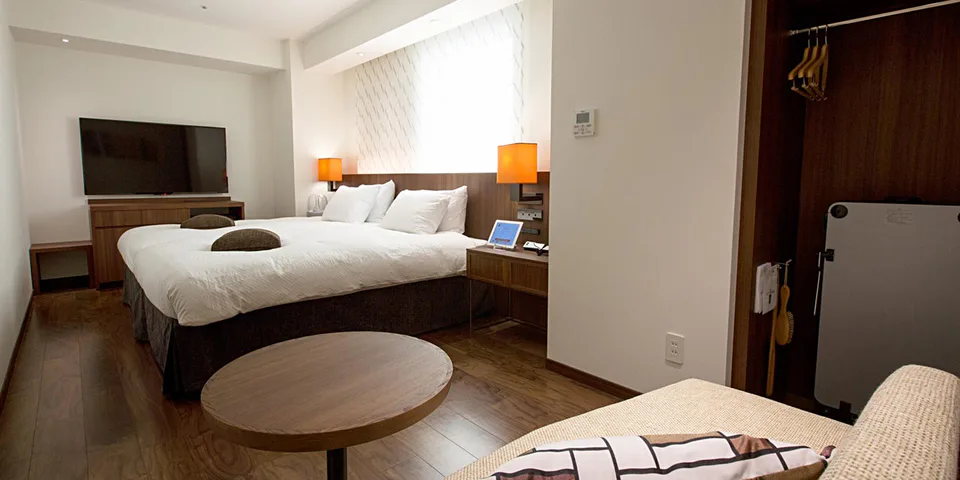
30-second verdict | On a late arrival in Fukuoka, pay first for fewer failure points—not the prettiest room
Fukuoka is one of Japan’s easiest major cities to reach from its airport, but that headline can hide the part that matters after a late flight. The real decision is not “which hotel is closest to Fukuoka Airport?” It is how many things can still go wrong between leaving the terminal and closing your hotel-room door: immigration, baggage, an inter-terminal shuttle, a train or bus cutoff, the wrong station exit, rain, and the final suitcase walk.
For a late international arrival with checked bags, especially when the next morning starts with JR or the Shinkansen, I would usually pay first for a Hakata hotel with a very short or covered station-to-lobby route. If you clear the airport early enough and most of the trip is already Tenjin-centred, I would usually keep one Tenjin base instead. Optimising one difficult night is useful; creating an unnecessary hotel move for the next day is not.
↔ Scroll table left or right
Your arrival pattern | First-night priority | What you actually save | Trade-off to accept |
Arrive around 18:00–20:00 with light luggage and still want dinner or shopping | Tenjin core | No hotel move next day; dinner, shopping and the walk back stay in one area | You may still return toward Hakata for early JR or Shinkansen plans |
Arrive after 20:00 with checked bags and mostly want to reach the room | Hakata Station side: Miyako, Blossom or Forza | Less wayfinding and a shorter final luggage segment | You may pay a location premium or accept a smaller room |
Late international arrival | Judge the route from the International Terminal, not from the subway station | You stop pretending the subway is directly outside immigration | Immigration, baggage and terminal-transfer time make your real city departure less predictable |
Early JR, Shinkansen, Yufuin or Beppu departure next morning | Hakata for night one | The same location removes friction twice: arrival night and departure morning | Moving later only pays off if the rest of the trip strongly belongs in Tenjin |
Night one is mostly sleep but days two to four are all Tenjin | Do not automatically split the stay | You avoid checkout, luggage storage and another check-in | The first-night transfer to Tenjin can still be annoying if you clear the airport very late |
Start with the real first-night question: Hakata or Tenjin?
ValueNavi Arrival Resilience Score | Which setup survives delays, rain and heavy luggage best?
This is an editorial planning score, not a hotel-quality rating. Each dimension is scored from 1 to 5, with 5 meaning the setup is easier to recover when the arrival runs late or the group is tired. For this article I deliberately weight route simplicity, luggage friction and weather exposure more heavily than hotel facilities, because the job of night one is to end a travel day reliably.
Setup | Route simplicity | Luggage friction | Weather resilience | Delay resilience | Whole-stay fit | ValueNavi verdict |
|---|---|---|---|---|---|---|
Miyako Hotel Hakata | Best when arrival-night certainty is worth a premium: late, wet, luggage-heavy, or followed by an early rail departure. | |||||
JR KYUSHU HOTEL Blossom Hakata Chuo | The strongest middle ground when you want Hakata simplicity without paying mainly for a direct underground connection. | |||||
HOTEL FORZA Hakata Station Chikushi-Guchi I | Best for “end the day fast”; confirm the exact room type if you are staying several nights because the standard Forza Double is 18m² while other room types differ. | |||||
One Tenjin base for the whole stay | Best when you clear the airport with enough margin and most of the trip is Tenjin-centred; it avoids paying a hotel-move penalty for one awkward evening. |
The important part is the asymmetry. Miyako can win the first-night problem and still lose the whole-trip problem if you then move to Tenjin for three nights. Do not average the scores and choose the biggest number. Ask whether your one high-friction arrival segment is costly enough to justify optimising the trip around it.
Separate the scheduled landing time from the time you can actually leave the airport
A 20:30 international arrival does not mean you are on a subway platform at 20:40. You still need to deplane, walk to immigration, queue, collect checked luggage and decide how to reach the city. For international passengers choosing the subway, there is another step that ordinary airport-to-city comparisons often bury: the subway station is on the Domestic Terminal side.
Fukuoka Airport currently states that the free shuttle from the International Terminal to the Domestic Terminal takes about 10 minutes, and that traffic can make the journey longer. That ten-minute figure begins after you have reached the shuttle stop; it does not include immigration, baggage claim or waiting for the bus. This is why I would plan from a conservative airport-exit time, not the scheduled landing time. It also means the famous “Fukuoka Airport is only minutes from Hakata” advantage remains real, but international late arrivals should not treat it as terminal-to-hotel time.
Do not hard-code one last train into your hotel choice months in advance. Transport schedules change. Check the official route for your exact date after your flight schedule is settled, and check again close to departure if your arrival is near a cutoff.
Why Hakata works so well on night one | The advantage is fewer second decisions
Hakata is not simply “closer to the airport.” Its real advantage is that once you reach the station, a station-side hotel can end the journey without another line change or a long unfamiliar walk. That distinction matters much more at 22:00 with two suitcases than it does at 14:00 with a backpack.
Hakata becomes especially strong when the next morning also begins there. A JR or Shinkansen departure, or an onward trip toward Yufuin, Beppu or Kumamoto, means the same location removes friction twice. If the rest of your itinerary instead lives around Tenjin, Daimyo and Nishitetsu services, compare that one-night benefit with the administrative cost of changing hotels. The Fukuoka 3-day itinerary is useful for seeing where your actual days cluster.
Miyako Hotel Hakata | Direct access is most valuable when it is late, wet or luggage-heavy
Miyako Hotel Hakata is the cleanest version of the “remove the final segment” strategy. The hotel’s official access page says the B1 entrance connects directly with Hakata Subway Station’s East Exit 7; from JR or Shinkansen services, the Chikushi Exit is about a one-minute walk. That is a meaningful difference from merely being “near Hakata Station” when it is raining or the group has large luggage.
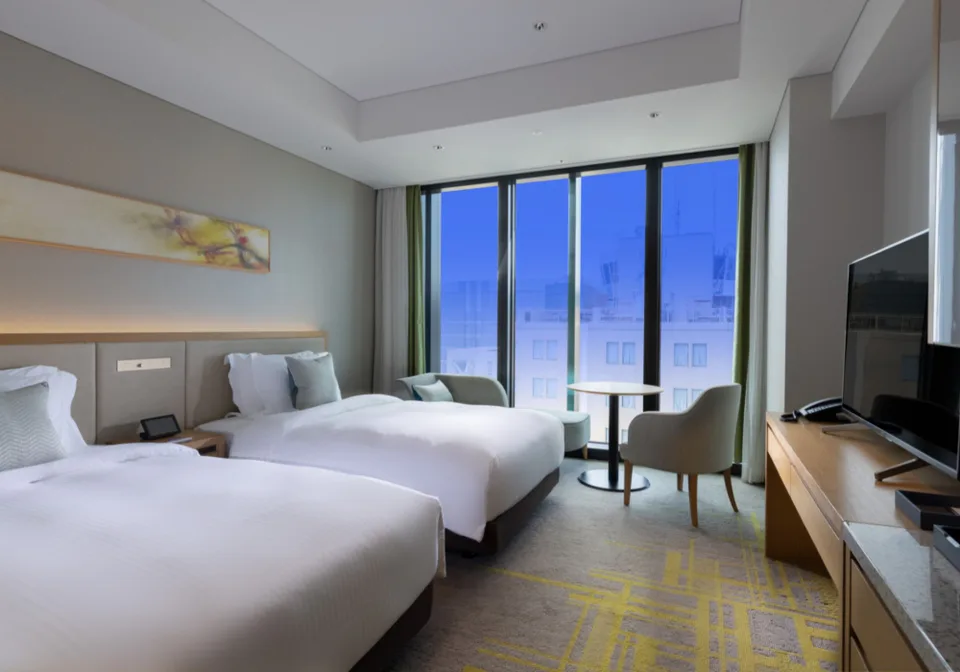
Do not pay the premium automatically. If you leave the airport comfortably before dinner, have one small bag and spend the next three days around Tenjin, the direct connection may be a feature you use intensely only once. Read the Miyako Hotel Hakata review, then compare it with Miyako vs JR KYUSHU HOTEL Blossom Hakata Chuo. The question is not whether direct access is “better”; it is whether eliminating one exposed final segment is worth the room-rate difference on your date.
Compare direct access with a two-minute Hakata walk
JR KYUSHU HOTEL Blossom Hakata Chuo | The practical middle ground
JR Hotel Group lists Blossom Hakata Chuo as a two-minute walk from the Hakata Exit of JR Hakata Station. That is close enough to remove most of the “where exactly is my hotel?” problem without making a direct underground connection the main thing you are paying for. For travellers who are arriving, eating something simple, showering and sleeping, this can be the most rational balance.

The trade-off is that two minutes is still an outdoor walk. Heavy rain, two large cases or an exhausted child can make a very short street segment more important than it looks on a hotel map. If those conditions do not apply, Blossom may already remove enough friction. The Blossom Hakata Chuo room guide is the better place to decide whether its room and bed configuration work for the rest of your stay.
HOTEL FORZA Hakata Station Chikushi-Guchi I | “One minute to bed” can beat extra floor area
HOTEL FORZA’s official site lists the Chikushi-Guchi I property as a one-minute walk from Hakata Station. That makes it a strong late-arrival choice when night one is not meant to be a hotel experience; the objective is simply to end the travel day.
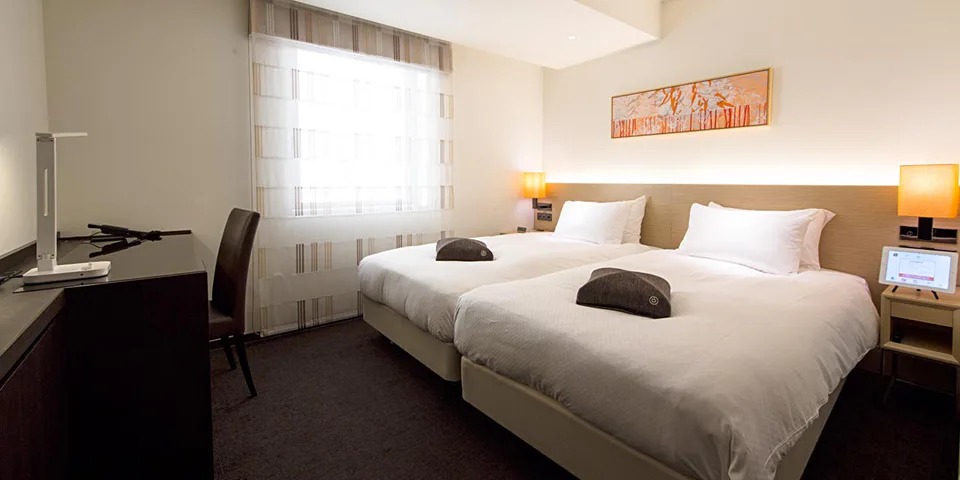
The room-size caveat needs to be precise. The hotel has several room categories; the standard Forza Double is 18m², while larger doubles and twin rooms are also offered. So “18m² is fine for one night” is useful only if that is the room you are actually pricing. For a multi-night stay, check the exact room type, bed layout and how many suitcases must remain open. The HOTEL FORZA Hakata Station Chikushi-Guchi I review is a better fit for that room-versus-location calculation.
See whether one-minute access is worth the room trade-off
Tenjin is not wrong for a late arrival | Avoid creating a hotel move just to optimise one night
A late arrival does not automatically mean Hakata. If you clear the airport around early evening, have manageable luggage and the next three nights are built around Tenjin department stores, Daimyo, Akasaka, Nakasu and Nishitetsu trains, going straight to Tenjin can still be the better whole-trip choice. The slightly harder first transfer can buy you three days without checkout, baggage storage and another check-in.
This is the boundary condition that stops “Hakata for late arrivals” becoming a lazy rule. The correct question is whether night one is unusually difficult enough to justify changing the rest of the stay. If not, use the normal Hakata vs Tenjin hotel comparison and keep one base.
International arrivals need their own route calculation
The Domestic and International terminals do not work the same way. The subway station is directly connected to the Domestic Terminal side. If an international passenger wants to use the subway, the official inter-terminal shuttle becomes part of the door-to-door journey. If a direct bus or taxi from the International Terminal better matches your hotel and arrival time, it can remove that transfer completely.
That does not make a taxi the default answer. It means a family of four with several large cases should compare the cost against the group’s total friction rather than against one traveller’s subway fare. A solo traveller with one carry-on and plenty of timetable margin may reasonably prefer the shuttle plus subway; a tired family landing late in bad weather may value a direct vehicle much more.
Late check-in and no-show rules | The expensive mistake is assuming your room waits forever
Late-arrival travellers care less about the advertised check-in start time than about what happens if they miss their expected arrival. Before paying, check the hotel’s late-arrival guidance, whether you should notify the property if your flight is delayed, how a no-show is handled and whether the front-desk arrangement actually covers your expected arrival.
If an airline delay moves a 21:00 expected arrival toward midnight, send the hotel a message rather than relying on an assumption. This matters even more with a non-refundable rate. A ¥1,000–¥2,000 saving (roughly US$7–14 / NT$210–420 / HK$50–110 at rounded planning rates, not live FX) is not a good trade if the booking terms become fragile when the flight moves.
First-night food | Put the bags down before you chase yatai
Fukuoka makes it tempting to over-plan the first evening. Yatai, Nakasu and late-night ramen sound easy because the city is compact. They are easy when you are luggage-free. They are less charming when two people are each towing a large suitcase and checking a map every block.
Put the bags in the room first, then treat dinner as optional upside. A Hakata base gives you a useful reset: if you are exhausted, eat nearby and stop; if you still have energy, go out again. A Tenjin hotel can do the same if Tenjin is already where you want to spend the night. Do not choose the wrong base for three days because of one first-night restaurant.
Room size | Score the room twice: once for night one, once for the whole stay
Late-arrival logic can make location feel so important that travellers forget the room itself. A compact double may be perfectly acceptable for shower-and-sleep night one. The same room can become irritating by night four if two large suitcases stay open and there is nowhere to pass each other.
Give location a high weight for the arrival night, then give room size, bed layout, storage, laundry and bathroom practicality a second score for the full stay. A one-hotel strategy is only truly convenient when the same property survives both tests. Groups of three or four should also compare one room vs two rooms in Fukuoka rather than assuming a stated maximum occupancy gives every adult an equivalent bed.
Should you stay in Hakata for night one and move to Tenjin on day two?
A split stay needs more than “Hakata is easier from the airport.” On day two you must check out, store or move luggage, travel to the next hotel and work around another check-in. If the move solves a ten-minute first-night problem but creates a half-day of admin, the exchange is weak.
I would usually require at least two separate payoffs before splitting: for example, a genuinely late arrival and an early Hakata rail departure the next morning, followed by several full Tenjin-centred days. If only one of those conditions exists, a single base is normally more resilient.
Your first stop on day two can decide night one better than a hotel rating can
If you need an early JR, Shinkansen or highway-bus departure from Hakata the next morning, a Hakata first night solves two difficult movements with one location. Miyako, Blossom and Forza are not automatically “better hotels” in that situation; they are better route fits.
If your first real activity is Tenjin Underground Mall, Daimyo coffee, shopping or a Nishitetsu trip, and your arrival has enough margin, Tenjin becomes more competitive. A hotel-area decision should connect the end of day one to the beginning of day two rather than rely on a generic claim that one district is “more convenient.”
If the next morning is Yufuin or another rail day, Hakata is much easier to justify
A late arrival followed by Yufuin is one of the clearest Hakata cases. You avoid pushing tired travellers across town at night and avoid pulling the same luggage back toward Hakata the next morning. Before locking that plan, read the Fukuoka to Yufuin transport comparison so you know whether your actual train or bus plan begins where you think it does.
The broader Fukuoka transport guide is useful for the same reason. Choose a hotel around the lines you will actually use, not whichever line looks closest on a general map.
Compare prices correctly | Same date, same people, same cancellation terms
Do not compare Miyako, Blossom and Forza using three unrelated screenshots. Use the same travel date, number of guests, bed requirement, breakfast choice and cancellation conditions. A connected hotel can look expensive because you are comparing a flexible breakfast rate against a non-refundable room-only rate somewhere else.
Late-arrival travellers should put extra weight on cancellation and arrival conditions because the flight itself is part of the risk. The real price is not the smallest number on the search page; it is the cost of the room you can still use if the arrival moves.
Final verdict | Make sure you can reach it, find it and drop the bags before you pay for “better”
If you are arriving internationally late, have checked luggage and need JR or the Shinkansen from Hakata the next morning, a Hakata first night has the clearest payoff. Miyako is strongest when eliminating the final station-to-room segment is worth a premium; Blossom Hakata Chuo is the practical middle ground; HOTEL FORZA is compelling when the main objective is to end the travel day almost immediately and the exact room type works for your luggage.
If you arrive early enough and the rest of the trip is already Tenjin-centred, do not create a hotel move to save a small amount of first-night friction. Before paying, verify six things: domestic or international terminal, a conservative airport-exit time, day-of public-transport options, the hotel’s late-arrival/no-show rule, the real station-exit-to-lobby route, and where your first activity starts the next morning. Once those six are clear, a generic “best Fukuoka hotels” list is unlikely to make the decision better.
Recheck the whole trip before you lock the first night
Fukuoka Hotels for Couples: Decide Where Your Night Goes Before Paying for Views or a Luxury Room
Fukuoka Hotels With Public Baths: Will You Actually Use the Onsen, Spa or Sauna?
Fukuoka Family Hotels: Choose Beds, Laundry and Daily Returns Before Hakata or Tenjin
Tokyo Honeymoon Hotels: Don’t Pay for the View Until You Pick the Night You’ll Stay In
Sources
Time-sensitive route and hotel-access facts rechecked on August 27, 2026. Transport schedules, hotel policies and room inventories can change, so late-arrival travellers should recheck their exact date before paying.
Fukuoka Airport | Inter-terminal transfers
Miyako Hotel Hakata | Official rail and subway access
JR Hotel Group | JR KYUSHU HOTEL Blossom Hakata Chuo
HOTEL FORZA Hakata Station Chikushi-Guchi I | Official access
HOTEL FORZA Hakata Station Chikushi-Guchi I | Official room types