
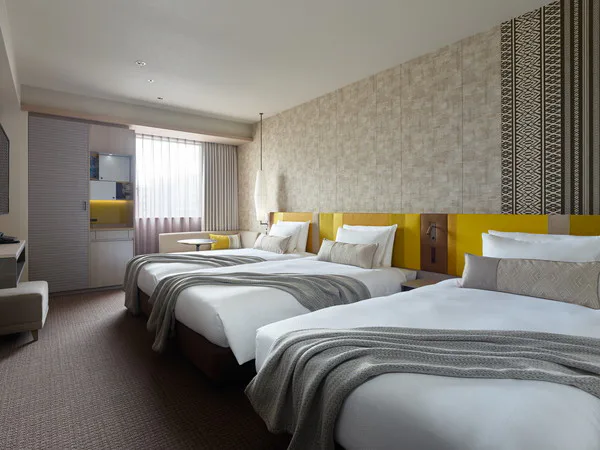
For families in Fukuoka, choose the sleeping arrangement first, then the district. A room that “sleeps 5” may still mean three normal beds plus a sofa bed, while a room that “sleeps 6” may depend on parents sharing with young children. After that, choose Hakata, Tenjin or Gion by the movement your family will repeat: JR departures, midday naps, shopping-drop returns, stroller transfers or laundry.
My default is simple: Hakata for rail-heavy families, Tenjin for city-heavy families who expect to return to the room during the day, and Gion when you want a compromise between Hakata access and central sightseeing. But bed layout can overturn the area winner. A slightly less convenient hotel with three real beds can be a better family product than a station-front room that technically accepts three people but gives the third person a poor sleeping arrangement.
If the district itself is still unclear, start with Hakata vs Tenjin hotels. If your trip includes several rail or Nishitetsu days, keep the Fukuoka transport guide open while comparing hotels.
ValueNavi family decision table: start with the sleeping map
↔ Scroll table left or right
Family pattern | Best starting point | Why it works | What can reverse the answer |
3 people who all need separate beds | Mitsui Garden Hotel Fukuoka Gion Standard Triple | 26.6 m² with three 1,110 mm beds | Several early JR departures may make a Hakata-station room more valuable |
4 people wanting one larger room in Tenjin | Solaria Nishitetsu Hotel Fukuoka Deluxe Quad | 41.8 m², central Tenjin base, useful for midday returns | The fourth sleeping place is a daybed, so check whether that works for your group |
4–5 people staying several nights | Tokyu Stay Fukuoka Tenjin Deluxe | 40 m², washer-dryer, kitchenette, microwave, separate bath/toilet | Up to five uses a sofa-bed arrangement; two rail-heavy nights may not justify Tenjin |
2 adults + young children, up to 6 total | Nishitetsu Hotel Croom Hakata Gion Comfort Fourth | 30.4 m² and a family-oriented Japanese-style layout | Do not treat maximum occupancy as six independent adult beds |
ValueNavi rule: eliminate rooms with the wrong sleeping map before comparing neighborhoods, breakfast or hotel ratings. Maximum occupancy is a safety/booking rule; it is not a comfort score.
For three people, three real beds can beat a better station location
Mitsui Garden Hotel Fukuoka Gion’s current Standard Triple is unusually easy to understand: 26.6 m², sleeps three, with three 1,110 mm beds. That removes one of the most common family booking ambiguities. You are not relying on a sofa bed or assuming that a child will share.
The trade-off is floor space. Three beds plus a stroller, three bags and shopping can make 26.6 m² feel much tighter than the raw number suggests. If two of your three mornings start with JR departures from Hakata, I would compare the triple against a more station-oriented option rather than automatically choosing the cleaner bed plan.
This is where the decision becomes personal: sleeping certainty is worth paying for when bad sleep affects everyone; station proximity is worth paying for when the whole family repeats the same transfer several mornings. The more often one friction repeats, the more weight it deserves.
The dedicated Mitsui Garden Fukuoka Gion triple-room guide goes deeper into the walk, luggage and room trade-offs.
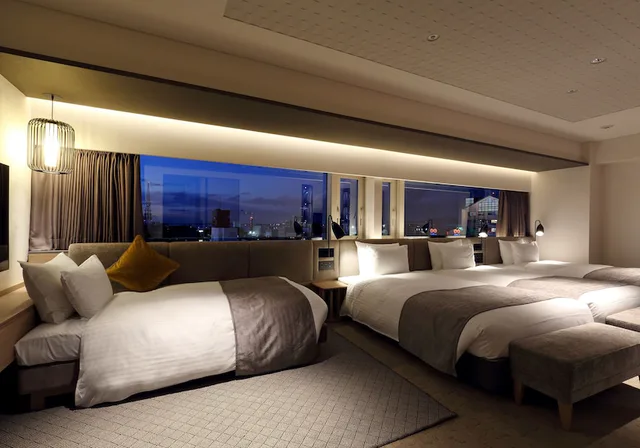
For four people, check the fourth bed before paying for the 41.8 m² room
Solaria Nishitetsu Hotel Fukuoka’s Deluxe Quad is 41.8 m² for four guests, but the official room description matters: it is based on a Deluxe Triple with a 100 cm × 195 cm daybed added for the fourth guest. The three standard beds are 120 cm × 205 cm.
That is not a flaw; for two adults and two children it may be an excellent layout. The mistake is booking it because “quad” sounds like four identical beds. For four adults, older teenagers or anyone sensitive to different bed comfort, the fourth sleeping position should be part of the decision before the Tenjin location seduces you.
Solaria becomes strongest when your family actually uses Tenjin as a daytime base. If a toddler naps, someone wants to change clothes, or you regularly drop shopping before dinner, the hotel can be used twice in one day. In that pattern, a central Tenjin room produces more value than it does for adults who leave at 08:00 and return at 22:00.
The answer flips with repeated JR mornings. Two or three day trips from Hakata can turn “great central location” into a family transfer you pay again every morning. Read the Solaria Nishitetsu Hotel Fukuoka review beside your actual itinerary, not beside a generic map of Fukuoka.
For five people, Tokyu Stay works when the washer-dryer changes what you pack
Tokyu Stay Fukuoka Tenjin’s current Deluxe Room is 40 m² and sleeps up to five. It includes an in-room washer-dryer, kitchenette, microwave and separate bath/toilet; the official hotel description says a sofa bed can be arranged to reach five-person occupancy.
This is a strong family product for four or five nights because the room solves several repeating problems at once. Laundry can run while children shower or the family repacks. A microwave and small kitchen reduce the need to turn every meal or snack into another restaurant decision. The separate bath/toilet matters more with several people sharing one room.
But do not overvalue those functions on a two-night stay. If the washer runs once, the kitchenette is never used and both mornings start at Hakata Station, the feature list may be compensating for the wrong location. Long-stay equipment only matters when it changes your real routine.
Tokyu Stay’s housekeeping rules also differ from a conventional daily-clean hotel: multi-night guests request simple cleaning, while stays of seven nights or more receive full room cleaning once a week in addition to simple cleaning. Families who expect daily bed-making should know that before booking.
The hotel’s current breakfast is ¥2,200 (about US$14) per person. For a family, multiply before adding it automatically. Four paid breakfasts are ¥8,800 (about US$55) per morning, so the better question is how many mornings your family will realistically sit down for breakfast before a day trip. USD conversions are approximate and exchange rates move.
If laundry is becoming the deciding factor, use the Tokyu Stay Fukuoka Tenjin long-stay guide.
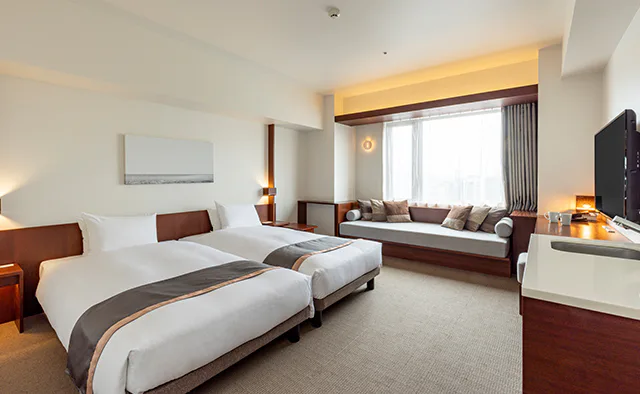
For six people, one room is only a win if the sleeping and bathroom map still works
Nishitetsu Hotel Croom Hakata Gion’s Comfort Fourth is 30.4 m² with maximum occupancy up to six. The important word is maximum. Published room information describes a family-oriented Japanese-style layout and notes that a 150 cm double bed allows co-sleeping, which is how the room can reach the higher occupancy.
So I would shortlist it for parents travelling with young children before I would shortlist it for six adults. For six adults, two rooms may cost more but can solve sleep quality, bathroom queues, different bedtimes and luggage spread. One-room convenience is not automatically the cheaper option once everyone is tired and waiting for the same bathroom.
The dedicated Croom Hakata Gion group-room guide handles the exact sleeping-layout trade-off. If your party is mostly adults, use the logic in Fukuoka hotels for 3–4 adults rather than treating a family occupancy limit as an adult comfort target.
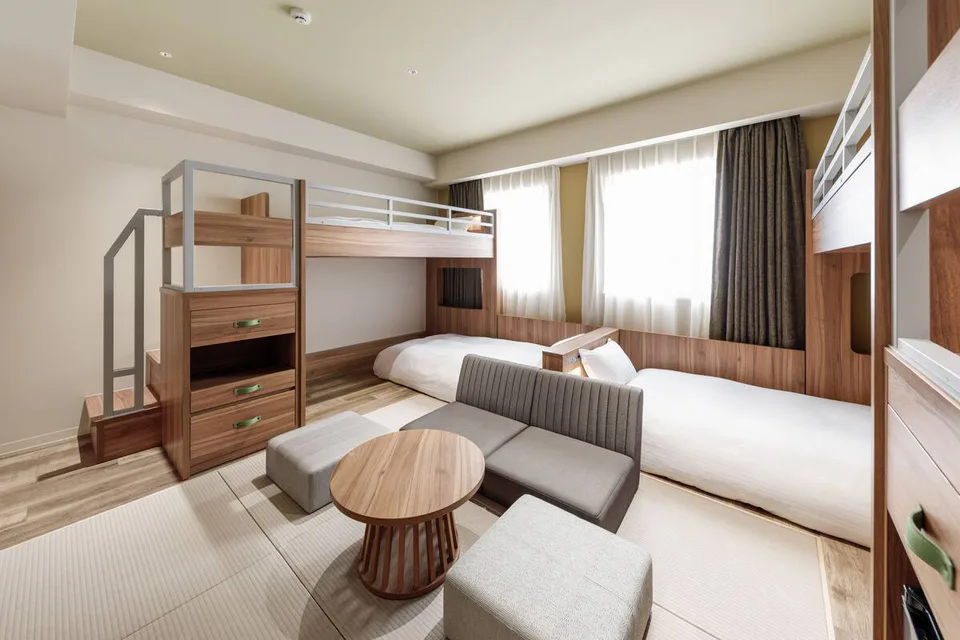
The family-room price test: compare total cost, not the headline room rate
Family rooms often look expensive because one room is carrying the cost of several sleepers. Two ordinary rooms can look cheap because the booking screen shows a lower per-room figure. Compare the total nightly cost for the same people, then price the operational difference.
↔ Scroll table left or right
Question | Why it matters |
One family room or two rooms? | One room keeps parents and children together; two rooms add bathroom capacity and floor space |
Is the family room premium recurring? | A ¥5,000 (about US$31) nightly premium becomes ¥20,000 (about US$126) over four nights |
Does one room reduce another cost? | In-room laundry, kitchenette use or easier naps can replace other spending or time |
Are both rooms equally cancellable? | A cheaper headline price is not directly comparable if cancellation or breakfast terms differ |
The ¥5,000 example is an illustration, not a universal “worth it” threshold. The point is to multiply the difference by the whole stay. A small nightly premium can become meaningful over five nights; a large-looking family room can become reasonable once it replaces two separate rooms.
Strollers and large luggage: one fewer transfer can beat a shorter walk
Families should not compare hotel access using walking minutes alone. With a stroller and two large suitcases, elevators, level changes and crowded transfers matter more than a three-minute difference on Google Maps.
If several days start from Hakata JR platforms, keeping the family close to Hakata can remove one repeated transfer. If most days stay around Tenjin, Daimyo, Nakasu and central shopping, moving the whole family to Hakata just because it is the main railway station can create the opposite problem.
ValueNavi three-repeat rule: when the same transport friction appears three or more times, promote it from a minor inconvenience to a hotel-selection factor. One awkward transfer is manageable. The same stroller-and-luggage movement repeated across several mornings deserves budget.
Naps change location value more than most adult hotel rankings assume
A couple may leave once in the morning and return once at night. A family with a toddler can leave, return for a nap, go out again, return with shopping, then leave for dinner. That means the hotel location can be used two or three times in the same day.
This is why Tenjin can be worth more for a family than an adult-only ranking suggests. If the day is built around Tenjin and nearby central areas, Solaria or Tokyu Stay can turn a midday reset into a short interruption rather than a cross-city detour. But if nap-age children are not part of the trip and every day starts on JR, that advantage largely disappears.
Laundry becomes a selection criterion only when it changes the suitcase
For one or two nights, I would not change district just to get a washer-dryer. For four or five nights, summer humidity, young children or a longer Kyushu trip can make laundry materially useful because it lets you pack fewer clothes.
The test is not “does the hotel have laundry?” It is how many loads will this family realistically run? One load in five nights is a bonus. A load every day or two can justify choosing an in-room machine over shared coin laundry, especially when waiting for a communal machine would consume family evening time.
Breakfast is a time decision as much as a food decision
Hotel breakfast is easiest to justify on slow city mornings. It is much harder to justify when a family needs to reach Hakata early for a reserved train. The cost is not only the meal; it is the compressed wake-up, dressing, feeding and departure sequence.
Before adding breakfast for every night, count the mornings when the whole family will actually use it. A five-night booking with two early departures may be better booked room-only, with breakfast added selectively where the hotel allows it. If you prefer eating outside, the Fukuoka breakfast guide gives alternatives.
Four common family-hotel failure modes
1. Booking by maximum occupancy. “Sleeps 5” and “five equivalent beds” are different products.
2. Choosing Tenjin because it sounds more lively while every morning starts at Hakata. The family pays for that mismatch repeatedly.
3. Paying for laundry or a kitchenette on a two-night stay without using either. A feature only has value if it changes the routine.
4. Booking one room for a large family because it looks cheaper. If bathroom queues, sleep schedules and luggage make the room dysfunctional, two rooms can be the better travel product.
Final verdict: remove the wrong rooms before choosing Hakata or Tenjin
For three people needing three real beds, start with Mitsui Garden Hotel Fukuoka Gion’s Standard Triple. For four people whose days repeatedly return to Tenjin, Solaria’s 41.8 m² Deluxe Quad is compelling—but check whether the daybed works for the fourth sleeper. For a four- or five-night family stay where laundry and a kitchenette will be used repeatedly, Tokyu Stay Fukuoka Tenjin has the strongest functional case. For up to six with young children, Croom Hakata Gion can work, but the maximum occupancy should never be read as six equivalent adult beds.
Then apply the route test. Choose Hakata when several mornings depend on JR, airport movement or large luggage. Choose Tenjin when city days, shopping and midday returns dominate. Choose Gion when the bed product is better and you want a compromise between the two.
The red-team condition is simple: if a “family-friendly” hotel only wins because of its label, max-guest number or room size, the decision is incomplete. The winning hotel should solve a sleeping problem, a repeated movement problem or a repeated household problem such as laundry. If it solves none of those, keep comparing.
Fukuoka Girls’ Trip Hotels: Twin Beds, Bathroom Queues, Shopping Bags and Late Nights
Sapporo Solo Hotels: Late Returns, Snowy Walks and Laundry Matter More Than the Cheapest Room
Fukuoka Hotel Selector: Answer 8 Questions Before You Compare Hotels
Osaka Long-Stay Hotels for 5–7 Nights: Laundry, Kitchens and When Not to Change Areas
Sources
Mitsui Garden Hotel Fukuoka Gion — official room information
Solaria Nishitetsu Hotel Fukuoka — official Deluxe Quad information
Tokyu Stay Fukuoka Tenjin — official room and housekeeping information
Tokyu Stay Fukuoka Tenjin — official hotel and breakfast information
Nishitetsu Hotel Croom Hakata Gion — official hotel information
Room configurations, child sharing rules, breakfast prices and availability can change. Recheck the exact room type, occupancy, bed arrangement and cancellation terms for your travel dates. USD conversions are approximate and use a recent JPY/USD exchange rate; your card or bank rate will differ.