Marine World Uminonakamichi in 30 seconds: the ticket is cheaper than the half-day
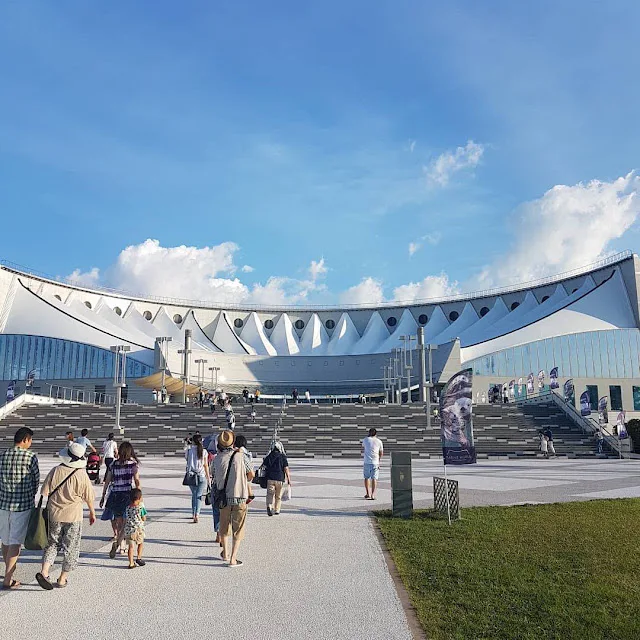
Marine World Uminonakamichi is easy to misjudge because adult admission is only ¥2,500 (about US$15.70). That looks cheap enough to become an automatic add-on to a Fukuoka itinerary. The bigger cost is the block of time: leaving central Fukuoka, changing trains or using another transport mode, spending two to three hours inside, and returning.
That does not make Marine World a bad choice. It means you should buy it as a destination, not as a spare 90-minute indoor stop. It is strongest for families, aquarium fans, travellers already planning Uminonakamichi Seaside Park, or visitors using the 2026 Night Aquarium to move the attraction into the evening.
If you are still deciding how much time Fukuoka deserves, start with How Many Days in Fukuoka?. The scarce resource is usually a clean half-day, not a few hundred yen of admission.
↔ Scroll table left or right
| Your situation | ValueNavi verdict | Why | Main opportunity cost |
|---|---|---|---|
| Family trip or aquarium is a main interest | Strong | Exhibits, show pool and optional experiences can justify the block | Less city time |
| Also visiting Uminonakamichi Seaside Park | Strong | One outbound journey supports two attractions | A full coastal day |
| Only two full days in Fukuoka | Usually skip | The aquarium competes with Dazaifu, Itoshima, food and city time | One of very few flexible half-days |
| 2026 Night Aquarium date | Strong | Extended hours let you shift the aquarium later | Late return and closing-time transport |
Current admission: localize the ticket, then stop pretending the ticket is the whole cost
Current individual admission is ¥2,500 for adults (about US$15.70), ¥1,200 for elementary and junior-high students (about US$7.50), ¥700 for children aged three to pre-school (about US$4.40), and ¥2,200 for visitors aged 65 or older (about US$13.80).
Those prices are straightforward. The decision is not. Marine World sits in Uminonakamichi, so the true comparison is:
admission + hotel-to-aquarium transport + two-to-three-hour visit + return journey + what that half-day replaces.
This is the ValueNavi opportunity-cost model for this article. It is editorial, not an operator formula.
Why “two to three hours” should never be copied as door-to-door time
Two to three hours is a reasonable inside-the-aquarium planning range. It gives you time for the Kyushu-themed galleries, the large open-ocean tank, jellyfish, one show and some slower stops without racing.
It does not include the journey from Hakata, transfer time around Kashii, waiting, or the return. This is why a three-hour gap between lunch and dinner in central Fukuoka is not enough, while three hours after you have already arrived at Uminonakamichi Station is comfortable.
The “Seas of Kyushu” structure is a better reason to go than counting famous animals
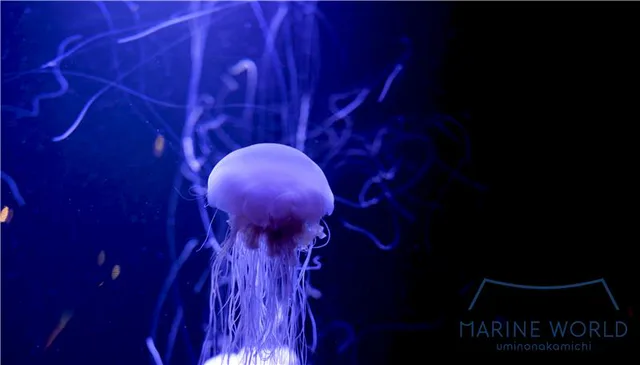
Marine World becomes more distinctive when you follow the geography of the exhibits. The route builds around Kyushu’s coastal and marine environments rather than treating every species as a disconnected headline. The large open-ocean tank then expands that regional idea toward warmer southern waters and the Kuroshio environment.
If you have already visited several Japanese aquariums, this regional structure matters more than asking whether Marine World has one particular shark or ray. If you only want one dramatic tank photo, the half-day may be harder to justify.
2026 Night Aquarium: the value is schedule relocation, not a promise of smaller crowds
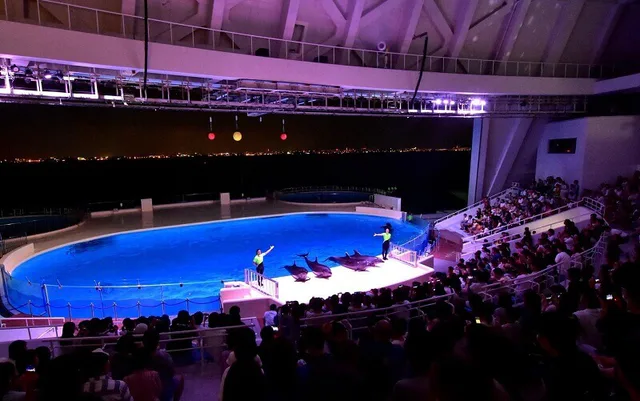
The official 2026 Night Aquarium runs July 18–20 and July 25–26, every day from August 1–23, and then weekends and public holidays from August 29 through September 23. On those dates the aquarium operates 09:30–21:00, final admission is 20:00, and the indoor lighting switches to the night version from 18:00.
There is no need to buy a second ticket simply because the lighting changes. The useful strategy is to arrive in the later afternoon, see the daytime version and a workable show, then remain through the 18:00 transition. The value is that you can preserve daylight for another Fukuoka activity instead of giving the aquarium the middle of the day.
Do not convert “open until 21:00” into “arrive at 19:55.” A very late arrival throws away the day-to-night contrast and still leaves you dealing with closing-time transport.
The dolphin and sea lion show is useful — but one show time should not own the itinerary
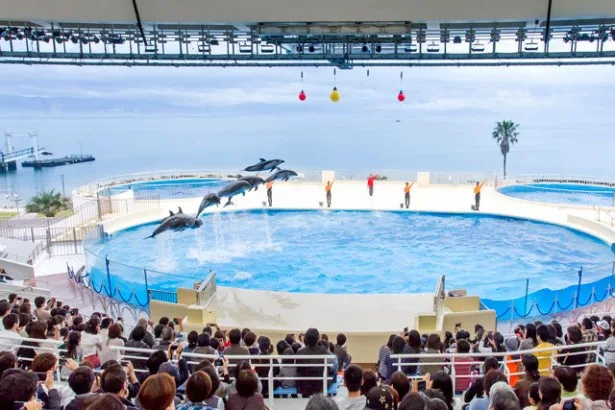
The outdoor show pool has Hakata Bay behind it, which gives Marine World a setting that a fully enclosed city aquarium cannot copy. The trade-off is that schedules vary by date and the area is still exposed to weather.
Check the official show schedule on the day. If a convenient performance fits, use it as a natural midpoint. If not, keep moving rather than sacrificing a large part of the visit to protect one seat. Front rows can also get wet.
This is why “rainy day = aquarium” needs nuance. Much of Marine World is indoors, but some of its strongest experiences are not. For truly poor weather, compare a more city-centred Fukuoka rainy-day route.
Paku Paku Dolphin: the ¥1,000 add-on can be more important than the admission ticket
The current dolphin-feeding experience costs ¥1,000 per serving (about US$6.30), is available from age three, and is sold separately from aquarium admission. The official site releases tickets from midnight two weeks before the activity date and shows sold-out dates as unavailable.
For the current late-summer 2026 schedule, sessions are listed at 13:00–13:15 on the specified Night Aquarium dates, with a later-season weekend/holiday schedule also published. If this feeding experience is the one thing a child cares about most, secure that first and build the aquarium visit around it. General admission does not reserve it.
Marine World + Seaside Park: a ¥260 saving is not a reason to invent a full day
The official aquarium + Uminonakamichi Seaside Park combination currently costs ¥2,690 (about US$16.90). Buying the adult aquarium admission at ¥2,500 plus the park’s ¥450 admission separately would total ¥2,950 (about US$18.50), so the bundle saves ¥260 (about US$1.60).
That is a good deal only if the park was already in your plan. If you do not want cycling, seasonal flowers, playgrounds or outdoor park time, spending more hours to “use the discount” is the opposite of saving.
For families who already want both attractions, the logic flips: one outbound journey supports an entire coastal day, so Marine World no longer carries the full transport cost by itself.
Transport bundles can be smarter than admission discounts
The official ticket page also lists products that combine Marine World admission with JR round-trip travel, a Fukuoka city bus pass, or the Uminaka Line boat. The best one depends on where your hotel and the rest of the day are located.
A Hakata-based traveller, a Tenjin-based traveller and someone already around the waterfront do not have the same cheapest or easiest route. Compare the whole chain rather than choosing transport after you have already bought a fixed ticket.
If your wider itinerary is still unstable, Dazaifu vs Itoshima is a useful next comparison because it forces the same question: what kind of half-day do you actually want outside central Fukuoka?
Klook vs KKday: use ticket flexibility to solve your schedule, not to chase a tiny price gap
Klook and KKday both list the exact Marine World admission product. Check the final price, validity, redemption method and cancellation terms for your travel date rather than relying on one platform’s headline discount.
Compare the exact Marine World ticket on Klook
Compare the exact Marine World ticket on KKday
ValueNavi half-day score: when does Marine World earn the transfer?
↔ Scroll table left or right
| Factor | Strong case | Weak case |
|---|---|---|
| Interest | Aquarium / marine life is a real priority | You are going only because admission looks cheap |
| Route | Uminonakamichi already fits the day | You must leave and return to central Fukuoka just for this |
| Time | You can protect a clean half-day | You have a fragmented 2–3 hour city gap |
| Bundle | You already want Seaside Park or useful transport | You add unwanted attractions merely to “save” |
| Night Aquarium | Evening hours relocate the visit out of valuable daylight | You arrive so late that you barely see the transition |
When a coastal overnight changes the equation
Most visitors do not need to move hotels for an aquarium. But if you already want Seaside Park, a slower coast day and resort time, staying in Uminonakamichi removes the return commute and changes the area from “one distant attraction” into a destination.
The separate THE LUIGANS Spa & Resort Fukuoka guide handles that decision. Do not move hotels simply because the resort is near Marine World; do it only if the coastal day itself deserves the overnight.
Four travellers who can skip Marine World
1|A first-time visitor with only two complete Fukuoka days who has not yet protected time for the city itself.
2|Someone only mildly interested in aquariums who has already visited several large Japanese aquariums.
3|A traveller treating it as a fully indoor typhoon-proof attraction despite the outdoor show and coastal setting.
4|Anyone trying to combine another distant day trip with the same date just because the ¥2,500 admission looks inexpensive.
Final verdict: first buy the half-day, then buy the ticket
Marine World Uminonakamichi is a strong aquarium whose ticket is cheaper than the time commitment. Go when the half-day already has a job: family travel, genuine aquarium interest, a Seaside Park day, or a 2026 Night Aquarium date that lets you use the evening productively.
Skip it when the itinerary is short enough that the coastal transfer removes something you want more. The right order is: decide whether you can spend the half-day, choose the transport chain, then buy the exact ticket or bundle that supports it.
Next decision: decide how many Fukuoka half-days you can actually spend
Tokyo Budget Hotels: A Cheaper Night Can Cost More If You Add a Transfer Every Day
Abashiri Drift Ice Cruise: Aurora Ticket, 2-Day Sapporo Tour or Private Charter?
Chiikawa Park Tokyo 2026: ¥3,500 Is Not a Shopping Fee — Check the Time Slot First
Tokyo Disney Split Stay: Move the Night Before or After Your First Park Day?
Kishiwada Danjiri October 2026: Districts, Transport and How to Plan the Day
Sources
Marine World Uminonakamichi|Current admission fees
Marine World Uminonakamichi|Current operating hours
Marine World Uminonakamichi|Night Aquarium 2026
Marine World Uminonakamichi|Current experience menu and Paku Paku Dolphin
Marine World Uminonakamichi|Advance, transport and Seaside Park combination tickets