
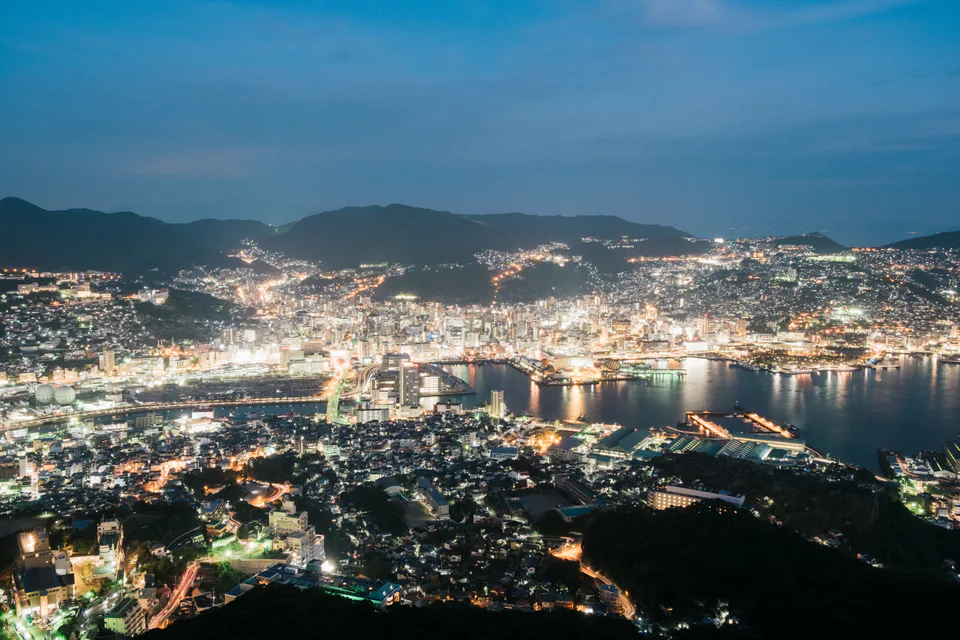
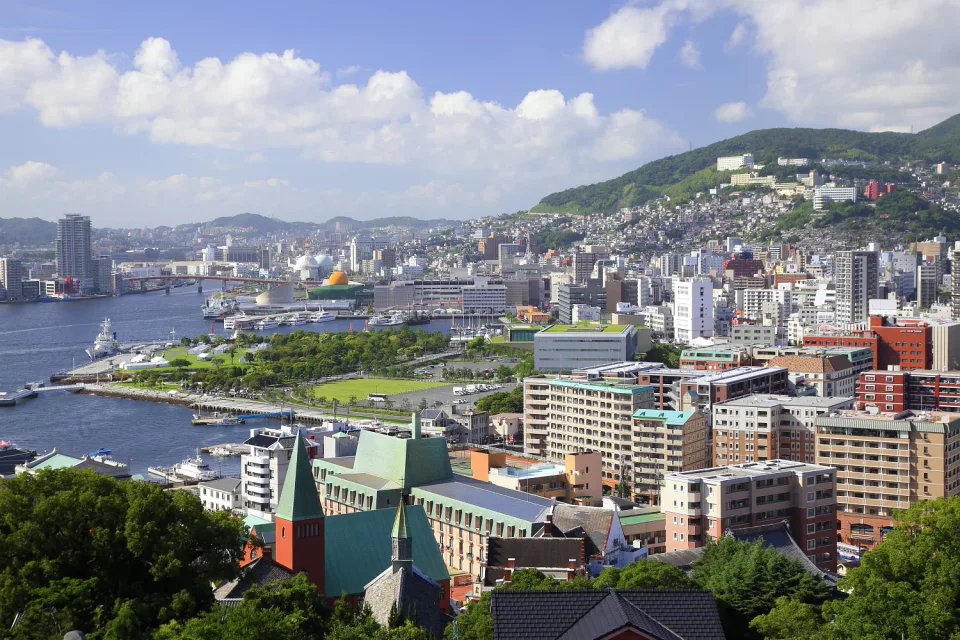
Two days is enough for a first Nagasaki visit if you build around two hard gates: the Peace District before the Atomic Bomb Museum closes, and one evening view rather than every famous night-view stop. My default is Day 1 for Peace Park, the Hypocenter and Atomic Bomb Museum before moving south into central Nagasaki; Day 2 for Oura Cathedral, Glover Garden and Minamiyamate. Then choose either Mount Inasa when visibility and the ropeway are good, or an after-dark Glover Garden / harbour evening when its seasonal late opening fits.
This is the main correction to many Nagasaki itineraries: Glover Garden and Mount Inasa do not both need to be compulsory Day 2 night-view anchors. From July 17 to October 11, 2026, Glover Garden is scheduled to stay open until 21:30 and its Lantern Night runs from sunset. From October 12 to December 31 it generally stays open until 20:00, with selected late-October dates until 21:30. That can turn the southern heritage district into its own evening rather than forcing another cross-city transfer to Mount Inasa.
↔ Scroll table left or right
Time block | Default plan | Hard gate |
Day 1 morning | Peace Park → Hypocenter → Atomic Bomb Museum | The museum closes far earlier than Nagasaki’s evening sights, so do not leave it until the end of the day |
Day 1 afternoon | Lunch → Spectacles Bridge → Dejima / waterfront if energy remains | Do not add every central sight merely because the tram makes them look close |
Day 2 morning / early afternoon | Oura Cathedral → Glover Garden → Minamiyamate | Slopes, cobblestones and summer heat make this a stamina block, not a flat-city stroll |
Day 2 late afternoon | Hotel rest, harbour, Chinatown or early dinner | Keep energy in reserve if Mount Inasa is still under consideration |
Day 2 evening | Choose one: Mount Inasa panorama OR Glover Lantern Night / southern harbour evening | Weather, seasonal Glover hours and current ropeway operation decide the winner |
Day 1: put the Peace District first because it has the least flexible closing time
The Atomic Bomb Museum is the clearest hard gate in this itinerary. Current official guidance lists 08:30–17:30 from September through April, with last entry at 17:00. From May through August it stays open until 18:30, with last entry at 18:00. The surrounding Peace Park and Hypocenter do not create the same indoor closing deadline.
That means the efficient order is not accidental: Peace Park → Hypocenter → museum, with enough time left to enter the museum without watching the clock. I would protect roughly two to three hours for the whole district, but the exact museum time should follow your interest rather than a stopwatch. If the morning runs long, cut a lower-priority central stop later instead of rushing the museum.
The sequence also works emotionally. The outdoor sites establish the geography before the museum provides the historical record. Afterward, take a real lunch break. Do not immediately turn the day into another queue or a cross-city food mission.
Use local food as the reset between the two halves of Day 1
Nagasaki’s official tourism material highlights champon, sara udon, castella and shippoku cuisine. In a two-day itinerary, food should support the route rather than become another transport district.
A strong pattern is champon or sara udon after the Peace District, then castella as a snack or souvenir while you are already central. Shippoku deserves a deliberate dinner only when the meal itself is a priority. The goal is to eat something specifically Nagasaki without spending forty extra minutes crossing town for a restaurant that happens to rank first on a list.
Day 1 afternoon: central Nagasaki is the flexible part of the itinerary
After lunch, move toward Spectacles Bridge and the Nakashima River area. This is where the itinerary should loosen. Add Dejima and the waterfront if attention and energy remain; stop earlier if the museum morning has already been substantial.
Do not stack Spectacles Bridge, Chinatown, Dejima, the waterfront, Suwa Shrine and Mount Inasa simply because each individual transfer looks short. Nagasaki’s hidden cost is stop-start movement: wait for the tram, ride, walk from the stop, find the entrance, then repeat. In a hilly city, the fatigue created by six “small” movements can be larger than one longer journey.
This gives Day 1 a built-in deletion order. If time slips, delete an optional central stop first. Do not sacrifice the museum or force Mount Inasa merely to keep every pin on the map.
Day 2: treat Oura Cathedral, Glover Garden and Minamiyamate as one slope block
These sights belong together geographically. The main cost is not tram fare; it is elevation, cobblestones and time on your feet. Glover Garden provides moving walkways, wheelchair ramps and even electric-wheelchair lending, but its own visitor guide warns that much of the garden remains cobbled and sloped and that wheelchair users may still need assistance.
For fit adults, an early start keeps the sequence simple: Oura Cathedral, then Glover Garden, then the surrounding Minamiyamate streets while the group still has energy. For older travellers, young children or anyone with mobility constraints, shorten the district rather than assuming every hillside residence has equal value.
The most useful rule is do not spend the same unit of energy twice. If Mount Inasa is one of the trip’s highest priorities, stop the southern heritage block before it becomes exhausting and take a proper late-afternoon rest.
2026 late opening changes the old “Glover by day, Inasa by night” formula
Glover Garden’s current 2026 schedule creates a genuine alternative evening. From July 17 through October 11 it is scheduled for 08:00–21:30, last entry 21:10. From October 12 through October 31 it generally runs until 20:00, with selected Friday/Saturday dates extending to 21:30. November and December are scheduled to 20:00. The 2026 Lantern Night programme illuminates the garden from sunset during those late-opening seasons.
This matters because Glover Garden already overlooks Nagasaki harbour. On a summer or autumn visit, you can let the southern district evolve from late daylight into lanterns and city lights without adding another major transport leg.
Choose Glover after dark when: the group is tired, the south-side heritage district is already the centre of Day 2, the weather is mediocre for a mountain panorama, or you prefer a slower historic/harbour evening to a summit viewpoint.
Choose Mount Inasa when: the wide city panorama is one of the reasons you chose Nagasaki, visibility is good and you are willing to spend the extra transport and waiting time.
The two experiences are different. The mistake is assuming a two-day first visit must buy both.
Mount Inasa: the current 2026 access is ropeway-first because the slope car is suspended
Older itineraries can now be misleading. Nagasaki’s official tourism site says the Inasayama Slope Car is currently out of service for maintenance and safety work, with no restart date announced. The Nagasaki Ropeway is the active public-access baseline.
The current route from Nagasaki Station is bus to Ropeway-mae, about a three-minute walk to Fuchi Shrine Station, then roughly five minutes on the ropeway and another short walk to the observatory. Official tourism guidance estimates about 20–30 minutes from Nagasaki Station for the bus-and-ropeway chain. The ropeway currently operates 09:00–22:00, subject to weather and maintenance, and the adult round trip is JPY 1,900.
This turns Mount Inasa into a conditional finale, not a fixed reservation in your mental itinerary. Check visibility and ropeway operation in late afternoon. If cloud, rain, wind or a service suspension removes the payoff, delete the mountain rather than replacing one disappointing night view with several extra transfers.
If you drive, do not assume the car removes every constraint. Official tourism guidance notes evening access restrictions at the summit parking lot on weekends, holidays and designated peak dates. The transport method still needs a current-date check.
Use a one-night-view rule unless night views are a top-three trip priority
In two days, I would normally buy only one deliberate evening-view product:
Mount Inasa: best for the broad panorama and “iconic Nagasaki night view” objective.
Glover Lantern Night / southern harbour: best for lower transfer friction and a continuous heritage-to-evening sequence on eligible 2026 dates.
Waterfront / central dinner: best when weather or fatigue makes both formal viewpoints poor value.
Stack both Glover-at-night and Mount Inasa only when night photography or viewpoints are a genuine trip priority. Otherwise, the second night view usually costs more in movement than it adds in distinct experience.
Summer version: move the slope block to the cooler edge of the day
July and August add a different constraint: heat. Glover Garden opens at 08:00, while its 2026 summer late opening provides a second option after the hottest part of the afternoon. That gives you two resilient patterns:
Early Glover: start the southern heritage district early, finish before peak heat, rest in the afternoon, then decide on Mount Inasa.
Late Glover: use a slower or more indoor central afternoon, enter Glover later and let the visit run into Lantern Night.
Do not force a steep midday route simply because Day 2 was originally labelled “Glover morning.” The seasonal opening hours are useful precisely because they let the plan move.
Tram pass: cluster the route first, then decide whether a pass is worth it
Nagasaki Electric Tramway currently accepts major Japanese IC cards and publishes both one-day and 24-hour pass products. That does not mean every two-day visitor should buy one.
The pass decision comes after geographic clustering. Day 1 already groups the northern Peace District, then central Nagasaki. Day 2 groups the southern heritage district. If you keep the route compact, you may use fewer tram rides than a checklist itinerary that zigzags across the city.
Count the rides you genuinely plan, compare them with the live pass price, and buy only when the pass already wins. Do not buy a pass first and then add distant stops to “get value” from it. The pass should reduce the cost of a good route; it should not create a worse route.
Where to stay for this exact two-day route
Nagasaki Station: safest for a late arrival, early departure, large luggage or a rail-heavy wider Kyushu trip. It protects the hardest first/last edges of a short stay.
Shinchi / Hamamachi / waterfront: stronger when dinner, bars and evening walking matter more than rail convenience. It also fits a Day 1 central finish and a Day 2 south-side start reasonably well.
I would not choose the Peace Park area solely because Day 1 begins there. That optimises one morning while making the rest of the city less balanced.
If Huis Ten Bosch or Unzen is competing for a night, use Nagasaki City vs Huis Ten Bosch vs Unzen before booking. A park evening or onsen night changes the product enough that this two-day city itinerary should shrink rather than absorb another hotel move.
Large luggage should never follow the sightseeing route
If Nagasaki sits between other Kyushu stops, leave the main cases at the hotel, verified station storage or send them ahead when the receiving hotel confirms it can accept them. Do not pull a full-size suitcase through tram stops and Minamiyamate slopes.
Use the Japan luggage-forwarding guide for receiving-hotel, lead-time and size checks. The useful principle is simple: luggage belongs on the transfer day; it does not belong on the sightseeing route.
If you arrive late on Day 1, protect the museum before protecting the original sequence
A late Day 1 arrival can break the default order. Do not rush from the station to the Peace District if you can no longer give the museum enough time before closing. Use the arrival evening for the station, waterfront, Chinatown or a central dinner, then put the Peace District first on Day 2.
Something must then give. The correct deletion is usually an optional central stop or Mount Inasa, not a frantic museum visit followed by a full Glover slope block and summit night view. A 1.5-day Nagasaki stay should become a smaller Nagasaki itinerary, not a two-day itinerary played at double speed.
What not to add without deleting something else
Huis Ten Bosch, Gunkanjima and Unzen are not small extensions to this route. Huis Ten Bosch needs a substantial park block, Gunkanjima is tied to a boat schedule and sea conditions, and Unzen is a separate mountain/onsen transport problem.
If one becomes a hard priority, remove one of the four core Nagasaki products: Peace District, central city, southern heritage district or evening viewpoint. Do not keep all four and call the extra destination a “half-day add-on.”
If the wider question is whether Nagasaki belongs in a short Fukuoka trip at all, use Nagasaki Day Trip or Overnight from Fukuoka first.
Final verdict
For a first two-day Nagasaki visit, protect the least flexible things first: the Atomic Bomb Museum before its closing time, the southern heritage district before the group’s legs are spent, and only one deliberate night-view anchor. Day 1 works best as Peace District → lunch → central Nagasaki. Day 2 works best as Oura / Glover / Minamiyamate → rest → one evening choice.
On clear dates when the panorama is a priority, use the currently operating ropeway for Mount Inasa and remember that the slope car is suspended. On 2026 summer/autumn dates when Glover Garden stays open late, let Lantern Night replace Mount Inasa if that keeps the day coherent. If weather or fatigue kills both ideas, finish with the harbour and dinner. That is not a failed itinerary; it is the resilient version.
5-Day Hokkaido Autumn Leaves Itinerary: Driving, Public Transport and Where to Stay
10-Day Japan Autumn Leaves Itinerary: Regional Routes, Transport and Where to Stay
Where to Stay in Fukuoka: Hakata or Tenjin for Trains, Food and Day Trips
Miyakojima 4-Day Itinerary: Turtle Snorkeling, SUP, Pumpkin Cave and Bridges
Osaka for Couples: A 7-Day Itinerary That Saves the Best Nights for Kyoto, Kobe and One Big View
References
Nagasaki Atomic Bomb Museum — current opening hours · Glover Garden — 2026 opening hours, late-opening schedule and accessibility notes · Glover Garden — Lantern Night 2026 schedule · DISCOVER NAGASAKI — current slope-car suspension notice · Nagasaki Ropeway — current operating hours and fare · Nagasaki Electric Tramway — English riding and pass guidance. Checked August 25, 2026. Opening hours, late-opening dates, ropeway operation and transport can change; recheck the exact travel date.