
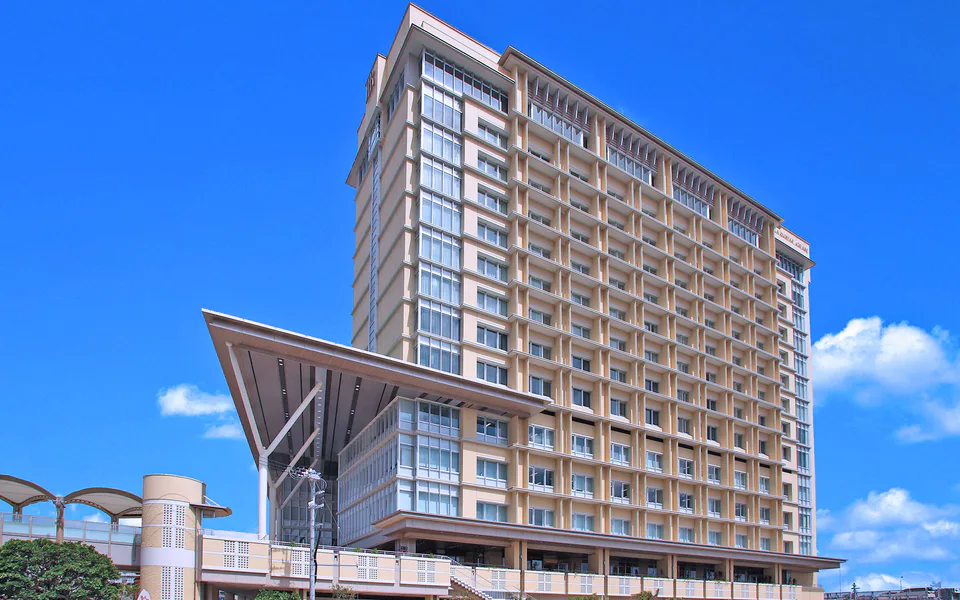
30-second answer | Count doors, bathrooms and fixed beds before square metres
For a three-generation Okinawa trip, “one room for everyone” is not automatically the most family-friendly answer. Five or six people can legally fit into a large room and still fight the same three bottlenecks every night: someone is sleeping on the wrong kind of bed, everyone needs the bathroom at once, and grandparents and children have different lights-out times. The useful question is not “What is the biggest room?” but “How many separate sleep and bathroom lanes does this group need?”
For five people with similar routines, HIYORI Ocean Resort Okinawa can work because the Ocean Suite combines a large living area, kitchen and washer-dryer—but only two of the five sleeping positions are fixed 120 cm beds. For six people spending at least two nights in Motobu, two rooms at Ala Mahaina usually make more sense than trying to stretch a four-person suite. For six without a car, two eligible rooms at RIHGA Royal Gran Okinawa can keep transport easy around Asahibashi. For six who split up after dinner or all shower around the same time, JR Kyushu Hotel Blossom Naha is stronger because multiple rooms create multiple bathrooms and independent bedtimes.
If you are still deciding the Okinawa base itself, start with Okinawa Family Hotels or the broader Okinawa hotel decision guide. This article starts one step later: the trip is multigenerational, and now you need to decide whether togetherness should mean one room or simply one hotel.
↔ Scroll table left or right
Group pattern | Start with | Why it can work | What can reverse the answer |
5 people, 3–5 nights, similar bedtimes, children accept daybeds | HIYORI Ocean Suite | 56.4–60.87 m², kitchen, washer-dryer, shared living area | Only two fixed beds; guests 3–5 use one extra bed and two daybeds |
4 adults who all want fixed beds and more separation | HIYORI Sky Luxury Suite | Two bedrooms, four fixed beds, bathroom plus separate shower room | Official maximum remains 4; it does not solve a six-person booking |
6 people, 2+ nights in Motobu / Churaumi area | Two Ala Mahaina rooms | Large kitchen-equipped rooms, real northern base, separate sleep zones | One aquarium half-day may not justify moving six people north |
6 people, no car, public-transport-heavy Naha stay | Two eligible RIHGA Royal Gran rooms | Asahibashi and Naha Bus Terminal access, 35 m²-class rooms | Kokusai-dori-heavy evenings may favor a more central nightlife base |
6 people with different bedtimes or bathroom pressure | JR Blossom Family Room + another room, or 2–3 rooms | Separate washing-area bathrooms, 24-hour laundry, Kokusai-dori access | More rooms can cost more and adjacency must be confirmed |
ValueNavi Multigenerational Split Score | One room should earn the right to keep everyone together
Use this as an editorial decision model, not an official hotel rating. Start at 10 and subtract points for the frictions that actually exist in your group. Subtract 2 points if an older traveller who needs a conventional bed would be pushed onto a daybed, sofa bed or unsuitable extra bed. Subtract 2 if the grandparents’ and children’s normal bedtimes differ by two hours or more. Subtract 2 if three or more people normally need to shower or prepare during the same one-hour window and the room has only one bathing lane. Subtract 2 if nighttime assistance, mobility or accessibility needs require proximity that the room plan does not reliably provide. Subtract 1 if the kitchen / laundry / living-room features will be used fewer than three meaningful times. Subtract 1 if everyone has to share one lighting and wake-up zone.
↔ Scroll table left or right
Score | ValueNavi interpretation | Likely direction |
8–10 | One-room friction is low | A large suite can genuinely improve togetherness and convenience |
5–7 | One room works only if the weak point is acceptable | Price one suite and two rooms under the same conditions before deciding |
0–4 | The room is solving square metres while leaving daily friction untouched | Two rooms are usually the more resilient setup |
The score is deliberately harsh on sleep and bathroom conflicts because those repeat every day. A sea view is enjoyed when someone looks at it. A bad mattress assignment or one-bathroom queue is experienced whether anyone planned for it or not.
HIYORI Ocean Resort Okinawa | Five people can stay together, but only two get fixed beds
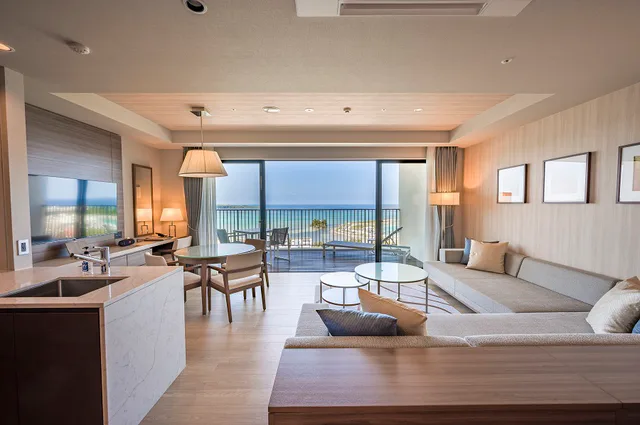
HIYORI’s current official room information lists the Ocean Suite at 56.4–60.87 m² plus a 14.4 m² terrace, with a maximum occupancy of five. The detail that matters for three generations is not the headline floor area: there are two 120 cm fixed beds, one extra bed and two daybeds. Five sleeping positions therefore do not mean five equivalent beds.
Assign the fixed beds before you book. If a grandparent cares about mattress support, bed height, balance when standing up or getting to the bathroom at night, that person should not end up on a daybed because the children claimed the fixed beds first. A child who sleeps comfortably on a daybed and an older adult who needs a conventional mattress are not interchangeable occupants.
The suite becomes much stronger when the shared-space functions are used repeatedly. HIYORI states that all rooms have washer-dryers, while the Ocean Suite also includes an IH kitchen, fridge-freezer, microwave, cookware and tableware. Across four nights, several laundry cycles, simple breakfasts, snacks and midday room returns can make the room function like family infrastructure rather than expensive empty space.
There is also a useful counterexample inside the same hotel. The Sky Luxury Suite is far larger—90.46 m² plus a 68.84 m² terrace—and has four fixed 120 cm beds across two bedrooms, a bathroom and a separate shower room. For four adults who care more about fixed beds and separation, that can be a better multigenerational layout than the five-person Ocean Suite. But its official maximum is four. Bigger does not mean “add more people”; occupancy and bedding quality are separate decisions.
If the group is five and all five insist on conventional beds, or if the bedtime gap is large, price two rooms before assuming the Ocean Suite is the family-friendly option. The detailed long-stay trade-off is covered in the HIYORI 56 m² suite guide.
Ala Mahaina Condo Hotel | A 98 m² suite still does not become a six-person room
Ala Mahaina is a good test of whether a family is confusing room size with occupancy. The current Superior Room is 55.15 m² for up to three guests. The Deluxe 4 Beds room is 63.88 m² for up to four. Even the 98.28 m² two-bedroom Infinity Suite has a maximum occupancy of four. For six travellers, the correct starting point is therefore two rooms, not creative arithmetic around the largest suite.
That is not necessarily a compromise. Put the parents and children in a four-bed room and give the grandparents a separate room, or split the group according to who needs nighttime assistance. Everyone can still gather in the larger room during the day while nighttime creates a second bathroom, a second lights-out time and a private recovery space.
The second-room premium makes more sense when Motobu is genuinely a base. Ala Mahaina is about five minutes by car from Okinawa Churaumi Aquarium, so two northern days can turn a room split into a transport advantage. For one aquarium visit in a longer central-Okinawa stay, moving six people, several cases and two room bookings may cost more family energy than one longer day trip.
There is also a current hidden cost for drivers. Ala Mahaina charges hotel guests ¥1,000 (about US$6.27) per passenger car per night, capped at ¥2,000 (about US$12.55) under its current published parking policy. The cap matters: for a continuous stay, the third night onward does not add another accommodation parking charge. But that does not make the car park operationally friction-free. Parking cannot be reserved, the facility’s free four-hour service applies only to the first entry of the day, and after leaving and re-entering the published rule switches to ¥200 (about US$1.25) per 60 minutes from re-entry. For a two-room, two-car family, count cars and planned exits—not only nights.
FX assumption: ¥1,000 ≈ US$6.27, checked August 27, 2026. USD figures are rounded planning equivalents and will move with exchange rates.
If northern Okinawa is taking two or three nights, use the Ala Mahaina long-stay guide to decide whether the base itself earns the hotel move.
RIHGA Royal Gran Okinawa | Two rooms can make a six-person no-car trip simpler
For a multigenerational Naha stay without a rental car, RIHGA Royal Gran Okinawa solves a different problem. Its current City View Twin is 35 m² with two 120 × 200 cm beds and an official occupancy of two to three, with an additional bed used when eligible. That means two suitable three-person room configurations can be more practical for a six-person group than searching for one rare six-person room.
The location is the main reason. The hotel is around two minutes on foot from Asahibashi Station and Naha Bus Terminal, with the monorail ride to the airport roughly ten minutes. When grandparents care about reducing long last-mile walks or the family has several bus-based days, those repeated transfers can matter more than keeping all six people behind one door.
The answer changes if the group’s evenings are centered on Kokusai-dori. Daytime transport can be excellent while one half of the family still wants an easier walk back after dinner. If grandparents regularly finish the evening earlier than the parents and children, compare Asahibashi efficiency with the Kokusai-dori proximity of JR Blossom rather than treating “closest to transport” as universally best. The RIHGA-specific trade-off is in the Asahibashi location guide.
JR Kyushu Hotel Blossom Naha | Bathroom concurrency can matter more than room size
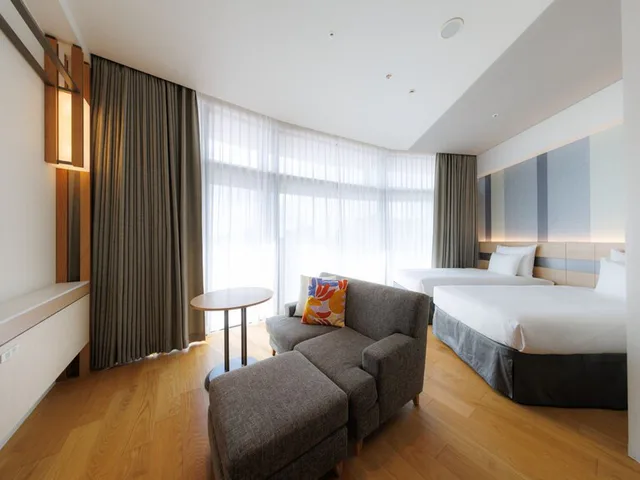
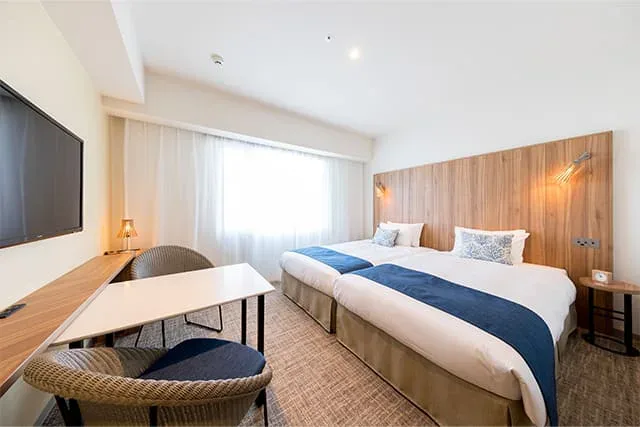
JR Blossom looks less impressive if you search only for a giant family room. That is exactly why it is useful here. Its current Family Room is 33 m² for three to four guests, with two 120 × 200 cm beds, a bunk bed and a sofa bed. A Superior Twin is 26 m² for one to two guests, while the Deluxe Twin is 33 m² and can accommodate up to three with an extra bed. For six people, a Family Room plus a suitable second room—or two or three rooms arranged around care needs—can produce a better night than one larger single suite.
The reason is bathroom concurrency. JR Blossom states that all rooms have bathrooms with separate washing areas. If the grandparents want to shower at 21:00 while the children are also getting ready for bed, two rooms create two simultaneous bathroom lanes. In one huge room with one bathroom, everyone can still queue despite having more floor area.
The hotel’s 11th-floor coin laundry operates 24 hours and its remaining time can be checked through the room VOD system. Six travellers create laundry faster than two, so this is one of those facilities whose value increases with group size. The hotel is also about one minute on foot from Kokusai-dori and roughly five minutes from Miebashi Station, which makes it easier for grandparents to return first while the rest of the family keeps shopping or eating.
The hotel also lists a Universal Twin among its current room types. If one older traveller has mobility or accessibility requirements, start the room allocation there rather than choosing the biggest family room first and trying to fit accessibility around it later. For the hotel itself, see the JR Blossom Naha location and room guide.
The Door Count Test | A second door becomes valuable before a second bedroom looks necessary
For six people, I would strongly price a second room if any of these are true: grandparents and children normally sleep more than two hours apart; one older traveller gets up several times at night; someone needs private medication, dressing or care; three or more people tend to shower during the same one-hour period; or one adult needs to work, pack or plan after others are asleep.
Notice that none of those problems is solved by adding another 20 m² to the same open room. They are solved by another door, another bathroom or another quiet zone. “Stay together” can still mean the same hotel, the same floor and most of the day together. It does not have to mean one set of lights and one bathroom.
Adjacent and connecting rooms are not the same as a request in the notes field
The emotional objection to two rooms is usually the fear of being separated across floors. Treat three statements differently: “we requested adjacent rooms,” “these room types can be adjacent,” and “the hotel has guaranteed this exact adjacent / connecting configuration.” Only the last one solves a real care-proximity requirement.
If a grandparent may need assistance during the night, proximity is not a nice-to-have. Ask the hotel whether the exact room types can be adjacent, whether an internal connecting door exists, and whether the arrangement can be guaranteed for your dates. If the answer is “request only, subject to availability,” do not build essential care around it. Change the room types or hotel if necessary.
Accessibility outranks floor area
A 63 m², 90 m² or 98 m² room does not prove that it works for someone who needs grab bars, a wheelchair turning radius, step-free bathing, a particular bed height or a specific bathroom threshold. “Large” and “accessible” describe different things.
Once mobility needs are real, stop using room size as a proxy. Ask for the exact accessible / universal-room layout and confirm the route from entrance to lift, room, bathroom and transport pickup point. Then fit the rest of the family around that room. The accessibility requirement should determine the room plan first, not inherit whatever space is left after everyone else chooses.
The Bathroom Concurrency Test | Count how many people need the same hour
Take the busiest 60 minutes of the trip—often 20:30–21:30 after dinner or 07:00–08:00 before departure—and count how many people need a shower, toilet, sink, hair dryer or private changing space. If five or six people are competing for one bathing area, a second room can recover time every single day.
↔ Scroll table left or right
Peak-hour pattern | Likely result |
2–3 people, flexible order | One bathroom can be fine |
4 people needing the same hour | One bathroom becomes a meaningful scheduling constraint |
5–6 people plus different bedtimes | A second bathroom often creates more daily value than extra living-room floor area |
This is why the cheapest “one huge room” is not always the cheapest in practice. If the bathroom queue delays departure every morning and stretches bedtime every night, the room is consuming time even if its nightly rate is lower.
ValueNavi Room-Split Payback Model | Price the second room against repeated friction, not against zero
The usual comparison is “one suite costs X, two rooms cost Y.” That treats the second room as if it buys only extra floor area. For a multigenerational group, it can also buy a second bathroom, a second lights-out time and a second recovery zone. A better comparison is to ask how often those extra lanes will actually be used.
Use this simple scenario model before paying a room premium. It is deliberately based on repeatable trip friction rather than pretending there is one universal yen value for family time:
↔ Scroll table left or right
Four-night pattern | What one room may force | What a second room can remove | ValueNavi call |
Same bedtime, 2–3 people shower at once, no care needs | Occasional queue only | Little repeated friction | Do not pay a large two-room premium just for space |
Grandparents sleep 2+ hours earlier; children stay active | Four nights of shared lighting and noise compromise | Independent bedtime every night | Second door has recurring value |
5–6 people need the bathroom in the same morning hour | Departure prep becomes serial | Two bathing lanes operate in parallel | Compare the room premium with four mornings of recovered flexibility |
One older traveller may need nighttime help | One room keeps proximity but may hurt everyone’s sleep | Adjacent/connecting rooms can separate sleep while preserving care access | Only choose two rooms if proximity is actually guaranteed |
Kitchen, laundry and living room will be used daily | Large suite features replace outside logistics | Two standard rooms may duplicate beds but lose shared infrastructure | One suite can still win even with one bathroom |
A concrete way to use the model is to count friction events, not minutes. Over four nights, a bedtime conflict can happen four times, the morning bathroom bottleneck can happen four times, and laundry or meal-prep needs can happen several more times. If the second room solves eight or ten predictable conflicts, a moderate premium is buying something repeatable. If it solves one hypothetical inconvenience, the premium is mostly buying unused capacity.
This also gives the recommendation a boundary condition. Two rooms are not automatically “better for families.” They become better when the family repeatedly needs parallel routines. A suite remains the stronger product when shared cooking, laundry and living space will be used more often than independent sleep and bathroom lanes.
ValueNavi Room-Plan Matrix | Which physical feature is doing the work?
This matrix is an editorial synthesis of the verified room layouts above. It is not an official hotel ranking and it does not compare live nightly prices.
↔ Scroll table left or right
Setup | Fixed-bed strength | Bathroom parallelism | Bedtime separation | Best when |
HIYORI Ocean Suite, 5 guests | Low–medium: 2 fixed beds + extra/daybeds | Low: one main bathroom lane | Low–medium: large shared space, one room | Children accept flexible bedding and the family uses kitchen/laundry repeatedly |
HIYORI Sky Luxury Suite, 4 guests | High: 4 fixed beds | High for one room: bathroom + separate shower room | High: two bedrooms | Four adults value proper beds and separation more than maximum occupancy |
Two Ala Mahaina rooms, 6 guests | Depends on selected room pair | High: two room bathrooms | High | Motobu is a real 2+ night base and the hotel move already makes geographic sense |
Two RIHGA City View Twins, up to 6 eligible guests | Medium: extra beds may be required for third guests | High: two bathrooms | High | No-car Naha logistics and Asahibashi access matter most |
JR Blossom Family Room + second room | Mixed: fixed, bunk, sofa or extra bed depends on the pair | High: separate washing-area bathrooms in each room | High | The group splits after dinner or needs parallel bathroom routines near Kokusai-dori |
The point of the matrix is not to manufacture one winner. It shows which physical feature is earning the booking. If you cannot name the feature that solves your family’s repeated problem, the upgrade is probably being driven by room marketing rather than trip design.
Compare total trip cost for the same six people, not one headline room rate
Multigenerational bookings are easy to compare incorrectly because adults, children, bed-sharing children and extra-bed guests may all price differently. Breakfast can also vary by age or occupancy, and two-room bookings may attach different packages to each room. Fix the same dates, all travellers’ exact ages, exact bed configuration, breakfast and cancellation terms before comparing one suite with two rooms.
For stays from February 1, 2027, add Okinawa’s accommodation tax to the comparison. The prefecture currently sets the tax at 2% of the room-only accommodation charge per person per night, after rounding the taxable base down to the nearest ¥1,000, with a ¥2,000 (about US$12.55) per-person nightly cap. The tax applies to stays on or after the effective date even if the reservation was made earlier. Where a municipality also levies an accommodation tax, the prefectural and municipal portions are structured to make up that same 2% total under the current prefectural rules. For a six-person booking, this is a group-level cost—do not compare a pre-tax suite quote with two rooms whose booking screen already includes the tax.
Also compare the cost of the constraints around the room. Add parking when driving, repeated taxi or transfer costs if the hotel is awkward for part of the group, and the value of flexible cancellation when six people create more chances for illness, flight disruption or plan changes. A cheap non-refundable single-room option can be the highest-risk choice for a three-generation trip.
Final verdict | With five people, prove that one room works; with six, prove why two rooms would not work better
For five people with similar routines, children who accept daybeds and repeated use of the kitchen / washer-dryer, HIYORI Ocean Suite can genuinely keep the group together efficiently. For four adults who care more about fixed beds and separate sleeping zones, HIYORI’s four-person Sky Luxury layout shows why bed quality can matter more than maximum occupancy.
For six in Motobu, think of Ala Mahaina as a two-room plan from the beginning. For six using public transport in Naha, RIHGA’s Asahibashi position can reduce repeated last-mile friction. For six who split up after dinner or all need bathrooms around the same time, JR Blossom’s multi-room setup can beat a more dramatic family suite.
The simplest rule is this: one room wins only when shared space is used more often than separate sleep, bathroom and care zones are needed. If the family spends ten hours together sightseeing, another two hours eating together and then needs eight hours of different sleep routines, two doors can make the trip feel more harmonious—not less.
If your Naha shortlist has narrowed to RIHGA and JR Blossom, continue with the RIHGA vs JR Blossom comparison. If the group is still unsure whether Naha, Chatan, Onna or Motobu should be the main base, return to the Okinawa family hotel decision guide before pricing rooms.
Four Adults in Okinawa? “Sleeps 4” Is Not the Same as Four Real Beds
Okinawa Hotels With Babies and Toddlers: Naps, Strollers and Laundry Come Before the Pool
Sapporo Autumn Fest 2026: The One-Kilometre Food Route That Leaves Room for Dessert
Okinawa Travel Guide: First-Time Itinerary, Hotels and Transport
lyf Tenjin Fukuoka Review: Is a 12m² Room Worth the Shared Kitchen and 24-Hour Lounge?
Sources
Facts rechecked on August 27, 2026. Room occupancy, bedding, parking, accessibility arrangements, adjacent-room availability and taxes can change; reconfirm the exact room type and stay dates before payment.
HIYORI Ocean Resort Okinawa | Official room sizes, occupancy and bedding
HIYORI Ocean Resort Okinawa | Official kitchen and washer-dryer information
Ala Mahaina Condo Hotel | Official room occupancy, parking rules and room sizes
RIHGA Royal Gran Okinawa | Official room information
RIHGA Royal Gran Okinawa | Official Asahibashi / transport access
JR Kyushu Hotel Blossom Naha | Official room and Universal Twin information
JR Kyushu Hotel Blossom Naha | Official 24-hour laundry and facilities
Okinawa Prefecture | Official accommodation-tax rules and February 1, 2027 effective date