
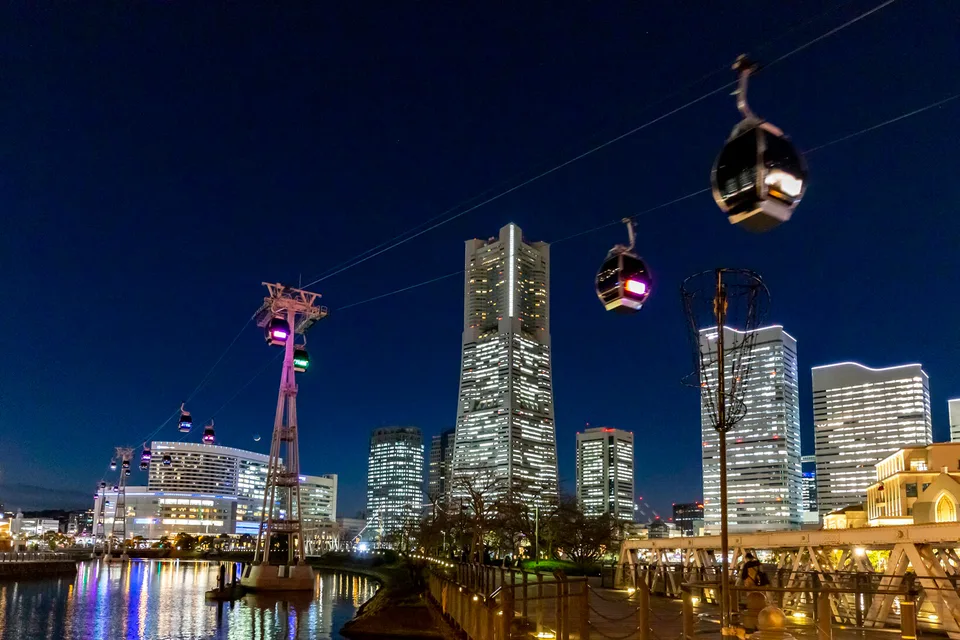
This Yokohama evening works because every leg is short enough to change on the fly: start at Sakuragicho, cross the waterfront by YOKOHAMA AIR CABIN, walk through Shinko and Red Brick Warehouse, then finish on the 24-hour Osanbashi rooftop. If you are deciding whether Yokohama deserves a hotel night at all, start with Yokohama or Tokyo for two nights before building the walk around a late return to Tokyo.
Start at Sakuragicho before sunset, not after dark
The route is strongest when the cabin ride happens while the sky still has colour. You get the railway, Landmark Tower, Cosmo Clock and waterfront geometry before the city lights take over. Check the AIR CABIN operating calendar on the day because maintenance and special schedules can change hours. If Yokohama is only one evening inside a larger city stay, the first-time Tokyo area guide helps choose a base that does not turn the return journey into the hardest part of the day.
Air Cabin is useful because it replaces a transfer and adds the first viewpoint
The cable car links Sakuragicho with the Shinko waterfront. It is not a long attraction, so judge it as a transport-plus-view purchase rather than a destination by itself. If the queue is long or service is interrupted, walking from Sakuragicho is a perfectly workable backup. For a different waterfront transfer that can replace another train segment, compare the Yokohama Sea Bass guide before deciding whether to use boat and ropeway on the same day.
After leaving the cabin at Unga Park, do not rush straight to Osanbashi. The value of the walk comes from watching the skyline change angle as you pass the warehouse district. If your Tokyo stay is short, this is usually a better evening add-on than sacrificing a full city day; the 3-, 4- or 5-day Tokyo guide shows when Yokohama fits without displacing core neighbourhoods.
Red Brick Warehouse is the flexible middle stop
Use Red Brick Warehouse as the point where you decide whether to eat, browse or keep moving. Building and event hours vary, and the outdoor plaza frequently hosts seasonal programming. In August 2026 the site has summer events that change crowd patterns, so check the day’s event page rather than assuming a quiet pass-through. Travellers staying on Tokyo’s west side can compare Shinjuku vs Shibuya if a late Yokohama return is one of several night trips.
Pair this with: choose the return station before blue hour
If you have an early Shinkansen the next morning, the Tokyo Station vs Shinjuku comparison may matter more than squeezing in one final photograph. For a station-adjacent night, compare Hotel Metropolitan Tokyo Marunouchi with other Tokyo Station bases; for a Narita-oriented return, the NOHGA HOTEL UENO luggage route explains why Ueno can simplify the final transfer.
Osanbashi is the best final viewpoint because the rooftop stays open
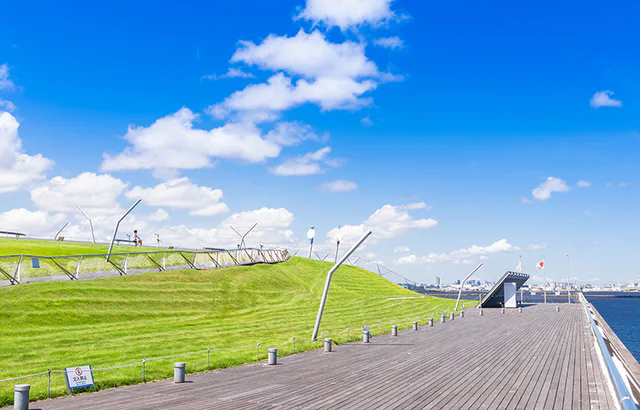
Osanbashi’s rooftop, the Whale’s Back, is open 24 hours and free. The sloping timber-and-grass design gives you a broad view back toward Minato Mirai without needing a timed ticket. The indoor second-floor facilities have shorter hours, so toilets, shops and indoor shelter should not be treated as 24-hour services just because the rooftop is. For a higher-cost night-view alternative, compare the Tokyo helicopter night-view guide and decide whether the premium actually changes the experience you want.
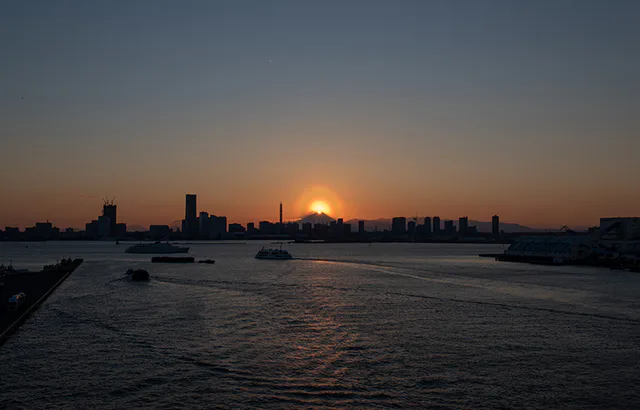
For photographs, arrive before the sky becomes completely black. Blue hour keeps detail in the water, pier and buildings while the Ferris wheel and towers are already illuminated. A small handheld setup is easier than a large tripod on a busy evening. If autumn colour is also part of your Tokyo-region trip, the Tokyo autumn leaves day-trip guide is a better place to allocate long daytime photo stops.
Rain does not automatically ruin the route
Light rain can make reflections stronger, but exposed sections at Shinko and Osanbashi become less comfortable in wind. In heavier rain, shorten the route around indoor Minato Mirai stops and skip the exposed pier. The same decision-making approach appears in the Tokyo rainy-day itinerary if the whole day needs an indoor fallback.
Exit through Nihon-Odori or keep walking to Yamashita Park
After Osanbashi, the low-friction exit is Nihon-Odori Station. Continue to Yamashita Park only if your legs, weather and final train allow it. Visitors with a long Tokyo itinerary can afford the extension; those with only a few nights should protect the following morning. For a later regional day trip, compare Tokyo to Nikko autumn routes instead of stacking another long evening before an early departure.
Osaka Cultural Itinerary: 7 Days of Sumo, Tea Ceremony, Samurai and Sake — With One Night in Kyoto
Hotel Sosei Sapporo Review: Is a 39 m² Twin-Queen Room Worth a 15-Minute Walk from Sapporo Station?
Fukuoka Coffee and Dessert Walk: REC, manu, NO COFFEE and I'm donut?
Eikando Nanzenji Philosopher’s Path Autumn Route: Day, Night and Access
Tokyo Day Trips Compared: Mt Fuji, Nikko, Kamakura, Kawagoe or Yokohama?
References
YOKOHAMA AIR CABIN — official operation and ticket information
Osanbashi Terminal — official rooftop information
Yokohama Red Brick Warehouse — official events and facility information