The Yokohama Sea Bass is worth it when the boat replaces a bad transfer. It is much less compelling when it simply gets added to an itinerary that was already easy on foot or by rail. That distinction matters because the current service is not a metro-frequency shuttle. It links Yokohama Station East Exit, Yokohama Hammerhead, Pier Aka Renga and Yamashita Park, but individual sailings can skip intermediate stops, departure gaps vary, and regular individual passengers generally do not reserve a specific seat in advance.
The most useful way to judge it is therefore not “boat versus train fare.” It is friction removed versus friction added. A Sea Bass ride that eliminates a rail transfer, avoids retracing the waterfront and gives tired legs a seated break can be excellent value. A ride that requires a 35-minute wait, a detour to the pier and then another transfer afterwards is an attraction, not efficient transport.
Fact-checked August 26, 2026. JPY remains the primary currency; approximate USD figures use the current working rate of about ¥159 = US$1. Timetables and operating conditions can change, so recheck the operator on the day.
If Yokohama is only one day inside a Tokyo trip, decide first whether the city deserves the time with How Many Days in Tokyo?. If you are considering sleeping here, compare Yokohama vs Tokyo for two nights before using one scenic transfer to justify a hotel change.
ValueNavi Transfer Replacement Test: does the boat remove a leg, or create one?
This is the core ValueNavi decision framework for the Sea Bass. Before buying a ticket, write the next stop in your itinerary and ask what disappears if you use the boat.
↔ Scroll table left or right
Your Sea Bass use | What disappears | ValueNavi call |
Yokohama Station → waterfront hotel / Red Brick / Yamashita | A rail leg plus part of the final walk, provided the sailing fits. | Strong transport case. |
Yamashita Park → Yokohama Station at the end of the day | Backtracking across the waterfront and another local transfer. | Strong exit-strategy case. |
Hammerhead → Red Brick | Only a relatively short waterfront walk. | Usually scenic, not necessary. |
Red Brick → Yamashita Park after hours of walking | A repeated waterfront walk when your legs are already tired. | Good recovery use. |
Tight connection to airport / reserved train | Nothing reliable; the boat adds timetable dependency. | Use rail instead. |
“We want to ride it because it looks fun” | No transport friction needs to disappear. | Perfectly valid—but price it as an attraction. |
My rule: I treat the Sea Bass as transport only when it removes at least one meaningful land-transfer problem and the next sailing does not create a new waiting problem. Otherwise I classify it as a mini-cruise. That sounds semantic, but it stops the same ¥1,300–¥1,500 ticket from being judged by two incompatible standards.
This is ValueNavi analysis, not an operator rule.
The fares are easy; the waiting time is the real variable
Current adult fares from Yokohama Station are ¥1,300 (about US$8.20) to Hammerhead, ¥1,300 to Pier Aka Renga and ¥1,500 (about US$9.45) to Yamashita Park. Children pay ¥650 or ¥750 on those sectors. Waterfront-to-waterfront adult sectors are currently ¥1,000–¥1,300 (about US$6.30–US$8.20).
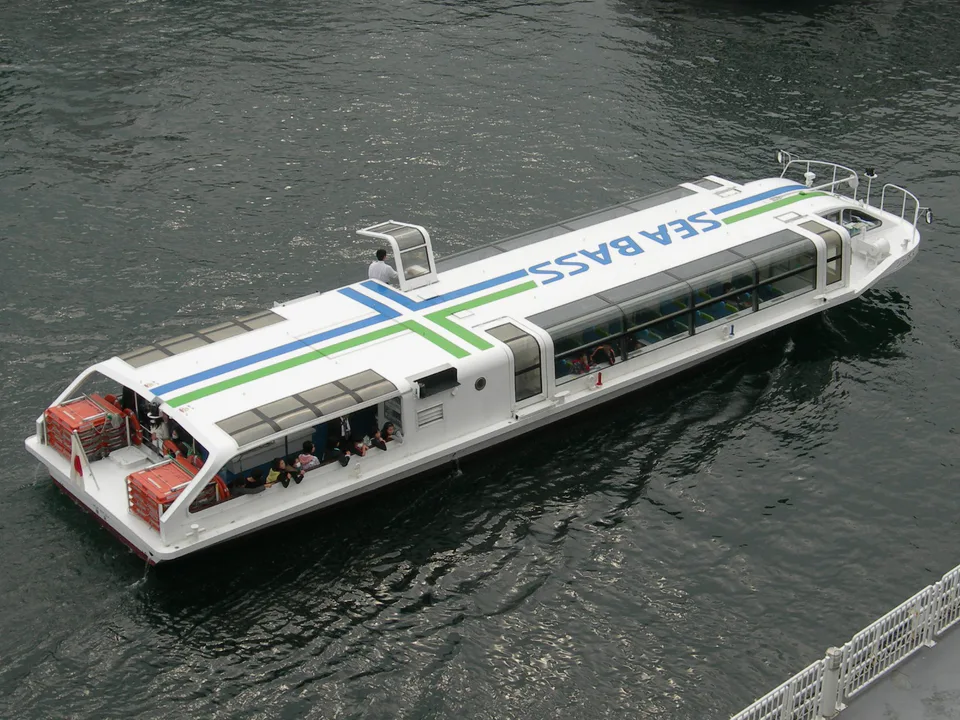
Yokohama Sea Bass seen from Hikawa Maru. Photo: Ogiyoshisan / Wikimedia Commons, CC BY-SA 3.0.
The operator lists roughly 15 minutes from Yokohama Station to Hammerhead, around 10 minutes from Hammerhead to Red Brick, another 10 minutes from Red Brick to Yamashita Park, and about 20 minutes for a direct Yokohama Station–Yamashita Park sailing. But the scheduled ride time is only one part of the journey. The timetable can have gaps of 30, 50 or even around 80 minutes depending on the hour and direction, and some boats skip Red Brick or Hammerhead.
ValueNavi Wait Budget: when a scenic transfer stops being a transfer
I use a simple wait-budget rule when deciding on the day. It is deliberately an editorial threshold, not an official service guarantee.
↔ Scroll table left or right
Time until the next useful sailing | How I treat it | Reason |
0–15 minutes | Transport mode | The wait is short enough that the ride can genuinely replace a land transfer. |
15–30 minutes | Mixed transport / attraction | Still reasonable if you want the harbour view, have luggage or need a seated reset. |
More than 30 minutes | Attraction mode | I would only wait if the cruise itself is part of the day, not because I expect the fastest transfer. |
Next sailing skips your intended stop | Do not force it | A nominally “soon” departure is useless if it creates another transfer afterwards. |
This is where the Sea Bass differs from a train decision. With a high-frequency railway, you can usually decide after reaching the station. With the Sea Bass, I would check the exact useful sailing before walking to the pier. The operator also warns that departure times and sectors can change and that the final service may be cancelled depending on conditions.
The Yokohama Station pier is the first hidden transfer
The Yokohama Station pier is at Yokohama Bay Quarter on the second floor. The operator lists it as about five minutes on foot from JR Yokohama Station’s North East Exit, but about ten minutes from the main East Exit and about ten minutes from the Minatomirai Line side.
That creates a useful boundary condition: the Sea Bass is not “at Yokohama Station” in the same way a platform connection is. If you exit in the wrong part of the station or arrive from a line that leaves you far from the North East Exit, the first few minutes of convenience can disappear into station navigation.
The other piers have the same logic. Hammerhead is about a 10-minute walk from Bashamichi Station Exit 6 and about 15 minutes from Sakuragicho. Pier Aka Renga is about seven minutes from Bashamichi Exit 6 and about 20 minutes from Sakuragicho. Yamashita Park is about five minutes from Motomachi-Chukagai Station Exit 4 and about 15 minutes from Ishikawacho.
Those numbers explain why the Sea Bass is strongest when your destination is the waterfront itself. If you are going to Red Brick Warehouse, Hammerhead or Yamashita Park, the pier is already where the day wants to be. If your next stop is inland or beside another rail station, the boat may simply move the transfer problem to the other end.
If you are starting in Tokyo and still choosing a hotel base, Where to Stay in Tokyo for First-Time Visitors matters more than the Sea Bass. Compare Shinjuku vs Shibuya or Tokyo Station vs Shinjuku before optimising one Yokohama transfer.
Luggage can improve the case—and then reverse it
The intuitive argument is that a boat ride avoids hauling a suitcase through another station. That can be true, but the operator’s luggage rules make it more complicated.
Carry-on items including suitcases are limited to two pieces per person. The operator states that hand luggage exceeding 1.2 metres in total three-side dimensions, or hand luggage whose combined weight exceeds 10kg, is subject to an additional charge equivalent to a child fare. Additional pieces beyond two per person can also trigger a child-fare-equivalent charge.
That creates a hidden-cost test. On the Yokohama Station–Yamashita Park sector, the adult fare is ¥1,500 and the child fare is ¥750 (about US$4.70). A traveller carrying a large suitcase should therefore not assume the transport cost is automatically just ¥1,500. Check whether the bag falls into the operator’s charged category before using “luggage convenience” as the deciding reason.
I would still consider the Sea Bass with luggage when it is the final movement to a waterfront hotel or attraction. I am less enthusiastic if you will carry the suitcase off the boat and immediately make another rail transfer anyway. At that point, the boat has not removed the luggage chain; it has inserted itself into it.
If luggage is shaping the whole day, use the Japan luggage-forwarding guide before designing the itinerary around one water-bus sector.
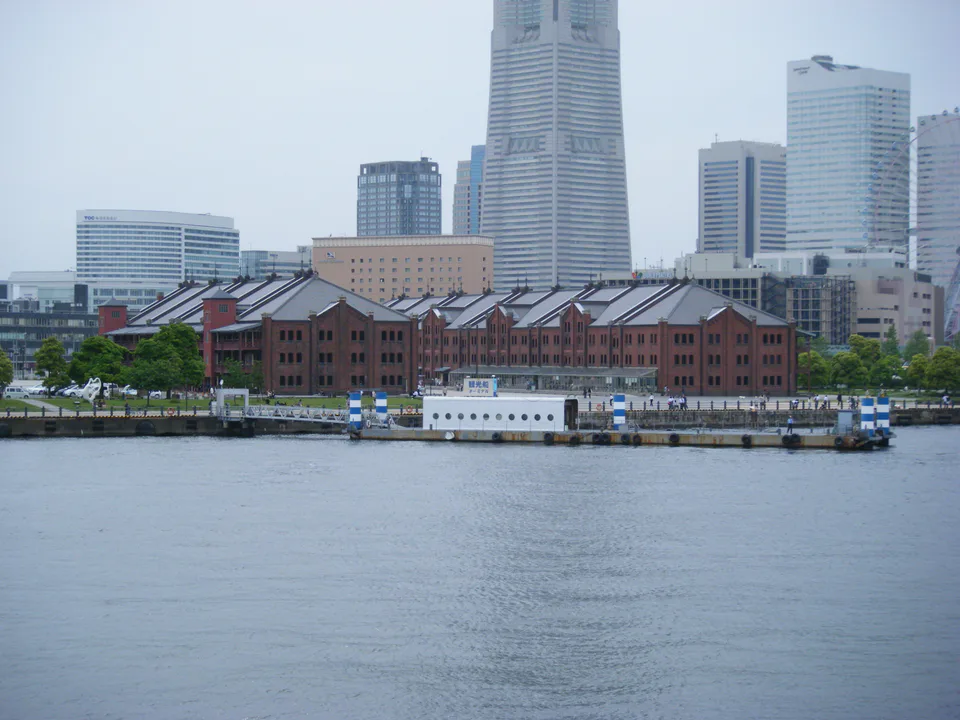
The Red Brick Warehouse waterfront from Osanbashi. Photo: Tu-ka-pon / Wikimedia Commons, CC BY-SA 3.0.
Between Hammerhead, Red Brick and Yamashita Park, walking should usually be the default
The three waterfront stops are close enough that a short Sea Bass hop should have a clear job. I would not automatically buy another ticket every time the route map shows a pier.
↔ Scroll table left or right
Situation | My choice | Why |
Fresh legs, good weather, no luggage | Walk | The waterfront itself is part of Yokohama sightseeing. |
You have already walked for several hours | Sea Bass can be worth it | The ticket buys a seated reset and avoids retracing the same promenade. |
Young children are fading before dinner | Consider the boat | The ride can substitute for another attraction-sized walking block. |
Next sailing is more than 30 minutes away | Usually walk | The waiting cost can exceed the friction you were trying to remove. |
Photography / harbour view is a goal | Take the boat | You are buying a mini-cruise, so speed is no longer the only metric. |
This is one of the easiest places to over-optimise. Yokohama’s waterfront works well precisely because you can connect several areas by walking. If every short sector becomes another vehicle, the day starts to feel fragmented.
For a coherent harbour evening, pair the ride with the Yokohama night walk from Air Cabin to Osanbashi instead of jumping back onto trains between every stop.
Rain is not the main cancellation problem; schedule resilience is
The operator says ordinary rain does not automatically stop the regular Sea Bass service. The deck is not protected from rain, so photography and outdoor comfort become worse, but the service can still run. Weather and sea conditions can nevertheless cause cancellation, and the operator tells passengers to check the day’s operation status.
The bigger planning risk for most visitors is that the timetable is sparse enough that one missed departure can materially change the next hour. Regular services are not reserved individually in the same way as a timed attraction; the operator lists advance booking of regular Sea Bass services for groups of 15 or more, while special cruises have separate reservation rules.
That means I would never use the Sea Bass as the final step before a hard onward deadline. If dinner reservation, airport train or Shinkansen timing matters, use a more frequent land route. The Sea Bass is at its best when the next step is flexible.
If weather is affecting the whole day, use the Japan rainy-day itinerary backup guide. If everyone is simply tired, Tokyo Toyosu Manyo Club is a different kind of recovery stop for a Tokyo-based trip.
Accessibility is vessel-specific, not just pier-specific
Wheelchair access is a real boundary condition. The operator says Sea Bass ZERO can accept up to two wheelchairs and Sea Bass ACE one, while Sea Bass No. 5 is not wheelchair-compatible. The operator also requires one accompanying helper for each wheelchair user and says staff do not provide lifting assistance.
The piers are not simply “step-free means easy” either. The operator notes that tide conditions can make the slope to the pier very steep, and Yokohama Station uses a wheelchair lift. Anyone relying on wheelchair access should therefore confirm the specific vessel for the intended sailing rather than assuming every departure offers the same accessibility.
This is exactly the kind of condition that can reverse the recommendation: the scenic water route may look easier than a rail transfer, but only if the actual vessel can accommodate the traveller.
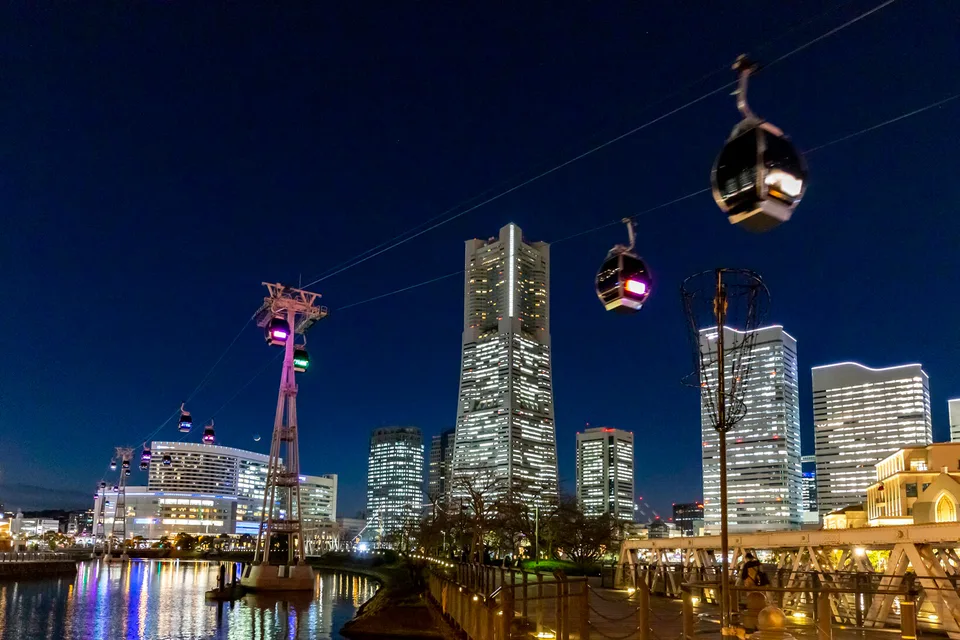
Yokohama Air Cabin and Minato Mirai waterfront. Source: Minato Mirai 21 official media.
Three itinerary shapes show when the Sea Bass earns its fare
1. Tokyo → Yokohama Station → Red Brick / Yamashita Park → Chinatown
This is the strongest first-time use. Arrive by rail at Yokohama Station, walk to Bay Quarter, then use the Sea Bass as the transition from “Tokyo transport” to “Yokohama sightseeing.” The boat ends at the waterfront instead of forcing another underground segment. If the useful sailing is within the wait budget, I like this route.
2. Minato Mirai → Red Brick → Yamashita Park → return to Yokohama Station
Walk outward through the waterfront and save the Sea Bass for the return. This avoids paying for a short hop while your legs are fresh and uses the boat when it can eliminate backtracking. Dinner in Chinatown can make Yamashita Park a logical final sightseeing point before the return ride.
3. Two-hour gap before a fixed evening train
I would not build the gap around the Sea Bass unless a direct useful departure lines up almost perfectly. Sparse frequency and changing stop patterns mean the boat can consume too much of a short window. In this scenario, the harbour view is not worth reducing schedule resilience.
If this is one specialist day in a first Japan trip, the 10-, 12- or 14-day itinerary helps judge whether Yokohama deserves the day. If the whole route is still open, start with How to Plan a Trip to Japan.
ValueNavi failure-mode table: the ways this “easy” boat transfer goes wrong
↔ Scroll table left or right
Failure mode | What happens | Fix |
You arrive at the wrong side of Yokohama Station | The advertised five-minute pier walk becomes much longer. | Aim for JR North East Exit / Bay Quarter, not just “East Exit” generically. |
The next boat skips your stop | You ride past the destination or need another transfer. | Read the stop pattern, not only the departure time. |
You assume every large suitcase is included | Oversize/heavy hand luggage can trigger a child-fare-equivalent charge. | Check the operator’s luggage thresholds before relying on the fare headline. |
You miss one sailing | The next useful departure may be far enough away to break the itinerary. | Do not place a hard reservation immediately after the boat. |
You take a short waterfront hop because it appears on the map | Waiting and boarding consume more time than the walk would. | Use the Wait Budget and walk by default when fresh. |
You assume any vessel is wheelchair-compatible | Sea Bass No. 5 is not wheelchair-compatible. | Confirm the vessel before travel. |
Final verdict: use the Sea Bass to delete friction, not collect another ride
I would use the Yokohama Sea Bass when one ride replaces a poor land transfer, removes waterfront backtracking or gives a tired group a meaningful seated reset while keeping the day geographically coherent. Yokohama Station → Red Brick / Yamashita Park and Yamashita Park → Yokohama Station are the clearest examples when the timetable lines up.
I would usually walk between neighbouring waterfront stops when the group is fresh, and I would use rail for any itinerary with a hard onward deadline. I would also check luggage rules before describing the boat as automatically easier with a large suitcase.
The ValueNavi red-team question is: if the harbour view were removed and this were just a plain shuttle, would the ride still simplify your route? If yes, the Sea Bass is genuinely solving transport friction. If no, that is fine—but you are buying a mini-cruise, and the fare and waiting time should be judged as attraction cost rather than transport efficiency.
FAQ
How much is the Yokohama Sea Bass from Yokohama Station?
Current adult fares are ¥1,300 to Hammerhead, ¥1,300 to Pier Aka Renga and ¥1,500 to Yamashita Park. Child fares are ¥650, ¥650 and ¥750 respectively. Recheck the official fare table before travel.
How long does the Sea Bass take?
The operator lists about 15 minutes from Yokohama Station to Hammerhead, about 10 minutes from Hammerhead to Red Brick, about 10 minutes from Red Brick to Yamashita Park and about 20 minutes for a direct Yokohama Station–Yamashita Park service. The exact sailing can call at or skip intermediate stops.
Can I reserve a normal Sea Bass service?
Regular scheduled Sea Bass reservations are currently accepted for groups of 15 or more. Special sightseeing and event cruises have separate reservation systems. Individual travellers should check the current service pattern and go directly to the pier.
Can I take a large suitcase?
Yes, but the operator has specific hand-luggage rules. Up to two items per person are allowed, while oversized or heavier hand luggage can incur an additional child-fare-equivalent charge. Check the official thresholds for your bags.
Does the Sea Bass run in rain?
Ordinary rain does not automatically stop service, but the deck is not rain-protected. Weather and sea conditions can still cause cancellation, so check the day’s operating status.
Is the Sea Bass wheelchair accessible?
Accessibility depends on the vessel. Sea Bass ZERO and ACE have limited wheelchair capacity; Sea Bass No. 5 is not wheelchair-compatible. Confirm the vessel for your intended sailing.
More to read
How Many Days in Tokyo? · Japan Luggage Forwarding Guide · How to Plan a First Japan Trip
Kawagoe Castle Is Worth Leaving the Old Town For — The ¥100 Honmaru Palace Is the Easy Part
BEB5 Mojiko Just Opened: Is the Kanmon Strait View Worth an Overnight Stay?
Sakura Castle: The Stamp Is Open 24/7 — The Castle Is in the Moats, Not a Keep
Mt Fuji Day Trip or Overnight: When an Extra Night Is Worth It
Osaka and Kyoto in 7 Days: 3 Nights Each — When One Hotel Move Is Actually Worth It
References
Y Cruise — Sea Bass official route, FAQ and operating information · Y Cruise — current Sea Bass timetable and fares · Y Cruise — official pier access information · Y Cruise — wheelchair and accessibility information