
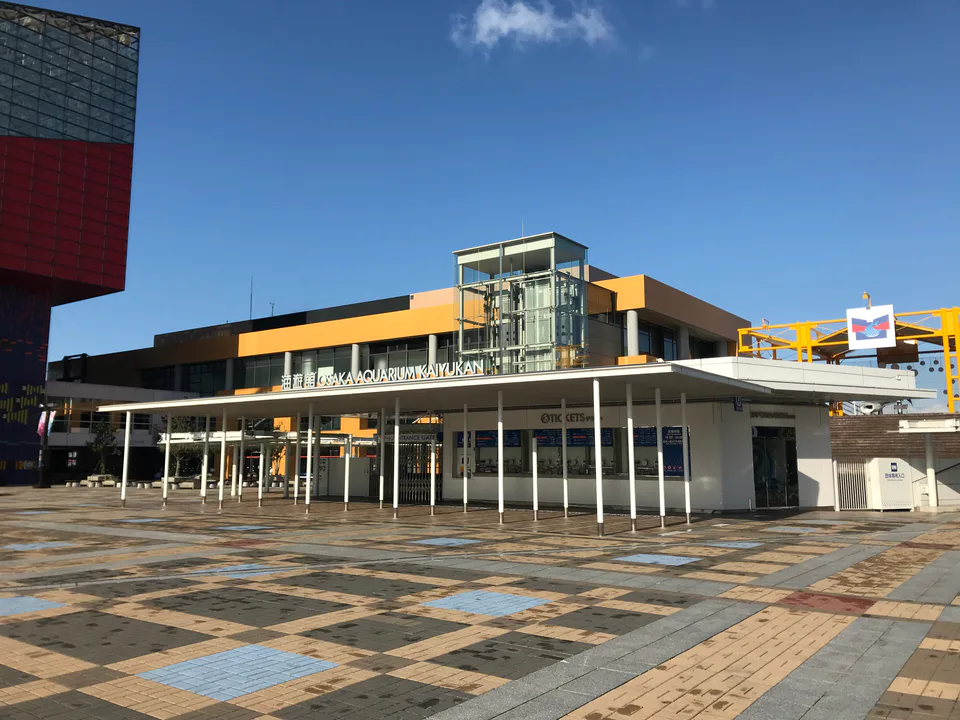
The biggest mistake at Osaka Aquarium Kaiyukan in 2026 is no longer arriving at the “wrong” time for the whale shark. It is following an old itinerary. Admission is managed by date and timed entry; re-entry ended on June 15, 2026; and since April 24, suitcases, carts and oversized luggage above the current size limits cannot be taken into the aquarium. The old plan of seeing half the exhibits, leaving for lunch at Tempozan, then coming back for the night tanks no longer works.
For a first visit, I would protect about 2 to 2.5 hours for the aquarium itself. If you travel with children, move slowly, photograph the tanks, or want to stay across the 5 PM switch to the Night Aquarium, 2.5 to 3 hours is more realistic. If you only have an hour, your day already crosses several Osaka districts, or USJ is already a full-day commitment, Kaiyukan does not become essential just because it appears on a “things to do in Osaka” list. If your hotel base is still undecided, start with where to stay in Osaka for first-time visitors. The trip feels very different from Namba, Umeda or Universal City.
30-second verdict: the no-re-entry rule should decide your visit before the whale shark does
↔ Scroll table left or right
Your situation | Allow | Best entry window | Avoid |
First visit; you want the core exhibits | About 2–2.5 hours | Any suitable daytime timed slot | Compressing the aquarium into a 60-minute photo stop |
You want the Night Aquarium after 5 PM | About 2.5–3 hours | Roughly 3:30–4:00 PM, subject to that day’s hours | Turning up at 5 PM and hoping your preferred slot is still available |
Families, older travellers or slow photography | About 3 hours | Choose the least stressful slot for your group | Adding another cross-city attraction immediately afterwards |
Check-in or check-out day with large luggage | Store luggage first | Travel to Osakako only after storage is sorted | Dragging a suitcase to the entrance |
USJ already fills one full day | Use separate days | Give Kaiyukan its own half-day | Combining two major attractions only because the boat ride is short |
Kaiyukan works best for travellers who will actually stop and watch. The aquarium’s current group guidance uses roughly 90–120 minutes as a circulation estimate, but an independent visit with repeated views of the Pacific Ocean tank, photos and a few pauses is better treated as a two-hour-plus attraction. Families, older travellers and anyone deliberately staying into the evening should give themselves closer to three hours.
If you only have two or three Osaka days, decide the daily travel friction first. Namba vs Umeda and the broader Osaka accommodation decision hub will often tell you whether Osaka Bay belongs on this day before the aquarium opening time does.
The two 2026 rules old Kaiyukan guides are most likely to get wrong
No re-entry from June 15, 2026
Kaiyukan previously allowed same-day re-entry after completing the required procedure, which is why older itineraries often suggest leaving for lunch and returning later. The aquarium officially ended re-entry on June 15, 2026. Once you enter, plan to finish the main route in one continuous visit. Put a proper meal before your slot or after you leave.
That change makes an afternoon entry more useful if you want the evening atmosphere: instead of leaving the building between the daytime and night versions, you can enter once and remain inside as the lighting changes.
Suitcases, carts and oversized luggage have been restricted since April 24, 2026
Kaiyukan’s current rules prohibit suitcases and cart-type luggage, pet carts, and large items with a combined three-side measurement of 120 cm or more, or any one side over 70 cm. The aquarium tells visitors to store them at a hotel or in lockers before arriving. Lockers exist around Kaiyukan and Tempozan Harbor Village, but availability is finite.
That makes Kaiyukan a poor “gap filler” between checking out of one hotel and moving into another. If you are planning a family trip, the same issue is worth solving at hotel level first; our Osaka-with-kids hotel guide treats the hardest day of the trip as the thing that should choose your base.
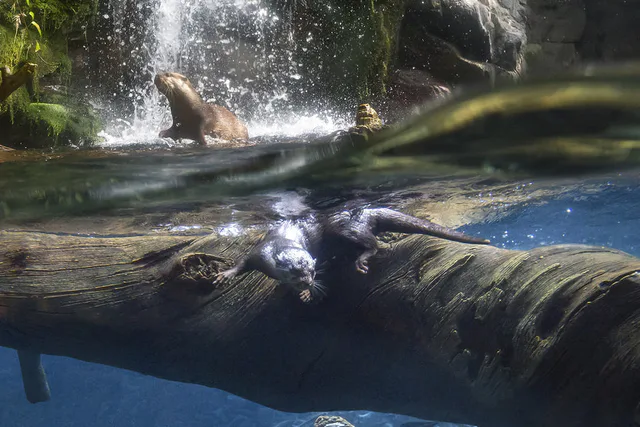
Aqua Gate is the opening scene; the real route begins when Japan Forest sends you downward
The transparent Aqua Gate tunnel is the first obvious photo moment, with blue water wrapping around your field of view. But it is closer to a prologue than the main event. The route then lifts you toward Japan Forest before gradually taking you from land and freshwater environments down toward open ocean and deeper-water habitats.
Japan Forest can feel unrelated to a visitor who came specifically for the whale shark, but it explains the aquarium’s structure. Water moves from forest and stream toward the sea. If you sprint to the headline tank, the rest can feel like a list of animals; if you follow the intended pace, the aquarium reads more like one Pacific Rim environment unfolding by depth.
The whale shark is not one photo stop: keep watching the Pacific Ocean tank as you descend
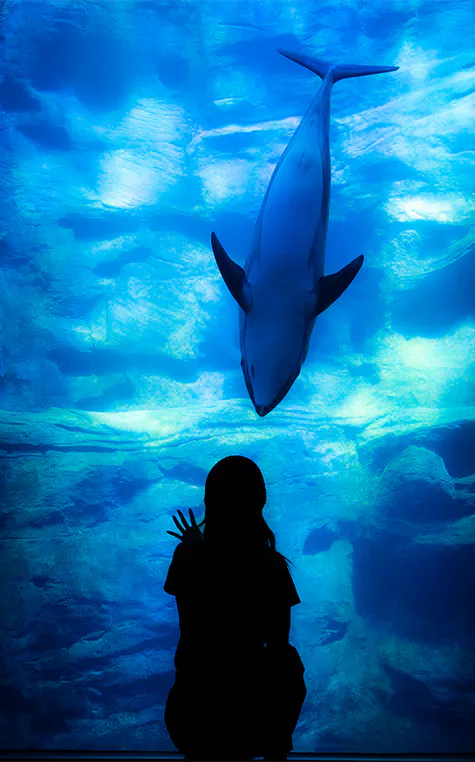
The Pacific Ocean tank is still Kaiyukan’s visual centre. Current exhibit information lists whale sharks, rays and schooling fish in the same enormous environment. Older official English material describes the tank at about 9 metres deep, up to 34 metres long and roughly 5,400 tonnes of water. The important part is not memorising those numbers. It is understanding why the same tank stays beside you for so long.
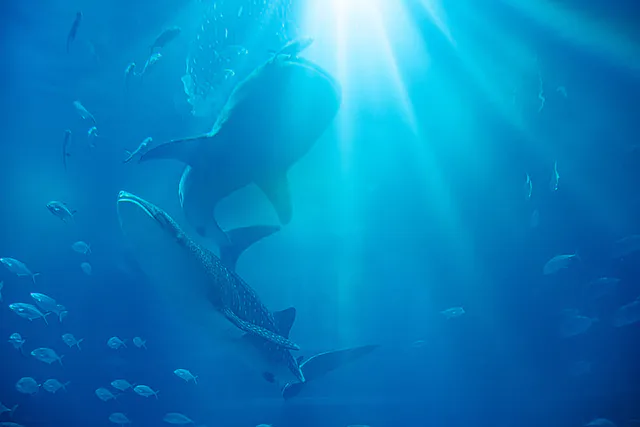
Take the first whale-shark photo if you want, but do not treat that viewpoint as “done.” As the spiral route drops, the same animals pass at different heights and distances. A ray that looks flat from one level suddenly becomes a moving ceiling below another viewing window. That repeated change in perspective is one of the hardest parts of Kaiyukan to replace with photos online.
The easiest way to waste the ticket is to spend all your time at the first good window
On busy days, the first obvious whale-shark view attracts people who wait for the perfect empty frame. You do not have to win that battle. The route gives you more Pacific Ocean viewpoints later. Spread your time across different depths rather than spending twenty minutes trying to clear one piece of glass.
The Arctic Region deserves time for the change in viewpoint, not just because seals are cute
Later in the route, the Arctic Region changes the way you watch again. Kaiyukan currently splits the environment across upper and lower levels so you can see an ice-surface world and underwater movement separately. A ringed seal gliding below the surface reads very differently from the same animal resting or surfacing above it.
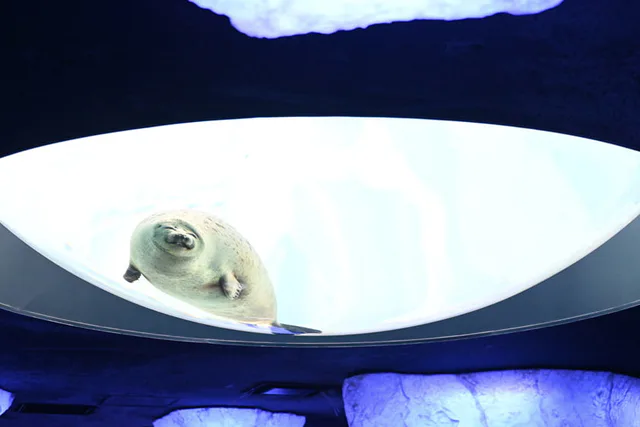
For children, this can produce more obvious behaviour changes than standing beside the whale shark for another ten minutes. If your group is already moving fast, you can still prioritise the Pacific Ocean tank. The point is not to give every exhibit equal time; it is to notice which kind of viewing actually holds your attention.
Jellyfish Galaxy is a reset in scale: do not judge it by how many species you count
Jellyfish Galaxy does almost the opposite of the Pacific Ocean tank. Kaiyukan presents it as a galaxy-like space built around transparency, floating movement and quiet. After the scale and motion of large fish, the room deliberately shrinks your attention and darkens the environment.
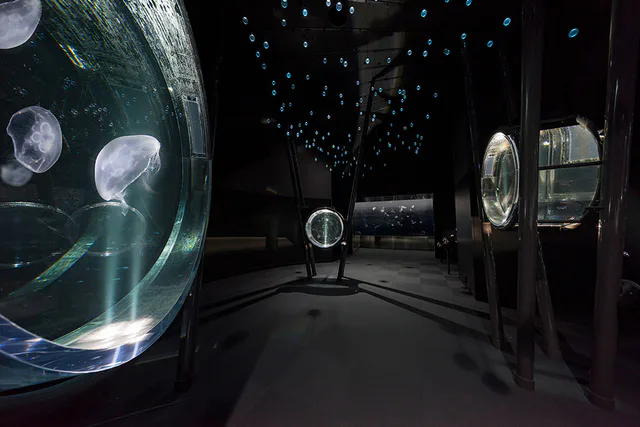
If jellyfish do nothing for you, there is no prize for forcing a ten-minute stop. But if you like low-light photography or simply need a slower visual rhythm between the large habitats, this can become one of the longest stops in the building. Kaiyukan is valuable precisely because different visitors do not need to get the same return from the same room.
Should you stay past 5 PM? If you only visit once, crossing the day-to-night change is the useful version
Kaiyukan’s current Night Aquarium begins at 5 PM, when lighting and music shift into a deeper blue, calmer evening presentation. The current official page shows 5 PM to 8 PM with final admission at 7 PM, but it explicitly says the schedule changes by season. Treat your visit date’s official hours as the source of truth rather than assuming 8 PM is permanent.
When that day’s opening hours allow it, adults and couples can use a timed slot around 3:30–4:00 PM, see part of the route under daytime lighting, then naturally cross into the night version after 5 PM. This is not a separate night ticket, and it does not require leaving and returning. In fact, re-entry is no longer available.
Families should not force the evening version if 5 PM lands right on dinner, nap or bedtime trouble. A comfortable earlier entry can be much better than turning the Night Aquarium into a tired final hour. If you want dinner back in the city afterwards, keep the next move simple: a separate Shinsekai food evening or a different-morning Kuromon Market visit is cleaner than stacking several districts around Kaiyukan.
One exhibit still should not be planned from an old map: the Aleutian Islands area is under renovation
Kaiyukan’s current exhibition page marks the Aleutian Islands tank as closed for renovation. This area has changed more than once recently: it reopened in late 2025 after earlier work, and the aquarium later announced another renewal tied to the end of its tufted-puffin display in May 2026. The practical lesson is simple: do not measure “value” by completing an old checklist of every tank.
The more stable core for a first visit remains the Pacific Ocean tank, Japan Forest, the Arctic Region and Jellyfish Galaxy, while individual animals and renovation areas can change. Check the official exhibition page shortly before your visit if one specific species is the reason you are going.
Do not start with the cheapest ticket: choose the date and 15-minute entry slot first
Kaiyukan uses variable pricing, so the admission price and opening hours depend on the date shown on the official calendar. Timed entry is managed in 15-minute increments. On popular dates, or when you specifically want to enter before 5 PM and remain for the Night Aquarium, “what time can I enter?” matters more than which reseller happens to display the lowest converted price.
The official e-ticket guidance also says that if you expect to miss your reserved time, you should first try to change the slot in your Webket account. If the desired replacement time is full, you may still have to wait at the gate because visitors booked for that time receive priority. Do not put a fragile airport transfer, hotel move or long day trip immediately before a Kaiyukan slot.
Kaiyukan’s June 2026 anti-fraud notice lists Klook, KKday and Trip.com among its authorised ticket routes. For this article, the exact Klook and KKday admission products are still listed as of this update. Compare the same date, same entry conditions and the same cancellation or change rules — not just the headline price.
Klook | Compare Kaiyukan entry times for your date
If Klook does not have the slot or conditions you need, check the same-date Kaiyukan ticket conditions on KKday. The point is not to “shop” two sites for a tiny currency difference while ignoring the only time slot that actually fits your day.
How to use a Tempozan half-day: three routes beat “Kaiyukan plus everything nearby”
A | You want the Night Aquarium: make the afternoon one continuous visit
A low-friction version is: arrive at Osakako or Tempozan for a late lunch → enter around 3:30–4:00 PM according to the time on your ticket → stay through part of the Night Aquarium after 5 PM → decide after leaving whether to eat around Tempozan or return to Namba or Umeda. This gives you both lighting moods without a second cross-city movement.
B | Families or rainy days: let Kaiyukan be the only must-do
For families, protect about 2.5–3 hours for Kaiyukan first, then eat after you leave. Tempozan Marketplace, the Giant Ferris Wheel and other nearby stops should be optional bonuses, not compulsory items. When children are already tired inside the aquarium, deleting one attraction “because it is right next door” often improves the day more than squeezing it in. The same logic appears in our Osaka family-base guide.
C | Kaiyukan and USJ on the same day? A short boat ride does not make two big attractions small
Captain Line connects Kaiyukan’s west pier and Universal City Port in roughly ten minutes on the current official route information. Geographically, the pairing looks brilliant. In time-budget terms, it often is not: USJ is easily a full-day attraction, while Kaiyukan deserves two hours or more. If you have a full-day USJ ticket, I would normally separate them.
Combining them becomes more reasonable only when one side is intentionally a half-day, or when your hotel and transfer plan makes the bay connection useful in its own right. If you are deciding whether moving to Universal City is worthwhile, compare one USJ day versus two days and when a Universal City hotel actually pays off. If Osaka is only four days and USJ already consumes one, settle the bigger trade-off with our four-day Osaka-and-Kyoto itinerary before you try to squeeze Kaiyukan into the remaining gaps.
Osakako Station is only about a five-minute walk; the real transport cost is how many districts you add that day
Kaiyukan currently directs rail visitors to Exit 1 of Osaka Metro Chuo Line’s Osakako Station, about a five-minute walk from the aquarium. That final approach is easy. The waste comes from treating Osaka Bay as a “quick add-on”: Namba in the morning, Osakako in the afternoon, Shinsekai or Umeda at night. Each individual trip looks manageable on a map, but the whole day becomes a chain of transfers.
If this is your first Kansai trip and you are still deciding how many nights belong in each city, start with Kyoto vs Osaka as a first-time base. If Osaka is fixed, use Namba vs Umeda to decide which side of the city should own the rest of the day. The aquarium itself is rarely the problem; the extra district before and after it is.
Who gets the most value from Kaiyukan — and who can delete it without regret?
Kaiyukan is strongest for travellers willing to give it at least two hours; families who need a major indoor attraction that does not collapse in bad weather; people who enjoy watching the same large habitat from different depths; and photographers or couples who deliberately want to cross the 5 PM day-to-night transition.
It is easy to cut if you only have 60–90 minutes, your only goal is one whale-shark photograph, USJ already fills the same day, or your short Osaka trip is already bouncing between districts. Kaiyukan is not a weak attraction in those cases. The problem is that this ticket pays back when you slow down, and your itinerary is refusing to give you that time.
Final verdict: choose the one continuous time slot first, then buy the ticket
For a first visit, use 2–2.5 hours as the default. For slower viewing, families, photography or the Night Aquarium, protect 2.5–3 hours. If you want the 5 PM change and your date’s official hours support it, a timed entry around 3:30–4:00 PM is a sensible target. Do not plan to see half the aquarium, leave for a meal and return — re-entry ended on June 15, 2026.
The buying order should be equally simple: choose your date → check the official hours and dynamic admission price → choose the entry slot that fits the experience you want → compare Klook and KKday for that same date and condition. Kaiyukan is not worth visiting because the whale shark is big. It is worth visiting when you actually protect the two or three hours the building was designed to use.
Next decision | Namba or Umeda for the Kaiyukan day?
Sources and what to re-check before you go
Osaka Aquarium Kaiyukan | Admission and dynamic price calendar
Osaka Aquarium Kaiyukan | Opening hours and closure calendar
Kaiyukan official notice | Re-entry ended June 15, 2026
Kaiyukan official notice | Large-luggage rules from April 24, 2026
Kaiyukan | Osakako Station and transport access
Kaiyukan | Current exhibition status
Kaiyukan | Group-visit time and current variable-price reference
Kaiyukan official e-ticket guidance | Late arrival and ticket changes
Opening hours, admission price, timed-slot inventory, reseller inventory, cancellation/change conditions, the Night Aquarium schedule and individual exhibits can change by date. Re-check the official calendar and the exact ticket page you are buying before payment.
Kyoto Aquarium: Is the ¥2,600 Ticket Worth 2–3 Hours in Kyoto?
National Museum of Nature and Science 2026: The ¥630 Ticket Is Cheap — Your 3–5 Hours Aren’t
Kenrokuen Autumn Leaves 2026: Early Entry, Illumination, Transport and Hotels
Osaka 5-Day Itinerary: Give USJ a Full Day — Namba, Umeda, Kaiyukan and Tennoji Without Backtracking