
The easiest way to overpay for a Hokkaido private car charter is not choosing the wrong vehicle. It is reading “10 hours” as “10 hours of sightseeing.” On some current Sapporo-based products, the clock starts when the vehicle leaves your Sapporo hotel, and if you finish outside Sapporo the driver’s return journey can still count toward working time. A 10-hour booking can therefore leave you with materially less than 10 hours at the places you actually came to see.
That changes the real question. Do not begin with “How much is a private car for a day?” Begin with three things: how many people are actually sharing the vehicle, how scattered your stops are, and where the driver must finish. A group of four to six visiting several points across Furano and Biei may genuinely buy back time. Two adults doing only central Sapporo or Otaru usually have a much weaker case. This guide treats a Hokkaido private car charter as a route-planning tool, not a luxury upgrade you automatically add because it is comfortable.
If your airport, hotel bases and regional direction are not settled yet, start with Hokkaido travel itinerary planning by region before deciding which day deserves private transport. Among all the things to do in Hokkaido, a charter makes the most sense when it removes repeated rural transfers rather than simply replacing a train that already works well.
30-second decision: which Hokkaido routes are most likely to justify a private car?
Best fit: four to six people staying in Sapporo who want three to five scattered stops across Furano and Biei in one day, especially with parents, young children, a stroller or substantial luggage. The gain is not only comfort. It is removing the friction between rural stops that are individually easy to name but awkward to connect in sequence.
Worth considering: Lake Toya plus Noboribetsu. A private vehicle removes transfers, but it does not make southern Hokkaido physically smaller. This is still a long road day, so the driver’s return time and overtime rules matter more than they do on a short urban route.
Usually unnecessary: two adults doing only central Sapporo, Otaru’s main canal-and-Sakaimachi area, or a straightforward Jozankei onsen trip. Rail, buses or join-in day tours already solve those trips reasonably well. Paying a whole-vehicle fixed cost only for the word “private” is often buying the simple version of the problem at a premium.
Niseko is a separate decision. If you only need New Chitose Airport to your ski hotel, or Sapporo to your Niseko accommodation, compare a point-to-point Hokkaido private transfer first. Do not automatically buy a full-day charter simply because the vehicle looks similar.
The first trap: a 10-hour charter is not always 10 hours of sightseeing
One current Sapporo private car charter states that service time begins from departure at the Sapporo hotel. If the group finishes at an attraction or station outside Sapporo, the driver’s return journey is included in the working hours. The listing even gives Lake Toya as the example: passengers may use the vehicle for about eight hours but still be charged on the 10-hour basis because the driver must return.
The same current product also says one-day charters are uniformly charged as 10 hours even when actual use is shorter. Its current overtime schedule is ¥5,000 per hour or ¥3,000 per half hour, and less than half an hour is rounded up. It also warns that overtime caused by traffic congestion can still be payable. The practical lesson is simple: squeezing in “just one more stop” is not necessarily free.
Do not memorize those numbers and apply them to every operator. Other current Hokkaido charter listings use different mileage ceilings, vehicle-size rules and overtime schedules. A route may be sold as 10 hours with a 300 km cap, while another product prices overtime by vehicle class. The useful rule is not “Hokkaido overtime costs X.” It is “the exact product you pay for owns the rule.”
Furano and Biei: where a private car is easiest to justify
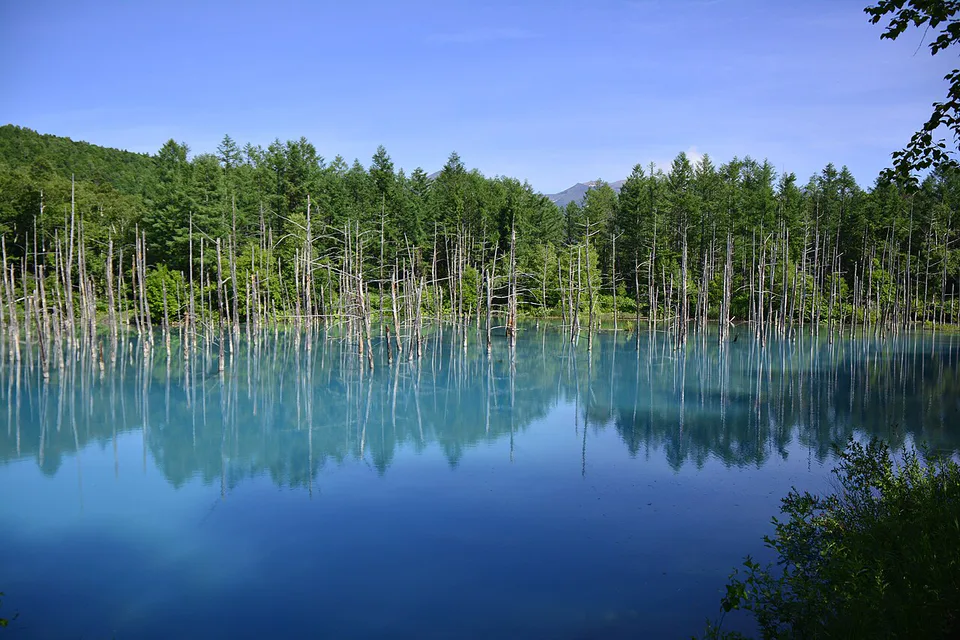
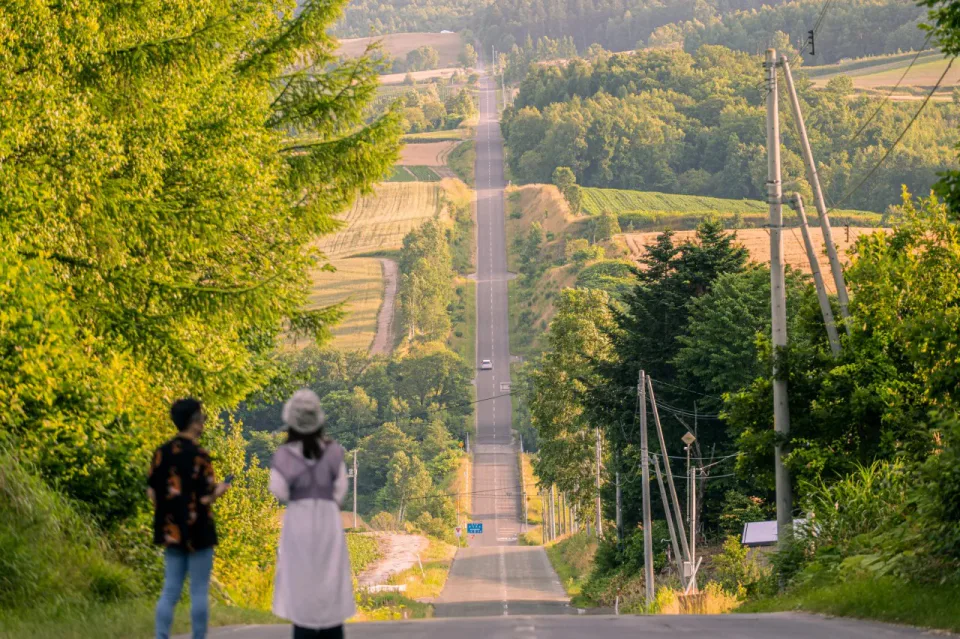
The strongest case for a Furano Biei private car is geographic dispersion, not seat comfort. Hokkaido’s official tourism transport guide currently lists Sapporo to Furano by rail at about 2 hours 35 minutes, while Asahikawa to Furano is about 1 hour 6–14 minutes and Asahikawa to Biei about 33 minutes. Rail gets you efficiently between cities and stations. It does not automatically connect the Blue Pond, Shirahige Falls, hill roads, flower farms, small cafes and unplanned photo stops in the order you want.
If you only want the main sights and can accept a timetable-led day, read Furano and Biei Without a Car first. If your real goal is scattered hills, farms, the Blue Pond and several stops that are awkward to sequence by public transport, private transport becomes much easier to defend.
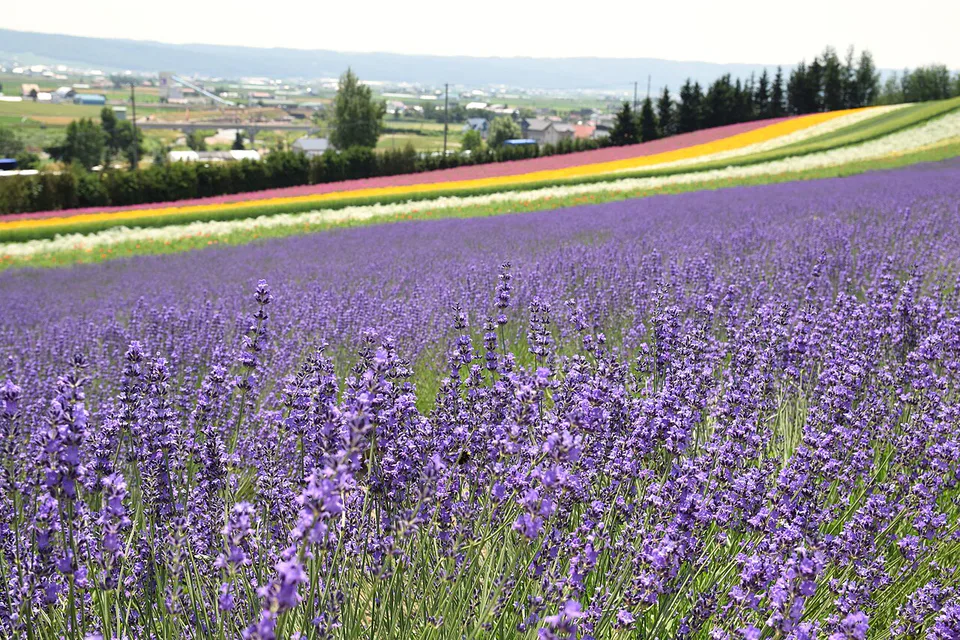
If you are trying to squeeze Furano and Biei into one Sapporo day while still wanting a slow pace, compare that plan against one versus two nights in Furano and Biei as a day trip versus overnight stay. Sometimes an extra night buys dawn, evening light and weather flexibility more effectively than paying overtime to force every stop into one vehicle day.
Next decision: check whether Furano and Biei actually require a private car
Lake Toya and Noboribetsu: a charter removes transfers, not road distance
Lake Toya and Noboribetsu are often paired in a Sapporo private car charter because the logic is obvious: both sit outside central Sapporo, and door-to-door travel is more comfortable than rebuilding the route around several connections. But a 10-hour booking does not suddenly make it sensible to add Shikotsu, Otaru, Shiraoi, New Chitose Airport and Niseko on the same day. A private car removes transfer friction. It does not remove kilometres.
If Lake Toya is your final stop and you do not return to Sapporo, check whether the driver’s deadhead return is still counted. If you do return to Sapporo, work backward from the driver’s end time before deciding how long to stay at Noboribetsu or Toya. The expensive mistake is discovering at the final attraction that your only choices are cutting the visit short or paying overtime.
Otaru and Jozankei: the easiest routes for two people to overbuy
Otaru and Jozankei are closer to Sapporo, and that is exactly why a full-day vehicle often has weaker economics. Two adults visiting Otaru Canal and Sakaimachi before returning to Sapporo already have a simple rail solution. A straightforward Jozankei onsen visit also has bus and hotel-shuttle options. A private car needs a stronger reason: limited walking ability, a stroller, a larger family group, remote photo stops or a schedule that genuinely requires flexible stop lengths.
Niseko: separate sightseeing charters from ski and airport transfers
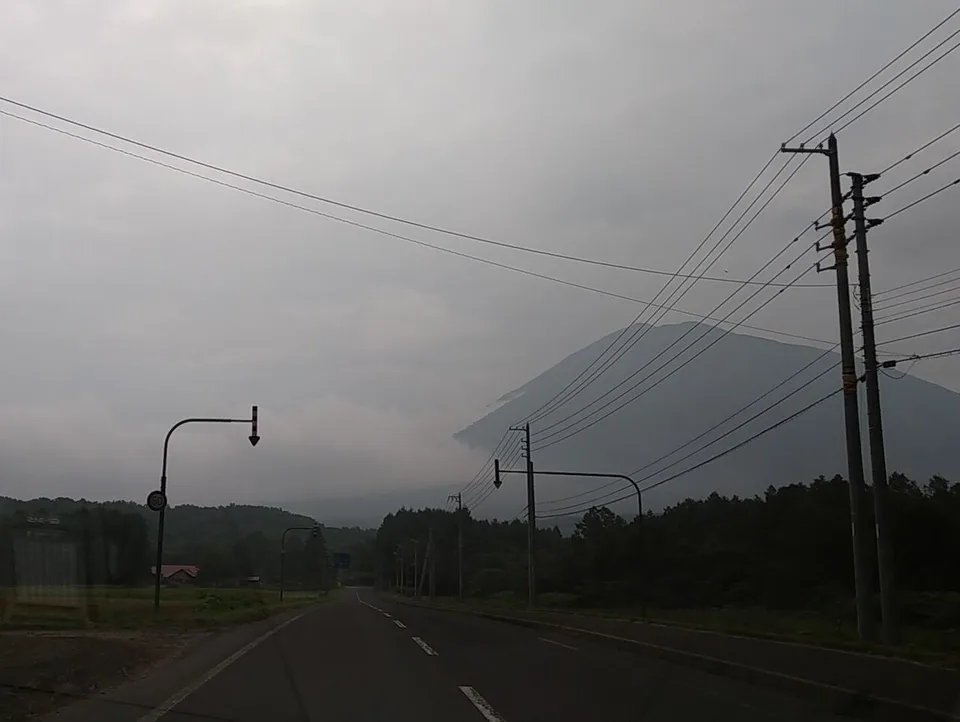
Niseko is where travelers most often mix product layers. A Sapporo-to-Niseko sightseeing charter means the driver and vehicle remain committed to you for a broad block of time. A New Chitose-to-Niseko hotel transfer is primarily point-to-point transport. The van may look almost identical, but you are buying a different amount of time and a different service obligation.
If the job is simply getting from the airport to your ski base, compare New Chitose Airport to Niseko: bus, private transfer, train or rental car before buying a day charter. If you are still deciding whether to collect your own car immediately after landing, compare renting at New Chitose on arrival versus waiting until Sapporo. A day charter, one-way transfer and self-drive rental solve different problems.
Vehicle size is not just headcount: luggage and child seats consume capacity first
A seven-seat vehicle being legally able to carry a certain number of passengers does not mean it can carry the same number of large suitcases at the same time. Current Hokkaido charter listings separate vehicle classes by passenger and luggage capacity, and some explicitly warn that a child seat consumes the space of roughly 1.5 passengers. That matters before you start choosing between an Alphard-style vehicle and a Hiace-style van.
Report three numbers at booking: people, luggage pieces and child seats. Five adults with five large suitcases are not the same vehicle problem as five adults carrying backpacks. Turning up and discovering the booked vehicle cannot safely hold the group and luggage is a much worse failure than paying slightly more for the right class from the start.
Driver language is not the same thing as a private guided tour
Current Hokkaido private-car products may list Japanese, Chinese or basic English support, but a driver who can communicate with you is not automatically a guide who provides historical interpretation, restaurant planning, ticket handling or escorted attraction visits. Check whether the service is described as a driver, driver-guide or guided tour. Those are not interchangeable labels.
For most travelers, the real value of a Sapporo private car charter is route control and fewer transfers. If your group needs fluent English throughout the day, treat language as a hard filter rather than assuming the platform interface language tells you what the driver can do.
Winter charters reduce driving stress, but they do not remove snow, closures or traffic
In winter, paying someone else to drive can remove the stress of handling snow roads yourself. It cannot remove heavy snowfall, accidents, road closures or congestion. Some current products explicitly warn that traffic-caused overtime can still be chargeable, which is exactly why a winter itinerary should not be packed to the final minute of the nominal 10-hour block.
If you are also considering self-driving, compare full-trip versus partial Hokkaido winter car rental. The best answer is often not “private car for every day” or “self-drive for every day.” Keep Sapporo and other strong rail corridors car-free, then spend transport money only on the rural day that truly benefits from it.
Next decision: compare private transport with partial winter car rental
A cheaper fix can be changing airports and hotel bases before buying a vehicle day
If your Furano and Biei trip already points toward Asahikawa, challenge the assumption that every rural day must begin and end in Sapporo. Hokkaido’s official tourism data currently puts Asahikawa to Biei at about 33 minutes and Asahikawa to Furano at about 1 hour 6–14 minutes by rail. An open-jaw flight plan or a better-positioned hotel base can sometimes remove more wasted distance than upgrading to a bigger private vehicle.
For a first summer trip, Hokkaido Summer 5 Days: Sapporo & Otaru or Add Furano and Biei? helps answer the more basic question: is rural central Hokkaido important enough to take one of your limited full days? If the answer is no, there is nothing for a private vehicle to optimise.
Families carrying more luggage should also think in hotel bases rather than isolated transport purchases. Hokkaido family road-trip hotel bases shows why two or three strong bases can be more useful than changing hotels every night and then buying transport to undo the resulting friction.
Who is most likely to get real value from a Hokkaido private car charter?
1 | Groups of four to six or more, where the whole-vehicle fixed cost can be meaningfully divided. 2 | Families with older parents, small children, strollers or heavy luggage who want to reduce platform changes and long walks. 3 | Furano-Biei days with three to five scattered stops. 4 | Photographers who benefit from changing stop order when light or weather improves. 5 | Winter travelers who do not want to drive themselves but still want a private route.
The weak fit is almost the mirror image: two able-bodied adults, direct rail already available, only one compact sightseeing area, minimal luggage and no special schedule needs. In that case a private vehicle often does not “save time” so much as convert a public-transport problem into a whole-vehicle fixed cost.
Four NO-GOs: if one applies, do not pay yet
NO-GO 1 | Two adults are visiting only Otaru or central Sapporo, with no mobility issue, child or remote stop, but choose a 10-hour charter only because private sounds more comfortable.
NO-GO 2 | Furano, Biei, Asahikawa, Lake Toya and Noboribetsu are all packed into one nominal 10-hour day without calculating road time.
NO-GO 3 | The booking says “10 hours,” but nobody checked whether driver return time after an out-of-Sapporo drop-off is included in that clock.
NO-GO 4 | The booking reports passenger count but not suitcase count or child seats, so the chosen vehicle may be legal on paper and unusable in practice.
Eight checks before paying
1 | Where the service clock starts, and whether driver return time counts when you finish outside Sapporo. 2 | Whether the 10-hour plan also has a kilometre limit, and how route changes or excess distance are charged. 3 | Whether expressway tolls, parking and fuel are included or paid separately. 4 | Overtime and late-night fees, including whether traffic-caused overtime is chargeable. 5 | Actual vehicle class, passenger limit, suitcase capacity and how child seats reduce usable space. 6 | Driver language and whether the product is transport-only or genuinely guided. 7 | Whether attraction tickets are separate from the vehicle price. 8 | Weather, road, cancellation and rescheduling rules—especially in winter, when you should not put a non-refundable dinner, last train or flight immediately after the theoretical return time.
Final verdict: do not ask whether Hokkaido car charters are expensive—ask whether your route deserves one
For four to six people based in Sapporo who want several scattered Furano and Biei stops in one day, a Hokkaido private car charter is one of the clearest cases where a fixed vehicle cost can turn into real route efficiency. For Lake Toya plus Noboribetsu, the decision is less about whether the car can reach both and more about whether you accept the long road day and keep enough return buffer. For Otaru, Jozankei or central Sapporo, two adults should usually test rail, bus or shared tours first.
For Niseko, separate a day charter from a Hokkaido private transfer. The fees that make a private vehicle unexpectedly expensive are often not the headline vehicle price but driver return time, overtime, distance, late hours, luggage, child seats and an itinerary that was too ambitious from the start. Calculate those first; compare platform prices last.
Sakura Castle: The Stamp Is Open 24/7 — The Castle Is in the Moats, Not a Keep
Niseko Snowmobile 2026–27: Book It as an Active Day, Not a Rest Day
Kyoto International Manga Museum 2026: The ¥1,200 Ticket Is Cheap — Is It Worth 2–4 Hours?
KidZania Fukuoka Tickets 2026: 4 vs 6 vs 8 Hours — and Is the English Program Worth It?
Sources
Klook | Hokkaido private car charter — separate urban/suburban packages and current overtime notes
HOKKAIDO LOVE! | Official Hokkaido transport guide — Sapporo to Furano travel time
HOKKAIDO LOVE! | Official Hokkaido transport guide — Asahikawa to Furano and Biei travel times
Image source | Shirogane Blue Pond, Biei — Wikimedia Commons

Image source | Furano landscape — Wikimedia Commons
.jpg)
Image source | Niseko Hirafu road and Mount Yotei — Wikimedia Commons
.jpg)